Herman Hollerith and the Punched Card
Abstract
Herman Hollerith solved a bureaucratic emergency (the 1880 US Census had taken eight years to tabulate and the 1890 census threatened to take twelve) by inventing an electromechanical system that read data encoded in holes punched in cards. The 1890 census was processed in six weeks. Hollerith’s invention created the data processing industry, his company became IBM, and the 80-column punched card he standardized remained the dominant medium for data input and storage for eighty years.
The Census Problem
The United States Constitution requires a population census every ten years to apportion seats in the House of Representatives. As the population grew and as the government collected more data per person (occupation, birthplace, language, family structure) the tabulation burden grew faster than the population.
The 1880 census was tabulated by hand, by clerks working through stacks of paper, and it took until 1888 to complete, eight years, two years before the next census was due. At the observed rate of growth, the 1890 census was projected to take longer than ten years, meaning the results would be obsolete before they were published.
The Census Bureau held a competitive test in 1889, using population data from four St. Louis districts, to choose a tabulation system. Herman Hollerith’s electromechanical punched-card system captured the data in about 72 hours; the two rival hand methods (Charles Pidgin’s colored-“chip” system and William Hunt’s “slip” system) took roughly 111 and 144 hours. Hollerith’s machines were even more dramatically faster at the tabulating stage, and he won the contract.
Hollerith’s Background
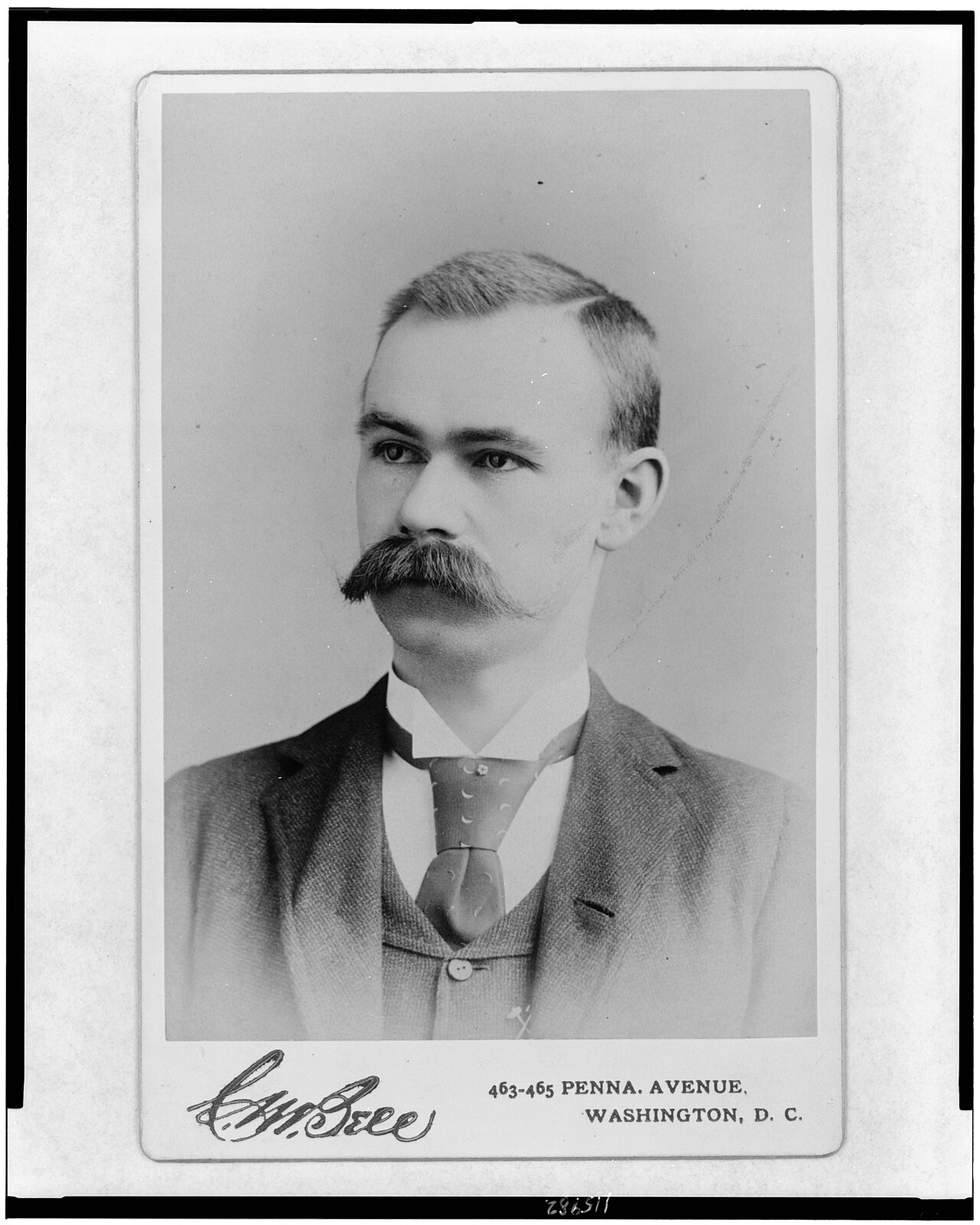
Herman Hollerith was born on February 29, 1860, in Buffalo, New York, to German immigrant parents. He graduated from the Columbia School of Mines in 1879 and took a position at the Census Bureau, where he worked on the 1880 census and witnessed firsthand the tabulation problem. His mentor, John Shaw Billings, reportedly suggested over dinner that there ought to be a machine for doing the work.
Hollerith left the Census Bureau to work at the Patent Office and then at MIT as an instructor, during which time he developed his tabulating system. The core components:
The punched card: Data was encoded by punching holes at specific positions in a paper card. Each card represented one census record (one person). Different positions in the card encoded different data items (age, sex, occupation, birthplace. The card was not Hollerith’s invention) Jacquard looms had used punched cards since 1804 to control weaving patterns, and Babbage had proposed them for his Analytical Engine, but Hollerith’s systematic application of the concept to data rather than process control was original.
The sensing mechanism: Cards were placed one at a time in a reader that pressed the card against a grid of mercury-filled cups. Spring-loaded pins descended onto the card; where a hole existed, the pin passed through into the mercury and completed an electrical circuit. Each completed circuit actuated a mechanical counter.
The tabulating machine: Counters recorded totals as cards were processed. Multiple runs through the deck with different tabulation schemes could produce cross-tabulations, how many married women of each age worked in manufacturing, for example.
The 1890 census of 63 million people was tabulated in six weeks using Hollerith’s machines. The final publication took longer due to analysis and typesetting, but the core data processing was complete.
The Tabulating Machine Company
Hollerith recognized that the census was a demonstration, not a market. He founded the Tabulating Machine Company in 1896 to commercialize his patents. Early customers included the New York Central Railroad, several life insurance companies, and foreign governments (Russia used Hollerith machines for its 1897 census, Austria for its 1900 census).
The business model was rental rather than sale: Hollerith leased the machines and sold the punched cards, creating recurring revenue from the consumable. This model (hardware leased, supplies sold) established a pattern that IBM would maintain for decades.
Hollerith had a difficult personality that created commercial problems. He was contentious with customers, resistant to feedback, and slow to improve his equipment. When the Census Bureau negotiated for the 1910 census, it found Hollerith’s prices and attitude unsatisfactory and developed competing equipment in-house. Hollerith sold the Tabulating Machine Company in 1911 to financier Charles Ranlett Flint, who merged it with three other companies to form the Computing-Tabulating-Recording Company (CTR).
In 1914, Flint hired Thomas J. Watson Sr. to run CTR. Watson renamed the company International Business Machines (IBM) in 1924 and built it into the dominant computing company of the twentieth century. Hollerith received his buyout and retired; he played no role in IBM’s subsequent history.
The 80-Column Card
The punched card Hollerith developed for the 1890 census was sized to the US dollar bill of the era, not for technical reasons but for the practical convenience of reusing existing file boxes. It had 24 columns and 12 rows.
IBM standardized the 80-column card in 1928, a format that fit more data by shrinking the hole size and increasing column count. The 80-column card became the universal data input medium for the mid-twentieth century. Every program submitted to a mainframe computer, every batch processing job, every data file entered into early computing systems passed through punched cards.
The legacy of the 80-column card outlasted the cards themselves: the 80-character line length standard in text terminals (and still the default in many code style guides today) derives from the 80-column Hollerith card. When Unix terminal displays defaulted to 80 characters, they were accommodating a constraint set by a census tabulating machine in 1928.
Info
The phrase “do not fold, spindle, or mutilate” (printed on Hollerith cards sent to individuals for self-reporting) became a rallying cry in the 1960s student free speech movement at Berkeley and elsewhere. Students wore the instruction ironically on buttons, representing their resistance to being processed as IBM cards by institutions. The specific phrase was adopted from the student experience of returning course registration cards that bore this instruction.
The Wiring Board and Programmable Data Processing
Hollerith machines were not programmable in the modern sense, but they were configurable through plugboards (also called control panels or wiring boards): panels of sockets connected by physical cables that determined how the machine processed data. To change the tabulation scheme, an operator rewired the plugboard.
This mechanical “programming” (physical connections specifying data flow) was the dominant paradigm for data processing until stored-program computers displaced batch tabulating in the 1960s. IBM’s accounting machines, sorters, and tabulators all used plugboards. The transition from plugboard configuration to stored programs is one of the underappreciated discontinuities in computing history.
Legacy
Hollerith died on November 17, 1929, wealthy from his sale of the Tabulating Machine Company but largely invisible in the public narrative of computing. IBM did not prominently acknowledge its Hollerith origins.
His direct technical legacy:
- The punched card as data medium (dominant through the 1970s)
- The 80-column standard (its shadow visible in text formatting conventions today)
- The machine rental model (IBM’s business model for fifty years)
- The creation of a data processing industry separate from scientific computing, the commercial infrastructure that made IBM’s dominance possible
Computing history focuses disproportionately on scientific firsts, first stored-program computer, first transistor machine, first programming language. Hollerith’s contribution was administrative: he made computation useful for business at a time when computation was synonymous with astronomical tables and ballistics calculations. The administrative-commercial use of computing, which generates most of the economic value that computing produces, traces its lineage to a punched card reader built for a census in 1890.