Bill Atkinson and HyperCard
Abstract
Bill Atkinson wrote QuickDraw, the graphics engine that made the Lisa and the Macintosh possible, and MacPaint, the program that showed people why they wanted one. Then he built HyperCard, a tool that let anyone wire text, pictures, and buttons into linked “stacks” without being a programmer, and gave it to Apple on one condition: it had to ship free with every Mac. HyperCard sold the idea of clicking a link years before the web existed. Atkinson later said his greatest miss was not realizing the links could point to other people’s computers.
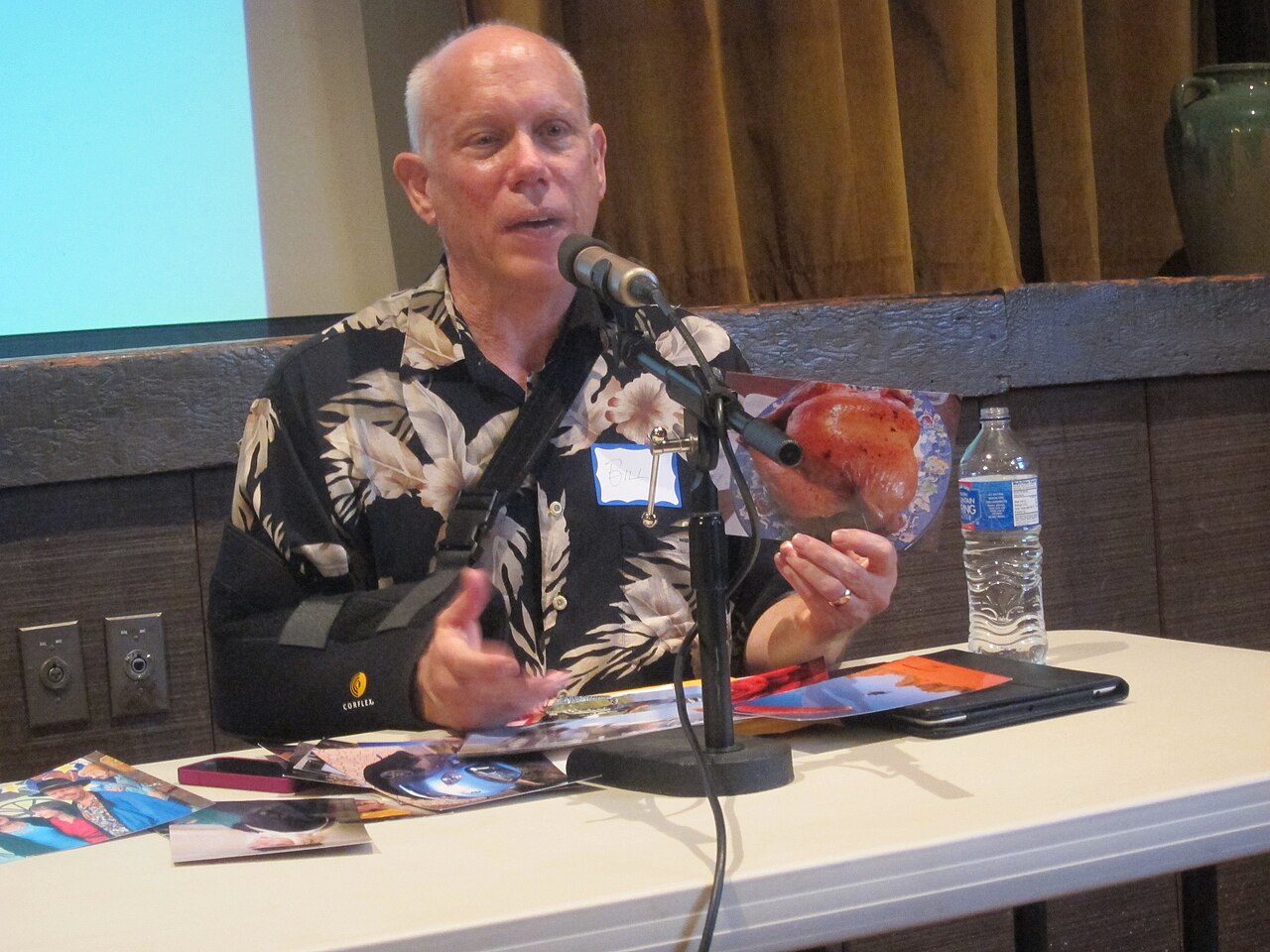
From Neurochemistry to Employee 51
Bill Atkinson was born on March 17, 1951, in Ottumwa, Iowa. He studied chemistry at the University of California, San Diego, where one of his professors was Jef Raskin, who later started the Macintosh project at Apple. Atkinson went on to graduate work in neurochemistry at the University of Washington, and was partway through a PhD when Raskin urged him to look at Apple. Steve Jobs closed the deal in 1978, and Atkinson left the doctorate unfinished to become Apple employee number 51.
QuickDraw
Atkinson’s first landmark was QuickDraw (originally LisaGraf), the graphics library underneath the Lisa and then the Macintosh. Its core idea was the region, an arbitrarily shaped area of the screen that could be clipped, combined, and drawn through. Regions are what made overlapping windows practical on a machine with an 8 MHz processor and 128 KB of RAM: the system only redrew the parts of a window that were actually visible. Along the way Atkinson produced a stream of things now taken for granted: the pull-down menu bar, the selection lasso, the “marching ants” animated selection border, the double-click, and an image-dithering algorithm that still carries his name. Working alone, he also reinvented the midpoint algorithm for drawing circles efficiently with integer arithmetic.
Two stories from this period stuck to him. In 1981 Atkinson showed Jobs that regions let him draw ovals and circles fast; Jobs demanded rectangles with rounded corners. Atkinson resisted until Jobs walked him around the block pointing at street signs, windows, and a “No Parking” sign, all rounded rectangles. Atkinson came back the next day with fast RoundRects, which became a standard shape in the Mac toolbox and its dialog boxes. And in 1982, after Atkinson’s Corvette hit a parked truck, a shaken Jobs rushed to the hospital fearing the one person who understood the graphics engine had been lost; Atkinson greeted him from the bed with the reassurance that he still remembered how regions worked.
MacPaint
For the Macintosh’s 1984 launch Atkinson wrote MacPaint, the bitmap drawing program bundled with the machine. MacPaint was the demo that made the mouse make sense: anyone could sit down and produce something in a minute, and the FatBits zoom mode let them edit individual pixels. Together with MacWrite it defined what “intuitive” was supposed to mean on a personal computer, and its artwork (much of it drawn by Susan Kare) fixed the visual style of early Mac software.
HyperCard
Atkinson spent the mid-1980s on a project he first called WildCard: a system where information lives on cards collected into stacks, and any card can hold buttons that jump to other cards, play sounds, or run scripts. The scripting language, HyperTalk (written with Dan Winkler), read like plain English (“go to the next card”), so people who had never programmed could build working software. Atkinson described the goal as programming for the rest of us.
He had leverage and used it. As an Apple Fellow he could have taken the project anywhere, and he told Apple he would hand HyperCard over only if the company shipped it free with every Macintosh. CEO John Sculley agreed, and HyperCard launched at Macworld Boston on August 11, 1987, bundled with new Macs and sold for $49.95 to existing owners. Apple distributed tens of thousands of copies within the first month.
What people built with it justified the giveaway. Teachers built courseware, doctors built patient databases, Renault built an inventory system, and the Voyager Company built a business making multimedia CD-ROMs. Cyan’s The Manhole (1988) and the prototype of Myst (1993), for a time the best-selling PC game in history, were HyperCard stacks. Ward Cunningham has traced the wiki to a HyperCard stack of linked programming patterns he built in the late 1980s (Ward Cunningham and the Wiki). Pei-Yuan Wei’s ViolaWWW, one of the first graphical web browsers, began as an attempt to reproduce HyperCard on Unix, and the pointing-finger cursor that HyperCard used for clickable buttons survives as the cursor every browser shows over a hyperlink.
Dead End: The Hypermedia That Missed the Network
Warning
HyperCard had one structural flaw: a link could only point to another card on the same machine. Every stack was an island. When Tim Berners-Lee combined the same click-a-link idea with the internet a few years later, HyperCard’s central trick became a global system and the original became a curiosity. Atkinson owned the miss in later interviews: raised on the ARPANET instead of the standalone PC, he said, he would have built the first web browser instead. Apple, meanwhile, starved the product. It stayed black-and-white for years, was handed off to the Claris subsidiary and back, received its last release in 1998, and was formally discontinued in March 2004. Steve Jobs had no interest in reviving it; by one account he dismissed it as having “Sculley’s stink all over it.” The program died. Its idea, that ordinary people click links and build things without asking permission, is roughly a description of the web.
After Apple
Atkinson left Apple in 1990 to co-found General Magic with Marc Porat and Andy Hertzfeld, the spin-off that tried to build a pocket communicator a decade too early (its story is told in Dead End: General Magic). After General Magic’s collapse he turned to nature photography, spending years on extreme close-ups of polished stones published as the book Within the Stone (2004), and built PhotoCard, an iPhone app for mailing physical postcards of his photographs. He received the EFF Pioneer Award in 1994. In his final years he became a public advocate for psychedelics, writing guides on the use of 5-MeO-DMT.
Atkinson died of pancreatic cancer at his home in Portola Valley, California, on June 5, 2025, at age 74.
📚 Sources
- Bill Atkinson — Wikipedia
- HyperCard — Wikipedia
- Round Rects Are Everywhere! — Folklore.org (Andy Hertzfeld)
- Bill Atkinson, architect of the Mac’s graphical soul, dies at 74 — Ars Technica (June 2025)
- Image: Bill Atkinson at 25 years of HyperCard event.jpeg by Jay Cross from Berkeley, California, US (CC BY 2.0), via Wikimedia Commons