Ward Cunningham and the Wiki: The Simplest Thing That Could Possibly Work
Abstract
Ward Cunningham created the wiki in 1994, a web of pages that anyone could edit, built on a philosophy of radical trust. His Portland Pattern Repository at c2.com became the first place on the web where content was genuinely collaborative: written, revised, and argued over by a community of equals with no editors, no gatekeepers, and no hierarchy beyond the quality of an idea. The design was deliberately minimal, almost aggressively so: Cunningham’s guiding principle was to build “the simplest thing that could possibly work.” That simplicity, applied to the problem of collaborative writing, produced a technology that eventually became Wikipedia and changed how knowledge is created and shared on the internet. Cunningham got the recognition; he did not get the money.
From Tektronix to Pattern Languages
Howard G. “Ward” Cunningham was born in 1949 in Indiana. He studied electrical engineering at Purdue, graduating in 1972, and earned a master’s degree there in 1978. In between and after those degrees, he worked at Tektronix, the Portland, Oregon electronics company known for its oscilloscopes and test equipment, where he spent nearly two decades as a software engineer and researcher.
At Tektronix in the early 1980s, Cunningham became fascinated with a problem that had nothing obvious to do with test equipment: how do experienced programmers communicate their hard-won knowledge to less experienced ones? The expertise embedded in good code was difficult to extract and transfer. You could show a junior programmer the finished program, but the reasoning behind its structure (why this abstraction rather than that one, why this factoring of responsibilities) was invisible.
He found a partial answer in an unlikely source. Christopher Alexander’s 1977 book A Pattern Language described recurring solutions to problems in architecture: patterns for light, space, community. Alexander argued that good design was not arbitrary but embodied patterns, documented forms that could be recognized, communicated, and applied in new contexts. Cunningham saw immediately that the same idea applied to software. Good software had patterns too: recurring solutions to recurring problems. If those patterns could be documented, they could be taught.
Through the 1980s, Cunningham developed what he called the THINK notebook, a personal record of programming patterns he had observed and found useful. He built a HyperCard stack on his Macintosh that linked patterns together, each card describing a pattern and linking to related patterns. HyperCard had been Apple’s attempt at end-user hypermedia (Bill Atkinson and HyperCard), and it fascinated Cunningham: the ability to link documents to each other, following associations rather than linear text. The HyperCard experiment showed him both the potential of linked documents and the limitations of a single-user, single-machine format.
WikiWikiWeb: The Name From an Airport Shuttle
By 1994, Cunningham was working at Cunningham & Cunningham (C2), his own consulting firm. He had been active in the object-oriented programming community and had become convinced that the pattern language concept needed a public, collaborative space where practitioners could document, debate, and refine programming patterns together. No single person (not even Cunningham) could capture the accumulated wisdom of a field; the community had to do it collectively.
He had recently learned HTML and had access to a web server. The question was how to build a system that would let many people contribute to a shared body of knowledge. The obvious models (a mailing list, a Usenet newsgroup) were linear and ephemeral. He wanted something more like an encyclopedia: structured, persistent, and cross-linked.
The design he arrived at was nearly nothing. A WikiWikiWeb page was an HTML page that could be edited by anyone who loaded it. Clicking “Edit” displayed the page’s text in a form field; editing the text and clicking “Save” replaced the page’s content. No login. No password. No version history displayed by default (though the server kept old versions). Any word written in CamelCase (two or more words run together with capital letters, like “WikiWikiWeb” or “SoftwarePatterns”) automatically became a link to a page with that name, creating it if it didn’t already exist.
The name came from an experience at Honolulu Airport. Cunningham had taken the Wiki Wiki Shuttle, the bus service that ran between the airport’s terminals, “wiki wiki” being Hawaiian for “quick” or “fast.” The name captured what he wanted the system to feel like: quick, nimble, nothing in the way.
He deployed WikiWikiWeb at c2.com in March 1994 as the Portland Pattern Repository, a home for the programming patterns community. It was the first wiki in the world.
Cunningham’s Law
Cunningham is credited with what the internet now calls “Cunningham’s Law”: the observation that the best way to get the right answer on the internet is not to ask a question, but to post the wrong answer. Someone will correct you. This principle, which Cunningham described as an observation rather than a prescription, turned out to be one of the most accurate predictions ever made about online community behavior. Wikipedia’s correction mechanism, Stack Overflow’s voting system, and the general internet phenomenon of confident wrong assertions attracting immediate correction are all expressions of it. Cunningham himself noted later that the law was really a corollary of wiki’s trust model: if you create a space where anyone can correct anything, correction becomes easy enough that it actually happens.
The Design Philosophy: Radical Trust
The wiki’s design embodied a specific theory about human behavior that was, in 1994, far from obvious: most people, given the opportunity to contribute to something valuable, will contribute constructively.
This was not naive. Cunningham understood that some people would vandalize, spam, or argue in bad faith. His response was to make the cost of such behavior low and the cost of reverting it equally low. Wiki pages had histories; a vandal’s change could be undone with a click. The community (people who cared about the content) would outnumber the vandals. The trust model was a bet on the aggregate goodwill of participants, not a guarantee of any individual’s behavior.
The Portland Pattern Repository validated the bet. The programming community that gathered there was precisely the audience for Cunningham’s theory: technical, opinionated, and genuinely invested in improving the documentation. Pages about design patterns were written, argued over, split, merged, and refined through community editing. The wiki worked.
The minimalist design philosophy had a name in Cunningham’s work: “the simplest thing that could possibly work.” This phrase, which Cunningham used frequently in the Extreme Programming community that grew up around his ideas, was a methodological principle: resist the temptation to add features, abstractions, and complexity in anticipation of needs that might never materialize. Build the minimal thing that solves the actual problem. Everything else can be added later, if needed. The wiki was a demonstration of the principle: the simplest collaborative document system that could actually enable collaboration.
The Gang of Four and a Parallel Career
In the same year he launched WikiWikiWeb, Cunningham contributed to a book that would become one of the most influential texts in the history of software engineering: Design Patterns: Elements of Reusable Object-Oriented Software (1994), by Erich Gamma, Richard Helm, Ralph Johnson, and John Vlissides, the “Gang of Four”.
Cunningham did not write the book, but the project had grown directly from the pattern language community he had been cultivating. The Gang of Four acknowledged Cunningham’s influence; the book’s concept (documenting recurring software design patterns in a structured, reusable form) was what Cunningham had been advocating since the late 1980s. Design Patterns sold hundreds of thousands of copies and established the pattern vocabulary (Singleton, Factory, Observer, Strategy, and twenty others) that object-oriented programmers have used ever since.
The parallel careers, the conceptual work on patterns formalized by the Gang of Four, and the collaborative infrastructure represented by the wiki, reinforced each other. The wiki at c2.com became the living community around the Design Patterns book; debates about the patterns, proposals for new ones, and critiques of the Gang of Four’s choices played out in the Portland Pattern Repository through the late 1990s.
From c2.com to Wikipedia
The direct line from Cunningham’s WikiWikiWeb to Wikipedia ran through Jimmy Wales and Larry Sanger, who were aware of the wiki concept when they relaunched Nupedia as a more open project in January 2001. Sanger had encountered wikis and proposed using the wiki model to accelerate content creation for what became Wikipedia. Wales later acknowledged Cunningham’s influence explicitly; the MediaWiki software that eventually ran Wikipedia descended from tools that drew on Cunningham’s design concepts.
Cunningham was generous about this lineage. He participated in early Wikipedia discussions, contributed to thinking about wiki governance, and made no attempt to claim proprietary ownership of an idea he had deliberately published as openly as possible. The wiki concept, like the open-source software it was designed to support, was meant to be used, adapted, and extended.
The Scaling Problem
What worked for a technically sophisticated community of programmers at c2.com did not automatically scale to a global encyclopedia. WikiWikiWeb’s trust model (no logins, no barriers to editing, community self-governance) functioned because the Portland Pattern Repository community was self-selected and had strong norms. As Wikipedia grew to millions of articles and millions of editors, the same open editing model generated industrial-scale vandalism, edit wars, and coordination problems that required increasingly complex governance structures, semi-protection policies, and eventually a large corps of volunteer administrators. The “simplest thing that could possibly work” for a community of hundreds required substantial elaboration for a community of millions. Cunningham observed this evolution with interest rather than criticism, noting that every wiki community had to find its own governance equilibrium.
Cunningham After the Wiki
Cunningham’s post-wiki career was peripatetic, following interesting technical problems wherever they led. He was deeply involved in the Extreme Programming movement of the late 1990s, which adopted his “simplest thing” philosophy and his pattern language framework as core methodological principles. XP’s practices (test-driven development, pair programming, continuous refactoring) were built on assumptions about software quality that Cunningham had been articulating since the 1980s.
He joined Microsoft in 2003, working in its Patterns & Practices group on best practices for enterprise software, and brought the wiki concept into the company’s internal development practices. In 2005 he became Director of Committer Community Development at the Eclipse Foundation, applying his collaborative-development experience to its open-source community. He later moved to New Relic, the application performance monitoring company, where he worked on software analytics. Throughout these moves, he remained a speaker, writer, and presence in the software community, a figure whose ideas were cited more often than his name was known to the people citing them.
He gave the wiki itself a kind of formal capstone in 2011 by donating the WikiWikiWeb code and community history to the Wikimedia Foundation for preservation. The site at c2.com continued to operate, tended by its community, now decades into its existence, one of the oldest continuously operating community websites on the internet.
The Simplest Thing, and Its Consequences
Ward Cunningham did not get rich from the wiki. He held no patent on collaborative web editing, the concept was too general, the system too deliberately minimal, and the software released too openly for proprietary control. Wikipedia alone became one of the most visited websites on earth; the wiki software industry generated hundreds of millions of dollars; enterprise wiki platforms like Confluence were acquired for billions. Cunningham’s direct financial share of this was effectively zero.
He seemed genuinely unbothered. The philosophy that produced the wiki, the belief that the simplest open system usually beats the most sophisticated proprietary one, that trust in community behavior is usually vindicated, that shared knowledge is worth more than owned knowledge, was not incidentally Cunningham’s design principle. It was his worldview. He had applied it to software architecture, to collaborative documents, and apparently to the question of what he wanted from his career.
The simplest thing that could possibly work, in his case, was to build something genuinely useful and let it go.
📚 Sources
- Cunningham, Ward: “WikiWikiWeb” — original Portland Pattern Repository (1994, ongoing)
- Cunningham, Ward: “Wikis Then and Now” — keynote at Wikimania 2006 (video)
- Gamma, Erich; Helm, Richard; Johnson, Ralph; Vlissides, John: Design Patterns: Elements of Reusable Object-Oriented Software (1994), Addison-Wesley
- Leuf, Bo & Cunningham, Ward: The Wiki Way: Quick Collaboration on the Web (2001), Addison-Wesley
- Alexander, Christopher et al.: A Pattern Language: Towns, Buildings, Construction (1977), Oxford University Press — intellectual precursor to software pattern languages
- Economist: “Wiki’s Wild World” — The Economist, April 20, 2006
- Wales, Jimmy: On Ward Cunningham’s influence on Wikipedia — multiple interviews, 2001–2005
- Computer History Museum: Oral history of Ward Cunningham (2007)
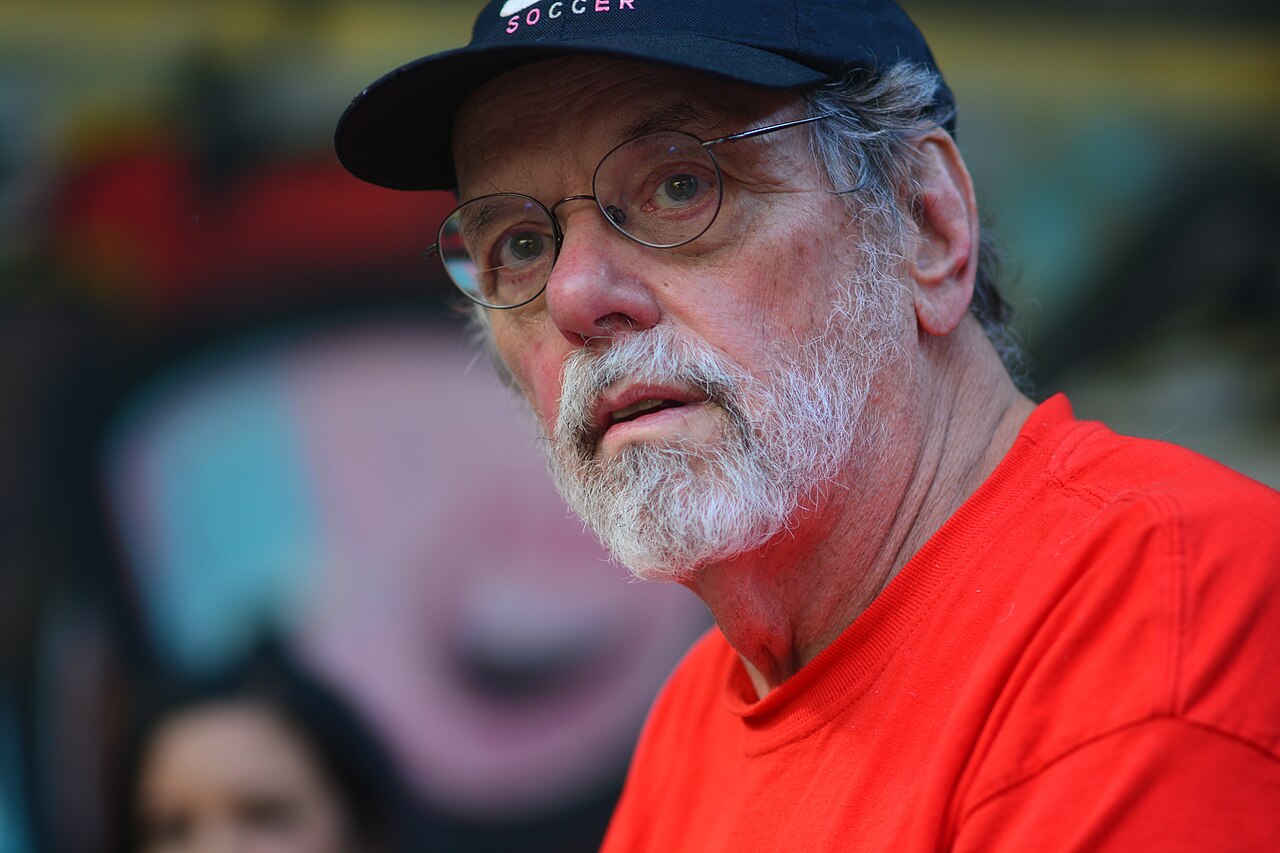
- Image: Ward Cunningham 01.jpg by Joe Mabel (CC BY-SA 4.0), via Wikimedia Commons