Dead End: General Magic
Abstract
General Magic set out in 1990 to build the smartphone, fifteen years early. Spun out of Apple with the Macintosh’s best-known engineers on board, backed by Sony, Motorola, AT&T and a dozen other giants, it designed a pocket communicator with apps, a touchscreen, downloadable software, online shopping, and emoji-like graphics in messages. Its 1995 IPO raised $96 million on essentially no revenue. Its actual products, the Sony Magic Link and Motorola Envoy, sold in the low tens of thousands, mostly to the industry itself. The company died slowly and completely, and then its alumni built the future it had promised: the iPod and iPhone (Tony Fadell), Android (Andy Rubin), eBay (Pierre Omidyar), the Apple Watch (Kevin Lynch). No failed company has a better claim to having been right.
A Secret Project Leaves Apple
The idea began inside Apple in 1989 as a project called Paradigm. Marc Porat, a Stanford PhD with a gift for prophecy, pitched CEO John Sculley a device he described in terms no engineer would dare: a tiny computer and phone in one, a personal object so beautiful it would deliver the satisfaction of fine jewelry, something people would carry everywhere and mourn if they lost. Porat argued Apple could not build it alone; it needed the computer, communications, and consumer electronics industries in alliance.
Sculley agreed, then let the project go. In May 1990 Paradigm was spun out as General Magic, with Apple keeping a stake. Porat recruited the two most famous engineers of the original Macintosh team, Andy Hertzfeld and Bill Atkinson, and the company acquired an aura no startup has matched since: to young engineers of the early 1990s, it was simply where the future was being built. Susan Kare drew its interface art; Macintosh marketing veteran Joanna Hoffman ran its evangelism; the junior ranks included a fresh Michigan graduate named Tony Fadell, a young engineer named Andy Rubin, and a programmer named Pierre Omidyar.
Magic Cap and Telescript
The software was genuinely new. Magic Cap, the operating system, presented the device as a world of rooms: a desk with a phone and datebook, a hallway leading to a game room and a library, a street of shops where merchants could open storefronts. Messages could carry animations, sounds, and little pictorial stamps, a decade before emoji reached phones. Telescript, the companion language, was the more radical bet: programs as mobile agents that would leave your device, travel across the network, negotiate on your behalf (find the cheapest flight, book the table), and come home with results.
By 1994 the General Magic Alliance counted sixteen partners, among them Sony, Motorola, Matsushita, Philips, AT&T, France Télécom and NTT, each investing up to $6 million. The alliance was also a cage: the partners were each other’s competitors, every design decision needed consensus, and the secrecy that protected the magic kept the product from ever meeting a real user until launch.
Launch into a Void
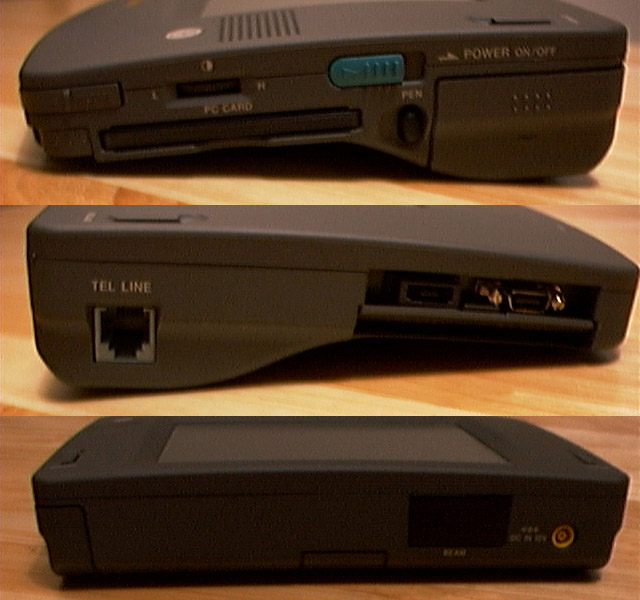
Sony’s Magic Link PIC-1000 shipped in September 1994 at around $1,000 (list $995); Motorola’s Envoy followed. The reviews respected the ambition and noted the reality: the devices were slow, the batteries weak, and the communication ran not on the open internet but on PersonaLink, a closed AT&T network priced by the message, reachable mostly over a wired modem. The mass customer General Magic imagined, a mobile professional who had never used e-mail, did not exist yet; the technology to serve them did not either. Sales stalled in the low tens of thousands of units, and insiders joked that most Magic Links were bought by the alliance’s own employees and their families.
The wounds came from every direction, including from the parent. Apple, still a shareholder, had announced its own handheld, the Newton, in 1992 and shipped it in 1993, a year before its spin-off could launch, souring partners and splitting the tiny market. Then in February 1995 General Magic went public anyway, raising $96 million; the stock doubled on the first day, one of the earliest pure “concept IPOs” of the decade. Six months later Netscape’s IPO detonated the web era, and General Magic’s central asset became its central liability: Telescript agents only worked inside a proprietary network, and the open web made proprietary networks look absurd. AT&T shut PersonaLink down in 1996. The alliance drifted apart; Porat stepped back; the rooms metaphor became a museum piece.
The Long Goodbye
General Magic kept finding smaller futures to almost own. It pivoted to voice: Portico, a phone-based virtual assistant that read e-mail aloud and managed calls, served millions of users at its peak and became the basis of the OnStar Virtual Advisor for General Motors, work that briefly revived the stock around 2000. The dot-com crash took the rest. The company announced its shutdown on 18 September 2002 and was liquidated in 2004; its patent portfolio went to Paul Allen’s holding company. Total consumed: over $200 million of the industry’s money, and the decade’s densest concentration of talent.
Dead End
General Magic is the cleanest case study in being early as a form of being wrong. Every layer it needed was missing: wireless data was 9,600 bits per second where it existed at all, processors and batteries could not carry the interface it designed, and the customer had not yet learned to want a computer in their pocket. Its secrecy prevented the market feedback that would have said so, its alliance structure prevented the fast unilateral decisions that could have acted on it, and its bet on a closed network was falsified by the web within months of launch. Palm succeeded in the same years by shipping a fraction of the vision that actually worked.
What survived was the people and the blueprint. Fadell went on to build the iPod and co-create the iPhone (Tony Fadell: From iPod to Nest); Rubin built Android; Omidyar, still a General Magic employee, wrote AuctionWeb over a holiday weekend in 1995 and it became eBay (see the Pez myth); Kevin Lynch later led the Apple Watch software; Megan Smith became CTO of the United States. When the iPhone appeared in 2007, veterans could map it feature by feature onto the Magic Cap screens of 1994. The 2018 documentary General Magic fixed the company’s afterlife as Silicon Valley’s favorite parable: the flop as first draft.
📚 Sources
- General Magic — Wikipedia
- General Magic (2018 documentary, dir. Sarah Kerruish & Matt Maude) — official site
- Magic Cap — Wikipedia
- Telescript — Wikipedia
- Hertzfeld, Andy: folklore.org — Macintosh and General Magic stories
- Image: Sony MagicLink (4725298888).jpg by Blake Patterson (CC BY 2.0), via Wikimedia Commons