Chester Carlson
Abstract
Chester Carlson (1906–1968) invented xerography, the dry electrostatic copying process inside every photocopier and laser printer. He worked it out alone, at night, in a rented room in Astoria, Queens, while holding down a patent-department job and studying law, and made the first copy on October 22, 1938. Between 1939 and 1944 more than twenty companies, IBM, General Electric, Kodak and RCA among them, turned it down. A small Rochester photo-paper maker called Haloid took the licence in 1947, spent $75 million and twelve years on it, and in 1959 shipped the Xerox 914, which Fortune called the most successful product ever marketed in America. Carlson earned something like $200 million from it, kept a three-bedroom house and one car, and gave most of the money away anonymously before he died in 1968.
A Childhood on the Move
Carlson was born on February 8, 1906, in Seattle, the only child of Olof Adolph Carlson, an itinerant barber, and Ellen Josephine Hawkins, who had grown up on neighbouring Swedish farms in Grove City, Minnesota. Olof had spinal arthritis and, in his thirties, tuberculosis, and the family spent Chester’s childhood chasing a climate that might help: a brother’s house in California, a camp in the Arizona sand dunes, an adobe hut on a worthless farm in Mexico, a single room in a Los Angeles doctor’s house where Ellen worked as housekeeper, a rented house in San Bernardino. In the autumn of 1915 Olof decided cold might do what heat had not and moved them to a shed in the mountains above San Bernardino, where the snow lay three and four feet deep and Ellen flashed a hand mirror down to a storekeeper in the valley each morning to signal that they had survived the night. Chester was the only pupil in the local school. He later called the year “the beginning of a considerable setback in my social development.”
He worked from the age of eight and was the family’s main earner by high school. At ten his favourite possession was a toy typewriter; at fifteen he started a pocket notebook of inventions (a rotating billboard, a shoe-cleaning machine, a trick safety pin) that he kept for the rest of his life. He worked for a printer, took a discarded press in lieu of wages and printed a magazine for classmates, the Amateur Chemists’ Press. “I don’t think I printed two issues,” he said later, “and they weren’t much. However, this experience did impress me with the difficulty of getting words into hard copy, and this, in turn, started me thinking about duplicating processes.” In his junior year his mother died of tuberculosis at 53, which he called the worst thing that ever happened to him. By graduation he and his father were living in a former chicken coop with a bare concrete floor; Chester slept outside in a sleeping bag he had sewn himself, partly to avoid the disease that had killed her.
He worked his way through three years at Riverside Junior College, then transferred to Caltech, graduating in physics in 1930 while mowing lawns and working at a cement mill, his father cooking in the shared Pasadena apartment. He left owing $1,500. He wrote to 82 firms and received two replies before Bell Telephone Laboratories in New York took him as a research engineer at $35 a week (see Bell Labs: The Idea Factory).
Bell Labs and the Law Library
After a year he moved into Bell’s patent department, on the theory that an inventor should know how patents work. The Depression cost him the job in 1933. He worked briefly for a patent attorney and then joined the electronics firm P. R. Mallory & Co., where he rose to manage the patent department, married Elsa von Mallen in 1934, and in 1936 enrolled in night classes at New York Law School. “I had my job,” he said, “but I didn’t think I was getting ahead very fast. I was just living from hand to mouth, and I had just gotten married. It was kind of a struggle, so I thought the possibility of making an invention might kill two birds with one stone: It would be a chance to do the world some good and also a chance to do myself some good.”
Two frustrations pointed at the same invention. At Mallory there were never enough carbon copies of patent specifications, and getting more meant expensive photostats or retyping and proofreading. At the New York Public Library, where he studied because he could not afford the books, he copied long passages from law texts in longhand until his hand cramped. His notebooks from the 1930s hold more than 400 ideas (a raincoat with gutters, a see-through toothpaste tube, a filter cigarette), but the office copier was the one he pursued. He reasoned that if ordinary photography could be made into a copier, Kodak would already have done it, “so I deliberately turned away from the conventional photographic processes and started searching in the library for information about all the different ways in which light will affect matter. I soon came upon photoelectricity and photoconductivity.” He read the Hungarian physicist Pál Selényi’s work on electrostatic images, and by October 18, 1937, had filed his first patent application for what he called electrophotography.
The scheme was this. Coat a grounded metal plate with a photoconductor, a material that insulates in the dark and conducts in the light. Charge the whole surface in darkness. Project the image of a page onto it: where the page is white the light drains the charge to ground; where the page is black the charge stays. Dust the plate with an oppositely charged powder, which clings only to the charged areas, and transfer the powder to paper and fix it. No liquid, no chemical reaction, no treated paper. His first experiments, melting sulfur on the kitchen stove of the couple’s Jackson Heights apartment, produced fires, a smell of rotten eggs, and an angry wife.
10.-22.-38 ASTORIA
In 1938 he rented a room in Astoria, Queens (his biographer David Owen places it behind a beauty parlour; Xerox’s own company history puts it above a bar) and hired Otto Kornei, an unemployed physicist who had emigrated from Austria. Kornei managed what Carlson had not: a clean film of sulfur on zinc plates the size of business cards. Carlson’s own account of October 22, 1938: Kornei “took a glass microscope slide and printed on it in India ink the notation ‘10-22-38 ASTORIA.’ We pulled down the shade to make the room as dark as possible, then he rubbed the sulfur surface vigorously with a handkerchief to apply an electrostatic charge, laid the slide on the surface and placed the combination under a bright incandescent lamp for a few seconds. The slide was then removed and lycopodium powder was sprinkled on the sulfur surface. By gently blowing on the surface, all the loose powder was removed and there was left on the surface a near-perfect duplicate in powder of the notation which had been printed on the glass slide.” They repeated it several times to be sure, pressed the powder onto wax paper, melted the wax to fix it, and went out to lunch. The scrap of wax paper is in the Smithsonian.
Kornei was unimpressed and left for an electronics job in Cleveland. Carlson filed the patent that covers the process on April 4, 1939; it issued on October 6, 1942, as US 2,297,691. Then he went looking for someone to build the machine.
Twenty Rejections
From 1939 to 1944 he demonstrated his plates to more than twenty companies, IBM, General Electric, RCA and Eastman Kodak among them, and to the National Inventors Council. “Some were indifferent,” he said, “several expressed mild interest, and one or two were antagonistic. How difficult it was to convince anyone that my tiny plates and rough image held the key to a tremendous new industry. The years went by without a serious nibble. I became discouraged and several times decided to drop the idea completely. But each time I returned to try again.” His phrase for the collective response was “an enthusiastic lack of interest.” The companies had reasons. The demonstration was a smudged powder image on a plate the size of a business card; the market for copies was assumed to be small (as late as the mid-1950s Carlson himself doubted many offices would need a hundred copies a day); and Kodak, the one company with the chemistry, had a business in photographic paper it did not want to undercut. None of them got a second chance. The 1975 consent decree that later forced Xerox to license its patents, and the Japanese copiers that took its United States market share from nearly all to under 14 percent within four years, came thirty years too late for them.
The break came sideways. In 1944 Carlson, in the course of Mallory patent business, handed one of his patents to Russell Dayton, a physicist at the Battelle Memorial Institute, a non-profit research organisation in Columbus, Ohio. He gave his usual demonstration to a half-dozen Battelle staff and braced for the usual throat-clearing, and Dayton held up the wax paper and said, “However crude this may seem, this is the first time any of you has seen a reproduction made without any chemical reaction and by a dry process.” Battelle took 60 percent of any royalties in exchange for doing the development, and allocated $3,000 for 1944. Dayton later estimated that at least half of the Battelle people who knew about the project thought it stupid: “It just goes to prove that if you’ve got something unique, you don’t take a poll.” Battelle’s contribution was real: its researchers replaced sulfur with selenium, a far better photoconductor, and devised the two-component developer of toner and carrier beads that copiers still use.
Battelle and Haloid
The same year a patent agent named Nicholas Langer wrote an admiring article about Carlson’s patent for Radio News (July 1944); Kodak’s Monthly Abstract Bulletin condensed it, and John Dessauer, research head of the Haloid Company of Rochester, showed it to his president, Joseph C. Wilson. Haloid, founded in 1906, made photographic paper in Kodak’s home town and was losing its wartime business; in 1946 it earned $101,000 on $6.75 million in sales. Wilson wanted anything Kodak did not already own. He and Dessauer went to Columbus, saw the demonstration, and Wilson said it had “a million miles to go before it will be marketable. But when it does become marketable, we’ve got to be in the picture.” A contract took effect on January 1, 1947: $10,000 for a one-year licence with options to renew. A quarter of it, $2,500, went to Carlson, the first money the idea had earned him in ten years. Wilson later guessed why Battelle chose so small a partner: “we were going to make or break with it,” whereas a big company would have kept it on the back burner.
“Electrophotography” was judged too clumsy for advertising, so in 1948 Battelle asked an Ohio State classics professor for a word, and got xerography, from the Greek for “dry” and “writing.” Haloid demonstrated it to the Optical Society of America in Detroit on October 22, 1948, ten years to the day after Astoria, and shipped its first product in 1949, the XeroX Copier Model A. It was a flat selenium plate and a set of trays; the operator performed dozens of manual steps, cleaning the plate by rocking it in a tray of what was essentially cat litter, and a skilled one could produce a copy every three minutes. Early testers sent it back. It survived because it turned out to be a quick way to make paper masters for offset duplicators, and that side business, plus Copyflo (1955), the first fully automatic xerographic machine, which printed from microfilm onto a roll using the first rotating drum, kept Haloid alive. By 1956 xerographic products were nearly 40 percent of revenue. That year Haloid bought the four basic patents from Battelle for 25,000 shares, $500,000 a year for three years, and 3 percent of xerographic sales through 1965, and in 1958 renamed itself Haloid Xerox.
Carlson became a Haloid consultant in 1948 and moved to Rochester; he had divorced Elsa in 1945 and married Dorris Helen Hudgins in 1946. Haloid gave him a laboratory and an assistant and he took out some three dozen further patents, but a Battelle engineer’s later judgment was that his main contribution in the 1950s was keeping everyone’s nerve: “There always had to be something extralogical about continuing.” Between 1947 and 1960 Haloid spent $75 million on xerography, twice its operating earnings, borrowing $1 million from a Rochester bank in 1951 and $3 million from an insurance company in 1954, with employees buying stock and Dessauer mortgaging his house.
The 914
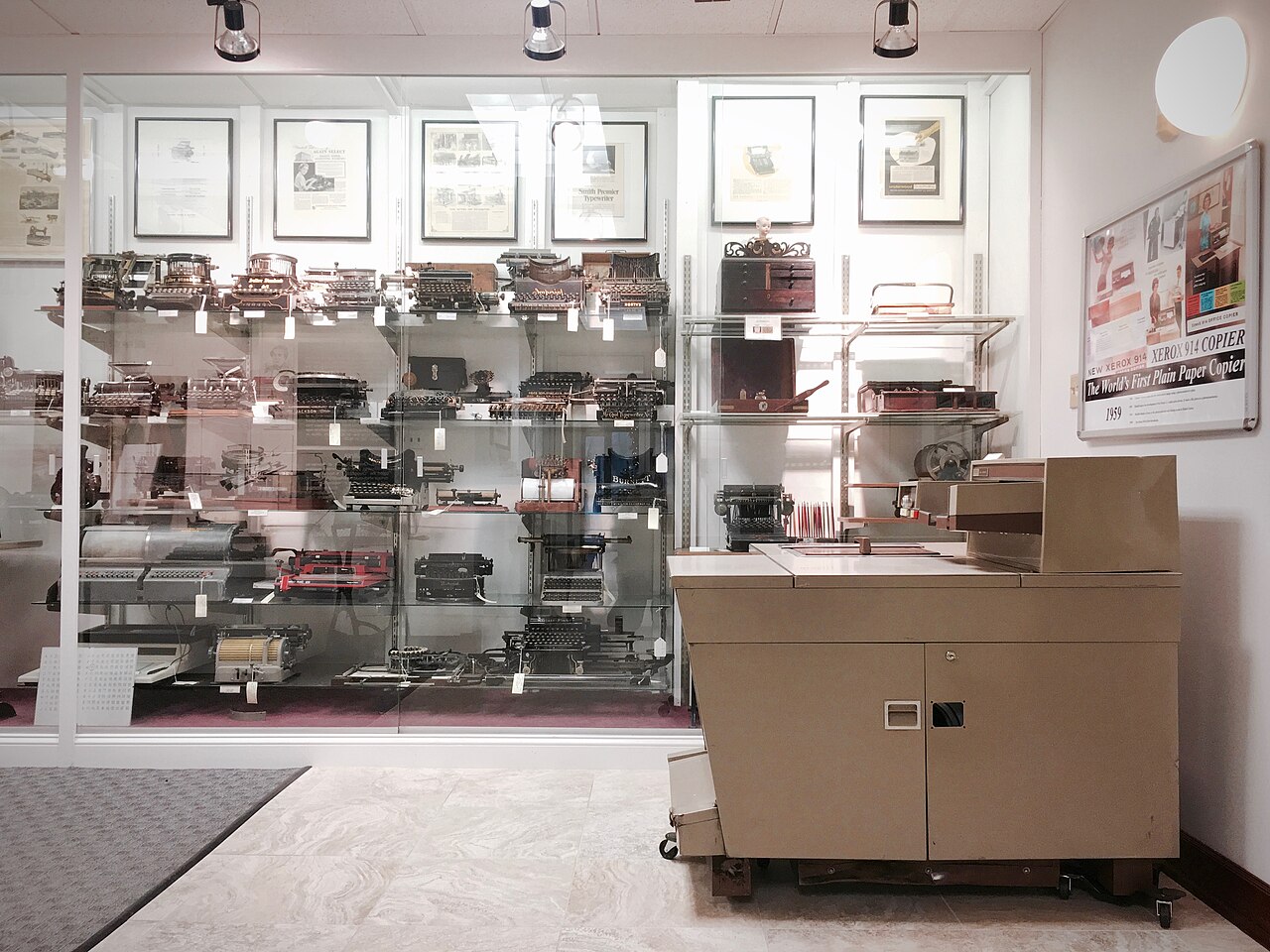
The 914, named for the largest sheet it took, nine by fourteen inches, had 1,260 parts. Its physicists worked in the attic of an old house in a poor part of Rochester, venting a fog of submicron carbon on any day but Tuesday, when the neighbour hung out her white linen; its engineers scavenged springs and tubing from a junkyard; its drum-cleaning brush was sewn from the back fur of New Zealand rabbits by the father of the furrier downstairs. A workable toner was found at almost the last moment by a Haloid chemist, Michael Insalaco. In August 1959 Wilson wrote to his division heads: “We are about to give birth, either to our greatest success or to our greatest failure—the 914.” He introduced it at the Sherry-Netherland Hotel in New York on September 16, 1959, where one of the two demonstration machines caught fire on live television, and the first production unit shipped on March 1, 1960, to Standard Press Steel of Jenkintown, Pennsylvania, on a tilting dolly so that its nearly 650 pounds could be angled through the door. It made about seven copies a minute on plain paper at the push of a button, and it listed at $29,500.
Almost no one bought it, because the company had decided almost no one should. Haloid Xerox leased the machine for $95 a month, including 2,000 copies, with each further copy metered at four cents, and it guaranteed the maintenance, which the temperamental machine needed (a small fire extinguisher was part of the kit). Wilson called leasing “the most important decision we ever made—except for backing xerography itself.” Haloid’s engineers had guessed a heavy user might make 10,000 copies a month; Standard Press made 2,000 to 3,000 a day from the first week, and so did the next customers. The machine created the demand it then met. Revenue went from $31 million in 1959 to $59 million in 1961, when 10,000 units were in place, the company renamed itself Xerox Corporation and listed on the New York Stock Exchange; it passed $500 million in 1965 and was approaching $1 billion when Carlson died. In 1955 the world had made about 20 million copies, nearly all by other means; in 1964 it made nine and a half billion, nearly all xerographically. The descendants are the ones this encyclopedia cares about: Gary Starkweather put a laser where the 914’s lamp had been in 1969 and gave Xerox the laser printer, and the profits that paid for Xerox PARC were 914 profits (see also The History of Printing).
Giving It Away
Carlson’s royalties began in 1947 and amounted to roughly a sixteenth of a cent on every Xerox copy made worldwide through 1965; with his stock the invention brought him something like $200 million. In 1953 he traded his old Studebaker for a new one, and in 1954 he and Dorris built a three-bedroom house outside Rochester, where he lived until he died, telling her he would be as happy in a trailer in the yard (“And will you take your 13 steel filing cabinets with you?”). He bought third-class train tickets in Europe until she stopped him; an acquaintance who heard he worked at Xerox asked whether he belonged to the union. When Fortune listed him among the richest Americans in 1968 he wrote to say the estimate was too high by $150 million, because he had already given that much away.
The giving was anonymous and he weighed every request himself. He paid for a chemical-physics building at Caltech on condition that it be named for his old professor Arthur Amos Noyes; gave millions to the United Negro College Fund and to individual Black colleges; bought apartment buildings in Washington and New York and had them racially integrated; funded pacifist groups and the United Nations Association; supported Robert Hutchins’s Center for the Study of Democratic Institutions through his life and his will; and, having taken up Zen in the 1950s, paid in 1966 for Philip Kapleau’s Rochester Zen Center and for the Dai Bosatsu monastery in the Catskills. He gave $1 million to the University of Virginia for parapsychology research. In 1965 he donated the first xerographic print and his original apparatus to the Smithsonian, and on December 16 of that year sat for the long tape-recorded interview with Dartmouth’s Joseph Ermenc that is the main record of the story in his own words. On September 19, 1968, he died of a heart attack in New York, aged 62. U Thant, the secretary-general of the United Nations and a friend, wrote that he had respected Carlson “more as a man of exceptional moral stature and as a humanist” than as an inventor. Congress made October 22, 1988, the fiftieth anniversary of the Astoria copy, National Chester F. Carlson Recognition Day.
📚 Sources
- David Owen, “Making Copies,” Smithsonian Magazine, August 2004 (the childhood moves, the mountain shed and the mirror, the chicken coop, Caltech and the cement mill, Bell Labs and the patent department, Elsa von Mallen, law school and the library copying, the 1937 application, the kitchen sulfur, Kornei and the beauty-parlour room, the Astoria copy in the Smithsonian, “enthusiastic lack of interest,” Battelle’s $3,000 and Dayton’s poll remark, Langer’s Radio News article, the $10,000 licence and Carlson’s $2,500, the Model A’s cat litter and three-minute copies, the rabbit-fur brush, Insalaco’s toner, the March 1960 shipment to Standard Press Steel, the copy counts, the sixteenth of a cent, the house, the trailer and the filing cabinets, the philanthropy, U Thant’s eulogy, the 1955 and 1964 world copy figures)
- Daniel Gross et al., “Betting the Company: Joseph Wilson and the Xerox 914,” from Forbes Greatest Business Stories of All Time (PDF) (Kornei, “How difficult it was to convince anyone,” Battelle’s 60 percent, Haloid’s 1947 revenue, Dessauer and the Kodak abstract bulletin, Wilson’s “million miles,” the 1948 naming and Detroit demonstration, the 1956 patent purchase terms, $75 million spent 1947–1960, the 1951 and 1954 loans, Dessauer’s mortgage, Copyflo, the 1958 rename, 1,260 parts, the August 1959 letter, $29,500, the $95 / 2,000 copies / four cents lease, “the most important decision we ever made,” the March 1, 1960 shipment, $31 million to $59 million, 10,000 units by 1961)
- The Story of Xerography, Xerox Corporation (PDF) (born February 8, 1906; the printing press and the Amateur Chemists’ Press quote; 82 applications and $35 a week; the Mallory patent department and the “two birds” quote; the library research and the turn from photography; the 1937 application; Jackson Heights; the room above a bar; Carlson’s verbatim account of October 22, 1938; the April 4, 1939 filing and patent 2,297,691; “more than twenty companies” and the “Some were indifferent” quote; the Dayton quote; selenium and the carrier-bead developer; Haloid’s 1946 figures; the January 1, 1947 contract; Wilson’s “make or break”; the Ohio State classics professor; Copyflo as the first drum; nearly 40 percent by 1956; “well over $150 million” and about $100 million given away; the 1965 Smithsonian gift; revenues approaching $1 billion at his death)
- Chester Carlson — Wikipedia (Riverside Junior College, the $1,500 debt, the 1933 loss of the Bell job, the New York Law School LL.B., the 1945 divorce and 1946 marriage to Dorris Helen Hudgins, the Fortune “too high by $150 million” letter, the Rochester Zen Center and Dai Bosatsu Zendo, the University of Virginia gift, death on September 19, 1968, Public Law 100-548 and the 1988 recognition day)
- Xerox 914 — Wikipedia (September 16, 1959 at the Sherry-Netherland, the demonstration fire, seven copies a minute, 650 pounds, the fire extinguisher)
- Xerox — Wikipedia (Haloid founded 1906, Haloid Xerox 1958, Xerox Corporation and NYSE listing 1961, over $500 million by 1965, the 1975 FTC consent decree and the fall to under 14 percent)
- Joseph J. Ermenc, “Interview of Chester F. Carlson, the Inventor,” New York Law School Law Review 44, no. 2 (2001), 247–285 (the December 16, 1965 tape-recorded interview; the Dartmouth interview quoted by Owen)
- Xerography — Wikipedia (the process steps, selenium, Selényi’s prior work, IBM’s later organic photoconductors)
- Image: Museumofbusinesshistoryandtechnology (32000833342).jpg by Marcin Wichary from San Francisco, U.S.A. (CC BY 2.0), via Wikimedia Commons