Joseph C. Wilson and Haloid
Abstract
Joseph C. Wilson (1909–1971) ran the Haloid Company of Rochester, New York, a maker of photographic paper that bought its raw materials from Kodak, the much larger company across town. In 1946 he committed it to Chester Carlson’s electrostatic copying process, which more than twenty companies, IBM, Kodak and RCA among them, had turned down, and spent thirteen years and about $75 million, twice the company’s operating earnings, before the Xerox 914 shipped in 1960. He decided to lease the machine by the copy rather than sell it, renamed the company Xerox in 1961, and by 1966 it had revenues above $500 million. He also spent the company’s money and reputation on causes other executives avoided: a commercial-free television series about the United Nations that drew tens of thousands of protest letters, and a hiring and training programme for Black workers after the Rochester riots of 1964. The copier profits he built paid for Xerox PARC.
A Paper Company in Kodak’s Town
Haloid began in 1903 as the M. H. Kuhn Company, founded in Rochester by four businessmen, one of them Wilson’s grandfather, also named Joseph C. Wilson. It took the name Haloid in 1906 and made photographic paper. Rochester was George Eastman’s city, and Haloid bought its raw materials from Eastman Kodak, which could have copied its product line whenever it chose. The family did not control the firm. Wilson’s father, Joseph R. Wilson, was a vice-president in the early 1930s and later president (1938 to 1945, by Encyclopedia.com’s dating), but the controlling interest belonged to Gilbert Mosher, Haloid’s president when the younger Wilson joined.
Joseph Chamberlain Wilson was born in Rochester in December 1909, went through the city schools, and graduated from the University of Rochester in 1931 having studied English, philosophy and economics. He took an MBA with high honours at Harvard Business School in 1933 and, with few jobs available in the Depression, went to work at Haloid, moving from department to department. In 1935 Haloid bought Rectigraph, a maker of photographic copying machines, so that it sold both the equipment and the paper it used. Wilson married Marie “Peggy” Curran that October; they had six children. He became company secretary in 1936 and vice-president in 1944. Sales rose from $1.8 million in 1938 to $6.8 million in 1946, much of it wartime demand for reconnaissance and document photography that would not last. An internal report of 1944 drew the conclusion: “A company of Haloid’s size and financial strength cannot hope to serve properly all the fields of photography. … It is our considered judgment that Haloid’s spot is in Documentary Reproduction.”
The Licence
Wilson told his colleagues that Haloid had to stop relying wholly on photographic paper. The idea came from John Dessauer, the head of research, who found an abstract of a Radio News article about Carlson’s patent in Kodak’s own Monthly Abstract Bulletin. The story of Carlson’s invention, the Battelle Memorial Institute’s development work, and the trip to Columbus after which Wilson said “it’s got a million miles to go before it will be marketable. But when it does become marketable, we’ve got to be in the picture” is told in Chester Carlson. Wilson became president of Haloid in 1946, at 36, and reached the agreement with Battelle that year; the licence ran from 1947. The negotiator was Sol Linowitz, a Rochester lawyer who had been trying to get Haloid’s business and later ran its patents and licensing department.
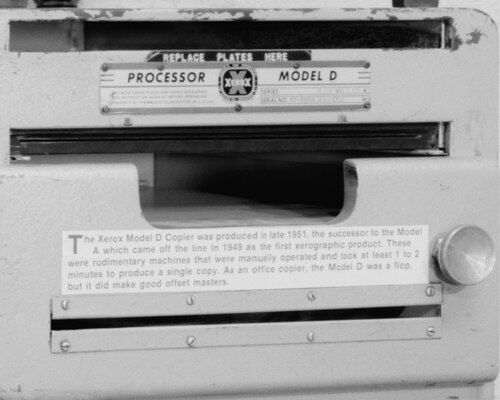
The licence bought an idea, not a product. Haloid showed xerography at the Optical Society of America in Detroit on 22 October 1948, and Wilson’s father predicted a commercial copier by 1950. What shipped in 1949 was the Model A, a set of plates and trays that took a trained operator minutes per copy, and the Model D of late 1951 was, in the words of the label now on a surviving unit, “a flop” as an office copier. Both survived as a way to make paper masters for offset duplicators. Copyflo (1955), which printed from microfilm onto rolls, was the first automatic xerographic machine. Wilson spent the time on patents. In 1950 Haloid became Battelle’s sole licensee; Carlson’s basic patent was due to expire in 1957, and Wilson reasoned that “if we own the rights to the new facets of xerography, our position will be less vulnerable.” Haloid received ten xerography patents in 1953 alone, and in 1956 bought Battelle’s four basic patents outright for stock, cash and royalties.
The money was borrowed. Between 1947 and 1960 Haloid spent about $75 million on xerography, including a $1 million loan from a Rochester bank in 1951 and $3 million from Massachusetts Mutual Life Insurance in 1954 to build a factory on farmland in Webster, fifteen miles outside the city. Wilson had started a profit-sharing plan in 1945; employees bought stock, and Dessauer mortgaged his house. Wilson refused to fire people to save money (“It’s unfair to release them when they’ve made such a sacrifice for us”) and moved weak performers to other departments instead. Dessauer later recalled that members of his own group “would come in and tell me that the damn thing would never work.”
To sell outside North America without the capital to do it, Haloid formed Rank Xerox in 1956, a 50/50 joint venture with the British film company Rank Organisation, which put up £600,000. At a demonstration of a prototype in London, the copier began to smoke and nearly set fire to the Piccadilly Hotel. Rank Xerox in turn formed Fuji Xerox with Fuji Photo Film in 1962, which lasted until 2021.
Leasing the 914
In 1958 Haloid, now called Haloid Xerox, spent nearly $2 million of $27.5 million in revenue on research and still had no office copier. It considered a larger partner, but IBM’s own market study badly underestimated the demand, and IBM declined to manufacture the machine. Horace Becker, the engineer who took the 914 into production, later explained the error: the studies counted how many copies were needed of documents at the point of origin, not how many people would copy a document once they had received it. In August 1959 Wilson wrote to his division heads: “We are about to give birth, either to our greatest success or to our greatest failure—the 914.”
The 914 cost $29,500 to buy, and Wilson did not want to sell it. Having watched IBM lease office machines, he offered it for $95 a month including 2,000 copies, four cents a copy after that, with Xerox maintaining the machine. He called leasing “the most important decision we ever made, except for backing xerography itself.” The first unit shipped on 1 March 1960. Customers made far more copies than anyone had modelled, and because Xerox owned every machine it could depreciate them against taxable income. Revenue went from $31 million in 1959 to $59 million in 1961, and on 18 April 1961, weeks before the stock was listed on the New York Stock Exchange, the shareholders renamed the company Xerox Corporation. In 1965 about 60,000 installed 914s earned 62 percent of Xerox’s $392.6 million in revenue; in 1966 revenue passed $500 million and the company held 61 percent of the copying market. Copies made in the United States went from an estimated 20 million in the mid-1950s to 14 billion in 1966.
Wilson remained unlike the executives he now sat among. A New York Times reporter who heard him address securities analysts in 1961 wrote that he “sounded more like a college professor lecturing a fairly advanced class rather than a salesman making a pitch,” quoting Byron, Dostoyevsky and Montaigne. He took a day around each Christmas to shake hands with every Xerox employee. In 1951 he had complained that women at Haloid were only clerks or factory workers: “We have no women who are executives or even in line to become executives. I think that’s disgraceful.”
The United Nations Series and the Rochester Riots
In 1964 Xerox agreed to spend $4 million on a series of television films about the United Nations, broadcast on ABC without commercial interruption. Four of the six planned films were made and aired between December 1964 and April 1966; the first, A Carol for Another Christmas, was written by Rod Serling and directed by Joseph L. Mankiewicz. The John Birch Society, which regarded the UN as a communist front, asked its members for 50,000 to 100,000 letters of protest. Xerox counted about 29,000 letters from about 6,000 people, against some 6,000 letters of support. “We hate to see a corporation of this country promote the U.N. when we know it is an instrument of the Soviet Communist conspiracy,” said the society’s John Rousselot. Xerox kept the sponsorship.
In July 1964 riots broke out in Rochester. Xerox had almost a thousand employees at the time and, partly because union rules required a high-school diploma, two of them were Black. Wilson met Minister Franklin Florence of FIGHT, the community organisation that Saul Alinsky helped found after the riots (“I hear you’re interested in jobs. Well, we need workers at Xerox”), and the two set up a Xerox programme through which Black trainees could earn a diploma and the skills to be hired. FIGHT then turned on Kodak, which after a long public confrontation agreed in 1967 to a training programme for 600 Black workers. Through an initiative Wilson led, FIGHT also set up a Black-owned manufacturer, FIGHTON, later Eltrex Industries, which employed 350 people at its peak and closed in 2011. When Martin Luther King Jr. was assassinated in April 1968, Wilson walked in the memorial march through Rochester’s Third Ward. His stated view was that “businessmen must stop casting themselves as salesmen for business and start revealing themselves as people who are as interested in the affairs and programs of mankind as the teacher, the scientist, or the welfare worker.”
The university that had educated him was the other beneficiary. Wilson joined the University of Rochester’s board of trustees in 1949 and chaired it from 1959 to 1968. In those two decades the university merged its men’s and women’s colleges and opened schools of business, education and engineering, and in the 1960s it ran a $38 million building campaign. He had steered the university into a $196,000 investment in Haloid stock, which Time reported was worth $120 million by 1971.
The Computer Detour
At the 1966 annual meeting Wilson told shareholders: “Our future from this point forward depends on what we do in fields other than copying.” In 1966 he became chairman, handing the presidency to Peter McColough, a salesman who had joined Haloid in 1954 and became chief executive in 1968. McColough bought his way into computing: in 1969 Xerox paid about $900 million in stock for Scientific Data Systems, the maker of the Sigma mainframes. Renamed Xerox Data Systems, it lost sales after the 1973–74 oil crisis, and in 1975 Xerox closed the division at a loss of hundreds of millions of dollars and sold most of the rights to Honeywell. The same strategy produced the Palo Alto Research Center in 1970, which Xerox could afford because of the 914 (see The Xerox PARC Revolution and Gary Starkweather).
Wilson did not see either outcome. On 22 November 1971 he had a heart attack at a lunch in New York with Governor Nelson Rockefeller and his wife, and died at 61. Time described him as a “lean, scholarly” man whom everybody called Joe, and put the company he left at $1.7 billion a year. He left the University of Rochester $20 million. From 1972 to 1987 the university held an annual Wilson Day of lectures and concerts in his name, and it named its student union, Wilson Commons, designed by I. M. Pei, after him. Carlson, whose patent he had bet the company on, had died three years earlier (see also Digital Photography and the Fall of Kodak for what became of the company across town).
📚 Sources
- Wilson’s Days: The Life and Legacy of Joseph C. Wilson — University of Rochester, Rare Books, Special Collections and Preservation — the exhibit pages Early Life (city schools, class of 1931, English, philosophy and economics), Life After College (Harvard with high honours in 1933, Haloid founded in 1903 by his grandfather and three others, Mosher’s controlling interest, Kodak raw materials, the 1935 Rectigraph purchase, the 1944 report, the October 1935 marriage and six children), Wilson and Carlson (Dessauer and the Kodak bulletin, the 1948 demonstrations), From Haloid to Xerox (the IBM market study and Horace Becker’s point-of-origin explanation), University Service (trustee from 1949, chair 1959–1968, the college merger and the 1958 professional schools, Wilson Commons and I. M. Pei), Community Service (the July 1964 riots, two Black employees out of almost a thousand, Franklin Florence and the training programme, the April 1968 march, the 1951 remark on women, “It’s unfair to release them”), and Celebrating Wilson’s Life (death at lunch with Rockefeller on 22 November 1971, Wilson Day 1972–1987)
- Daniel Gross et al., “Betting the Company: Joseph Wilson and the Xerox 914,” from Forbes Greatest Business Stories of All Time (PDF) — “We’ve got to stop relying wholly on photographic paper,” “a million miles,” Linowitz, Joseph R. Wilson’s 1950 prediction, the 1950 sole licence and the 1957 patent expiry, ten patents in 1953, $75 million in 1947–1960, the 1951 and 1954 loans and the Webster land, the 1945 profit-sharing plan, Dessauer’s mortgage and “never work” quote, the 1956 patent purchase, Rank-Xerox and the Piccadilly Hotel, 1958 research spending of $2 million on $27.5 million, the August 1959 letter, leasing after IBM’s example and the “most important decision” quote, depreciation, $31 million to $59 million, the 18 April 1961 rename, the New York Times 1961 description, the Christmas handshakes, the “businessmen must stop” quote, 60,000 914s and 62 percent of $392.6 million in 1965, 61 percent of the market in 1966, 20 million to 14 billion copies, the 1966 “fields other than copying” statement, SDS for $900 million in stock (this source dates Wilson’s presidency from 1945 and his departure as chief executive to 1968)
- Wilson, Joseph Chamberlain — Encyclopedia.com (second entry) — president of Haloid in 1946, the father’s presidency from 1938 to 1945
- Joseph Chamberlain Wilson — Encyclopedia.com — the grandfather and the M. H. Kuhn Co. of 1903, Haloid in 1906, the father as president, University of Rochester 1931 and Harvard MBA 1933, secretary in 1936 and vice-president in 1944, sales of $1.8 million in 1938 and $6.8 million in 1946, the 1964 UN series
- Joseph C. Wilson (entrepreneur) — Wikipedia — born 13 December 1909 (one Encyclopedia.com entry gives 19 December), president 1946–1966, chairman from 1966, death on 22 November 1971
- “Executives: An Original Copier,” Time, 6 December 1971 — “lean, scholarly,” “Joe,” death at lunch with Nelson and Happy Rockefeller at 61, the $1.7 billion company, the university’s $196,000 investment worth $120 million, the $20 million bequest
- United Nations television film series — Wikipedia — Xerox’s $4 million, ABC, four of six films between December 1964 and April 1966, A Carol for Another Christmas, the Birch Society’s call for 50,000 to 100,000 letters, Xerox’s count of 29,000 from 6,000 people and 6,000 in support, Rousselot’s quote
- FIGHT (Rochester, New York) — Wikipedia — FIGHT’s founding after the 1964 riot, led by Franklin Florence with help from Saul Alinsky and the Industrial Areas Foundation, and the 1967 Kodak agreement
- Franklin Florence — Wikipedia — the Kodak programme for 600 workers, the Black-owned company set up through an initiative led by Wilson, FIGHTON renamed Eltrex Industries, 350 workers at its peak, closure in 2011
- Rank Xerox — Wikipedia — the 1956 joint venture, 50/50 at the start, Rank’s £600,000
- Fujifilm Business Innovation (Fuji Xerox) — Wikipedia — founded in 1962 as a 50:50 partnership with Rank Xerox, renamed in April 2021 when the Xerox agreement ended
- Charles Peter McColough — Wikipedia — joined Haloid in 1954, president in 1966, chief executive in 1968
- Scientific Data Systems — Wikipedia — the 1969 sale to Xerox, Xerox Data Systems, closure in 1975 “at a loss of hundreds of millions of dollars,” rights sold to Honeywell in July 1975
- David Owen, “Making Copies,” Smithsonian Magazine, August 2004 — the Battelle licence of 1947
- Xerox Model D copier, Battelle Memorial Institute, Historic American Engineering Record OH-25-COLB-38A (Library of Congress) — the unit’s label: produced in late 1951, successor to the Model A of 1949, “a flop” as an office copier but good for offset masters
- Xerox — Wikipedia — the 1961 NYSE listing, revenues over $500 million by 1965, PARC opened in 1970 under McColough