Dead End: Maemo and MeeGo
Abstract
Maemo was Nokia’s second smartphone platform, the one built on Linux while Symbian earned the money. It began in 2005 on a pocket tablet without a phone, reached a hacker-beloved phone with the N900 in 2009, merged with Intel’s Moblin into MeeGo in 2010, and was cancelled in February 2011 before its best device shipped. The Nokia N9 arrived that autumn to reviews calling it possibly the most beautiful phone ever made, with its own CEO already on record that there would be no second one. The code outlived the strategy: Jolla’s Sailfish OS and Samsung’s Tizen both descend from it.
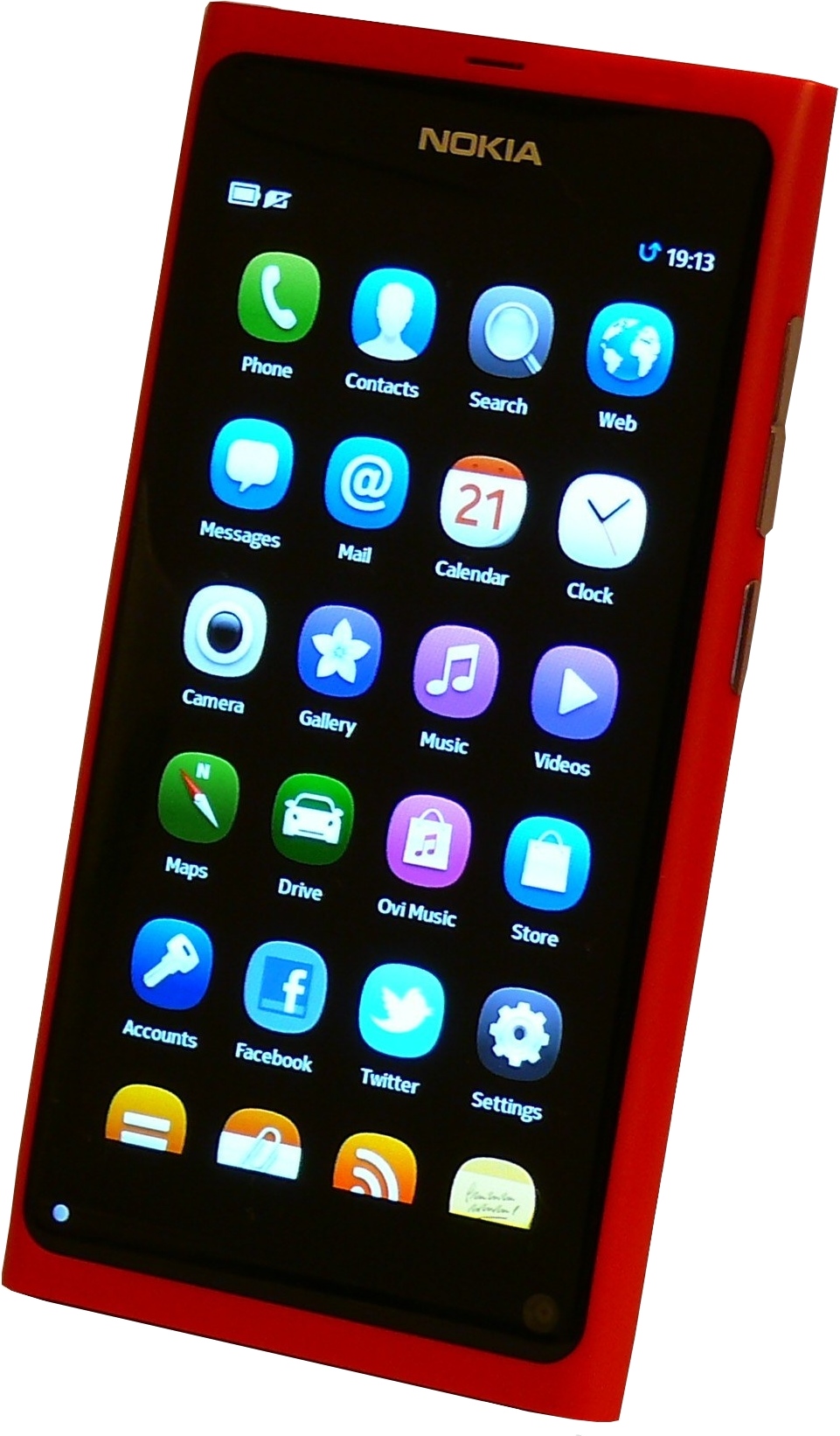
The Tablet Without a Phone
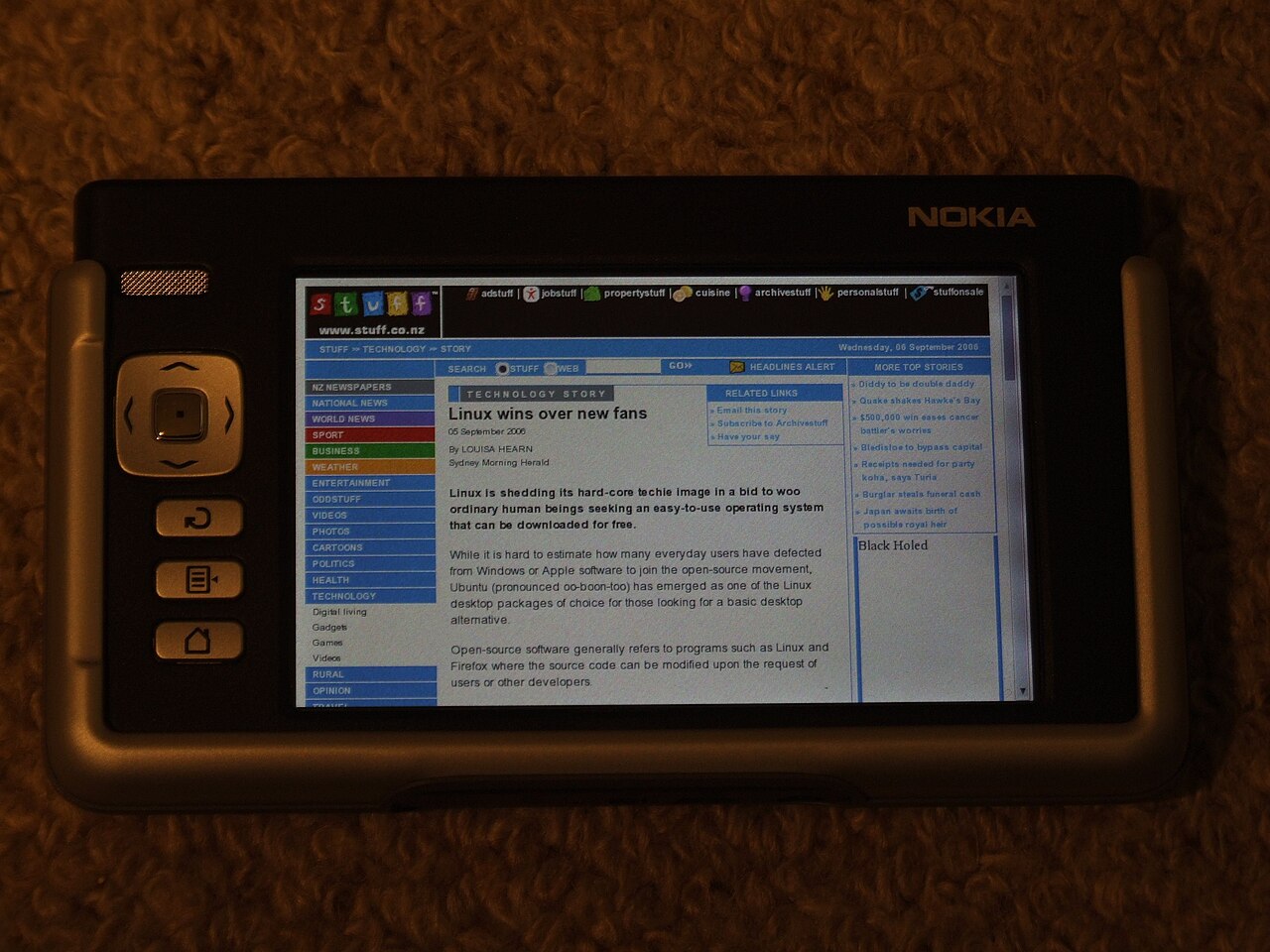
On 25 May 2005, at the LinuxWorld Summit in New York, the world’s largest phone maker announced a device that could not make phone calls. The Nokia 770 Internet Tablet had an 800 × 480 widescreen display of 4.13 inches, Wi-Fi, a 252 MHz Texas Instruments OMAP 1710 processor and 64 MB of memory. Away from a hotspot it went online through a Bluetooth phone acting as a modem. It went on sale in Europe on 3 November 2005 for €349 to €369, and in the US that month for $359.99.
Its software was the product. Maemo was a Debian-based Linux distribution with a touch interface called Hildon, built largely from GNOME libraries and tools. Ari Jaaksi, Nokia’s director of open source software operations, ran it as an upstream-first project with a public developer site, maemo.org, launched the same year. For a company whose phone software was a tightly controlled joint venture, this was a new way of working: most of the code came from existing open-source communities, and Nokia shipped it to hobbyists who could open a terminal on day one.
Reviewers were less taken with the hardware. The 770 was slow, the memory small, and battery life under four hours with Wi-Fi in continuous use. By July 2007 the price had fallen below US$150. Nokia kept going anyway: the N800 arrived with OS2007 on 8 January 2007 and the N810, with a slide-out keyboard, in November 2007. In January 2008 Nokia moved to acquire Trolltech, the Norwegian maker of the Qt toolkit, which gave it a cross-platform application framework it controlled.
The N900
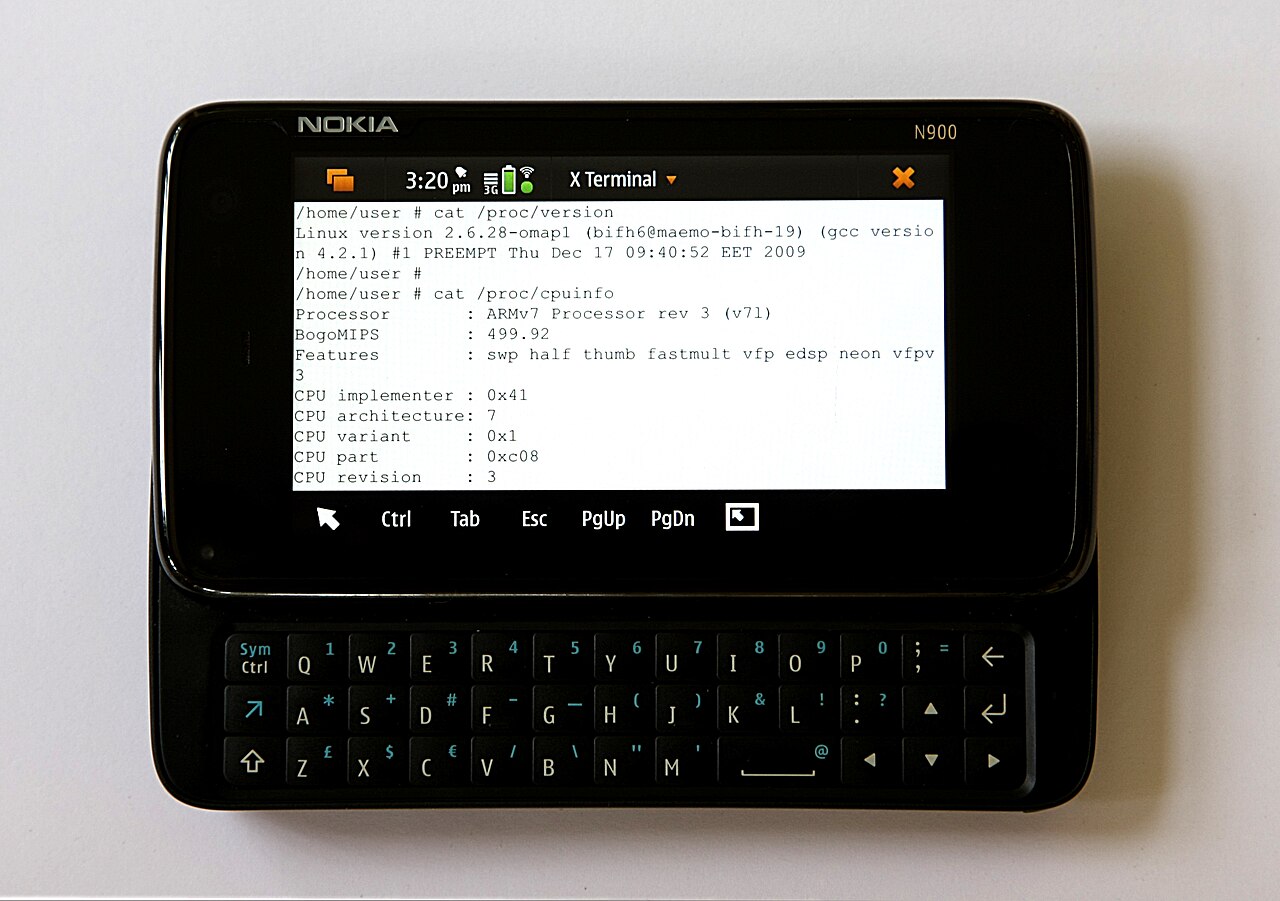
Four years after the 770, Maemo finally got a radio. The Nokia N900, announced on 27 August 2009, shown at Nokia World in Stuttgart on 2 September and released on 11 November, was the first Maemo device with telephony: quad-band GSM and 3G. It ran Maemo 5 (“Fremantle”) on a TI OMAP 3430, with a 3.5-inch resistive touchscreen at 800 × 480 and a three-row slide-out keyboard. It cost €599 in Europe and US$649 in the United States.
The N900 was a pocket Linux computer that also made calls. Owners got root access, an X terminal and the Debian package tools; it drew attention across the open-source community well beyond Nokia’s usual buyers. It also arrived two years after the iPhone, with a stylus-friendly resistive screen when the market had moved to capacitive glass, and it was positioned as a flagship for enthusiasts while Symbian carried the volume. Nokia sold both platforms at once and developers had to choose.
MeeGo
At Mobile World Congress in Barcelona in February 2010, Nokia and Intel announced in a joint press conference that Maemo would merge with Moblin, Intel’s Linux platform for netbooks and “mobile internet devices”. Intel had started Moblin in July 2007 to give its Atom processors a home outside Windows, and had handed it to the Linux Foundation in April 2009. The merged project, MeeGo, was hosted by the Linux Foundation and meant to span phones, tablets, netbooks, in-car systems and televisions.
The merger produced an operating system with two parents and two cultures. Maemo was Debian-based with a GTK+ interface; Moblin 2 came from Intel with its own interface built on the Clutter toolkit. MeeGo 1.0 appeared on 26 May 2010 and 1.1 on 28 October 2010, and devices such as the WeTab tablet (September 2010) shipped with it. The phone that Nokia actually had in development was Harmattan, planned as a bridge between Maemo and MeeGo, written heavily in Qt instead of Maemo’s GTK+ and Hildon, and built around swipe gestures from the edges of the screen. After problems with the joint MeeGo project, Nokia relabeled Harmattan as “MeeGo 1.2 Harmattan” and kept going on its own.
The Burning Platform
On 11 February 2011, days after Stephen Elop’s “burning platform” memo, Nokia announced that Windows Phone would be its primary smartphone platform. The same announcement ended the MeeGo partnership. Symbian and MeeGo were both written off in one press conference (the Symbian half of the story is told in Dead End: Symbian; Microsoft’s side in Dead End: Microsoft’s Mobile Failures).
For the Harmattan team the decision came with the product nearly finished. MeeGo 1.2 was released on 19 May 2011. Nokia allowed the consumer device to ship, once, and gave a keyboard developer version, the N950, to about 5,000 developers in July 2011 instead of selling it.
The N9
Nokia announced the N9 on 21 June 2011 at its Nokia Connection event in Singapore and released it in September. It had a polycarbonate unibody and no front buttons: the whole interface ran on swipes. A few days after the launch, Elop told the Finnish daily Helsingin Sanomat that even if the N9 was a success, it would be Nokia’s only MeeGo phone.
Engadget’s October 2011 review opened with “Love at first sight — this is possibly the most beautiful phone ever made”, called it “as glorious as a stillborn product can be”, and ended on “MeeGo is dead — long live MeeGo.” GSMArena titled its review “Once in a lifetime”. Nokia then kept the phone out of the United States, the United Kingdom, Canada, Germany, France, Italy, Spain, the Netherlands and Japan, and never published sales figures. Its case design was adapted for the Lumia 800, one of Nokia’s first two Windows Phones. The final official Maemo 5 update for the N900 came on 2 November 2011, and the last MeeGo release, 1.2.0.10, on 12 July 2012.
Afterlife
MeeGo’s partners scattered. On 27 September 2011 Intel’s Imad Sousou announced that MeeGo would be replaced by Tizen, developed with Samsung. The first Tizen phone, the Samsung Z1, went on sale in India on 14 January 2015 for 5,700 rupees (about $92). Tizen found its markets elsewhere: Samsung’s smartwatches and televisions, where research firm Strategy Analytics counted it on about 21% of smart TVs sold in 2018. In May 2021 Google announced that Samsung’s future watches would run Wear OS instead.
Nokia’s own MeeGo engineers took the other branch. On 29 March 2011, six weeks after the Windows Phone announcement, former MeeGo staff including Marc Dillon, Jussi Hurmola and Stefano Mosconi founded Jolla in Finland. Its Sailfish OS, built on the community-run Mer continuation of MeeGo, kept the N9’s swipe interface. The first Jolla phone went on sale in Helsinki on 27 November 2013, with almost 500 people queueing in Narinkkatori square that evening. Jolla later leaned on licensing Sailfish OS, took investment from Russia’s state-owned Rostelecom and announced its exit from Russia in 2022, and the original company went bankrupt in 2024 with the business continuing under a successor. Hobbyists, meanwhile, have maintained Maemo Leste, a Devuan-based revival of Maemo, since 2017.
Dead End
Maemo was the part of Nokia that had already made the transition the company needed. It had Linux, a full web browser, open development tools, and, after 2008, Qt, all years before Nokia’s crisis. It failed for reasons that were mostly organizational. Nokia ran it as a side project next to Symbian, which meant two platforms, two developer stories and an internal contest for resources during exactly the years (2007 to 2010) when Android and the iPhone were building their app stores. The Intel merger then added a second owner and a second technical lineage when the phone was already late, and Nokia ended up shipping its own fork anyway.
When the product finally arrived in finished form, the company that built it had already chosen another platform. The N9 was sold as a limited run in selected markets, its design passed to a Windows Phone, and its developers left to found Jolla. The code survives in Sailfish OS and in Samsung televisions, which run a system with MeeGo in its ancestry. The corporate story of the collapse is in Nokia.
📚 Sources
- Maemo — Wikipedia
- MeeGo — Wikipedia
- Moblin — Wikipedia
- Nokia 770 Internet Tablet — Wikipedia
- Nokia N900 — Wikipedia
- Nokia N9 — Wikipedia
- Nokia Internet Tablet — Wikipedia
- Lehrbaum, Rick: “Nokia’s open source director on the 770 Internet Tablet” — Linux.com (21 December 2005)
- Jaaksi, Ari: “Building consumer products with open source” — Nokia / maemo.org (PDF)
- Nokia N9 review — Engadget (22 October 2011)
- Nokia CEO: Even if the N9 is a success, it’ll be Nokia’s only MeeGo phone — TechCrunch (27 June 2011)
- Nokia’s Elop: We won’t return to MeeGo, even if N9 is a hit — Fierce Network (2011)
- Nokia CEO Stephen Elop’s “burning platform” memo, full text — Engadget (2011)
- Tizen — Wikipedia
- Samsung launches its first Tizen-powered phone, the Z1, in India for $92 — TechCrunch (14 January 2015)
- Maemo 5 injects speed and power into mobile computing — Nokia press release via GlobeNewswire (27 August 2009)
- Intel and Nokia Merge Software Platforms for Future Computing Devices — Intel press release (15 February 2010)
- Nokia N950 — Wikipedia
- Jolla — Wikipedia
- Happy Birthday Jolla Phone — Jolla Blog
- Image: Nokia N9.jpg by Animist (CC BY-SA 3.0), via Wikimedia Commons
- Image: N900 xterm.JPG by Ianaré Sévi (CC BY-SA 3.0), via Wikimedia Commons