CeBIT and the Age of the Computer Trade Fair
Abstract
For roughly two decades, the computing industry’s calendar revolved around two enormous annual gatherings: CeBIT in Hannover, the largest computer trade fair the world has ever seen, and COMDEX in Las Vegas, its brash American counterpart. These were the places where products launched, deals were signed, chancellors shook hands with CEOs, and hundreds of thousands of visitors queued in the rain to see the future. They also made and unmade remarkable people: Heinz Nixdorf died on the CeBIT fairgrounds during its very first edition; Sheldon Adelson turned COMDEX into the fortune that built the Venetian casino; Masayoshi Son bought the show at the top and watched it die. By 2018 both fairs were gone, killed not by a competitor, but by the disappearance of the problem they solved.
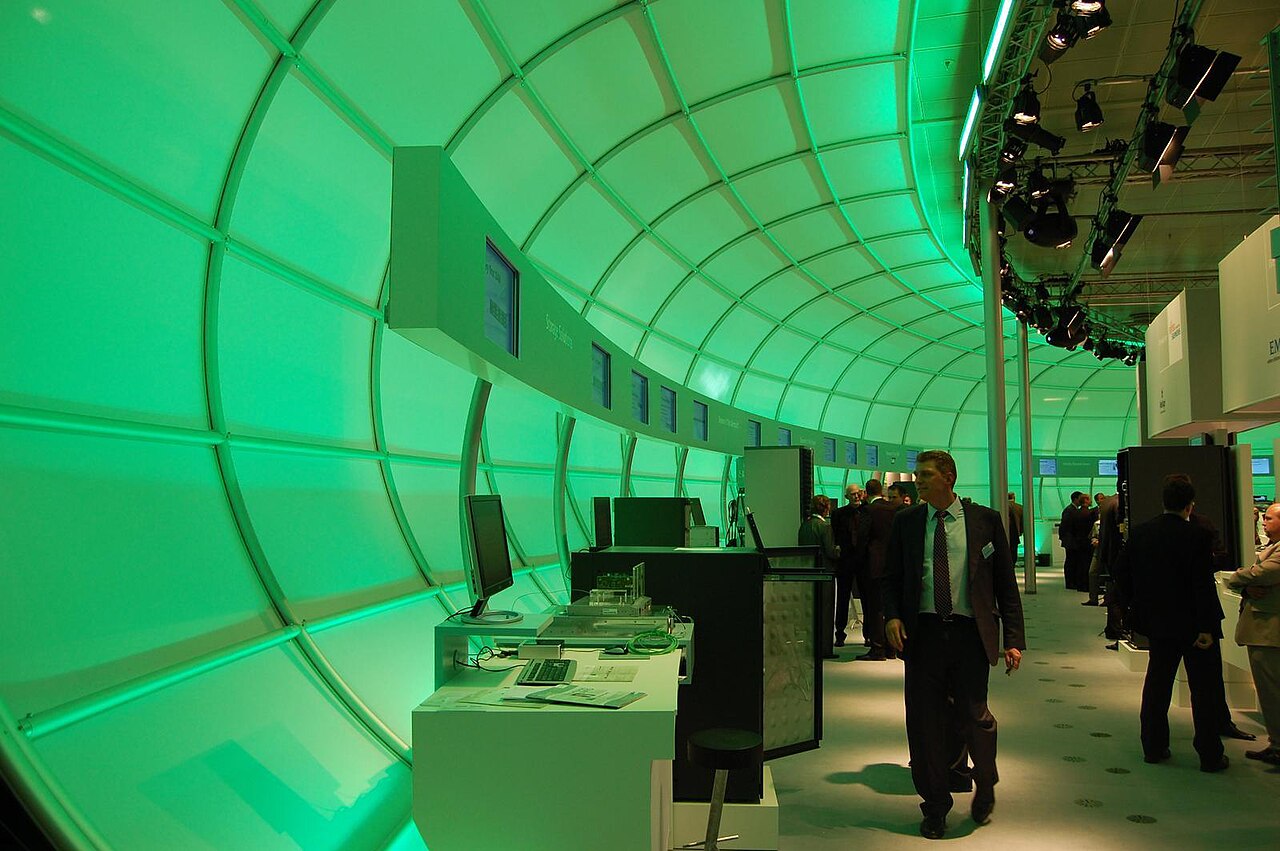
Hannover: A Fair Born from Rubble
The story begins with the Hannover Messe, the industrial trade fair the British occupation authorities launched in 1947 to restart export trade from a bombed-out Germany. It grew into the world’s largest industrial fair, and computing entered it almost by accident: office machines were simply one more category of industrial equipment.
In 1970, the Hannover fairground opened its new Hall 1 (then the largest exhibition hall in the world) and dedicated it to office technology under the label Centrum der Büro- und Informationstechnik: CeBIT. For sixteen years, CeBIT was a hall, not a fair. But the hall kept outgrowing itself. By the mid-1980s, the computing section was straining the entire Hannover Messe, and Deutsche Messe AG made the decision to spin it off as a standalone event, held four weeks before the main fair. The acronym was rebranded along the way as Centrum für Büroautomation, Informationstechnologie und Telekommunikation.
The first independent CeBIT opened on March 12, 1986, with 2,142 exhibitors and 334,400 visitors, instantly one of the largest technology events on the planet.
A Death at the Fair
The first CeBIT is remembered for a tragedy. Heinz Nixdorf (the Paderborn entrepreneur whose Nixdorf Computer AG was then Germany’s most successful independent computer maker) collapsed and died of a heart attack on the fairgrounds on March 17, 1986, at sixty, during the fair’s opening week. The symbolism was hard to miss then and is harder to miss now: the founder generation of German computing died, literally, at the moment the industry became big enough to need a fair of its own. Nixdorf’s company did not long survive him; Siemens acquired it in 1990.
COMDEX: The American Mirror
CeBIT’s American counterpart was younger, louder, and ran on different fuel. COMDEX (Computer Dealers’ Exhibition) was created in 1979 by The Interface Group, a Boston trade-show company run by Sheldon Adelson and partners including Richard Katzeff. The first show, at the MGM Grand in Las Vegas on December 3, 1979, drew 167 exhibitors and 3,904 attendees. Within a decade it filled the city every November, second in the world only to CeBIT, peaking at around 225,000 attendees in 1996.
COMDEX earned its place in computing history as a stage for turning points:
- In 1982, a young Bill Gates walked the COMDEX floor and saw a demonstration of VisiCorp’s Visi On, a graphical interface suite for the PC. The demo alarmed him into accelerating what became Windows, and Microsoft’s fall COMDEX keynote grew into an industry institution, the closest thing the PC business had to a state-of-the-union address.
- In 1999, Linus Torvalds presented Linux to a COMDEX audience, the countercultural operating system arriving at the industry’s most commercial venue was itself the news.
The most consequential COMDEX story, however, is about its owner. Adelson had bought Las Vegas’s Sands Hotel and Casino in 1988 for $110 million, largely because COMDEX needed convention space. In 1995, at the peak of the trade-show boom, he sold the Interface Group’s show division (COMDEX included) to Masayoshi Son’s SoftBank in a deal valuing it at $862 million, of which more than $500 million went to Adelson personally. He poured the proceeds into a $1.5 billion Venice-themed resort on the Sands site, inspired by his Venice honeymoon: The Venetian, opened in 1999, the foundation of one of the world’s great casino fortunes. Adelson sold the computer industry’s town square at the exact top of the market, to a buyer who would learn what that meant.
Peak CeBIT: The Ritual Years
While COMDEX changed hands, CeBIT kept growing. Around the turn of the millennium it was less a trade fair than a temporary city: at its 2001 peak, 830,000 visitors and roughly 450,000 square meters of exhibition space, bigger than COMDEX and COMPUTEX combined. Hotels for a hundred kilometers around Hannover sold out; companies rented private apartments for their staff a year in advance.
CeBIT developed rituals with the trappings of a state occasion. The German chancellor opened the fair each year with a televised walkabout (Angela Merkel made the tour a fixture of her chancellorship) flanked by the head of state or government of an annually chosen partner country, a diplomatic instrument as much as a marketing one. Celebrity keynotes ranged from Steve Wozniak and Wikipedia’s Jimmy Wales to security entrepreneur Eugene Kaspersky and, in the fair’s later years, California governor Arnold Schwarzenegger.
It was also a genuine launchpad. Voice-over-IP telephony was demonstrated to a mass audience at CeBIT in 1994; Windows 95 was shown there in March 1995, months before its retail launch; Nokia announced the 9000 Communicator (the phone-computer hybrid that anticipated the smartphone) at CeBIT 1996; Intel showed off an 800-MHz Pentium III in 1999; Windows 2000 debuted in 2000; Ericsson’s T68, shown at CeBIT 2001, carried the industry’s MMS hopes. For Germany’s IT industry, CeBIT week was the one moment each year when the world’s technology press was on German soil.
⚠️ Dead End: The Death of the Computer Trade Fair
Both giants died within fifteen years of their peak, and for the same underlying reason: the trade fair solved an information problem that stopped existing.
COMDEX went first, and fastest. SoftBank resold the show in 2001 to Key3Media, a Ziff-Davis spinoff, which filed for Chapter 11 bankruptcy in February 2003. The dot-com collapse had gutted exhibitor budgets, and marquee names (IBM, Apple, Compaq) had already withdrawn around 2000. The final Las Vegas COMDEX, in November 2003, drew 500 exhibitors and 40,000 visitors, a fifth of its peak; the 2004 show was cancelled outright. Las Vegas barely noticed, the consumer-oriented CES absorbed the January calendar and kept growing.
CeBIT declined more slowly but just as surely. Attendance fell to roughly 200,000 in the late 2000s, and by 2013 was below the level of the first fair in 1986. The organizers tried everything: refocusing on business-to-business “digitization,” moving from March to June, rebranding the 2018 edition as a technology festival with a Ferris wheel among the server racks. The final CeBIT, in June 2018, drew about 120,000 visitors and 2,800 exhibitors. On November 28, 2018, Deutsche Messe cancelled the fair for good.
Why did the model fail?
- Product launches stopped needing a fair. When Apple could stream a keynote to more people in an hour than CeBIT reached in a week (on a date it alone controlled) sharing a launch stage with 2,000 competitors became a liability. Vendor-owned events (Apple’s keynotes, Google I/O, Microsoft Build) replaced the shared calendar.
- The information asymmetry vanished. Trade fairs existed so buyers could see products that were otherwise invisible, specifications, prices, and demos travelled by catalog and salesman. The web made every product knowable from a desk, every price comparable in seconds.
- The industry consumerized and specialized. General-purpose “everything computing” fairs lost both ends of their audience: consumers migrated to CES and IFA, professionals to focused events like Mobile World Congress, Gamescom, and re:Invent. The middle (the everything-fair) hollowed out.
- Costs never consumerized. A large CeBIT stand cost millions; a hall’s worth of staff, hotels at fair-week prices, and a week of executive time bought less attention every year. Exhibitors, not visitors, killed the fairs, floor bookings collapsed first.
The pattern is a textbook platform death: each departing exhibitor made the fair less worth visiting, each lost visitor made exhibiting less worth paying for. The same spiral that builds a platform unwinds one.
Legacy
The computer trade fair was the industry’s public face for a generation: the one week a year when computing was a place you could walk through, crowded and loud and smelling of carpet glue. Its rituals survive in fragments: CES inherited the launch calendar, MWC the telecom deal-making, Gamescom the queues, vendor keynotes the theater. Hannover’s halls still fill each spring with the industrial Hannover Messe, where “Industrie 4.0” is pitched from the same stages that once launched the Communicator. And in Las Vegas, the most concrete monument of the trade-fair era is not a convention hall at all: it is the Venetian, a casino built from the proceeds of selling COMDEX at the perfect moment, computing history rendered in imitation marble.
📚 Sources
- CeBIT — Wikipedia, origins in Hall 1 (1970), 1986 spin-off, 2001 peak, decline and 2018 cancellation
- CeBIT — Wikipedia (German), first-fair figures (2,142 exhibitors, 334,400 visitors), Nixdorf’s death on the fairgrounds, product premieres, final-edition figures
- COMDEX — Wikipedia · 1979 founding, Gates and Visi On (1982), Torvalds (1999), SoftBank and Key3Media ownership, 2003 collapse
- Sheldon Adelson — Wikipedia · Interface Group, the $862M SoftBank sale, the Sands purchase and the Venetian
- Nokia 9000 Communicator — Wikipedia, announced at CeBIT 1996, released August 15, 1996
- Image: CeBit Hannover 2007.jpg by Think Blink (CC BY 2.0), via Wikimedia Commons