Ukraine's Developer Ecosystem: From Outsourcing Hub to Wartime Resilience
Abstract
Ukraine is not where most people look for the origins of the apps on their phone, yet WhatsApp, PayPal, Grammarly, and GitLab all trace part of their DNA to people born or working there. Over three decades, Ukraine turned a Soviet legacy of strong mathematics and engineering education into one of the world’s largest software-development workforces, built first on outsourcing for Western clients and increasingly on homegrown products. Then, in February 2022, Russia’s full-scale invasion put the entire industry to the ultimate stress test. The remarkable answer: the tech sector did not collapse. It became the only part of the economy that kept growing exports, kept the lights on with generators and Starlink, and turned its skills toward national survival. Ukraine’s story is about how human capital, not infrastructure, can be the durable core of a tech economy.
A Soviet Inheritance: Math, Not Machines
Ukraine entered the software era with one major asset and one major handicap. The asset was education: the Soviet system invested heavily in mathematics, physics, and engineering, and Ukrainian universities (Kyiv Polytechnic, Lviv Polytechnic, Kharkiv’s technical institutes) produced large numbers of rigorously trained graduates. The handicap was infrastructure: the USSR’s domestic computing industry lagged the West and largely cloned Western architectures, so Ukrainian talent matured without a domestic hardware or product industry to absorb it.
When the Soviet Union dissolved in 1991, that talent was suddenly available to the global market at a fraction of Western salaries, and connected to it by the internet. The result was almost inevitable: Ukraine became an outsourcing destination for software development.
The Outsourcing Boom
Through the 1990s and 2000s, an industry grew up around writing code for foreign clients. SoftServe, founded in the early-to-mid 1990s by graduates of Lviv Polytechnic, started with a handful of people in a cramped apartment and grew into the largest IT outsourcer headquartered in Lviv, employing thousands across Ukraine and abroad. Global service firms built large engineering centers in the country: EPAM, founded in 1993 by Belarus-born Arkadiy Dobkin, headquartered in the US, but with one of its largest engineering workforces in Ukraine. GlobalLogic, Luxoft, and others scaled to thousands of Ukrainian engineers each.
Lviv, in the west, became the symbolic capital of the sector. Local outsourcers including SoftServe, ELEKS, and N-IX founded the Lviv IT Cluster around 2009–2011 to pool training, lobbying, and infrastructure, an attempt to evolve the city from a pure outsourcing hub toward a self-sustaining “Ukrainian Silicon Valley.” Kyiv and Kharkiv developed their own large clusters. By the late 2010s, IT services had become one of Ukraine’s biggest and fastest-growing export sectors, employing hundreds of thousands of specialists.
The Ukrainian Diaspora’s Global Imprint
Outsourcing was only half the story. Many of Ukraine’s most consequential contributions came through émigrés who built or co-built world-changing products abroad:
- Jan Koum, born near Kyiv, emigrated to the United States as a teenager and co-founded WhatsApp in 2009; Facebook bought it in 2014 for about $19 billion.
- Max Levchin, born in Kyiv, left with his family in 1991 and co-founded PayPal, where he was the anti-fraud architect and helped build one of the first commercial CAPTCHA systems (a lineage that runs back to Manuel Blum).
- Grammarly was founded in 2009 in Kyiv by Ukrainians Max Lytvyn, Alex Shevchenko, and Dmytro Lider; it became a major writing-assistant company, US-headquartered with a large Kyiv development office.
- GitLab, the DevOps platform, was co-founded in 2011 by Dmytro Zaporozhets, who built the original software while working in Kharkiv and continued living there as the company grew into a publicly listed firm.
The common thread is that the value was created by Ukrainian people (at home or in the diaspora) rather than by Ukrainian capital or infrastructure. That distinction would matter enormously in 2022.
Digital State: Diia
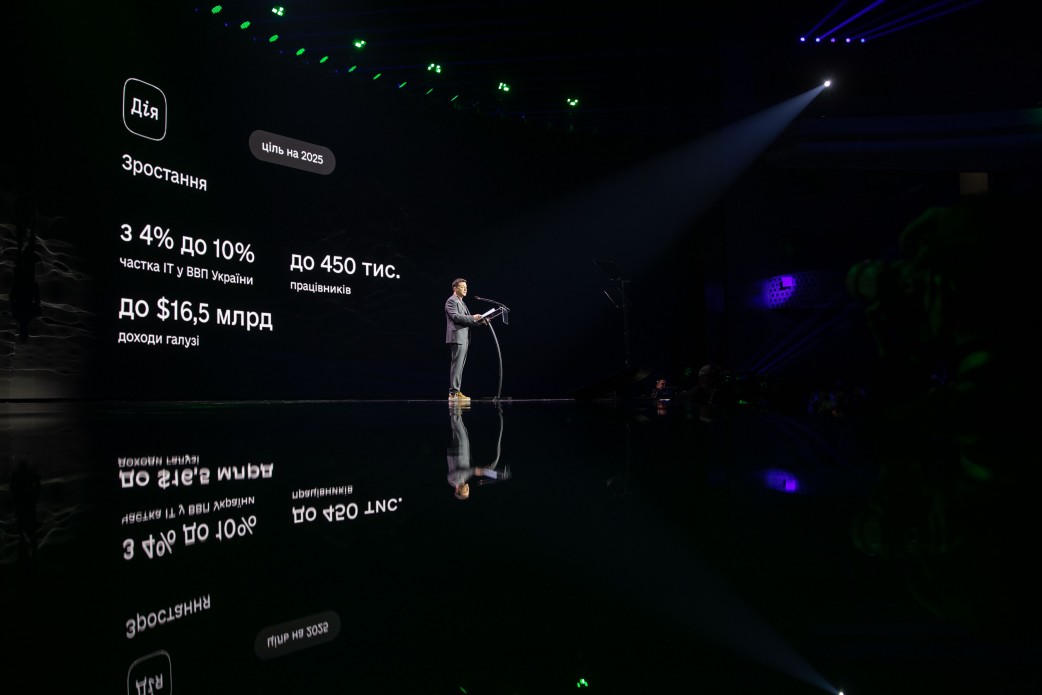
Before the war, Ukraine made an unusually aggressive bet on digital government. The Ministry of Digital Transformation, created in 2019, launched the Diia app in 2020, a smartphone platform that put official documents (digital passport, driver’s license, tax ID) and dozens of state services on the phone, aiming to make Ukraine a “state in a smartphone” and to cut the bureaucratic corruption that paper processes enabled. The government also created Diia.City, a special legal and tax regime designed to keep IT companies and their talent registered in Ukraine.
Wartime Resilience: The Industry That Refused to Break
Russia’s full-scale invasion in February 2022 should, by any normal logic, have destroyed the sector. It did not, and the reason is the industry’s defining feature: its value lived in people and code, not factories. Engineers could be relocated west, or abroad, and keep working; the product crossed borders as data.
The numbers were startling. While Ukraine’s GDP fell by roughly 29% in 2022, the tech sector grew its exports, generating on the order of $7 billion in annual export revenue, making IT the only major sector to increase foreign-currency earnings during the war. Companies kept delivering by equipping offices with diesel generators against Russian strikes on the power grid and using Starlink satellite internet to stay online through outages. Only a small fraction of firms ceased operating, and hundreds of new companies registered with Diia.City even during the war.
The Diia app, built for convenience, became infrastructure for survival: Ukrainians used it to obtain evacuation and damage-claim documents and to access services as displaced people. Tech workers also turned their skills directly to the war effort, the volunteer “IT Army” mobilized programmers for cyber-defense, while others built reconnaissance, drone, and logistics software, raised funds, and volunteered. A workforce trained to serve Western clients re-pointed itself, at least in part, at national defense.
⚠️ Dead End: The Limits of an Outsourcing Economy
Ukraine’s resilience is real, but it exposed the strategic weakness of the model the country grew up on. For decades the dominant business was outsourcing, selling engineering hours to foreign companies that owned the products, the brands, and the intellectual property. It built skills and incomes, but it meant the largest value of Ukraine’s most successful founders (WhatsApp, PayPal, GitLab) was largely captured abroad, by the companies and economies that owned the equity.
The war sharpened both the risk and the ambition. War accelerated a brain drain, as engineers relocated abroad and some never returned, and it made foreign clients wary of the country risk of placing critical work in a war zone, pushing some contracts elsewhere. The lesson the industry itself has drawn, visible in Diia.City, in the product ambitions of clusters like Lviv’s, and in the wartime pivot to homegrown defense software, is that selling hours is a fragile foundation, and that the durable path is owning products. Whether Ukraine can convert its deep talent pool from a global subcontractor into a builder of its own companies is the open question on which its tech future, and part of its postwar recovery, depends.
📚 Sources
- TechUkraine: Lviv tech hub · RFE/RL: Lviv seeks to evolve from outsourcing hub to Ukrainian Silicon Valley
- Wikipedia: SoftServe · EPAM Systems
- Kyiv Independent: 10 global companies you didn’t know have Ukrainian roots
- Wikipedia: Max Levchin · KyivPost: GitLab’s Ukrainian co-founder
- IT Ukraine Association: tech industry growing despite the war
- Atlantic Council: Ukraine’s tech sector is playing vital wartime economic and defense roles
- Ukraine.ua: Digital country (Diia)
- Image: %D0%92%D0%BE%D0%BB%D0%BE%D0%B4%D0%B8%D0%BC%D0%B8%D1%80 %D0%97%D0%B5%D0%BB%D0%B5%D0%BD%D1%81%D1%8C%D0%BA%D0%B8%D0%B9 %D0%BD%D0%B0 %D1%82%D1%80%D0%B5%D1%82%D1%8C%D0%BE%D0%BC%D1%83 Diia Summit.jpg by Office of the President of Ukraine (CC BY 4.0), via Wikimedia Commons