Stephen Wolfram
Abstract
Stephen Wolfram (born 1959) published his first physics paper at fifteen, took a Caltech doctorate at twenty, and was the youngest MacArthur Fellow at twenty-one. He then left academia after a dispute with Caltech over who owned the symbolic-algebra program he had written, founded Wolfram Research in 1987, and shipped Mathematica on June 23, 1988; it has been the dominant commercial system for symbolic computation ever since, and Wolfram|Alpha (2009) put its engine behind a question box. His 1983–85 classification of cellular automata is a real contribution to the theory of computation. So is his 1985 conjecture that Rule 110 is universal, which his employee Matthew Cook proved and which Wolfram’s company then kept out of print by court order until Wolfram’s own book was out. That book, A New Kind of Science (2002), 1,197 self-published pages, claimed to have founded a new science; the field’s reviewers said the sound results were old, minor, or Cook’s. He has spent forty years writing his own history in the first person, and this article tries to separate the record from the narration.
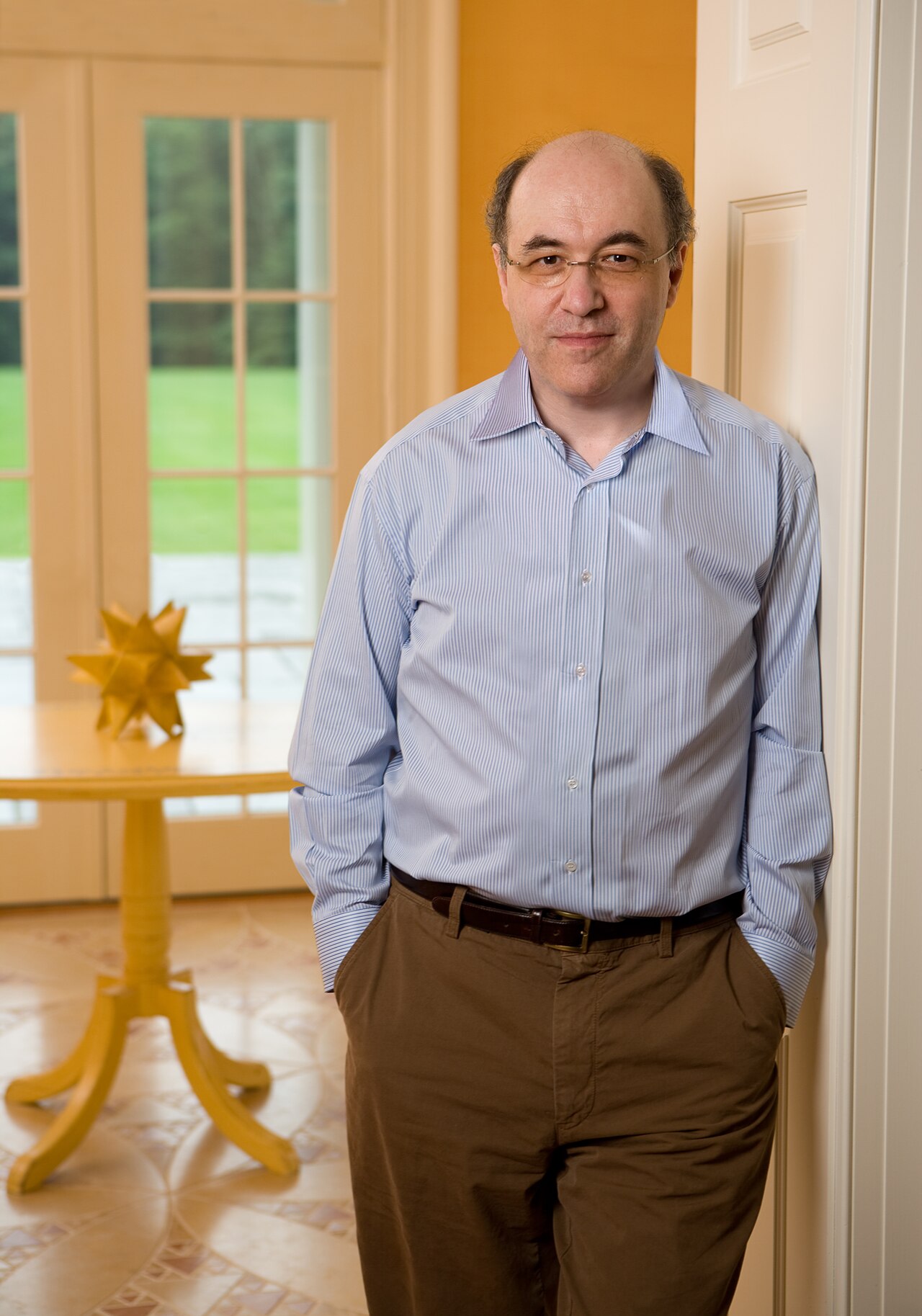
The Prodigy
Wolfram was born in London on August 29, 1959, to Hugo Wolfram, a textile manufacturer and novelist, and Sybil Wolfram, a philosophy lecturer at Oxford, both of them German-Jewish refugees. He went to the Dragon School and Eton, which he left in 1976, and to St John’s College, Oxford, at seventeen, which he left without a degree in 1978. He had published his first paper in particle physics at fifteen and about ten by the time he left Oxford. Caltech gave him a doctorate in theoretical physics in 1979, at twenty, with Richard Feynman on the committee; he stayed on the faculty, and in 1981 the MacArthur Foundation made him the youngest fellow in its first class, at twenty-one. The record on all of this is unambiguous and it is where the pattern of his life was set: the work was real, the speed was real, and he made sure everyone knew.
SMP
Doing quantum chromodynamics by hand had bored him, so at Caltech from 1979 he wrote SMP, the Symbolic Manipulation Program, a computer-algebra system in the tradition of Macsyma (see Computer Algebra Systems). When he tried to commercialise it through a company called Computer Mathematics Corporation, Caltech claimed ownership of software written on its premises. The dispute ended with Wolfram leaving Caltech in 1982. He went to the Institute for Advanced Study in Princeton in 1983 and changed subjects.
Rule 30
The subject was cellular automata, the grid-of-cells systems John von Neumann and John Conway had used, and Wolfram’s contribution was to treat them as a naturalist treats beetles. Between 1983 and 1985 he studied the 256 elementary one-dimensional rules and sorted the behaviour of cellular automata into four classes: rules that die to uniformity, rules that fall into repetition, rules that produce chaos, and a fourth class, in which localised structures move and collide, where he argued computation lives. Rule 30 produced a pattern from a single black cell that passed every test for randomness he applied, and he later used it as Mathematica’s random-number generator. Rule 110, a class-four rule, he conjectured in 1985 to be Turing-complete. He founded the journal Complex Systems in 1987 and, at the University of Illinois in 1986, the Center for Complex Systems Research. This is the work on which his scientific reputation properly rests, and it is described with its lineage in Cellular Automata and Artificial Life.
Mathematica
Wolfram Research was founded in 1987 in Champaign, Illinois, and Mathematica 1.0 shipped on June 23, 1988, with Steve Jobs’s NeXT as an early bundling partner. It combined symbolic algebra, numerics, graphics and a notebook interface in one product, built on a single language in which everything is an expression and computation is pattern-based rewriting. Where Macsyma had been a research tool and Maple came out of a university, Mathematica was a commercial product from the first day, tightly controlled, expensively licensed and continuously developed by one company under one person for nearly four decades. It became the standard in physics and engineering departments and in a large part of industry, and it funded everything Wolfram did afterwards. The language was renamed the Wolfram Language in 2014. Wolfram|Alpha, went live in May 2009 and put a curated database and the Mathematica engine behind a natural-language question box; it answers the arithmetic and factual queries behind Apple’s Siri and, from 2023, a ChatGPT plug-in, and it is the closest anyone has come to the “answer engine” the search-engine pioneers talked about.
A New Kind of Science
In 1991 Wolfram withdrew from public life to write a book, working, by his own account, at night for ten years. A New Kind of Science appeared on May 14, 2002, from his own Wolfram Media, 1,197 pages, about 350 of them notes, with no bibliography and few citations. Its thesis was that simple programs, rather than equations, are the right foundation for physics, biology and the rest, and that a Principle of Computational Equivalence, under which almost every non-trivial system is computationally universal, explains why the natural world is as complicated as it is. It went to the top of Amazon’s list on publication and was reviewed at length by people who read all of it.
The reviews established three things. The classification of cellular automata and the observations on Rule 30 were sound, and were Wolfram’s, and were from the 1980s. The principle of computational equivalence was stated too vaguely to be tested, and where it was precise it was either already known or contradicted by complexity theory, as Scott Aaronson set out in a 2002 review that also found the book’s treatment of quantum mechanics and relativity wrong in specifics. And the book’s one new theorem, the universality of Rule 110, had been proved by Matthew Cook, a Wolfram Research employee, in the mid-1990s. Cook presented the proof at a Santa Fe Institute conference in 1998; Wolfram Research sued him for breaching his non-disclosure agreement and obtained a court order that kept the paper out of the proceedings, so that the result first appeared in Wolfram’s book, credited to Cook in a note, and Cook’s own paper ran in Complex Systems, Wolfram’s journal, in 2004. Steven Weinberg, reviewing the book in the New York Review of Books, found no reason to think the approach would produce physics; Cosma Shalizi’s review title has been quoted more than its argument. The reception did not change the book’s sales or its author’s view of it.
The Physics Project
Wolfram has continued to publish in the same mode: long first-person essays on his company’s site, announced as breakthroughs, addressed past the specialist literature to the public. The Wolfram Physics Project, announced in April 2020, proposed that space is a hypergraph rewritten by simple rules and that relativity and quantum mechanics emerge from it; physicists who examined it found the claims non-quantitative and the choice of rules arbitrary, and the project has produced no prediction that could be tested. He has kept and published records of his own life since the 1980s, every email, keystroke and step counted, as a demonstration of “personal analytics”. With his son Christopher he wrote the Wolfram Language code that generated the alien script in the 2016 film Arrival.
The company he founded employs several hundred people and has never taken outside investment; he still runs it. The two claims his admirers and critics agree on are that Mathematica is the most successful symbolic-computation system ever built and that Wolfram’s account of his own place in science should be read the way one reads any autobiography, with the citations checked.
📚 Sources
- Stephen Wolfram — Wikipedia
- A New Kind of Science — Wikipedia (the 2002 self-publication, the two theses, the Cook attribution, the Aaronson, Shalizi and Weinberg reviews)
- Rule 110 — Wikipedia (Wolfram’s 1985 conjecture, Cook’s CA98 presentation, the NDA suit and court order, the 2004 Complex Systems paper)
- Wolfram Mathematica — Wikipedia (SMP and the Caltech dispute, Wolfram Research in 1987, version 1.0 on June 23, 1988, NeXT, the 2014 Wolfram Language)
- WolframAlpha — Wikipedia (the May 2009 launch, Siri, the ChatGPT plug-in)
- Stephen Wolfram — Britannica (the 1979 doctorate at twenty, Caltech 1980–82, IAS, the 1991 start on the book, the May 14, 2002 release)
- Aaronson, Scott — “Book Review: A New Kind of Science”, Quantum Information and Computation 2(5), 2002
- Weinberg, Steven — “Is the Universe a Computer?”, The New York Review of Books, October 24, 2002
- Cook, Matthew — “Universality in Elementary Cellular Automata”, Complex Systems 15(1), 2004, pp. 1–40
- Wolfram, Stephen — “Statistical mechanics of cellular automata”, Reviews of Modern Physics 55, 1983
- Image: Stephen Wolfram PR.jpg by Stephen Faust / Wolfram Research (CC BY-SA 3.0), via Wikimedia Commons