The Memory Race Before Core: Delay Lines, Williams Tubes, and the Selectron
Abstract
The stored-program computer, as von Neumann’s EDVAC report described it in 1945, needed something that did not yet exist: a fast memory of a few thousand words that the machine could both read and write. Between 1946 and the mid-1950s engineers tried four answers. Mercury delay lines kept bits as sound pulses circulating in tubes of hot mercury; Williams tubes kept them as charged spots on the face of a cathode-ray tube; RCA’s Selectron, built for von Neumann’s own machine, kept them in a purpose-built vacuum tube with a grid of tiny eyelets; and MIT’s electrostatic storage tubes held Whirlwind’s memory at more than $1,000 apiece. All four worked, after a fashion, and all four were gone within a decade, replaced by magnetic-core memory. The Selectron, the most elegant of them, was ready too late and in too small a version, and was used in exactly one computer for less than a year.
The Missing Organ
ENIAC, finished in 1945, held twenty ten-digit numbers in its accumulators, each built from dozens of vacuum tubes, and its program lived in cables and switches. The next design changed the problem. In the “First Draft of a Report on the EDVAC” of June 1945, John von Neumann described a machine that kept its instructions in the same memory as its data (see Von Neumann Architecture). A useful program and its data needed at least a thousand words. Building that from flip-flops would have taken tens of thousands of tubes, so the stored-program computer depended on a cheaper way of keeping bits: a “memory organ,” in the report’s biological vocabulary.
The requirements were contradictory. The memory had to be large by the standards of the day, fast enough not to leave the arithmetic unit waiting, cheap enough per bit to be built at all, and reliable enough to hold data for hours. Every candidate traded one requirement against another.
Mercury Delay Lines
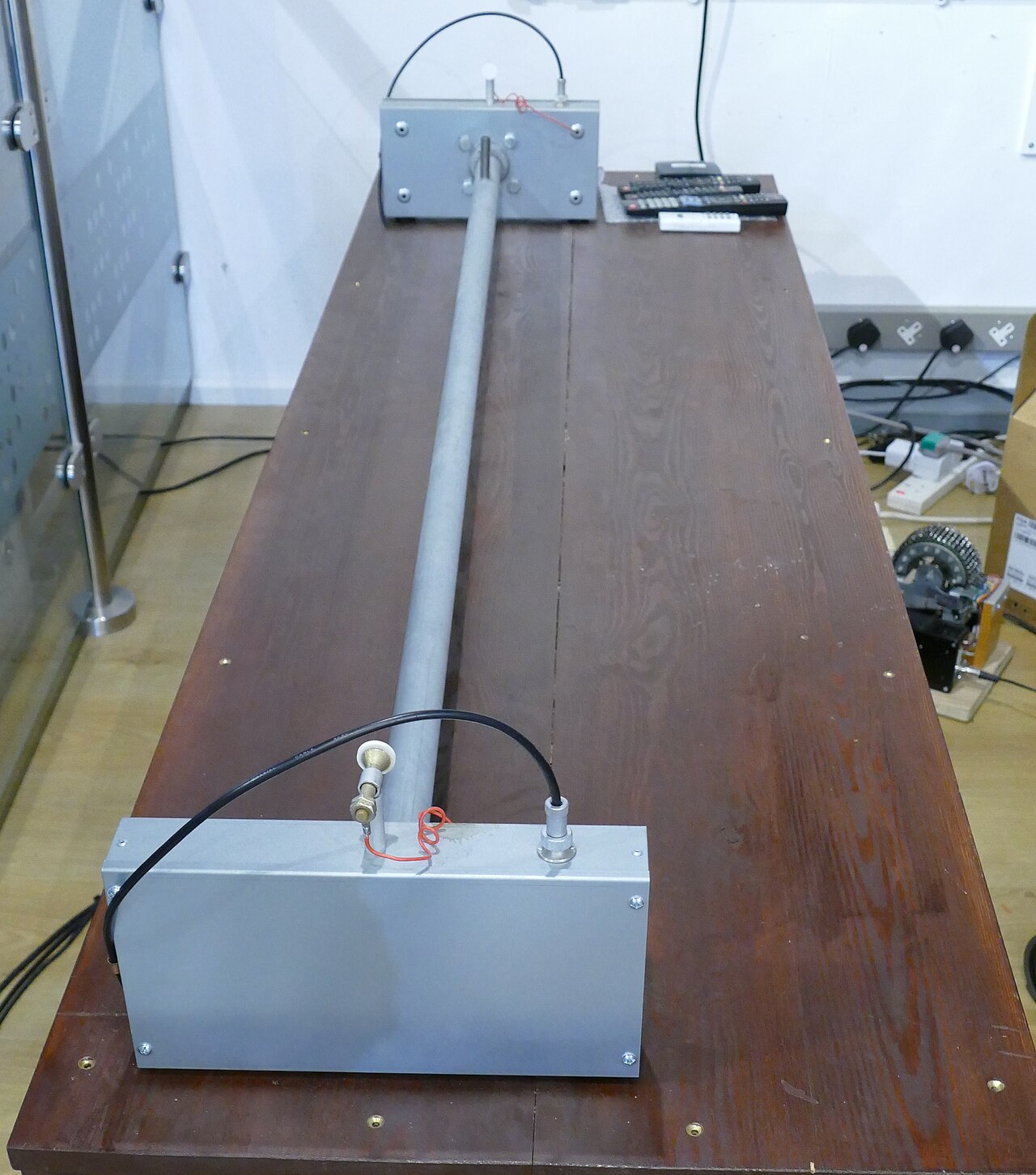
The first answer came from radar. Wartime radar sets used delay lines to compare successive echoes and cancel the stationary “clutter” of hills and buildings: the previous pulse was held back in a column of liquid until the next one arrived. At the Moore School in Philadelphia, J. Presper Eckert had built such a unit with a column of mercury and quartz transducers. For a computer, the same device could hold a stream of bits: a transducer at one end turned electrical pulses into sound, the sound travelled through the mercury at about 1,450 metres per second, a transducer at the other end turned it back into pulses, and electronics amplified, reshaped, and fed them in again. The bits circulated for as long as the power stayed on. Eckert and John Mauchly applied for a patent on 31 October 1947; it was granted in 1953.
The mercury delay line was the memory of the first generation of stored-program computers. EDSAC at Cambridge, which ran its first program on 6 May 1949, used steel tubes about five feet long, each holding 32 words of 17 bits; sixteen tubes gave 512 words. The Pilot ACE at the National Physical Laboratory (first program on 10 May 1950) used long lines of 32 words of 32 bits each, 128 words at first and 352 after expansion. SEAC in Washington (April 1950) held 512 words of 45 bits in 64 lines, and the CSIR Mk1 in Sydney (November 1949) held 768 words of 20 bits. The commercial UNIVAC I kept 1,000 words in seven memory units, each with eighteen columns of mercury holding 120 bits.
The drawbacks followed from the physics. A delay line was serial: a word could be read only when it came round to the end of the tube, so the average wait was half the circulation time, about 222 microseconds on the UNIVAC. Programmers placed instructions and data in the tanks so that each would emerge just when it was needed, a craft that Turing’s ACE design depended on and that vanished with the medium. The speed of sound in mercury depends on temperature, so the tanks had to be kept warm and constant, at about 40 °C. Mercury is heavy, expensive, and toxic. Against all this, delay lines aged well, which is more than could be said of the competition. Later machines and desk calculators used magnetostrictive delay lines, in which torsional waves travelled along coiled steel or nickel wire; the Olivetti Programma 101 of 1965 kept its registers in one.
Williams Tubes
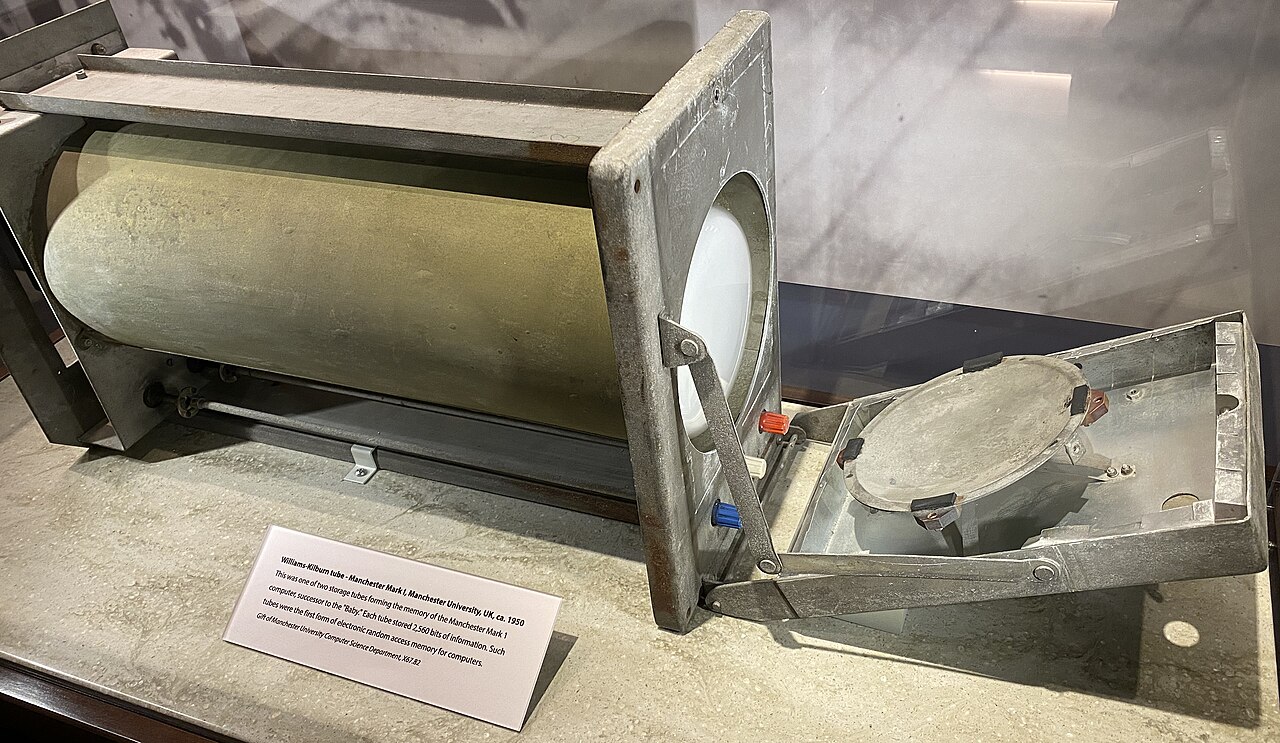
The second answer also came from radar. Freddie Williams and Tom Kilburn had spent the war at the Telecommunications Research Establishment and knew cathode-ray tubes thoroughly. Williams had noticed that the electron beam left a small charge on the screen where it struck, because the beam knocked secondary electrons out of the phosphor, and that the charge could be detected before it leaked away. A dot and a dash left different charge patterns; a pickup plate in front of the screen sensed the difference when the beam returned to the spot. Reading destroyed the bit, so it had to be written again at once, and since the charge faded within a fraction of a second, every spot had to be refreshed continuously, much as DRAM is refreshed today.
The advantage was random access. The beam could be deflected to any spot in microseconds, so the computer did not wait for its data to come round. Williams and Kilburn filed their first British patent application on 11 December 1946 and a second on 2 October 1947, and by December 1947 a tube stored 2,048 bits. To prove that the tube could hold data reliably while a computer used it at full speed, they built the smallest computer that would exercise it: the Manchester Baby, whose main store was one tube of 32 words of 32 bits. On 21 June 1948 it ran a 17-instruction program by Kilburn and became the first computer to execute a program from electronic memory.
The Williams tube became the most widely used random-access memory of the early 1950s. It served in the Ferranti Mark 1, von Neumann’s IAS machine, the SWAC in Los Angeles, the Soviet Strela-1, the Swedish BESK, Japan’s TAC, the UNIVAC 1103, and IBM’s first scientific computer. The IBM 701, announced on 21 May 1952, held 2,048 words of 36 bits in 72 Williams tubes of 1,024 bits each; nineteen were installed.
The tubes were also temperamental. Their behaviour drifted with age, nearby electrical fields disturbed them, and most installations had to be adjusted by hand. A Williams tube memory needed constant maintenance by people who understood it.
The Selectron
The third answer was designed for von Neumann himself. In 1946 the Institute for Advanced Study in Princeton began building its computer, and RCA Laboratories, a few miles away, took on the memory. Vladimir Zworykin, the television pioneer, supervised; the work fell to Jan Rajchman. Born in London in 1911 and trained at ETH Zurich (diploma 1935, doctorate 1938), Rajchman had joined Zworykin’s group at RCA in January 1936 and during the war had worked on the Computron, an electronic arithmetic tube for anti-aircraft fire control.
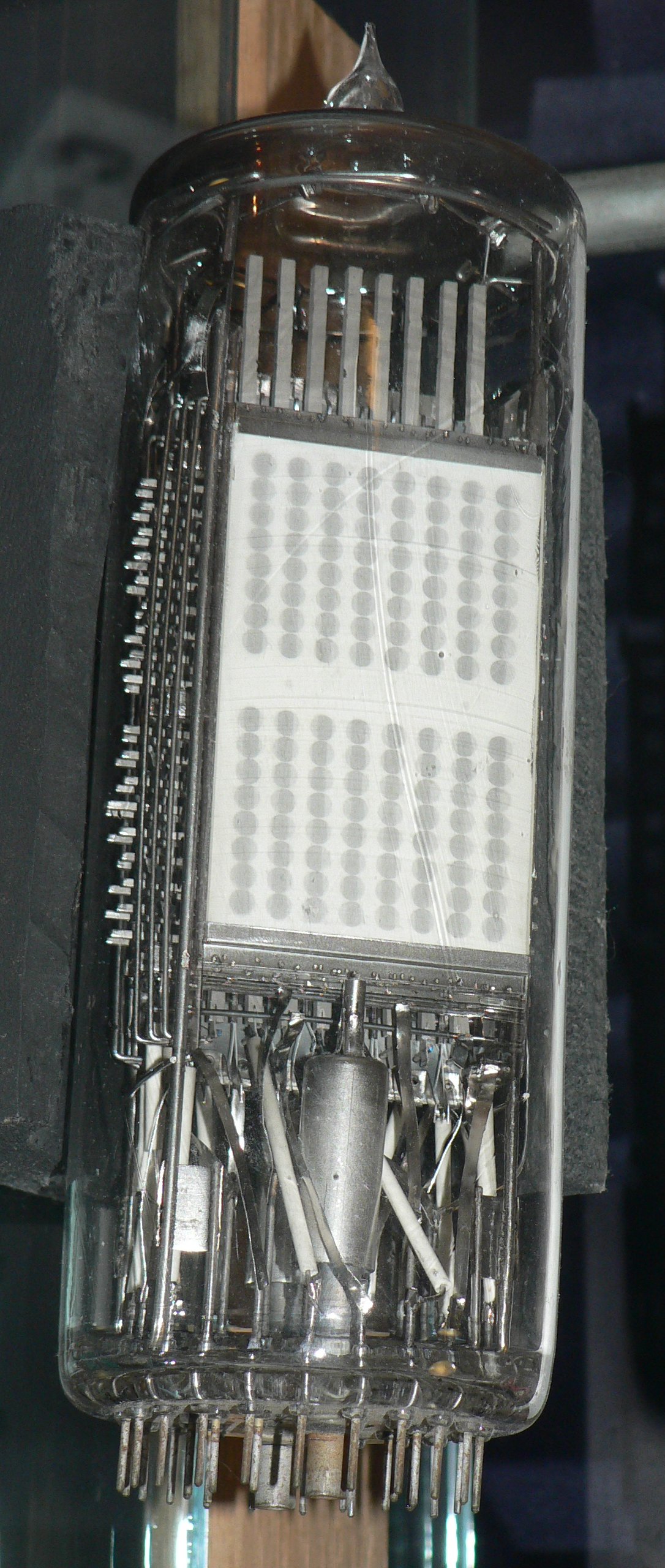
His design, the Selectron (from “selective electrostatic storage tube”), avoided the beam deflection that made Williams tubes fragile. Each bit had its own fixed place: a small area of dielectric behind a grid of crossed control wires. By biasing all but two adjacent wires in each direction negative, the tube let electrons from a central cathode reach exactly one storage location; a pulse on a signal plate wrote a charge there, and a later pulse revealed whether one was present. Between accesses, the electrons kept every stored charge topped up, so the Selectron was in effect static: it held its contents without the external refresh that Williams tubes needed. The original design held 4,096 bits in a tube ten inches long and three inches in diameter. The IAS machine was to use 40 of them, one for each bit of its 40-bit word, giving 4,096 words. RCA planned to produce 200 tubes by the end of 1946.
The tube was much harder to make than expected. By the middle of 1948 it was still not available, and the IAS team, under Julian Bigelow with James Pomerene responsible for the memory, gave up and built the machine around Williams tubes instead: 40 tubes of 1,024 bits, for 1,024 words. The IAS machine was in limited operation in the summer of 1951 and fully operational on 10 June 1952, with a quarter of the memory the Selectron would have given it. Its design was copied, Williams tubes included, by a family of machines from Los Alamos’s MANIAC to Illinois’s ILLIAC.
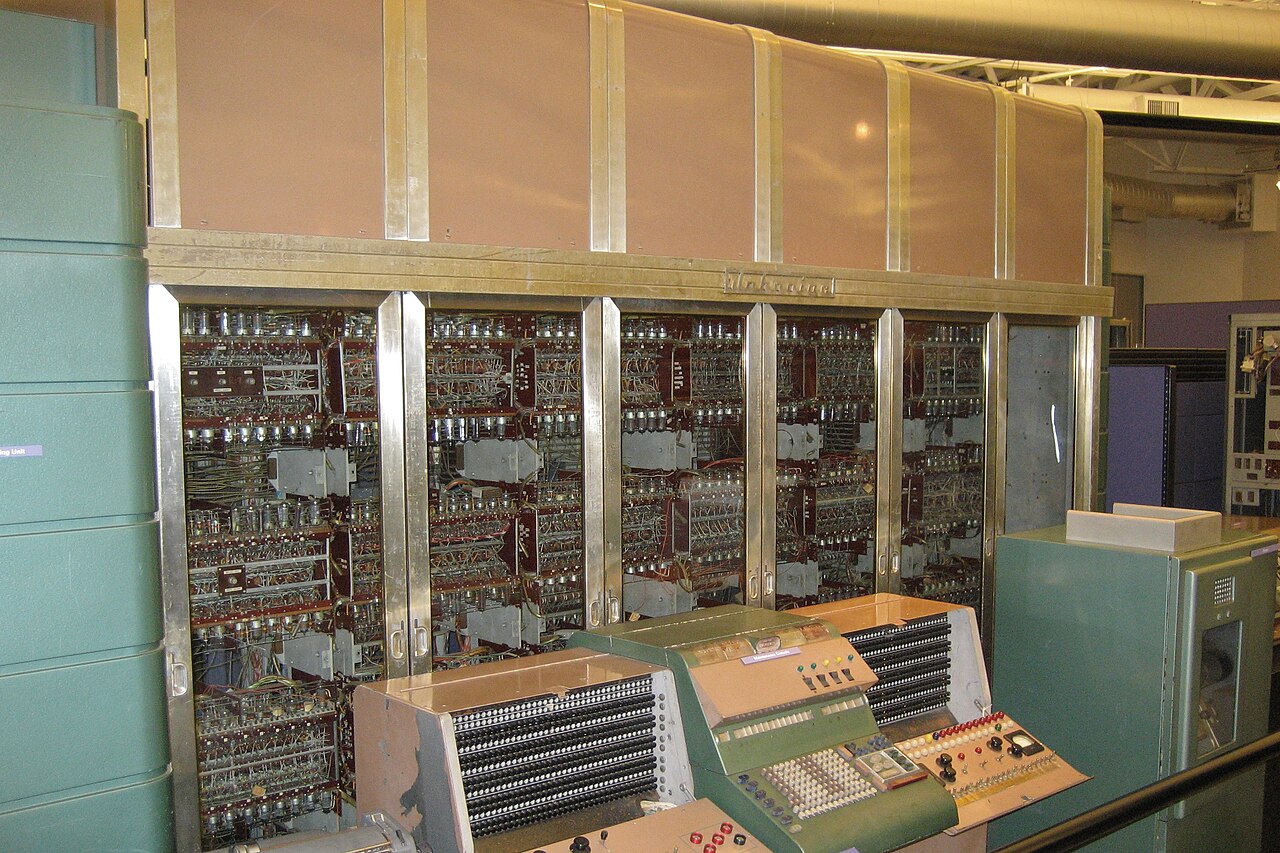
RCA kept going on a smaller scale. A US Air Force contract paid for a 256-bit version, the SB256, a flat array of 128 by 2 bits with visible eyelets. Its one customer was the RAND Corporation in Santa Monica, which was building a copy of the IAS design and named it the JOHNNIAC after von Neumann. RAND placed a sizeable order; Williams later complained that the price had been “remarkably arranged so that the more we bought the higher the unit cost became.” In June 1953 RAND’s John Williams warned that, if life tests on a prototype went badly, the machine might have to go on “a reduced diet” of 256 words (40 tubes) instead of 512 (80). The JOHNNIAC ran on 40 Selectrons, 256 words, for nearly a year. By the accounts of the people who used it, the memory was reliable. RAND had already ordered a magnetic-core memory to replace it, and in March 1955 the Selectrons were retired. RCA moved its tube engineers to colour television.
The Whirlwind Tubes and the Winner
MIT took a fourth path. Whirlwind, Jay Forrester’s real-time computer, used electrostatic storage tubes developed at MIT. Contemporary figures put their cost at $1,000 to $1,500 each; they never reached their planned 1,024 bits per tube (the last generation held 512), their access time was about 30 microseconds instead of the specified six, and they needed constant maintenance. Forrester had started looking for an alternative in 1949, when a notebook entry of 13 June records his first thoughts on storing bits in small rings of magnetic material.
Magnetic-core memory stored each bit as the direction of magnetization in a ferrite ring threaded on a grid of wires, and Forrester’s coincident-current scheme addressed one core among thousands by sending half the switching current along a row and half along a column. In August 1953 core memory went into Whirlwind, cutting the memory access time from about 25 to 9 microseconds, and the storage-tube problems disappeared (see Whirlwind, SAGE, and Core Memory). Rajchman built core memories at RCA in the same years, pressing his first cores on a converted aspirin press, and the patents of An Wang, Forrester, and Rajchman kept lawyers busy for a decade.
Core was random-access like the Williams tube, did not need refreshing, kept its data with the power off, did not drift, and could be made by stringing ferrite beads on wires, which was slow handwork but cheap. IBM offered a core memory for the 701 (the IBM 737) and built its successor, the IBM 704, around core from the start. The JOHNNIAC got its core memory, the UNIVAC 1103A replaced the 1103’s Williams tubes with core, and by the end of the 1950s new computers used nothing else. Magnetic drums, invented in the same years, survived longer as cheaper secondary storage (see The Storage Revolution).
Dead End
The four early memories lost for different reasons. Mercury delay lines were serial, temperature-sensitive, and toxic, but they worked; they lost to anything with random access. Williams tubes had random access but drifted, disturbed their neighbours and needed constant hand-tuning; they lost as soon as something equally fast and more stable appeared. The MIT storage tubes were too expensive and never met their capacity target.
The Selectron was the most carefully engineered of the four and, on the evidence of the JOHNNIAC, the most reliable. It lost on schedule and capacity. In 1946 it promised 4,096 bits per tube; when it was finally delivered, it held 256, and by then its first customer had built its computer around a different technology and core memory was a year away. A complex vacuum tube with hundreds of precisely aligned internal parts could not be made cheaply in volume, and RCA, whose money came from radio and television, had more promising uses for its tube engineers. Rajchman, whose static, individually addressed bits anticipated the organisation of semiconductor memory, went on to work on core memory, and an RCA colleague’s remark preserved in the histories describes what was left of the Selectron afterwards: a project handed to “the mothers-in-law of two deserving employees.”
📚 Sources
- Selectron tube, Wikipedia (RCA development from 1946 at von Neumann’s request, 4,096-bit design, 200 tubes planned for 1946, delay to mid-1948, 256-bit version, JOHNNIAC, color television, “mothers-in-law” remark from Gruenberger 1968)
- Rajchman, Jan A.: US Patent 2,494,670, cylindrical 4,096-bit Selectron, and US Patent 2,604,606, planar 256-bit Selectron
- The RCA Selectron: Background of memories for digital computers (Rajchman, Computron, Zworykin, Sarnoff, static operation)
- The RCA Selectron: The JOHNNIAC Computer at RAND (40 SB256 Selectrons, nearly a year in service, reliable, replaced by core)
- Gruenberger, Fred J.: The History of the JOHNNIAC, RAND Research Memorandum RM-5654-PR, 1968 (John Williams memo of 12 June 1953 on 256 versus 512 words, rising unit price, “mothers-in-law” remark)
- Jan A. Rajchman, Wikipedia (born London 1911, ETH Zurich 1935 and 1938, RCA from January 1936, core memory, 107 patents, awards, death 1989)
- Magnetic-core memory, Wikipedia (Rajchman’s converted aspirin press, Whirlwind access time 25 versus 9 µs)
- JOHNNIAC, Wikipedia (Selectron memory replaced by core in March 1955)
- IAS machine, Wikipedia (40 Selectrons planned, switch to 40 Williams tubes for 1,024 words, limited operation summer 1951, fully operational 10 June 1952)
- Williams tube, Wikipedia (patent dates, secondary emission, refresh, hand-tuning, machines that used it)
- Delay-line memory, Wikipedia (radar origin, Eckert’s mercury line, Eckert–Mauchly patent filed 31 October 1947, 40 °C, UNIVAC I memory layout and 222 µs access, magnetostrictive lines)
- Pilot ACE, Wikipedia (first program 10 May 1950, 128 words of 32 bits, later 352)
- IBM 701, Wikipedia (72 Williams tubes of 1,024 bits, 2,048 words of 36 bits, IBM 737 core option, announced 21 May 1952, 19 installed)
- Whirlwind I, Wikipedia (MIT storage tubes: 1,024-bit goal never reached, 512 bits in the last generation, about 30 µs access)
- Williams tube page, University of Amsterdam Computer Museum (Whirlwind tubes at $1,500 each)
- “1953: Whirlwind computer debuts core memory,” Computer History Museum, The Storage Engine (August 1953)
- Computer History Museum, Revolution: Jay Forrester notebook page (13 June 1949)
- Image: Selectron tube p1270778.jpg by David Monniaux (CC BY-SA 3.0), via Wikimedia Commons
- Image: Williams-Kliburn Tube, Manchester Mark I.agr.jpg by ArnoldReinhold (CC BY-SA 4.0), via Wikimedia Commons
- Image: Johniac (411106583).jpg by Adam Schuster from Orlando, FL, USA (CC BY 2.0), via Wikimedia Commons