Tom DeFanti
Abstract
Tom DeFanti (born 1948) wrote GRASS, a real-time animation language for artists, as a doctoral student of Charles Csuri at Ohio State, and in 1973 took it to Chicago, where he and the video artist Dan Sandin founded the lab that became the Electronic Visualization Laboratory. GRASS drew the Death Star briefing animation in Star Wars (1977); a stripped-down version, ZGRASS, was meant to turn Bally’s home video-game console into a graphics computer before Bally left the business in 1980. The same lab built the first data glove (1977), and in 1992 DeFanti, Sandin and their student Carolina Cruz-Neira showed the CAVE, a room whose walls were stereo projection screens, the main alternative to the head-mounted display for the next two decades. Alongside the hardware, DeFanti chaired ACM SIGGRAPH from 1981 to 1985, started the SIGGRAPH Video Review, co-edited the 1987 NSF report Visualization in Scientific Computing, and spent the 1990s and 2000s building the research networks that fed such rooms with data.
GRASS at Ohio State
Thomas A. DeFanti was born in Queens, New York, on September 18, 1948. He took a mathematics degree at Queens College in 1969 and went to Ohio State for graduate work in computer and information science, finishing a master’s in 1970 and a doctorate in 1973. His adviser was Charles Csuri, the art professor whose Computer Graphics Research Group put artists, designers and programmers in the same rooms on Kinnear Road. DeFanti’s dissertation was a language for them: GRASS, the GRAphics Symbiosis System, described as “a three-dimensional, real-time animation system usable by computer novices.” It ran on a PDP-11/45 driving a Vector General 3DR display, a vector machine that drew lines rather than pixels, and it let a user type a command and watch an object turn, scale or move at once, without waiting for film to come back from a lab.
Circle Graphics Habitat
In 1973 DeFanti joined the computer science faculty at the University of Illinois at Chicago Circle and set up a lab with Dan Sandin, a physicist turned video artist six years his senior. Sandin had just built the Sandin Image Processor (1971 to 1973), a patch-programmable analog computer for manipulating live video, laid out on the model of a Moog synthesizer. They called their lab the Circle Graphics Habitat; it became the Electronic Visualization Laboratory (EVL) in 1982. From 1981 it offered graduate degrees joining computer science and art, the first interdisciplinary art-and-science programme in the United States.
GRASS had outside users almost at once. In 1977 Nola Donato rewrote its control structures as GRASS3. The animator Larry Cuba, with DeFanti’s help, used it to make the computer-graphics briefing sequence in Star Wars (1977), the wireframe Death Star shown to the Rebel pilots before the attack.
The same year DeFanti and Sandin built the Sayre Glove, from an idea by their colleague Richard Sayre, on a National Endowment for the Arts project. Each finger carried a flexible tube with a light source at one end and a photocell at the other; bending the finger pinched the tube and dimmed the light, and the photocell reading gave the angle of the joint. It was the first wired data glove, seven years before VPL Research was founded and began selling its fibre-optic DataGlove.
ZGRASS and the Bally Arcade
Also in 1977, DeFanti was introduced to Jeff Frederiksen, a chip designer at Dave Nutting Associates. Nutting had been contracted by Midway, Bally’s video-game division, to design a standard graphics chip for its arcade machines and for the home console that became the Bally Professional Arcade (later the Astrocade). DeFanti wanted a machine that could run GRASS at the price of a personal computer, and the Bally chip set could be that machine. The project, called the Z-Box, produced ZGRASS, a raster version of the language for the Z80 processor, which first ran on an add-on unit that slid under the Bally Arcade and turned the game console into a programmable graphics computer. DeFanti described it in BYTE in November 1980.
Dead End: The Z-Box
The add-on never reached the mass market. Bally left the home-computer business in 1980 and dropped the Z-Box work, and the electronics went instead into the Datamax UV-1, a small company’s graphics machine with a resolution of 320 by 204 and up to 256 KB of memory, the second unit of which was built early in 1980. Whether the UV-1 was meant as a home computer or a professional graphics tool was never clear, and a ZGRASS-32 version appeared from Astrovision in the mid-1980s. The idea of a cheap home computer whose built-in language was an animation system, rather than BASIC, ended there; the machines that took the home market, the Apple II, the Commodore 64 and the IBM PC, shipped with BASIC and left graphics to whoever could program them.
SIGGRAPH
DeFanti was secretary of ACM SIGGRAPH from 1977 to 1981, chaired its 1979 conference, and was chair of the organisation from 1981 to 1985, years of fast growth for the annual conference. In 1979 he started the SIGGRAPH Video Review, a videotape series that recorded the animations shown at the conference. It collected on tape the computer art and early CGI that the conference’s film and video shows presented each year. ACM gave him its Outstanding Contribution Award in 1988, elected him a Fellow in 1994, and SIGGRAPH gave him its Outstanding Service Award in 2000.
Visualization in Scientific Computing
In 1987 DeFanti, Maxine Brown and Bruce McCormick of Texas A&M edited a report for the National Science Foundation, Visualization in Scientific Computing. It was written for an agency that was then funding supercomputer centres, and it argued for computer graphics as a tool of science in its own right. EVL’s own contribution in this period was the PHSCologram (1988), an autostereoscopic print, made with Sandin and others, that showed a three-dimensional image through a line screen without glasses.
The CAVE
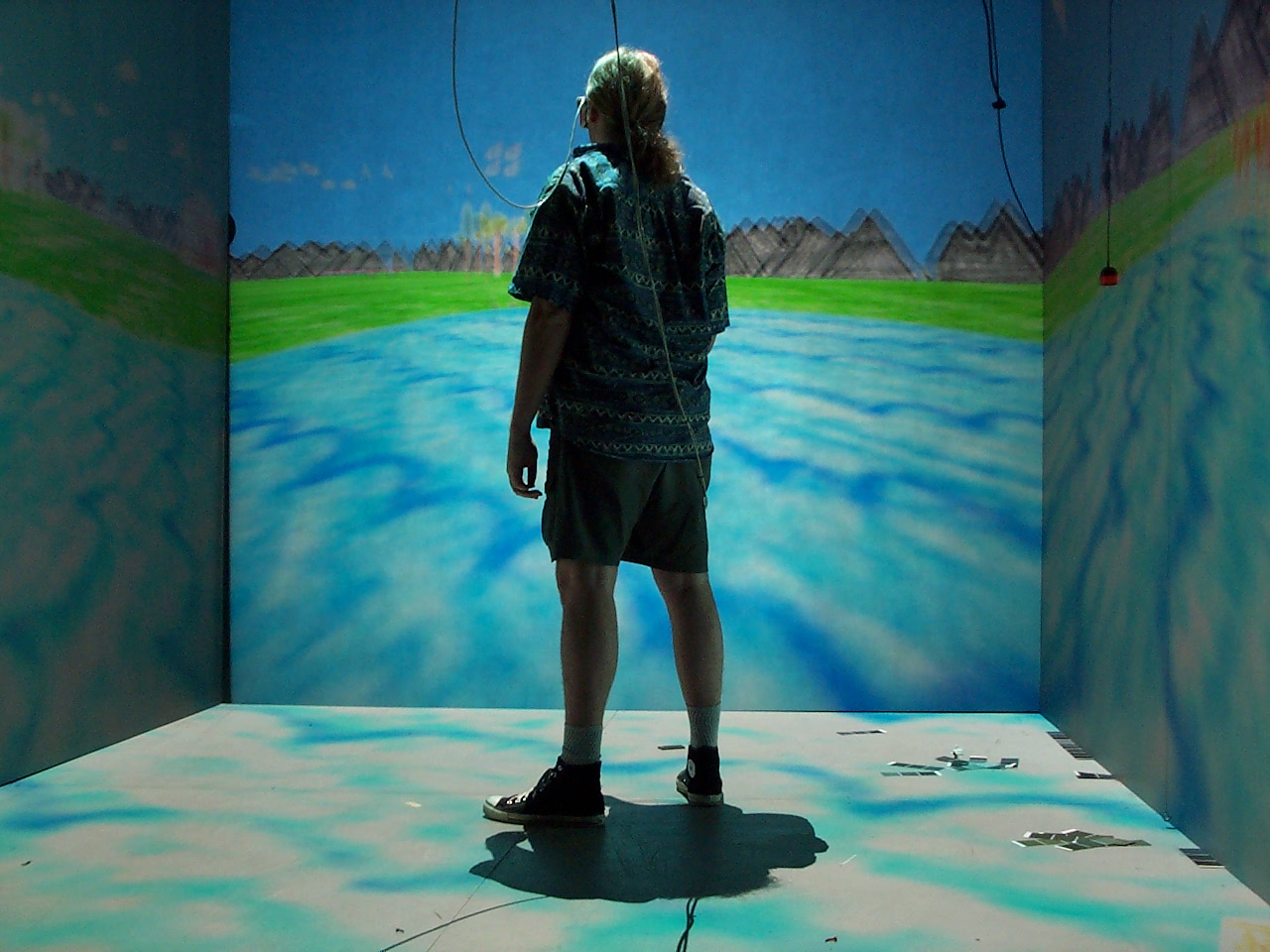
The head-mounted display, from Ivan Sutherland’s 1968 “Sword of Damocles” to VPL’s EyePhone, put a small screen in front of each eye and cut the wearer off from the room and from everyone in it. DeFanti and Sandin wanted the opposite: a room that was itself the display, which several people could stand in and talk in. Their doctoral student Carolina Cruz-Neira built it. The CAVE was a ten-foot cube with three walls of rear-projection screen and a floor lit from above, each surface showing a stereo image that viewers saw in depth through liquid-crystal shutter glasses. An electromagnetic tracker on one viewer’s glasses told the computer where that person’s head was, and the images on every wall were recomputed for that point of view many times a second. The floor was projected at an angle from the front top, so that the user’s shadow fell behind them. The name was a recursive acronym (CAVE Automatic Virtual Environment) and a reference to the cave in Plato’s Republic, where prisoners see only the projected shadows of real things.
It premiered at SIGGRAPH ‘92 in Chicago, in the juried Showcase of work by computational scientists; for the same conference DeFanti led the effort that brought 45 Mbit/s networking to a SIGGRAPH for the first time. The CAVE was shown again at Supercomputing ‘92, and described in full at SIGGRAPH ‘93 by Cruz-Neira, Sandin and DeFanti. Rooms of this kind were later built at universities and research laboratories for engineering, product design and training; EVL’s own successor, CAVE2, opened in October 2012 as a ring of 72 flat stereo panels.
Networks
A CAVE was only as useful as the data that could be sent to it, and from the mid-1990s DeFanti’s work moved towards the networks. At Supercomputing ‘95 in San Diego he and Maxine Brown organised the I-WAY, a temporary high-speed network that linked supercomputers, CAVEs and other displays for more than 60 US research collaborations and one Canadian. In 1997 they started STAR TAP, an interconnection point in Chicago for international research networks, which grew into StarLight, managed by Joe Mambretti at Northwestern University. In March 2005 DeFanti moved to the California Institute for Telecommunications and Information Technology (Calit2) at UC San Diego as a research scientist, where he directed large parts of the NSF’s OptIPuter project, begun in 2002 with $13.5 million, on optical networks built for moving scientific data, and built the StarCAVE, a 34-projector successor to the original room. The IEEE gave him its Virtual Reality Technical Achievement Award in 2007, and he was inducted into the ACM SIGGRAPH Academy in 2026. Sandin and DeFanti directed EVL together from 1973 to 2004; Jason Leigh, Maxine Brown and others have run it since.
📚 Sources
- Thomas A. DeFanti, Wikipedia (birth, degrees, Csuri as adviser, UIC 1973, SIGGRAPH chair 1981–1985, Video Review 1979, ACM Outstanding Contribution Award 1988, SIGGRAPH Outstanding Service Award 2000)
- Tom DeFanti, biography, Electronic Visualization Laboratory (Star Wars with Larry Cuba, the 1987 NSF report with Brown and McCormick, I-WAY at SC'95 with “over 60 US collaborations (and 1 Canadian)”, STAR TAP 1997 and StarLight, Calit2 from March 2005, OptIPuter $13.5M 2002, SIGGRAPH ‘92 as the first with 45 Mb/s networking under his leadership, StarCAVE, ACM Fellow 1994, IEEE VR Technical Achievement Award 2007)
- GRASS (programming language), Wikipedia (PDP-11/45 and Vector General 3DR, GRASS3 by Nola Donato 1977, Frederiksen and the Z-Box, Larry Cuba’s Death Star animation)
- Electronic Visualization Laboratory, Wikipedia (Circle Graphics Habitat renamed 1982, Sayre Glove 1977, CAVE2 October 2012 with 72 displays, directors from 1973)
- Daniel J. Sandin, Wikipedia (Sandin Image Processor 1971–1973, Sayre Glove and its light sensors, PHSColograms 1988)
- Datamax UV-1, Wikipedia (Frederiksen at Dave Nutting Associates, Bally’s 1980 exit, DeFanti’s November 1980 BYTE article, 320 × 204 resolution, ZGRASS-32)
- Cruz-Neira, Carolina, Daniel J. Sandin and Thomas A. DeFanti, “Surround-screen projection-based virtual reality: the design and implementation of the CAVE”, SIGGRAPH ‘93 Proceedings, 1993 (10 × 10 × 10 ft theatre, rear-projected walls and down-projected floor, tracker and shutter glasses, SIGGRAPH ‘92 Showcase and Supercomputing ‘92 debut, the Plato reference)
- Cave automatic virtual environment, Wikipedia (1992, the three inventors, recursive acronym)
- “Astrocade and Its Relation to the UV-1 Computer”, Bally Alley (Datamax as a small company set up to build the UV-1, the second unit manufactured early in 1980, the 320 × 204 chipset)
- “The Bally/Astrocade Expansion”, Lance F. Squire (ZGRASS first ran on an “add-under” unit beneath the Bally Arcade)
- Thomas (Tom) A. DeFanti, ACM SIGGRAPH History Archives (SIGGRAPH Academy 2026, 2023 interview)