John Whitney and Charles Csuri
Abstract
Computer animation has two founding figures who never worked together and came at the machine from opposite ends. John Whitney Sr. (1917–1995), a Pasadena filmmaker who had studied twelve-tone composition in Paris, bought war-surplus anti-aircraft gun directors in the 1950s and rebuilt them into a twelve-foot camera machine that drew the spirals of Hitchcock’s Vertigo (1958) and the demo reel Catalog (1961); in 1966 IBM made him its first artist in residence and he moved to digital film. Charles Csuri (1922–2022), an All-American tackle and Bronze Star veteran who taught painting at Ohio State, drew his first pictures on a mainframe in 1964, made Hummingbird (1967), the ten-minute film the Museum of Modern Art bought the next year as one of the first computer animations, and then built the research group, the NSF-funded lab and the production company (Cranston/Csuri Productions, 1981–1987) that trained a generation of animators for Pixar, Disney and ILM. Whitney gave the field its idea of visual harmony; Csuri gave it an academic home.
The Gun Director
John Hales Whitney was born in Pasadena, California, on April 8, 1917, and studied at Pomona College. His first films were 8 mm records of a lunar eclipse shot through a telescope he built himself. In 1937 he spent a year in Paris studying twelve-tone composition with René Leibowitz, and the music came first for the rest of his life: what he wanted from film was a visual equivalent of harmony, a way for shapes to resolve and modulate the way chords do. Back in California in 1939 he began making abstract films with his younger brother James, and their Five Film Exercises (1940–1945), scored on an electronic instrument of pendulums that John built to write directly onto the optical soundtrack, won a prize for sound at the first International Experimental Film Competition in Belgium in 1949. He received a Guggenheim Fellowship in 1948.
The machine that made him came out of the war. Whitney had worked at Lockheed on high-speed missile photography and had noticed that the fire-control mechanisms of anti-aircraft guns, the M-5 director that aimed a battery at a moving aircraft, computed smooth trajectories with mechanical precision. In the late 1950s he bought one as surplus and rebuilt it, later adding an M-7 mechanism, into a twelve-foot-high rig in which artwork on rotating tables was photographed by a camera that itself moved on several axes under mechanical control, with colour added afterwards in optical printing. It was an analog computer repurposed as a camera, and the earliest form of motion control: a camera whose path is computed and repeatable, the principle Industrial Light & Magic would later build electronically for Star Wars. His son John Jr. described it in Gene Youngblood’s Expanded Cinema (1970).
Motion Graphics
The rig’s first famous product was the title sequence of Alfred Hitchcock’s Vertigo (1958), designed by Saul Bass: the rotating spirals behind the credits are Lissajous curves that Whitney’s converted gun director drew. In 1960 he founded Motion Graphics Incorporated to sell the technique to advertisers and television, and the company kept him too busy to make personal films. The demo reel he cut in 1961 to show clients what the machine could do, spinning text, blooming curves and a final Lissajous figure multiplied into a flower, was released as Catalog and became, William Moritz wrote, “a popular classic of 1960s psychedelica.” One of the effects it demonstrated was slit-scan; someone else built the version used for the stargate sequence of 2001: A Space Odyssey, and Whitney’s own proposal to Kubrick for a computer-generated monolith was turned down. His brother James used the rig to shoot Lapis (1966), multiplying hand-drawn dots into mandalas, and finished in two years what would otherwise have taken seven.
IBM
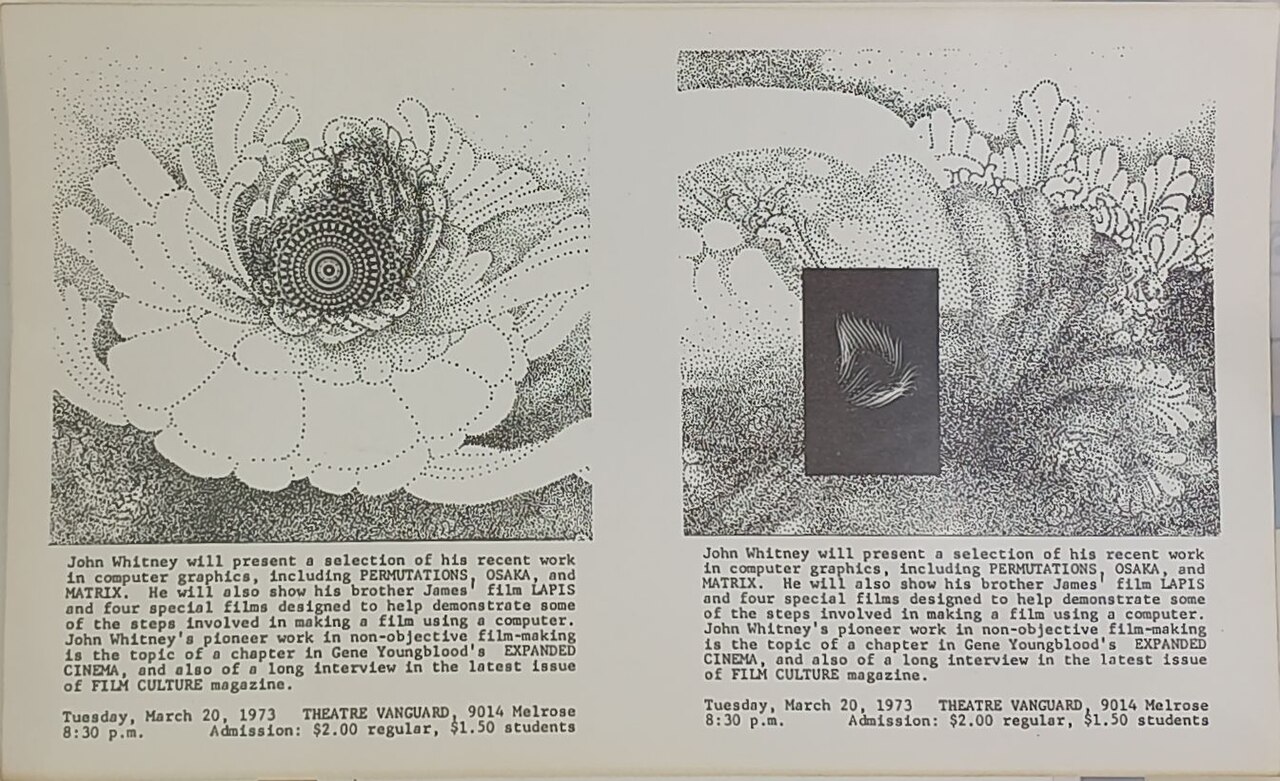
In 1966 IBM awarded Whitney its first artist-in-residence fellowship, and from then until 1969 the programmer Jack Citron wrote code for him on IBM System/360 machines in Los Angeles. His first digital film, Homage to Rameau, takes its name from the composer’s Treatise on Harmony, the book that gave Whitney his programme. Permutations (1968) followed, then Osaka 1-2-3 (1971), the Matrix trilogy (1971–1972) and Arabesque (1975), programmed by Larry Cuba, in which patterns derived from Islamic ornament bloom and dissolve in colour. Each is a demonstration of what Whitney called harmonic progression: points moving under simple periodic functions, phasing in and out of alignment, producing tension and resolution without a story. In 1972 he taught what is described as the first computer-graphics course at UCLA, and the Caltech undergraduate who saw him lecture in 1970 and decided to do this for a living was Gary Demos, whose business partner fifteen years later was Whitney’s son John Jr. The book that set out the theory, Digital Harmony: On the Complementarity of Music and Visual Art, appeared from Byte Books in 1980.
His last decade went into a computer instrument on which one could compose the music and the image at the same time, in real time. The first piece on it, Spirals, appeared in 1987, and the twelve-part Moon Drum (1989–1995), drawn from Native American ceremonial art, was still being extended when he died in Los Angeles on September 22, 1995. The Academy Film Archive holds the Whitney collection and has preserved more than a dozen of the family’s films; the Center for Visual Music’s restorations have since been shown at the Pompidou, the Hirshhorn and the Guggenheim.
The Tackle
Charles Csuri was born in Grant Town, West Virginia, on July 4, 1922, to Hungarian immigrant parents and grew up in Cleveland. He went to Ohio State on a football scholarship, played tackle on the 1942 team that won the university’s first national championship under Paul Brown, and was named All-American and team MVP. The Chicago Cardinals drafted him in 1944; he declined and served in the Army from 1943 to 1946, earning a Bronze Star for heroism at the Battle of the Bulge. He came back to Ohio State, took an MA in art in 1948, joined the faculty of the art department in 1949, and spent the 1950s as a painter, with work in the collections of Roy Lichtenstein and George Segal.
Hummingbird
In 1964 Csuri began drawing with the university’s mainframe, digitising a line drawing and having the computer transform it. Sine Curve Man (1967) maps a portrait onto a sine function; Random War (1967) scatters toy soldiers across a field by random number, assigns each a fate (dead, wounded, missing, survived) and lists the casualties by name, in the year the Vietnam War was at its height. Hummingbird (1967), made with the programmer James Shaffer, is a ten-minute film of a line drawing of a bird that is fragmented, scattered, reassembled and finally erased, computed frame by frame on an IBM mainframe and written to 16 mm film on a microfilm plotter; more than 14,000 frames were generated. The Museum of Modern Art bought it in 1968, at the time of its exhibition The Machine as Seen at the End of the Mechanical Age and of a film programme organised with Ken Knowlton, and it remains one of the earliest computer animations in a museum collection.
Ohio State
The National Science Foundation gave Csuri a grant in 1969 “to study the role of the computer and software for research and education in the visual arts,” and a second in 1971 for real-time film animation. His daughter recalled him saying the grant “sent shockwaves through the university. People thought I was crazy as an artist to be working with computers.” He formalised the Computer Graphics Research Group in 1971, at 1314 Kinnear Road, drawing faculty and students from art, industrial design, photography, cinema, computer science and mathematics. Out of it came the GRASS real-time animation language, written by the graduate student Tom DeFanti in the early 1970s and later the basis of his Electronic Visualization Laboratory in Chicago; Manfred Knemeyer’s ANIMA system (1973); and Richard Parent’s geometric modelling work from 1974. Csuri became a full professor of art education in 1978 and of computer and information science in 1986, and the group was folded in 1987 into the Advanced Computing Center for the Arts and Design, which he founded with Tom Linehan and which still runs; its graduates went to Pixar, Disney Animation, Industrial Light & Magic, Digital Domain and Blue Sky. He also co-founded the Ohio Supercomputer Center, whose graphics project produced apE, an early data-flow scientific-visualisation environment (see The Supercomputer Era).
Dead End: Cranston/Csuri Productions
In 1981 Csuri and the investor Robert Cranston Kanuth founded Cranston/Csuri Productions to sell what the research group had built. Kanuth installed Jim Kristoff as president, six of the researchers (Michael Collery, Wayne Carlson, Bob Marshall, Don Stredney, Ed Tripp and Marc Howard) moved across to rewrite the software for production use, and Julian Gomez rewrote the animation language Twixt. The company and the research group shared a building and were meant to feed each other: the university developed the tools, the company used them. One of its first large clients was ABC News, which commissioned openings for all eleven of its news programmes; over seven years it produced almost 800 animations for more than 400 clients, including CBS, NBC, ESPN, HBO and three Super Bowl openings, at a time when the whole industry consisted of a handful of houses (see The CGI Revolution).
It shut down late in 1987, and Wayne Carlson oversaw the liquidation. Its software ran on refrigerator-sized minicomputers, and the plan to license it collapsed at the moment Silicon Graphics workstations and off-the-shelf packages such as Wavefront made computer animation something any new studio could set up on a desk. The same shift that ended Digital Productions in Los Angeles that year ended Cranston/Csuri in Columbus; the difference was that the Ohio operation had a university behind it, and its people and tools survived inside ACCAD.
Csuri retired as professor emeritus in 1990 and kept making pictures for three more decades, now in three dimensions and colour. He received the Ohio Governor’s Award for the Arts and the university’s Sullivant Medal in 2000 and the ACM SIGGRAPH Award for Lifetime Achievement in Digital Art in 2011. The Smithsonian magazine called him the father of digital art and computer animation. He died in Lakewood Ranch, Florida, on February 27, 2022, at 99, four months short of his hundredth birthday.
📚 Sources
- John Whitney (animator) — Wikipedia (birth and death dates, Leibowitz, Five Film Exercises and the 1949 prize, Guggenheim 1948, Motion Graphics 1960, Catalog 1961, IBM 1966, UCLA 1972, the 1973 Theatre Vanguard programme, the M-5/M-7 machine, the Academy Film Archive)
- William Moritz, “Digital Harmony: The Life of John Whitney, Computer Animation Pioneer,” Animation World Magazine 2.5, August 1997 (Lockheed and the surplus gun directors, Vertigo with Saul Bass, Catalog and slit-scan, the 2001 monolith proposal, Jack Citron and the IBM 360, Homage to Rameau, the film list, Larry Cuba on Arabesque, Spirals 1987, Moon Drum)
- Vertigo (film) — Wikipedia (the title spirals drawn with a converted anti-aircraft gun director)
- James Whitney (filmmaker) — Wikipedia (Lapis 1966, two years instead of seven)
- Charles Csuri — Wikipedia (life dates, football, Army 1943–1946 and the Bronze Star, MA 1948 and faculty 1949, first digital works 1964, Hummingbird with James Shaffer, the 1971–1987 centres, professorships, death February 27, 2022)
- In memoriam: Charles Csuri — Ohio State News, March 2022 (Hungarian parents, Paul Brown, Random War, the NSF “shockwaves” quote, Lichtenstein and Segal, the 2000 and 2011 awards, ACCAD alumni)
- ACCAD History — Advanced Computing Center for the Arts and Design, Ohio State (the 1969 and 1971 NSF grants, CGRG formally established 1971 at Kinnear Road, GRASS, ANIMA, Parent, Cranston/Csuri’s 800 projects for 400 clients, ABC News, Super Bowls, the 1987 liquidation, apE, ACCAD’s founding with Tom Linehan)
- Cranston/Csuri Productions — Wikipedia (founded 1981 with Robert Cranston Kanuth, Kristoff and the six researchers, Twixt, the minicomputer-to-workstation shift, closure late 1987)
- Hummingbird — charlescsuri.com (the 1968 MoMA purchase, the Knowlton programme and the Machine exhibition)
- Charles Csuri’s Hummingbird — MoMA
- Oral history interview with Charles A. Csuri — Charles Babbage Institute