Triple-I: Information International
Abstract
Information International, Inc., known as Triple-I or III, was founded by Edward Fredkin in 1962 to read scientific data off film, and spent the next four decades converting between pictures and numbers in both directions. It built programmable film readers for oceanographers and radar labs, subcontracted the implementation of LISP 2, sold the FR-80 film recorder that became the publishing trade’s standard for writing digital pages onto film, ran the Motion Pictures Product Group that put computer imagery into Westworld, Futureworld and TRON, and in 1982 paginated the first newspaper produced as full electronic pages. Most of its one-off ventures sold one or two systems. The prepress business kept it alive until PostScript made its proprietary imagers ordinary; it merged with Autologic in 1996, and Agfa bought the combined company in 2001 for about $42 million.
A Film Reader for Woods Hole
Fredkin and his friend Roland Silver left Bolt Beranek and Newman together, planning at first to move to Brazil; when that fell through, Fredkin started the company in Maynard, Massachusetts, the mill town where DEC had its headquarters, with consulting work for DEC. By Fredkin’s account he and Silver soon went separate ways because together they got nothing done. Most accounts give 1962 as the founding year; Stephen Wolfram’s memoir of Fredkin, written from Fredkin’s own papers, gives 1961. The company had no clients and no product, and its founder had no degree.
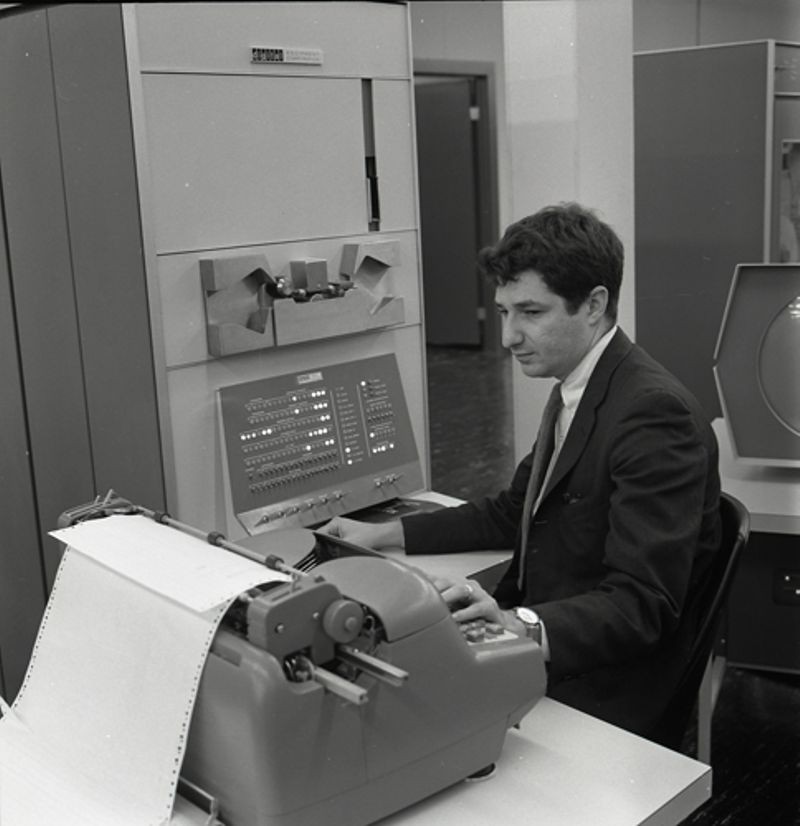
The first real job came from the Woods Hole Oceanographic Institution. Its current meters recorded the speed and direction of deep-ocean currents as dots of light on 16 mm film, and nobody had a way to get those dots into a computer. “At Woods Hole,” Fredkin recalled, “they had these meters which would measure how fast the ocean current was going and which way, and recorded it on 16 mm film.” He rented a projector, put a photomultiplier tube where the screen would be, connected it to a computer and patented the result as high-speed film reading. The Air Force, through Lincoln Laboratory, had the same problem with film records of radar tracks of missiles and paid $350,000 for equipment to read them. Programmable film readers at around $500,000 each became the business. By 1964 Fredkin reported a gross volume “in the neighborhood of $1 million”, spread over four divisions, with Marvin Minsky and John McCarthy on the board as consultants (see Marvin Minsky and the MIT AI Lab).
Fredkin intended to build computers as well, and persuaded Ben Gurley, who had designed DEC’s PDP-1, to join him. On 7 November 1963 Gurley was shot dead through the dining-room window of his home in Concord. Wolfram’s memoir concludes that the murder turned the company toward film readers rather than computers; it stayed with film and imaging.
LISP 2
The Minsky and McCarthy connection brought in a software contract that had nothing to do with film. LISP 2 was planned as the successor to LISP 1.5, with LISP semantics and ALGOL-like syntax. After design conferences at MIT and Stanford in 1963 and 1964, the implementation went to the System Development Corporation in Santa Monica, which had the AN/FSQ-32 time-sharing machine and systems programmers but no LISP experience, and SDC subcontracted Triple-I for the LISP people. Michael Levin, Lowell Hawkinson, Robert Saunders and Paul Abrahams came from Triple-I. Hawkinson, who joined in April 1965 at 22, effectively ran the implementation: “Though I was the most junior person involved, I effectively led the LISP 2 implementation effort because of my LISP and compiler building experience.” Someone at Triple-I typed up a promotional flyer that asked, “Are your symbols coming out of your machine with bits missing and frayed at the decrement?” and signed it “Bottled in bond by Information International, Inc.”
A fairly complete system ran on the Q-32 by the autumn of 1966, but it did not fit in the machine’s roughly 48,000 words of memory, the planned ports to the IBM 360/67 and the PDP-6 were never carried out, and the project stopped in 1967. McCarthy’s verdict was that it “proved more expensive than expected, the collaboration proved more difficult than expected, and so LISP 2 was dropped.” The AI laboratories stayed with LISP 1.5 dialects on the PDP-6 and PDP-10 (see The Lisp Machine Era).
The FR-80
Triple-I filed with the Securities and Exchange Commission on 26 November 1968, listing the programmable film reader as its principal product, and went public on 8 January 1969. Fredkin held 57.7 percent of the shares. He had given up the chief executive’s job in 1965 and joined the MIT faculty in 1968. The company moved to Southern California, first to Santa Monica, later to Culver City and Los Angeles.
The product that paid for everything else was the reverse of a film reader. The FR-80 film recorder, introduced in 1968, drew on film with a precision cathode-ray tube addressing a raster of 16,384 by 16,384 points, “more than one quarter billion addressable points,” in the words of the brochure. It wrote text at up to 10,000 characters a second, 40,000 with options, onto microfiche, 16 and 35 mm film or full-size film. Customers used it for computer output microfilm, stock charts, seismic sections for oil exploration and engineering drawings, and printers used its film to make plates. For a period the Triple-I CRT recorders were the publishing trade’s standard for getting digital pages onto film (see The History of Printing).
The company also built things it sold once or twice. It made CRT displays for the Stanford AI Lab. Its optical character recognition group combined the film scanners, a custom binary image processor and a PDP-10 and worked on the problem for more than ten years. It sold two systems: one around 1974 that reworked US Navy aircraft maintenance manuals by scanning pages, capturing the diagrams and reading the text, and one in 1976 to the British Department of Health and Social Security that read handwritten benefit forms. The OCR work left nothing lasting, except that it put PDP-10s and image-processing people in the building.
The Motion Pictures Product Group
Michael Crichton wanted the android gunslinger in Westworld to see the world as a computer would. The Jet Propulsion Laboratory quoted nine months and $200,000 for two minutes. John Whitney Sr. sent him to his son, John Whitney Jr., who worked with Gary Demos on Triple-I’s equipment at night. They colour-separated each 70 mm frame, scanned the separations into rectangular blocks and recoloured them by tone: about two and a half minutes of pixelated point-of-view in the 1973 film, generally counted as the first digital image processing in a feature.
In 1974 the two talked Triple-I into forming a Motion Pictures Product Group, with Art Durinski, Tom McMahon and Karol Brandt. It marketed its work as “Digital Scene Simulation.” Jim Blinn and Frank Crow wrote the rendering software, TRANEW; Craig Reynolds brought ASAS, a LISP-based animation language he had started at MIT’s Architecture Machine Group; Larry Malone wrote modelling software for the Tektronix 4014; McMahon built a 1,000-line RGB frame buffer. For Futureworld (1976) the group scanned and animated Peter Fonda’s head, the first three-dimensional computer graphics in a feature film. The computer artist David Em spent eighteen months of nights at Triple-I around 1976 learning the systems. From 1978 the group worked on the Foonly F1, a PDP-10-compatible machine of about 4.5 MIPS designed by Dave Poole, with Triple-I as sponsor and first customer.
Richard Taylor came over from Robert Abel and Associates as creative director. He directed the demonstration short Adam Powers, the Juggler, and the group did effects for Looker (1981), tests for Close Encounters, Star Wars, The Black Hole and The Empire Strikes Back, and station logos for ABC and KCET. For Disney’s TRON (1982), Triple-I was one of four graphics firms, with MAGI, Robert Abel and Associates and Digital Effects, that together produced fifteen to twenty minutes of computer animation; Triple-I’s share included the Master Control Program, the Solar Sailer and Sark’s carrier. Whitney and Demos, in dispute with management over how much computing power the business needed, left before the film was finished to found Digital Productions, and MAGI took over part of Triple-I’s contract (see TRON and the Academy). In 1982 Triple-I shut the group down. The Foonly went to Omnibus in Toronto, which later bought Digital Productions and collapsed with it (see Dead End: Omnibus Computer Graphics and The CGI Revolution).
Pages Without Paste-Up
The FR-80 lineage went into document production. Triple-I’s Automated Illustrated Documentation System produced technical manuals for the aerospace industry, and the output devices were adopted by Time and Newsweek. In 1982 the Pasadena Star-News became the first newspaper to produce full pages electronically on a Triple-I system, instead of pasting type and pictures onto boards by hand. The product was renamed NPS, the Newspaper Publishing System, and The Wall Street Journal adapted it for an early computer-to-plate process. The pioneer customer did not stay: in April 1990 the Los Angeles Business Journal reported that the Star-News was dropping the “once-heralded” system.
Dead End
Triple-I’s advantage was hardware precision in a proprietary format. From the late 1980s page output standardised on PostScript, and any imagesetter that spoke it could compete; Triple-I moved its 3850 Grafix imagers to PostScript, but margins shrank with the change (see The Desktop Publishing Revolution). The early-1990s recession forced staff cuts in 1992. In July 1995, under chief executive Charles Ying, it agreed to merge with Autologic, the prepress subsidiary of Volt Information Sciences; the merger closed in January 1996 in a transaction valued at about $35 million, with Volt holding around 59 percent of the new Autologic Information International. The two companies together had 1995 revenues of about $104 million, and operations were consolidated at Autologic’s headquarters in Thousand Oaks.
On 26 September 2001 Agfa-Gevaert announced a cash offer of $7.127 a share, about $42.5 million in all, for a company that then had some 370 employees and $81 million in annual sales. The offer expired on 29 November 2001 with 97.8 percent of the shares tendered, and the remainder was merged out. The film reader company from Maynard ended as part of a Belgian photographic firm’s prepress division.
📚 Sources
- Information International, Inc. — Wikipedia — the 1962 founding in Maynard and the moves to Santa Monica, Culver City and Los Angeles; the FR-80 of 1968 at 16384×16384; the Stanford AI Lab displays; the OCR group, the Navy system of about 1974 and the DHSS system of 1976; the Motion Pictures Product Group 1974–1982, Futureworld, Adam Powers, Looker, the TRON elements and MAGI taking over work; TRANEW, ASAS, Malone and McMahon; David Em’s eighteen months; AIDS, Time and Newsweek, the 1982 Pasadena Star-News pagination, NPS and the Wall Street Journal computer-to-plate system; the 1996 Autologic merger and 2001 Agfa purchase; the Los Angeles Business Journal headline of 2 April 1990 on the Star-News dropping the system (cited there; the article itself was not fetched)
- Stephen Wolfram, “Remembering the Improbable Life of Ed Fredkin (1934–2023) and His World of Ideas and Stories”, 22 August 2023 — Fredkin and Roland Silver leaving BBN and the founding (dated 1961 there), the murder as the turn away from building computers, Fredkin’s Woods Hole quote and the film-reading patent, the radar-film work, the 1964 volume of about $1 million and four divisions, Minsky and McCarthy as board consultants, the SEC filing of 26 November 1968, the 8 January 1969 public offering and 57.7 percent stake, Fredkin stepping down as CEO in 1965, Ben Gurley’s recruitment and his murder on 7 November 1963
- Robert Wright, “Did the Universe Just Happen?”, The Atlantic, April 1988 — the rented projector and photomultiplier, the $350,000 Air Force contract via Lincoln Laboratory and the $500,000 film readers
- Paul McJones, “The LISP 2 Project” (draft, 28 April 2016) — the 1963–64 design conferences, SDC’s subcontract to III, the III team (Levin, Hawkinson, Saunders, Abrahams), Hawkinson’s April 1965 arrival and quote, the “Bottled in bond” flyer, the Q-32 system of autumn 1966 and its 48K-word limit, termination in 1967, and McCarthy’s 1978 retrospective quote
- Wayne Carlson, “Information International Inc (Triple-I)”, Ohio State University (archived 2006) — the group’s founding in 1974 by Whitney and Demos with Durinski, McMahon and Brandt; “Digital Scene Simulation”; spots for Mercedes, ABC and KCET; Richard Taylor from Abel, Adam Powers and the TRON elements; tests for Close Encounters, Star Wars, The Black Hole and The Empire Strikes Back; the dispute over computing power and the departure to Digital Productions; MAGI taking up the contract
- Westworld (film) — Wikipedia — Crichton’s JPL quote of nine months and $200,000, Whitney Sr.’s referral, the colour-separation process and about 2 minutes 31 seconds of processed footage
- FR 80 Graphic Film Recorder brochure — Chilton Computing — the 16,384 by 16,384 raster, “more than one quarter billion addressable points,” 10,000 and 40,000 characters per second, and the application examples
- Tron — Wikipedia — the four computer graphics firms (Triple-I, MAGI, Robert Abel and Associates, Digital Effects) and the fifteen to twenty minutes of computer animation
- Foonly — Wikipedia — the F1 designed by Dave Poole with Triple-I as first customer, operating from 1978 at 4.5 MIPS, its use on TRON and Looker, and its later sale to Omnibus
- History of Autologic Information International, Inc. — FundingUniverse — III’s CRT typesetters and scanners, facsimile and display-ad workstations, the move of the 3850 Grafix imagers to PostScript, the 1992 staff cuts, Charles Ying as CEO, the July 1995 agreement, Volt’s roughly 59 percent, the $35 million value and $104 million combined revenue, consolidation at Thousand Oaks
- Agfa announcement of the Autologic acquisition, Form SC TO-C, 26 September 2001 (SEC) — $7.127 a share, about $42,458,000, some 370 employees and fiscal 2000 sales of $81 million, Volt as majority holder
- Autologic Information International, Form SC TO-T/A, December 2001 (SEC) — expiry of the offer at midnight on 29 November 2001, 5,660,541 shares or about 97.8 percent tendered, and the short-form merger