Yu Suzuki
Abstract
Yu Suzuki joined Sega in 1983 as a programmer with a university thesis on 3D graphics in games, and spent the next decade getting arcade hardware to do what the thesis described. His motorbike and driving games Hang-On (1985) and Out Run (1986) faked depth with scaled sprites; Virtua Racing (1992) and Virtua Fighter (1993) ran real polygons on the Model 1 board his team built, and Sony’s executives later said Virtua Fighter settled the question of whether the PlayStation should be a 3D machine. Shenmue (1999), an open-world Dreamcast game with weather taken from 1986 meteorological records, cost around $47 million by his own account, sold 1.2 million copies and lost money. Sixteen years later its fans paid $6.3 million on Kickstarter for a third part.
From Kamaishi to Sega
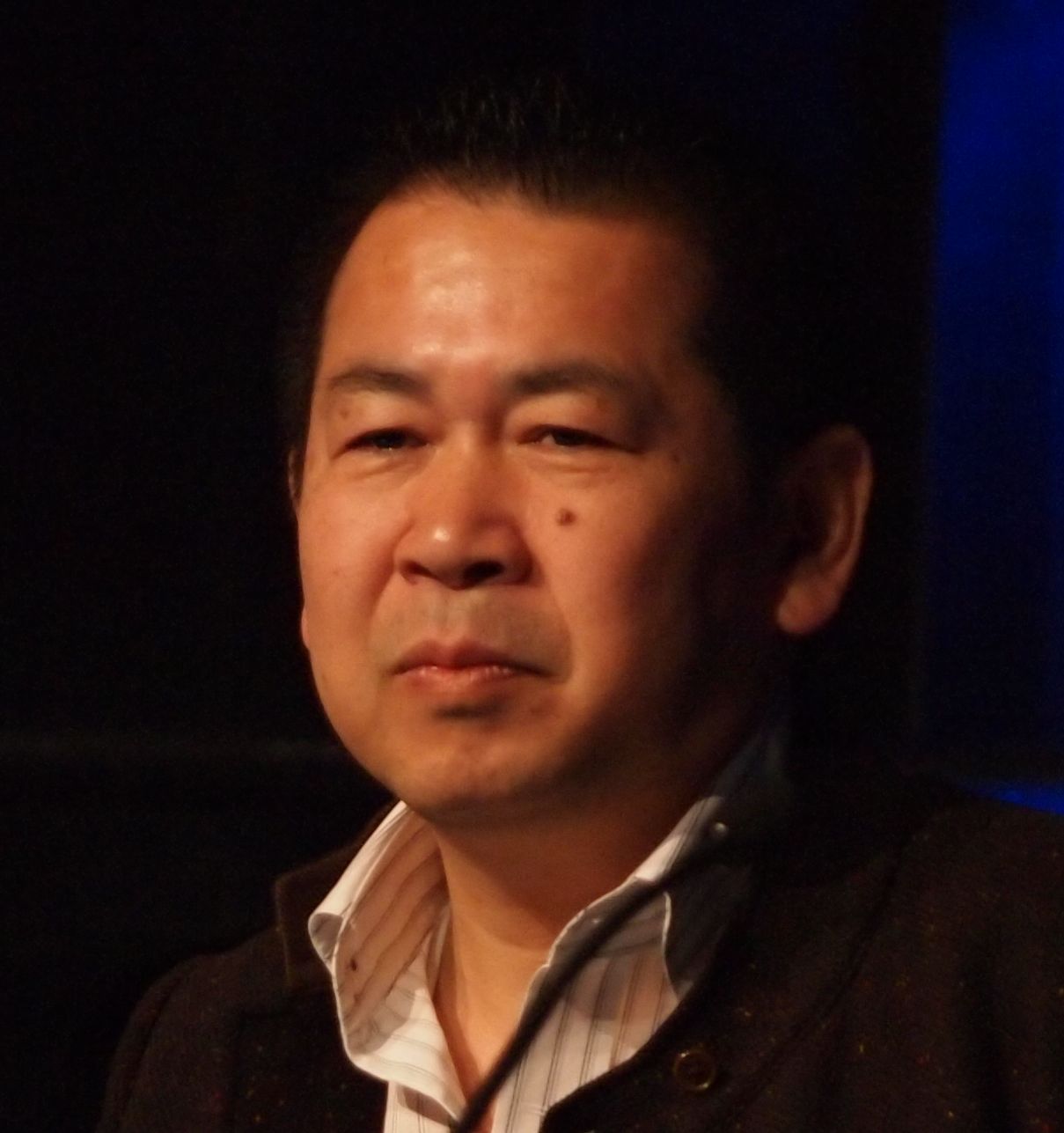
Yu Suzuki was born on June 10, 1958, in Kamaishi, Iwate Prefecture. At the Okayama University of Science he wrote his undergraduate thesis on 3D computer graphics in video games, at a time when arcade games were flat grids of sprites. He joined Sega in 1983 as a programmer.
His first project was Champion Boxing (1984) for the SG-1000, Sega’s first home console. By Suzuki’s account the executives liked it enough to put it in arcades by the simplest route available: they built an SG-1000 into an arcade cabinet.
Hang-On
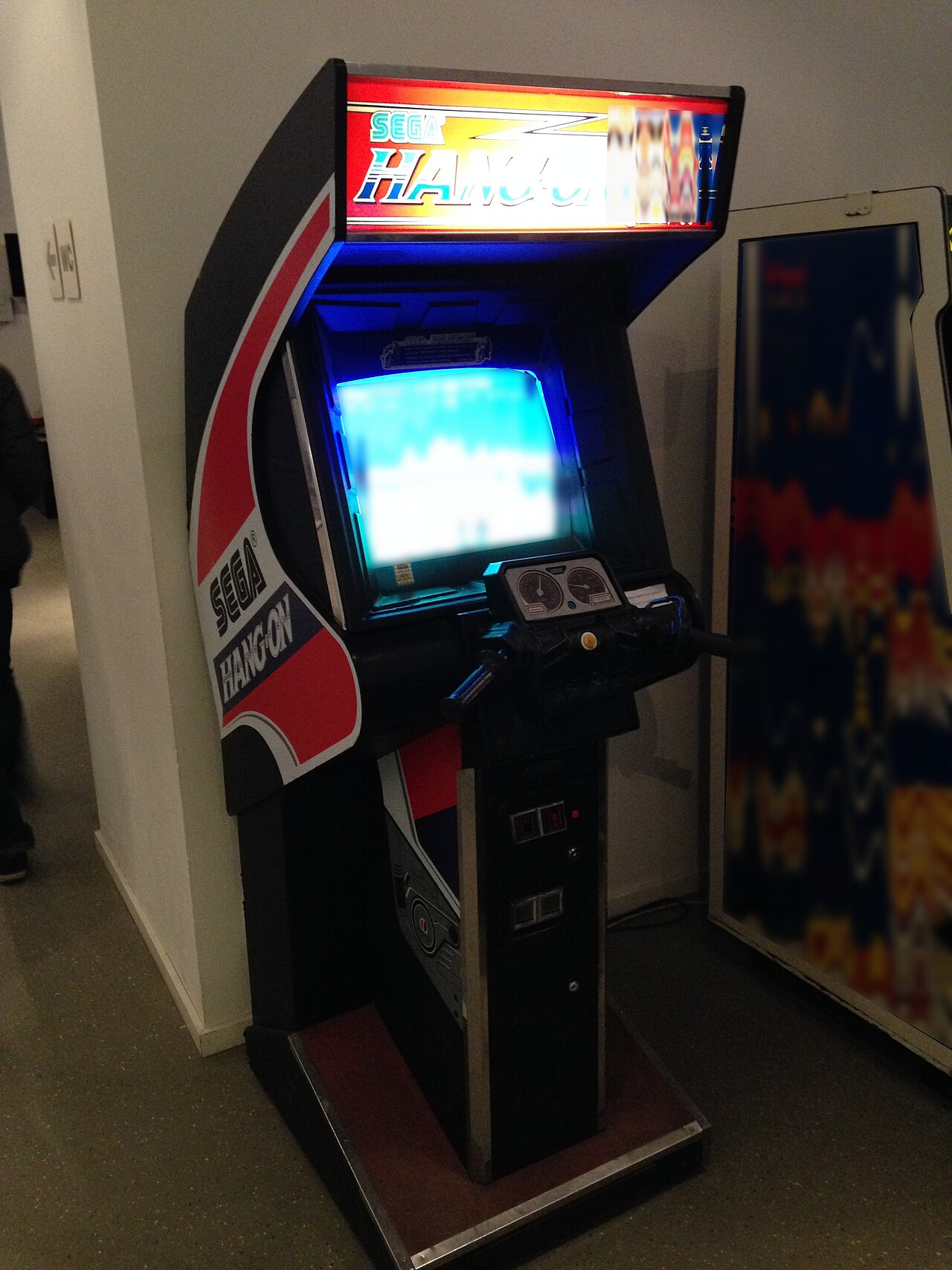
The next assignment began with a part, not a game: Suzuki was asked to build a torsion bar into an arcade machine, and he decided it should be a motorcycle. Hang-On came out in July 1985. The deluxe cabinet was a replica bike that the player steered by leaning, and the title came from the cornering style of the American racer Freddie Spencer (“he rode a Honda bike, and I loved the way he hung on!”).
Suzuki had wanted the game in full 3D. The hardware of 1985 could not draw polygons fast enough, so the team built the Super Scaler board, which stretched and shrank 2D sprites in real time to suggest a road running into the distance. Hang-On was the highest-grossing arcade video game in the United States in 1985 and in both Japan and the US in 1986. Sega sold about 20,000 cabinets; counterfeiters built another 20,000 to 30,000. Later the same year Suzuki used the same technique for Space Harrier, a third-person shooter flying into the screen.
Out Run
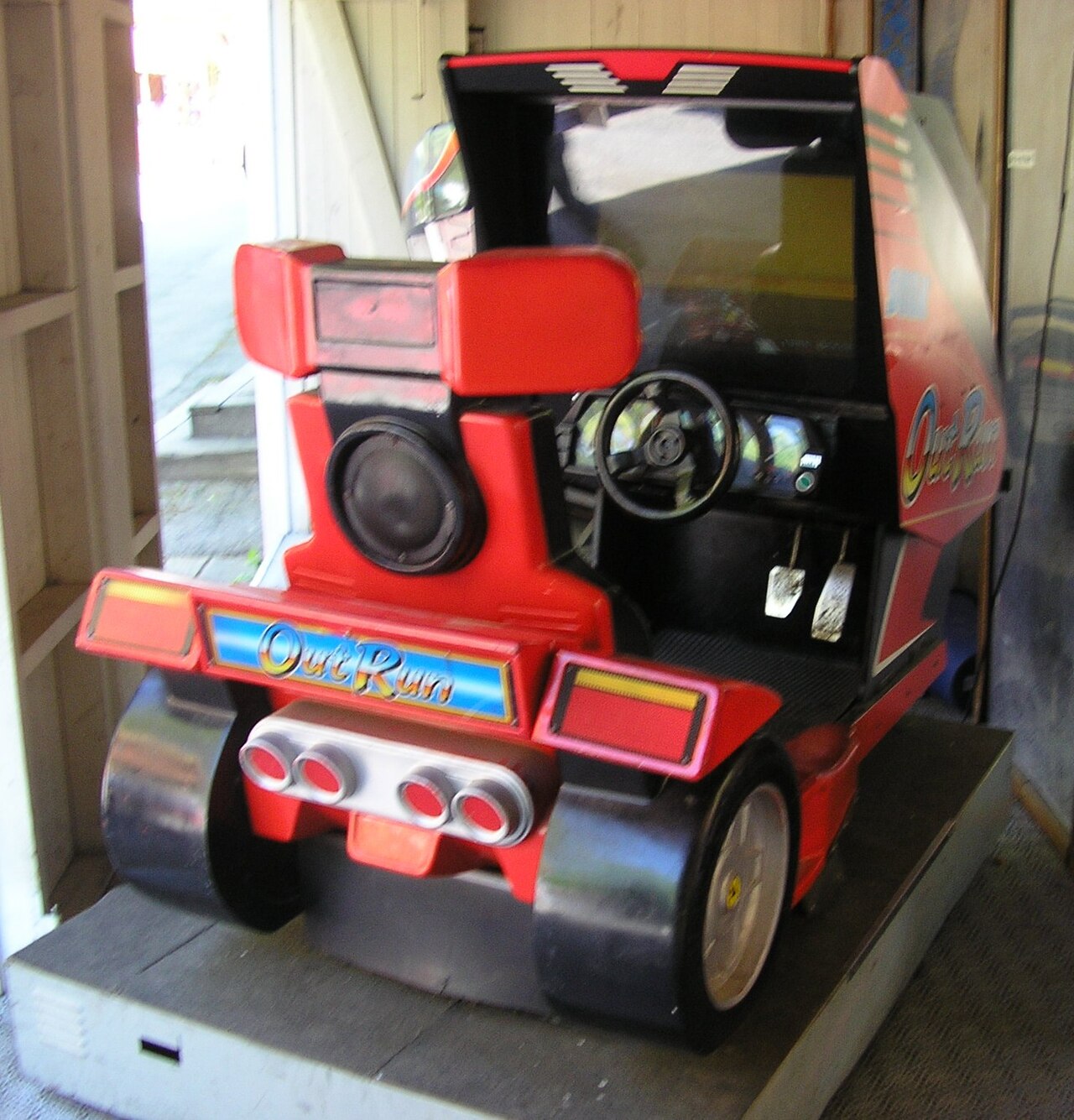
For his driving game Suzuki went location scouting. He spent two weeks driving through Europe (Frankfurt, the Swiss Alps, Monaco, the Riviera, Milan, Florence, Rome) in a BMW 520, and after Monaco he settled on the car the player would drive: a Ferrari Testarossa. Out Run reached Japanese arcades in September 1986. The player drove a convertible toward one of five endings, chosen by taking forks in the road, while picking one of three tracks on the car radio (“Passing Breeze”, “Splash Wave”, “Magical Sound Shower”).
Sega offered four cabinets, two upright and two sit-down models whose motors moved the seat with the action on screen. The game ran on Sega’s OutRun board, again with the Super Scaler technique, and Suzuki later insisted the fakery went deeper than it looked: “All the calculations in the system were 3D, even from Hang-On.” Only the drawing was 2D. About 20,000 cabinets were sold by late 1987 and 30,000 by 1994; the home ports sold in the millions. After Burner (1987) applied the method to a fighter jet.
Model 1 and Model 2
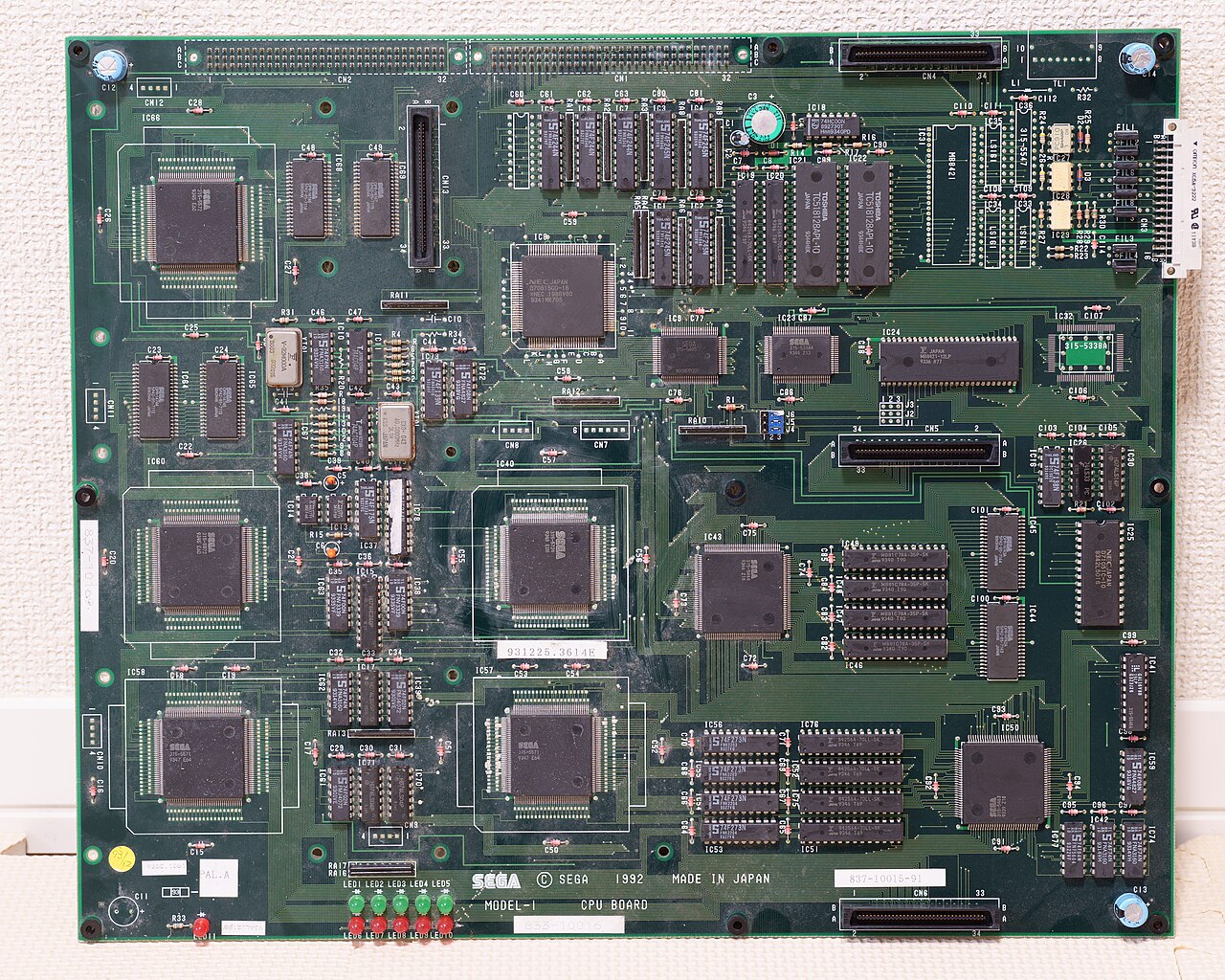
By the early 1990s Suzuki led AM2, Sega’s arcade research and development division, and the hardware had caught up with the thesis. The Model 1 board, developed under his lead, debuted in 1992 with Virtua Racing. It drew about 180,000 polygons per second, or 6,500 per frame.
For the successor Sega went to the flight-simulator business. Starting in September 1992 it developed the Model 2 with GE Aerospace, whose image generators trained military pilots. The board added texture mapping with filtering and anti-aliasing, used an Intel i960 RISC processor, and rendered about 300,000 textured polygons per second at 60 frames per second. Its flagship was Daytona USA (1994). Sega had sold more than 130,000 Model 2 systems by 1996.
Virtua Fighter
Virtua Fighter reached Japanese arcades on December 6, 1993, on Model 1. It was the first arcade fighting game built entirely from 3D polygons: fighters in blocky bodies, each with a real martial art (Bajiquan for Akira, Jeet Kune Do, professional wrestling) and moves recorded with motion capture. Suzuki described getting the 3D division fast enough for real-time rendering as work “equivalent to inscribing 100 words on a single grain of rice.” The Sega Saturn port sold 1,067,036 copies in Japan alone, counting the Remix edition.
At Sony, meanwhile, engineers were deciding what the PlayStation should be. At a Tokyo event in 2012, two former Sony Computer Entertainment executives described the debate. “What if we make the PlayStation using 2-D hardware? Such an idea was seriously considered,” said producer Ryoji Akagawa. “If it wasn’t for Virtua Fighter, the PlayStation probably would have had a completely different hardware concept.” Shigeo Maruyama, the company’s former chairman, said that once the game was out, “the direction of the PlayStation became instantly clear,” and added: “With great timing, Sega saved our hides.” The Saturn, launched with that same Virtua Fighter, sold fewer than ten million units; the PlayStation sold more than a hundred million (see The Video Game Console Wars).
Shenmue
In 1995 Suzuki started a role-playing game on the Saturn with a prototype called “The Old Man and the Peach Tree”. It became Virtua Fighter RPG: Akira’s Story. When Sega dropped a planned graphics add-on for the Saturn, the project moved to the Dreamcast, lost its Virtua Fighter connection, and was renamed “Project Berkeley” and then Shenmue. Sega invented a genre label for it, FREE (“Full Reactive Eyes Entertainment”).
The game is set in Yokosuka in 1986. Its weather follows the town’s meteorological records for that year, and more than 300 non-player characters keep daily schedules. Suzuki planned eleven chapters with a target of 45 hours of play, including four hours of martial-arts training. The team grew to more than 300 people, most of whom had never worked on anything that large, and tracked 10,000 open items in an Excel spreadsheet at the peak. In his 2014 postmortem Suzuki recalled shared motion data that made burly men walk “like Marilyn Monroe” and a convenience-store bug that trapped customers inside, and said that without heavy compression the game would have needed 50 to 60 discs.
Shenmue was released in Japan on December 29, 1999. It gave a name to the quick time event (QTE): the manual called them “quick timer events”, on-screen button prompts inside a cutscene that the player must hit in time. The mechanic itself was older, going back to laserdisc games such as Dragon’s Lair (1983); Shenmue made it part of an otherwise free-roaming game, and the term stuck.
Myth: Shenmue cost $70 million
The $70 million figure circulated in early press reports. Suzuki said in 2011 that the cost was “closer to $47 million including marketing,” and that the sum also paid for part of Shenmue II. His number is an estimate too, but it is the only one from someone who ran the project. See Myths and Misconceptions.
Dead end: an open world on a failing console
Shenmue sold 1.2 million copies. GamesRadar calculated that every Dreamcast owner would have had to buy it twice for it to break even. The platform did not last long enough to improve the arithmetic: in January 2001 Sega announced it would stop making the Dreamcast and leave the hardware business (see Sega). Shenmue II (2001) came out as that happened and left the story unfinished. In a 2011 Famitsu interview Suzuki put the cost down to an arcade team attempting a type of game nobody had built, on a console it had little experience with, and argued that open worlds need generated content, which Japanese studios, proud of their handwork, were slow to automate.
Ys Net and the Kickstarter
Suzuki founded his own studio, Ys Net, in 2008 and left Sega in 2011, staying on as a consultant. The honors arrived in between: the Academy of Interactive Arts & Sciences Hall of Fame in 2003, and the Pioneer Award at the 2011 Game Developers Choice Awards, where he gave a career retrospective with Mark Cerny as his interlocutor.
On June 15, 2015, Shenmue III was announced at Sony’s E3 press conference, with a Kickstarter campaign for its funding. It passed $1 million faster than any game before it on the platform and closed in July 2015 at $6,333,295 from 69,320 backers, at the time the most-funded video game on Kickstarter (see Crowdfunding and Kickstarter). Later backer campaigns brought the total to $7.18 million by 2018. The PC version then became a one-year exclusive on the Epic Games Store, and backers who wanted a Steam version were offered refunds.
Shenmue III was released for the PlayStation 4 and Windows on November 19, 2019. Reviews were mixed (67 and 69 on Metacritic), split between critics who valued its faithfulness to the 1999 games and critics who found it outdated, and it ended on a cliffhanger, with Suzuki writing in a letter included with the game that he hoped to make Shenmue IV. Ys Net’s next projects were small ones for subscription services: Air Twister, released on Apple Arcade on June 24, 2022, and Steel Paws, announced for Netflix Games in December 2024, released in March 2025 and withdrawn from the service that November.
In April 2025 BAFTA published the result of a public poll on the most influential video game of all time. Over 2,800 respondents wrote in their answers without a preset list, and Shenmue came first, ahead of Super Mario, Tetris and Grand Theft Auto.
📚 Sources
- Yu Suzuki — Wikipedia
- Hang-On — Wikipedia
- Out Run — Wikipedia
- Sega Model 2 — Wikipedia (Model 1 and Model 2 figures, GE Aerospace collaboration)
- Virtua Fighter (video game) — Wikipedia
- Feit, Daniel: “How Virtua Fighter Saved PlayStation’s Bacon” — Wired (September 2012)
- Shenmue (video game) — Wikipedia (development, $47M statement, 1.2 million sales, weather and NPC schedules)
- “Yu Suzuki recounts the making of Shenmue” — Game Developer (GDC 2014 postmortem)
- “Yu Suzuki talks Shenmue and open-world games” — SEGAbits (May 2011, from Famitsu)
- Quick time event — Wikipedia
- “Game Developers Choice Awards Honor Yu Suzuki, Brengle/MacKenzie” — Game Developer (February 2011)
- “Shenmue 3 Kickstarter Ends At $6,333,295, 69,320 Backers” — SEGAbits (July 2015)
- “Inside The Bizarre Development Of Shenmue III” — Game Informer (November 2019)
- Steel Paws — Wikipedia
- “Yu Suzuki’s Air Twister is now available on Apple Arcade” — SEGAbits (June 2022)
- Shenmue III — Wikipedia (funding totals, Epic exclusivity, reception)
- “Shenmue Revealed as ‘Most Influential Video Game of All Time’, According to BAFTA Poll” — BAFTA (April 2025)
- Image: Yu Suzuki - Game Developers Conference 2011 - Day 3.jpg by Official GDC; derivative work: Masem (CC BY 2.0), via Wikimedia Commons
- Image: Sega Hang on Arcade Automat - Artworks blurred.jpg by joho345 (CC BY-SA 4.0), via Wikimedia Commons
- Image: Outrun-sit-down-cabinet.jpg by Liftarn (CC BY-SA 3.0), via Wikimedia Commons