Sega: The Console War It Lost and the Games It Won
Abstract
Sega is the company that pushed Nintendo to its limits, gave the video-game industry its first true mascot rivalry, and then (after a string of self-inflicted hardware disasters) walked away from the console business entirely to become one of the most respected third-party game developers in the world. Founded from American slot-machine and jukebox roots, Sega rose through the arcades, challenged Nintendo with the Genesis/Mega Drive and the “Blast Processing” marketing war of the early 1990s, created Sonic the Hedgehog as an anti-Mario, and then destroyed its own momentum through the botched 32X, the rushed Saturn, and finally the brilliant-but-doomed Dreamcast. Sega’s exit from hardware in 2001 is one of the defining “dead ends” of console history, and a reminder that even a beloved, innovative company can be undone by strategic confusion.
Slot Machines, Jukeboxes, and Arcades
Sega’s origins are American. In 1940 a company called Standard Games was founded in Honolulu to supply coin-operated amusement machines to US military bases. After the war its founders reorganized it as Service Games, and in 1952 set up Service Games of Japan in Tokyo to import jukeboxes and slot machines for American bases there; from 1954 the machines carried the short form SErvice GAmes: Sega. In 1965 it merged with another firm run by American businessman David Rosen and began manufacturing its own arcade machines.
Sega became a powerhouse of the arcade era. Its 1966 electro-mechanical submarine game Periscope was an international hit, and through the 1980s and 1990s Sega arcade hardware (often led by designer Yu Suzuki) produced landmark titles like Hang-On, Out Run, After Burner, Virtua Fighter (an early 3D fighting game), and Daytona USA. Sega’s arcade engineering was world-class, and its arcade revenue funded its console ambitions.
Taking On Nintendo: Master System and Genesis
Sega entered the home-console market to challenge Nintendo’s overwhelming dominance. The SG-1000 (1983) and Master System (1985) made little headway against the Nintendo Entertainment System in Japan and North America, though the Master System did well in Europe and Brazil.
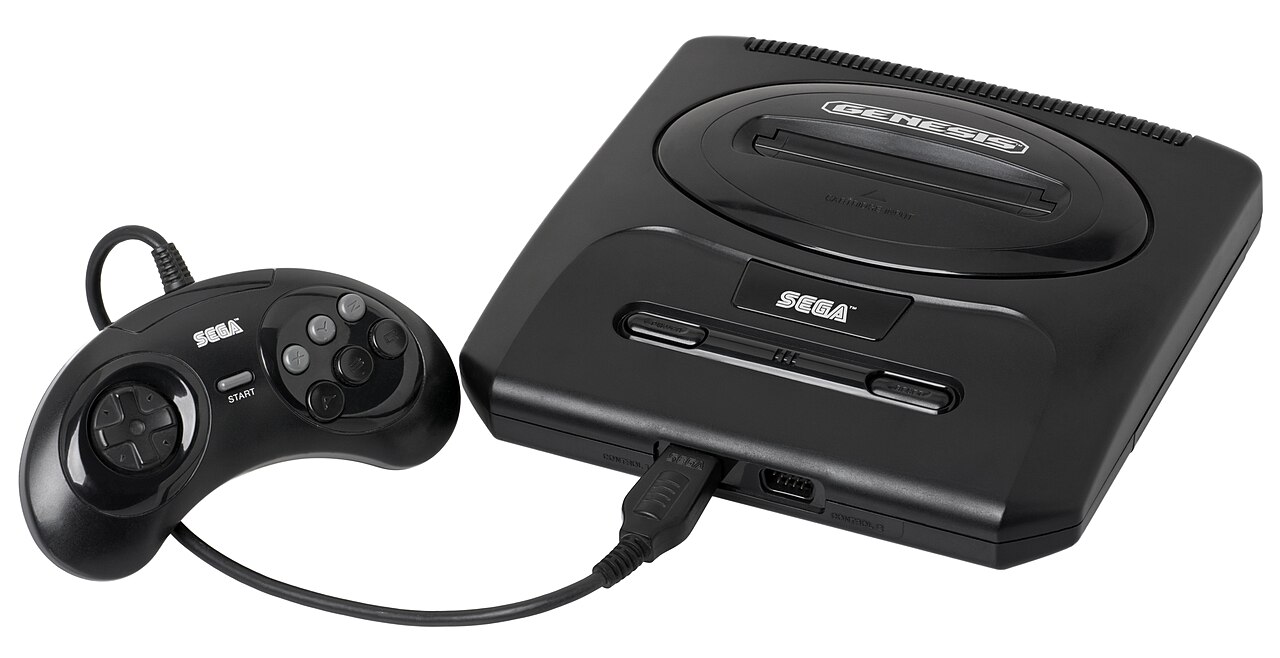
The real war came with the Sega Genesis (1989 in North America; as the Mega Drive it came out in Japan in 1988 and in Europe in 1990), a 16-bit console released two years before Nintendo’s Super NES. Sega seized that head start with one of the most aggressive marketing campaigns in industry history. The slogan “Genesis does what Nintendon’t” directly attacked Nintendo, and Sega pitched itself as the cool, edgy, older-kids’ brand against Nintendo’s family-friendly image. The marketing buzzword “Blast Processing” (a loosely defined claim about the Genesis’s speed) became famous, although no shipping game used the trick behind it (see Sonic Team).
This was the first time Nintendo faced a serious console rival, and for a period in the early-to-mid 1990s Sega genuinely led the US market. For the full back-and-forth, see The Video Game Console Wars.
Sonic the Hedgehog
Sega wanted a mascot to rival Nintendo’s Mario. In 1991 a small team built around programmer Yuji Naka, artist Naoto Ohshima and game designer Hirokazu Yasuhara delivered Sonic the Hedgehog, a blue, fast character whose game was built on speed and momentum where Mario’s rewarded careful platforming (see Sonic Team: Naka, Ohshima and Yasuhara). From November 1991 Sonic the Hedgehog was bundled with the Genesis, and Sonic remains Sega’s most valuable franchise.
The Self-Destruction: 32X, Saturn, and Dreamcast
Sega’s downfall was almost entirely self-inflicted, the result of strategic disarray, especially conflict between Sega of Japan and Sega of America.
Three Hardware Disasters in a Row
- The Sega CD (1991) and 32X (1994). Rather than release a clean next-generation console, Sega bolted expensive add-ons onto the Genesis. The 32X, a mushroom-shaped 32-bit add-on, was rushed to market in November 1994, the same month the Saturn launched in Japan and months before its Western release and confused and angered both consumers and developers. It was abandoned almost immediately, leaving early adopters burned.
- The Sega Saturn (1994 in Japan, 1995 in the West). A powerful but notoriously difficult-to-program console (it used a complex dual-CPU, quadrilateral-based 3D architecture). Worse, Sega of America surprise-launched it in the US months early at the 1995 E3 show, blindsiding retailers and developers who weren’t ready. The early launch alienated key retail partners and starved the system of games at launch. The Saturn did reasonably in Japan but was crushed in the West by Sony’s PlayStation.
- The Sega Dreamcast (1998/1999). Sega’s final console was, by most accounts, ahead of its time, the first console with a built-in modem for online play, excellent games, and an easy-to-develop architecture. It launched strongly. But Sega’s credibility with consumers and developers was already shattered by the 32X and Saturn debacles, and Sega lacked the financial reserves to fight a war with Sony. When Sony announced the PlayStation 2 (with its hyped DVD playback and far larger marketing budget) consumers waited for it rather than buying the Dreamcast. The Dreamcast’s momentum collapsed.
Exit from Hardware
In January 2001, Sega announced it would discontinue the Dreamcast and exit the console-hardware business entirely, ending a console lineage that had begun with the SG-1000 in 1983. The PlayStation 2 went on to become the best-selling console of all time; the Dreamcast became a cult classic, beloved by the players who stayed loyal.
Reinvention as a Game Maker
Freed from the ruinous economics of competing in hardware, Sega reinvented itself as a third-party software publisher and developer, making games for the very platforms (PlayStation, Xbox, Nintendo, and PC) it once fought. This proved a far healthier business. Sega’s studios produced and continued long-running franchises including Sonic, Yakuza/Like a Dragon, Total War, Persona (via Atlus, which Sega acquired), Football Manager, and Sonic-branded film tie-ins that became surprise box-office hits in the 2020s.
Sega merged with pachinko-maker Sammy in 2004 to form the Sega Sammy Holdings group, providing financial stability. Today Sega is a profitable, well-regarded publisher, a second act that, in the long run, may have been more durable than the console wars it lost.
Significance
Sega is the clearest demonstration that winning the technology is not the same as winning the market. It out-marketed Nintendo, created a mascot that rivaled Mario, and shipped genuinely innovative hardware (online gaming on the Dreamcast predated Xbox Live by years), yet a sequence of strategic blunders and internal civil war destroyed consumer and developer trust faster than good engineering could rebuild it. Its graceful pivot from failed hardware maker to thriving software house is one of the more successful reinventions in the industry. For the wider story, see The Video Game Industry; for the rival that ended it, see Sony.
📚 Sources
- Harris, Blake J.: Console Wars: Sega, Nintendo, and the Battle That Defined a Generation (It Books, 2014)
- Kent, Steven L.: The Ultimate History of Video Games (Three Rivers Press, 2001)
- Pettus, Sam et al.: Service Games: The Rise and Fall of SEGA (2013)
- Sega — Wikipedia (Standard Games and Service Games, release dates, 1992 market share, 2001 exit)
- Dreamcast — Wikipedia (built-in modem, launch dates, discontinuation)
- Sega Sammy Holdings: Corporate history and investor materials
- Image: Sega-Genesis-Mk2-6button.jpg by Evan-Amos (CC BY-SA 3.0), via Wikimedia Commons