Larry Tesler and the War on Modes
Abstract
Larry Tesler (1945–2020) spent his career trying to remove a single idea from computing: the mode, a state in which the same keystroke does different things depending on what the software is currently “in”. Working on the Gypsy editor at Xerox PARC in 1974–75, he and Tim Mott built one of the first modeless word processors and, with it, the cut/copy/paste commands now in every text field on earth. His car’s license plate read NO MODES. He also left behind a rule that every interface designer eventually collides with: complexity cannot be destroyed, only moved, either into the software or onto the user.
From Stanford to PARC
Lawrence Gordon Tesler was born in the Bronx on April 24, 1945, and entered Stanford at sixteen, graduating in mathematics in 1965. He worked as a programmer around Stanford’s Artificial Intelligence Laboratory in the late 1960s, then joined Xerox PARC in 1973, into the group building personal computing on the Alto (see The Xerox PARC Revolution).
At PARC he worked on Smalltalk, where he built a tool for reading through class hierarchies and named it a “browser”, giving the software world the term. His lasting work, though, was on text editing, and it grew out of a specific irritation.
Killing the Mode
Text editors of the early 1970s were modal. In a program like the widely used editor of the day, typing a letter sometimes inserted it and sometimes was interpreted as a command, depending on which mode you were in; forgetting the current mode meant your sentence became a string of destructive commands. Tesler considered this a design defect that placed the machine’s convenience above the user’s, and he set out to prove editing could work with no modes at all.
With Tim Mott, Tesler built Gypsy in 1974–75, a word processor for the Alto commissioned to help an educational publisher move to screen editing. Gypsy had no insert mode and no command mode: typed characters were always text, and operations were invoked by selecting with the mouse and pressing dedicated keys. To move a passage, the user selected it, pressed Copy or Cut to hold it, clicked a destination, and pressed Paste. The clipboard-and-verbs model that word “cut”, “copy”, “paste” came out of this work. Tesler and Mott are credited with the model together; it was collaborative design, not a lone invention, and it built on PARC’s broader push toward direct manipulation.
The anti-mode conviction became Tesler’s signature. His slogan was “Don’t Mode Me In”. From the mid-1990s his California license plate read NO MODES, and he later took the handle @nomodes online.
Apple
After Steve Jobs’s Apple team visited PARC in late 1979, Tesler was one of the PARC people who moved to Cupertino, joining Apple in July 1980. He worked on the Lisa, carrying modeless editing and cut/copy/paste into a commercial product, and in 1985 collaborated with Niklaus Wirth to design Object Pascal, the language Apple used for its application frameworks.
He rose to vice president of the Advanced Technology Group and Apple’s chief scientist. From 1990 he ran the Newton project, the handheld whose handwriting recognition was mocked into a punchline and which Jobs killed in 1998. In 1997, before leaving Apple, Tesler had the task of closing the Advanced Technology Group itself. His later career moved through user experience roles at companies selling to ordinary people: he co-founded Stagecast Software in 1997, was a vice president of engineering and then of the shopping experience at Amazon from 2001 to 2005, led user experience at Yahoo from 2005 to 2008, and spent a year at the genetics company 23andMe before consulting independently. He died in Portola Valley, California, on February 16, 2020, at 74.
Tesler’s Law
Out of decades of arguing over interfaces, Tesler distilled a principle now taught as the Law of Conservation of Complexity: every application has an irreducible amount of complexity, and the only real question is who has to absorb it. A feature that looks simpler to the user is usually simpler because an engineer took on extra work to hide the mess; complexity pushed out of the interface lands in the code, and complexity left out of the code lands on the person. The law reframed “make it simpler” as a decision about where to put difficulty rather than how to erase it.
The Limits of the Crusade
Tesler won the mainstream and lost the corners. The interface most people use, one where letters are always letters and editing runs on select-and-paste, is the modeless world he argued for. But modes never died. The modal editor he set out to replace, in the form of vi and its successor Vim, remains in daily use by programmers who prize its speed precisely because it separates typing from commanding. Every smartphone keyboard toggles between letters, numbers, and symbols, a mode by another name, because a touchscreen has too few keys to do otherwise. The verdict on his career is split cleanly: the model he built became universal, and the enemy he named turned out to be useful often enough to survive wherever screen space or speed is scarce.
📚 Sources
- Larry Tesler — Wikipedia
- Tesler, Larry: “A Personal History of Modeless Text Editing and Cut/Copy-Paste” — ACM Interactions (2012)
- Fast Company: A tribute to Larry Tesler, the father of user-friendly design (2020)
- Gizmodo: The Computer Scientist Responsible for Cut, Copy, and Paste, Has Passed Away (2020)
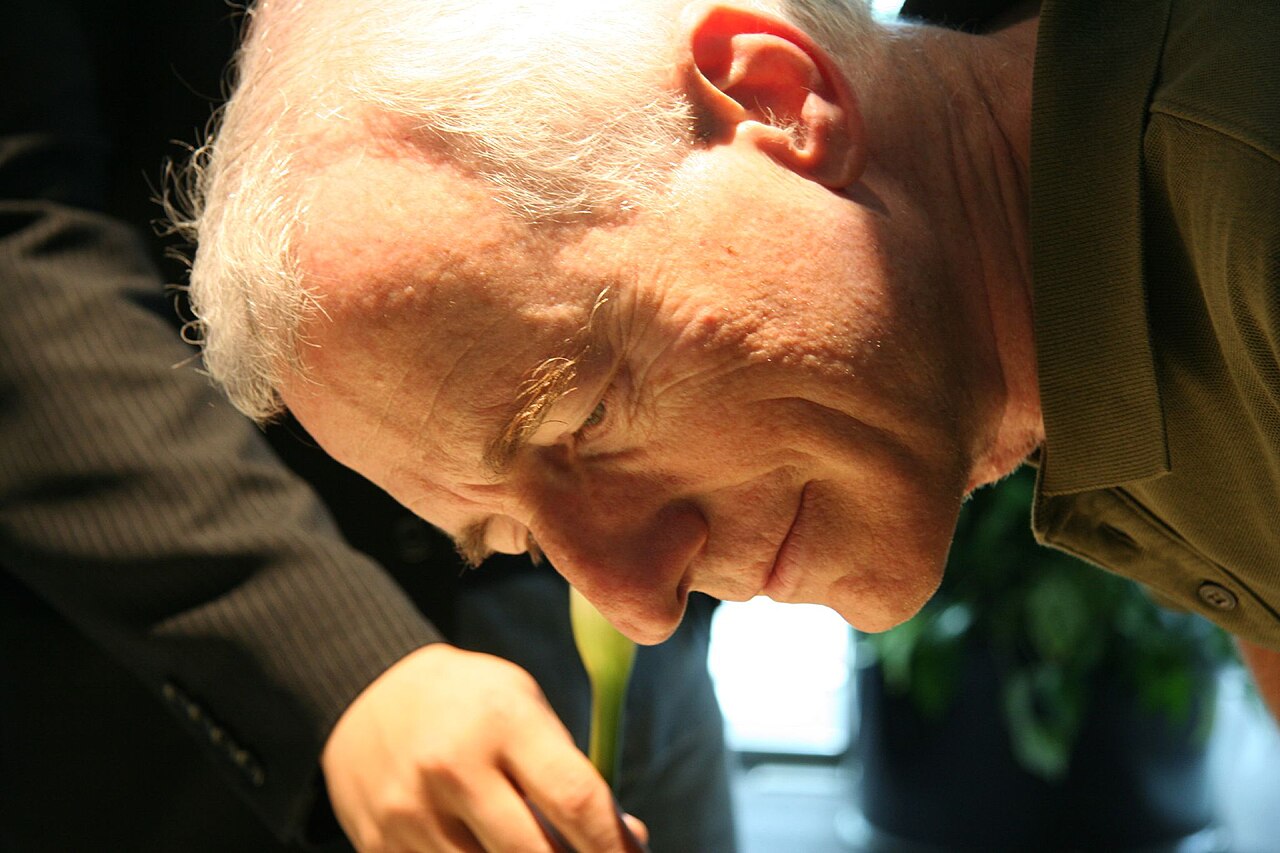
- Image: Larry Tesler and Whisper (6).jpeg by Yahoo! Blog from Sunnyvale, California, USA (CC BY 2.0), via Wikimedia Commons