Optical Discs: CD, DVD, and Blu-ray
Abstract
An optical disc stores data as microscopic pits in a plastic layer and reads them with a laser that never touches the surface. The idea was patented in the 1960s by an American physicist who wanted records that would not wear out; Philips and Sony turned it into the Compact Disc in 1982, and the CD-ROM made the same disc the software medium of the 1990s. The DVD of 1996 followed after the computer industry forced two rival camps into one format, and Blu-ray of 2006 used a blue-violet laser that had existed only since 1996. Each generation shortened the wavelength and packed the pits tighter, from about 700 megabytes to 4.7 and then 25 gigabytes a layer. By the 2020s networks had taken over distribution, and in 2025 Sony stopped making recordable Blu-ray discs.
Light Instead of a Needle
James T. Russell was a physicist at the Hanford site in Richland, Washington, and a record collector who sharpened cactus needles by hand because they sounded better than steel. In 1965, when Battelle took over the laboratory, he set out to make a recording that would not wear out from being played: store the music as binary digits and read them with light. He filed his first patent in 1966, and it was granted in 1970; a prototype was working in 1973, and about a hundred companies, Philips and Sony among them, came to look at it. How much the later industry owed him is disputed. David Paul Gregg had patented an optical video disc in 1958, and Philips researchers had worked on optical recording from 1969. Russell’s patents passed to a Toronto company, Optical Recording Corp., which pursued Sony, Philips, and Time Warner for royalties; Sony and Philips took licences in 1988.
LaserDisc
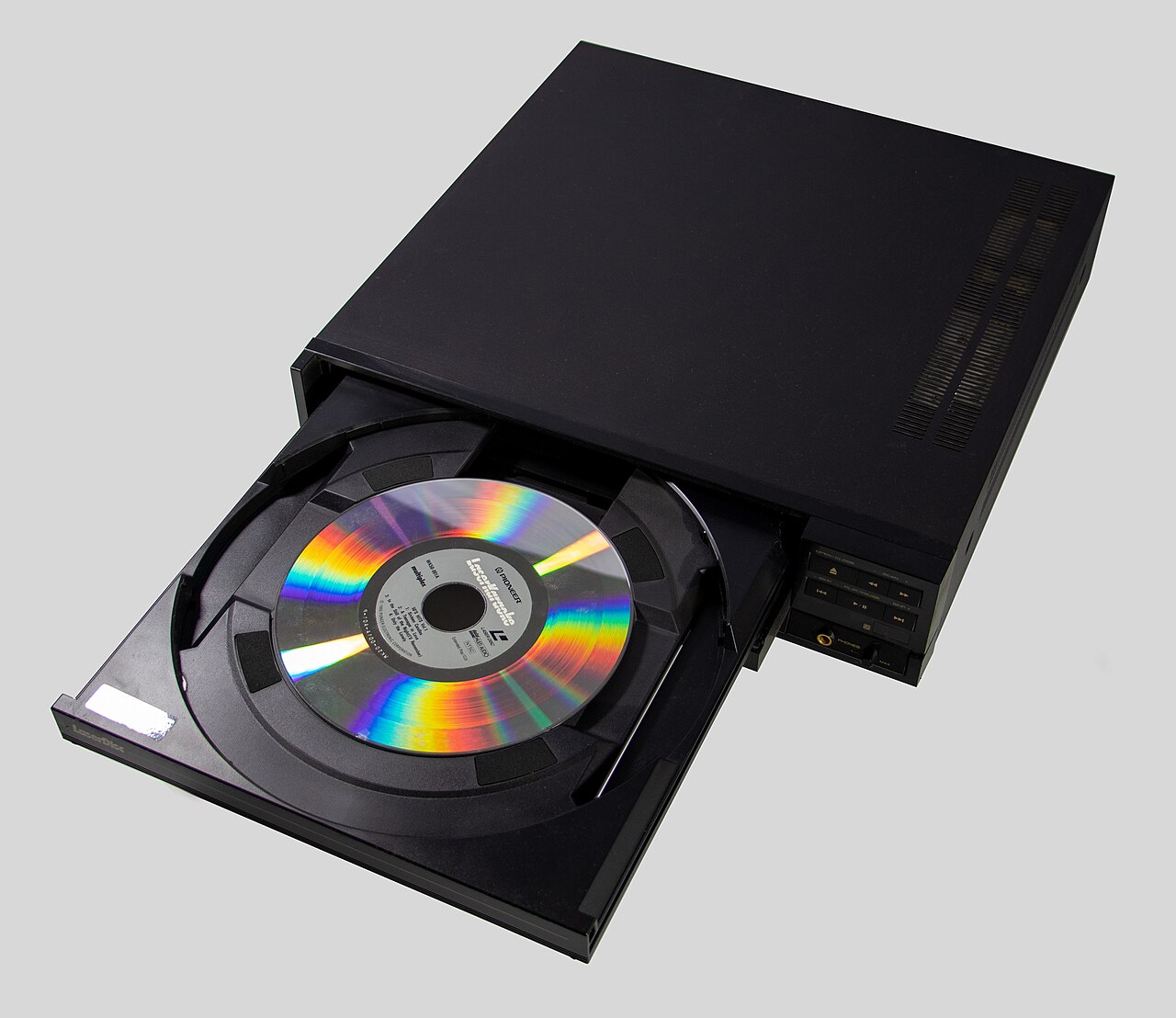
The first optical disc on sale carried video, and it was analog. Philips built the players and the film studio MCA pressed the discs, and in December 1978 MCA DiscoVision went on sale in a test market in Atlanta, with Jaws as the first title. The disc was 30 centimetres across, the size of an LP. Pioneer took over the format in 1981 under the name LaserDisc. Its picture was sharper than videotape, and film collectors kept buying it through the 1990s, but it could not record and a film needed two sides or two discs, and VHS took the mass market.
The Compact Disc
At Philips in Eindhoven, Lou Ottens had started a small group in 1974 to build an optical audio disc. The prototype was shown on 8 March 1979. Sony joined the same year, and a joint task force led by Kees Schouhamer Immink of Philips and Toshitada Doi of Sony settled the format. Immink contributed eight-to-fourteen modulation (EFM), which turns each byte into a pattern of pits whose lengths the laser can read reliably; Sony contributed the error correction, a cross-interleaved Reed–Solomon code that spreads every block of data over a stretch of the track, so that a scratch causes many small correctable errors instead of one large gap (see Coding Theory and Error Correction). The standard, the “Red Book”, was published in 1980. A 780-nanometre infrared laser reads the disc through 1.2 millimetres of polycarbonate, focused so tightly on the pits that dust on the surface is out of focus. How the disc came to be 12 centimetres across and to play 74 minutes is told, with its legend about Beethoven’s Ninth, in Beethoven’s Ninth and the Birth of the CD.
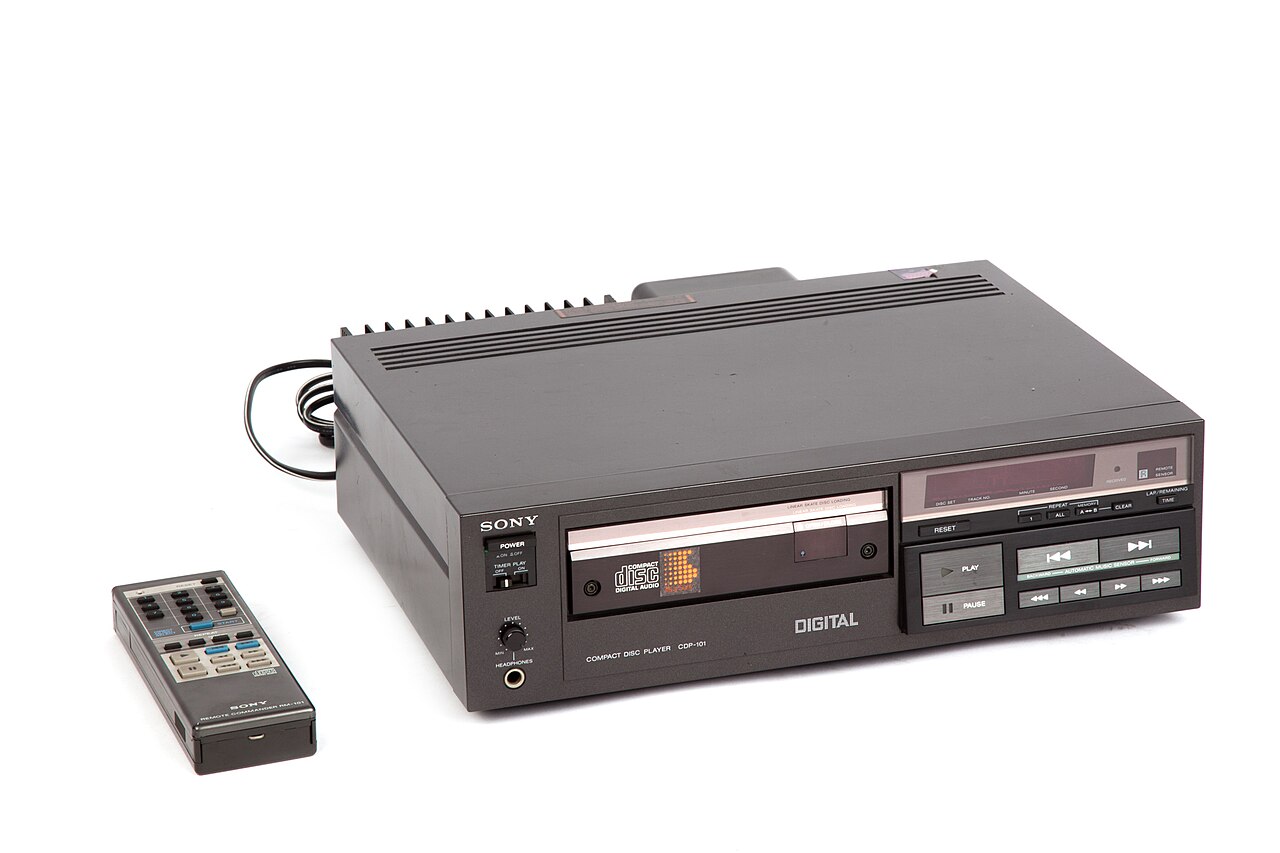
The first commercial CD was pressed on 17 August 1982, a recording of Chopin waltzes played by Claudio Arrau. On 1 October 1982 the first fifty titles went on sale in Japan, Billy Joel’s 52nd Street among them, together with Sony’s CDP-101 player. Europe and North America followed on 14 March 1983. In the United States the CD outsold the LP by 1988 and the cassette by the early 1990s, and in 2000 it held 92.3 percent of the music market. More than 200 billion CDs had been sold worldwide by 2007 (see Sony and the Netherlands’ tech industry).
CD-ROM
A disc that held 74 minutes of 16-bit stereo sound could hold about 650 megabytes of anything else, at a time when a floppy held 1.44 MB. The Yellow Book of 1983 defined the CD-ROM with an additional layer of error correction, because a wrong bit in a program matters more than one in a waveform. Philips brought out the first drive, the CM 100, in July 1985. Every manufacturer still organised files differently, so in November 1985 Microsoft, Philips, Sony, Apple, DEC, and others met and wrote a common file system, published as the High Sierra format in May 1986 and standardised as ISO 9660 in 1988. A single-speed drive read 150 kilobytes per second; by 2004 the fastest common drives were rated at 52 times that.
The first application to sell drives was reference: Grolier showed its encyclopedia on disc at the Microsoft CD-ROM Conference in March 1986 (see Britannica and the CD-ROM Encyclopedias). In early 1990 about 300,000 drives had been sold in Japan. Within a few years the disc carried operating systems, games, and the PlayStation’s whole library (see Ken Kutaragi and the PlayStation), and AOL mailed its sign-up software on so many of them that its marketing chief claimed half of the world’s CD production (see AOL’s CDs).
Writing on Light
A recordable disc replaced the pressed pits with a dye layer that a stronger laser could darken. Taiyo Yuden made the first CD-R media in 1988, and Philips and Sony specified the format in the “Orange Book”. The first recorders were professional machines: around 1990 a system built on a Yamaha recorder cost about $35,000, and typical recorders still cost $10,000 to $12,000 in 1992. In September 1995 Hewlett-Packard’s 4020i, made by Philips, became the first recorder under $1,000. Blank discs fell to a dollar or two, and the CD-R took the backup and exchange market that the Zip drive and its rivals had fought over (see Dead End: The Floppy Successor Wars). Manufacturers claimed a life of up to a hundred years for discs with gold reflective layers; a study by J. Perdereau put the average life expectancy of CD-Rs at about ten.
DVD
By 1994 two groups were preparing a high-density successor for video. Philips and Sony backed the Multimedia Compact Disc; Toshiba, Time Warner, and others backed the Super Density disc. The computer industry did not want two incompatible drives. IBM, Apple, Compaq, Hewlett-Packard, and Microsoft threatened to support neither unless the camps agreed, and they enlisted IBM’s chief executive Lou Gerstner to press the electronics companies. On 15 September 1995 Philips and Sony agreed to a single format, and the specification was finished on 8 December. The name became “digital versatile disc”, to cover more than video.
The DVD used a 650-nanometre red laser, smaller pits, and a tighter track, and held 4.7 GB on one layer and 8.5 GB on two. It went on sale in Japan on 1 November 1996 and in the United States on 24 March 1997. Film discs were protected by the Content Scramble System, a cipher with 40-bit keys whose decryption keys player makers had to license. In October 1999 a program called DeCSS, whose graphical interface was written by the Norwegian teenager Jon Lech Johansen, broke it; Johansen was prosecuted in Norway and acquitted in 2003 (see Digital Rights Management). An attempt to sell discs that expired after 48 hours ended in 1999 (see Dead End: DIVX). The PlayStation 2 of 2000 played DVDs, and American DVD sales peaked in 2005.
Blu-ray
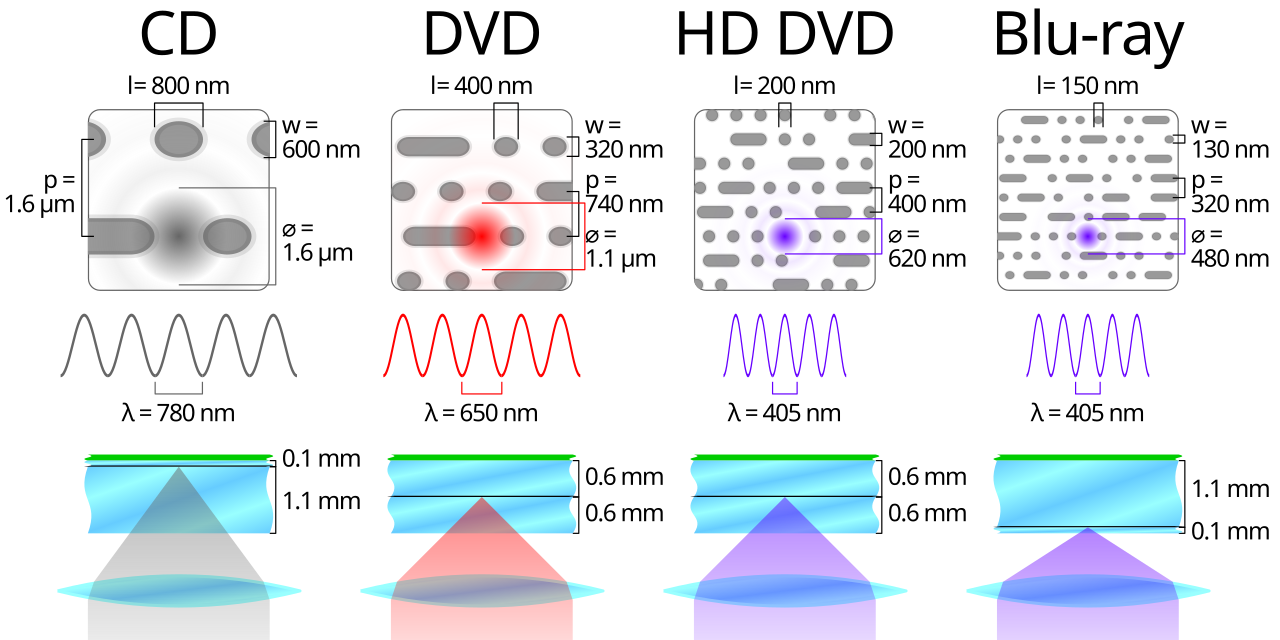
Smaller pits need a shorter wavelength, and the first violet laser diode was reported only in January 1996, by Shuji Nakamura at the Japanese firm Nichia: a pulsed device emitting at 417 nanometres. Nichia was producing violet laser diodes from October 1999. Sony showed prototypes of a disc read at 405 nanometres in October 2000, and the format was announced on 19 February 2002 by a group that became the Blu-ray Disc Association. Its data layer sits only 0.1 millimetres below the surface, so that a lens with a wider aperture can focus a smaller spot. The first device, Sony’s BDZ-S77 recorder, went on sale in Japan on 10 April 2003 for about $3,800. Players and films followed worldwide from June 2006, with 25 GB on a single layer and 50 GB on two.
Toshiba’s rival HD DVD lasted until 19 February 2008, a story told in Dead End: HD DVD. Later variants reached 100 and 128 GB on three or four layers, and Ultra HD Blu-ray brought 4K films in 2016.
Dead End: The Disc in the Drawer
The optical disc was a distribution medium that people tried to make into a storage medium. As distribution it worked for thirty years: pressing a disc cost little, every computer and console had a drive, and the format did not change underneath its owners. As working storage it never competed with the hard disk, because it was slow to seek and slow to write (see The Storage Revolution). As an archive it had advocates. In 2014 Facebook showed a cabinet of 10,000 Blu-ray discs holding a petabyte of cold data for photo backups, and Sony and Panasonic announced the Archival Disc for professional use, 300 GB in its first version and planned up to a terabyte; Panasonic mass-produced it from 2016. Sony’s archive cartridges of 2019 used 500 GB discs, the terabyte version never appeared, and the product was discontinued in 2024.
Distribution moved to the network once broadband was fast enough. Netflix, which had built its business on DVDs by mail, sent its last discs on 29 September 2023 after more than 5 billion shipments (see Reed Hastings and Netflix). Best Buy stopped selling films on disc in early 2024, and in January 2025 Sony announced that it would end production of recordable Blu-ray discs, MiniDiscs, and MiniDV cassettes in February, with no successor. Pressed discs are still made for collectors and for consoles, and the hundreds of billions of CDs already sold remain readable as long as there are drives to read them.
📚 Sources
- Wikipedia: Compact disc (finding aid: Russell’s patent filed 1966 and granted 1970, the 1988 licences, Ottens’s group of 1974, the prototype of 8 March 1979, the Immink–Doi task force, EFM and CIRC, Red Book 1980, the 780 nm laser, 17 August and 1 October 1982, 52nd Street, 14 March 1983, US market share and 200 billion discs)
- Wikipedia: James Russell (inventor) (finding aid: Battelle 1965, prototype 1973, about a hundred companies, Gregg 1958, Philips 1969, the dispute over credit)
- Seattle Times: “Scientist’s invention was let go for a song” (29 November 2004) (Hanford from 1953, Battelle in 1965, cactus needles, records that would not wear out, prototype 1973, Optical Recording Corp. and its royalty claims, the 1988 settlement with Sony and Philips)
- Wikipedia: DiscoVision and Wikipedia: LaserDisc (finding aid: Philips and MCA, Atlanta in December 1978, Jaws, Pioneer from 1981)
- Wikipedia: CD-ROM (finding aid: Yellow Book 1983, CM 100 in July 1985, High Sierra and ISO 9660, Microsoft CD-ROM Conference 1986, 150 KB/s and 52×, Japanese drive sales in 1990)
- Wikipedia: CD-R (finding aid: Taiyo Yuden 1988, Orange Book, early recorder prices, HP 4020i in September 1995, Perdereau’s ten years, manufacturers’ hundred years)
- Wikipedia: DVD (finding aid: MMCD and SD, the five computer companies and Gerstner, 15 September and 8 December 1995, the name, 650 nm, 4.7 and 8.5 GB, launch dates, CSS, the 2005 peak)
- Wikipedia: DeCSS (finding aid: October 1999, Johansen, 40-bit keys, acquittal in 2003)
- Laser Focus World: “Visible diode lasers: InGaN diode laser emits blue-violet light” (1 April 1996) (Nakamura’s 417 nm laser, January 1996, pulsed operation)
- Japan Times: “Nichia to make powerful DVD laser” (12 June 2001) (violet laser diodes in production since October 1999)
- Wikipedia: Blu-ray (finding aid: 405 nm, prototypes October 2000, announcement 19 February 2002, BDZ-S77 on 10 April 2003, June 2006, 25 and 50 GB, BDXL, Ultra HD Blu-ray 2016)
- PCWorld: “Facebook puts 10,000 Blu-ray discs in low-power storage system” (29 January 2014) (one petabyte, cold storage for backup copies of photos and videos)
- Campus Technology: “Sony, Panasonic Reveal 1 TB Archival Optical Disc Roadmap” (10 March 2014)
- Wikipedia: Archival Disc (finding aid: mass production by Panasonic in 2016, discontinued as of 2024)
- CDRinfo: “Sony’s Optical Disc Archive Generation 3 offers capacity of 5.5TB” (22 November 2019) (eleven 500 GB Archival Discs per cartridge)
- Netflix: “Netflix DVD: The Final Season” (last discs on 29 September 2023)
- The FPS Review: “The End of an Era, Netflix Has Shipped Its Last DVD” (30 September 2023) (more than 5 billion discs shipped)
- CBS News: “Best Buy set to stop selling DVD and Blu-ray discs” (2023)
- Engadget: “Sony is halting production of recordable Blu-ray, MiniDiscs and MiniDV cassettes” (January 2025)
- Image: Lettore CD Sony CDP-101 - Museo della Scienza e della Tecnologia Leonardo da Vinci.jpg by Alessandro Nassiri (CC BY-SA 4.0), via Wikimedia Commons
- Image: Pioneer CLD-1030 Laserdisc Player (Open tray with disc).jpg by Dillan Payne (CC BY-SA 4.0), via Wikimedia Commons
- Image: Comparison CD DVD HDDVD BD.svg by Cmglee (CC BY-SA 3.0), via Wikimedia Commons