The Portable Computer
Abstract
Making a computer portable meant solving four problems that had nothing to do with computing: a screen that worked without a picture tube, a battery that lasted a working day, a case that survived being carried, and a price a traveller could justify. The industry solved them in that order and took about fifteen years over it. The first machines called portable, like IBM’s 25-kilogram 5100 of 1975 and the Osborne 1 of 1981, still needed a wall socket. The Epson HX-20 of 1982 ran for 50 hours on its own batteries but had a four-line display. The GRiD Compass of the same year set the clamshell shape still in use. The Toshiba T1100 of 1985 made a battery-powered PC-compatible a product people bought in volume, and by the third quarter of 2008 notebooks outsold desktops worldwide for the first time.
The Suitcase Era
IBM announced the 5100 on 9 September 1975 and called it portable: a keyboard, a five-inch CRT, a tape drive, ROM and up to 64 KB of RAM in a case the size of a small suitcase, weighing 25 kg, with an optional carrying case, and costing between $8,975 and $19,975. It had to be plugged in, which is the definition of the whole first generation.
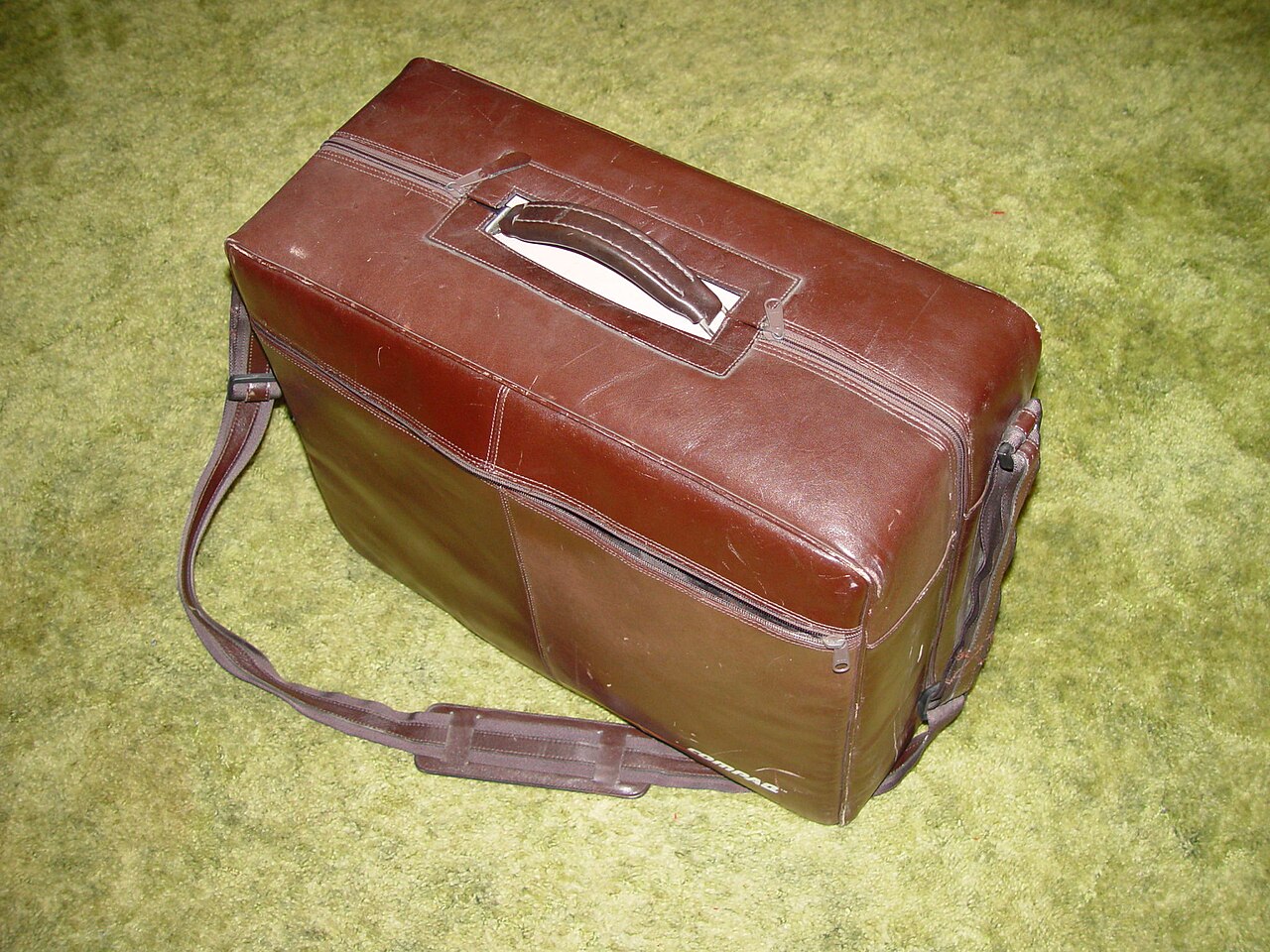
The commercial category opened in 1981 with the Osborne 1, 24.5 pounds with a five-inch screen and $1,500 worth of bundled software for $1,795, and continued in 1983 with the Compaq Portable, 28 pounds and $2,995, which added the one thing buyers had started to insist on: it ran the software from the IBM PC on the desk at the office. Compaq sold 53,000 in its first year (see The Commodity PC for what that business became). Both machines are covered in Dead End: Osborne and Compaq and the BIOS Clean Room. The trade press called them luggables, and the joke was that they were portable in the sense that a sewing machine is portable.
What none of them had was a battery, because a CRT and a pair of floppy drives draw more power than any portable battery of the period could supply for a useful length of time.
Batteries and a Flat Screen
The machine that broke that constraint gave up almost everything else to do it. Epson’s HX-20, conceived by Yukio Yokozawa in July 1980, shown at COMDEX in 1981 and on sale from July 1982 at $795, weighed 1.6 kg, ran two Hitachi 6301 processors at 614 kHz, and lasted about 50 hours on rechargeable nickel-cadmium cells. Its display was an LCD of four lines by twenty characters, 120×32 pixels, with a built-in microcassette and a small dot-matrix printer alongside it. It had roughly the footprint of an A4 notebook and could be held in one hand.
Four lines is not a workspace, and the HX-20 was bought mostly for data collection in the field. But it established that the parts existed: a flat display that drew milliwatts, CMOS logic slow enough to live on batteries, and ROM software that started instantly because there was no disk to boot from. The display side of this story is in The History of Displays.
The Clamshell
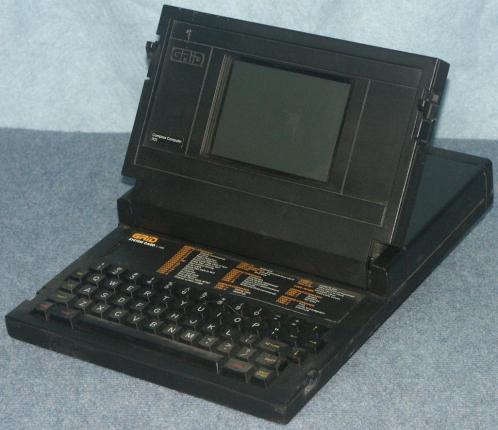
In April 1982 GRiD Systems shipped the Compass 1101 at $8,150. British industrial designer Bill Moggridge gave it a magnesium alloy case whose screen folded flat over the keyboard when closed, the first machine built that way, and a 320×240 electroluminescent display bright enough to read in daylight. Inside were an Intel 8086 and 256 KB of RAM, with 384 KB of magnetic bubble memory in place of a disk. It weighed 5 kg, had no internal battery, and cost more than a car.
Almost all of them went to the US government. Compasses flew on every Space Shuttle mission from 1983 to 1997, special forces bought them because they could be dropped out of an aircraft with a paratrooper, and the NSA asked about a TEMPEST-hardened version. The design outlived the company: every laptop since has been a box that opens like a book. Moggridge co-founded IDEO in 1991 and is credited, with Bill Verplank, for coining the term interaction design.
The Journalists’ Machine
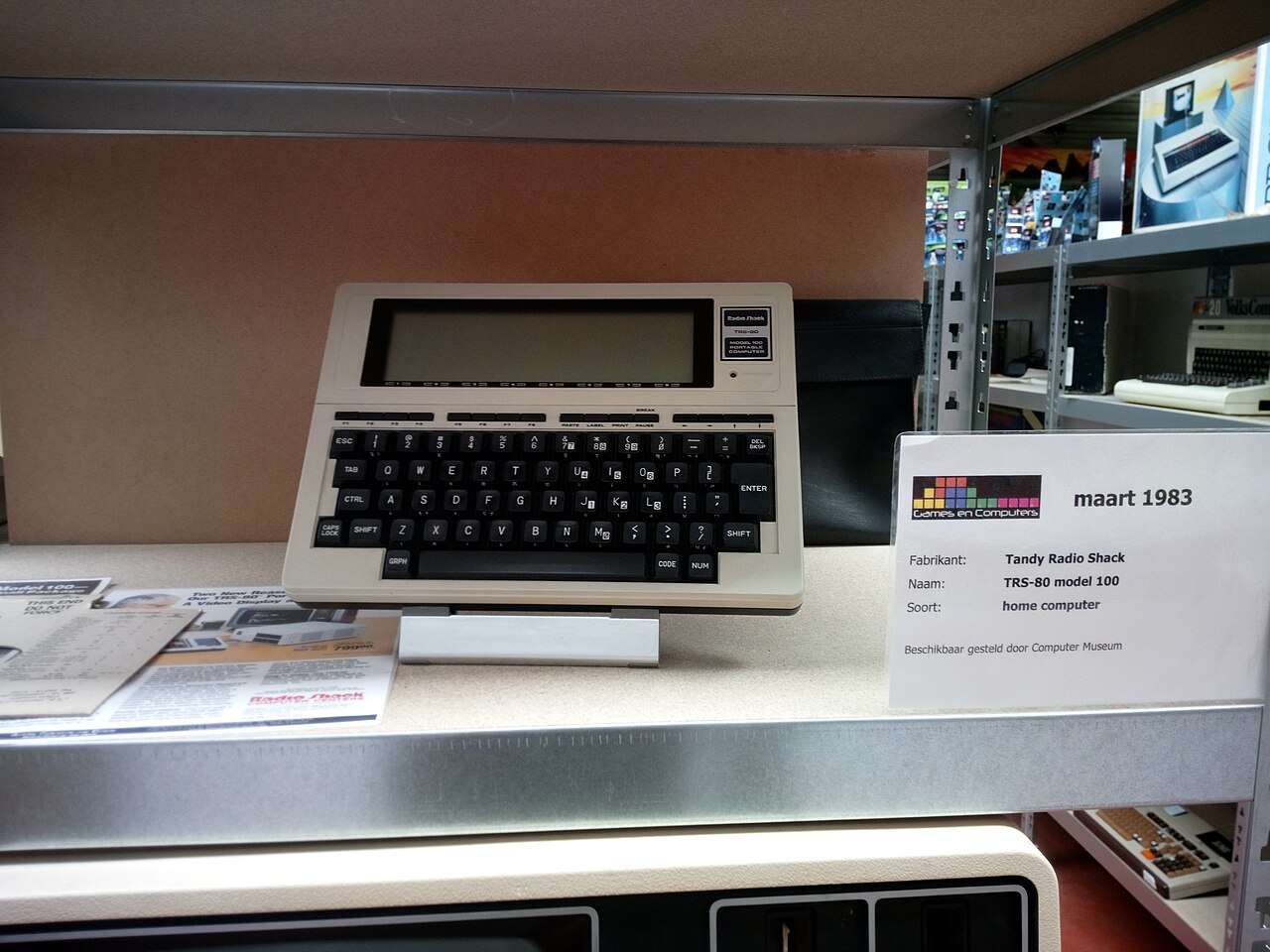
Tandy’s TRS-80 Model 100, released on 26 April 1983 at $1,099 for 8 KB and $1,399 for 24 KB, was designed and built by Kyocera and sold in Japan as the Kyotronic 85. It weighed 1.4 kg, showed eight lines of forty characters on a 240×64 LCD, ran up to twenty hours on four alkaline AA batteries, and had a 300-baud modem and a text editor, a terminal program, an address book and a scheduler in ROM, with Microsoft BASIC alongside them. Bill Gates wrote the firmware with Jey Suzuki and it was the last Microsoft product he developed personally: “Part of my nostalgia about this machine is this was the last machine where I wrote a very high percentage of the code in the product.”
It sold over six million units, which makes it one of the best-selling computers of the decade, and it found a profession. A reporter could write a story on the plane, plug the modem into a hotel telephone and file it. Newsday bought 500. When the Loma Prieta earthquake hit in 1989, the San Francisco Examiner put out an emergency edition with them. The combination of instant-on ROM software, AA batteries and a modem was the working journalist’s computer for a decade, and nothing that replaced it was as reliable in a hotel room.
Toshiba Makes It a Product
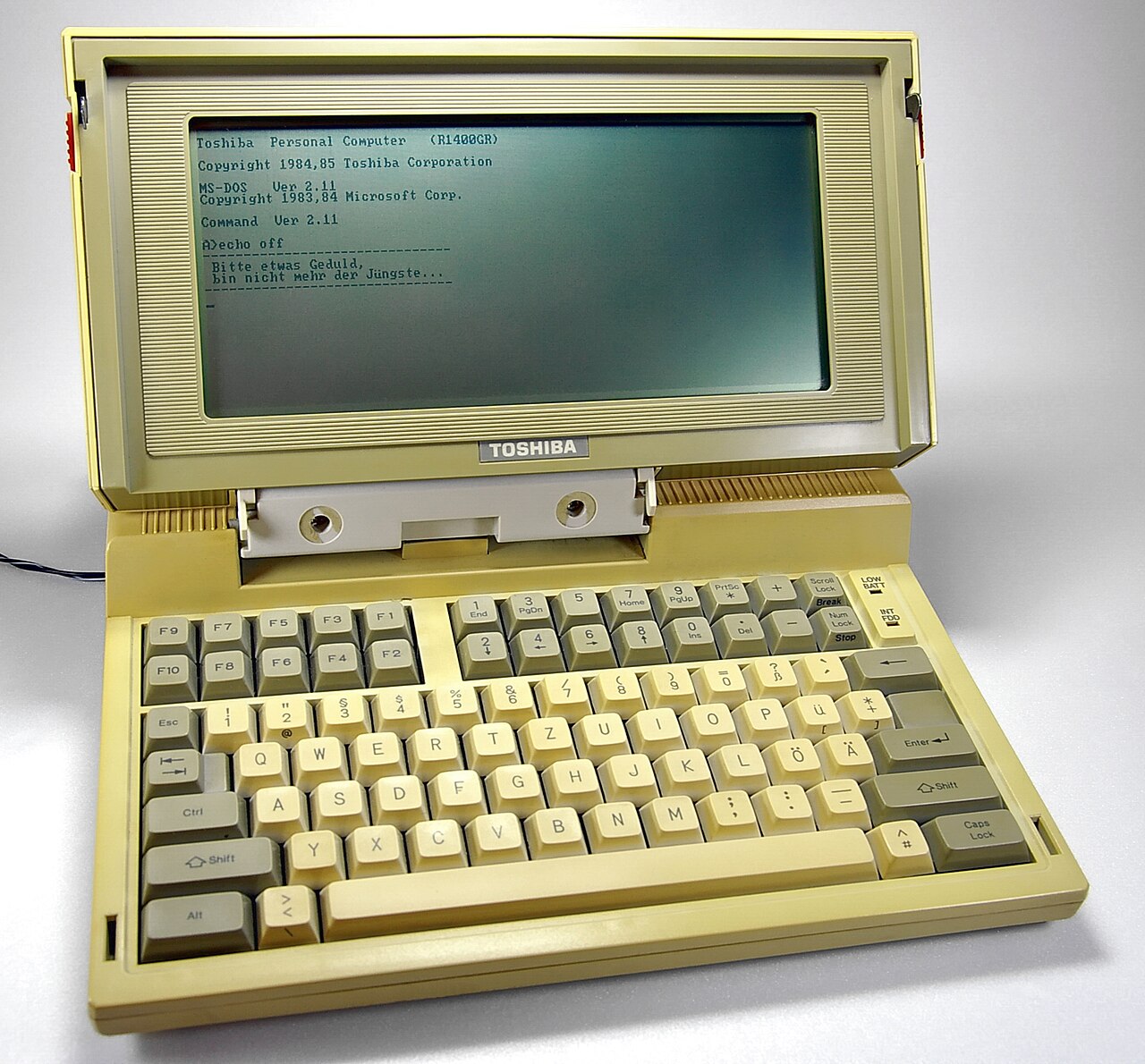
Toshiba launched the T1100 in Europe in April 1985 at the Hannover trade fair, at $1,899. It weighed 4.1 kg, ran an Intel 80C88 at 4.77 MHz with 256 KB of RAM, had a 3.5-inch 720 KB floppy drive, a monochrome LCD showing the standard 80 by 25 characters, MS-DOS 2.11 and a battery. It was, in other words, an IBM PC that ran on its own power, and it had no significant competition.
The internal history is the part worth keeping. Atsutoshi Nishida, then running personal computer sales at Toshiba Europe, pushed the project against a head office that did not believe in the market, and got approval by promising to sell 10,000 units in the first year. He did. By 1987 Toshiba held about 40% of the 130,000 portable PCs shipped annually in Europe, and the company stayed a leader in laptops for the next twenty years. The IEEE recognised the T1100 with a Milestone in 2013 for its contribution to the laptop PC.
Apple’s Two Attempts
The Macintosh Portable of 20 September 1989 cost $5,799, weighed 15.8 pounds and ran on a sealed lead-acid battery. Its active-matrix screen was the best display on any portable, and everything else about it was wrong: the Los Angeles Times summed it up as “too big, too heavy and too expensive”. Apple had forecast 50,000 in the first year and sold about 10,000 in the first quarter. It was discontinued on 21 October 1991.
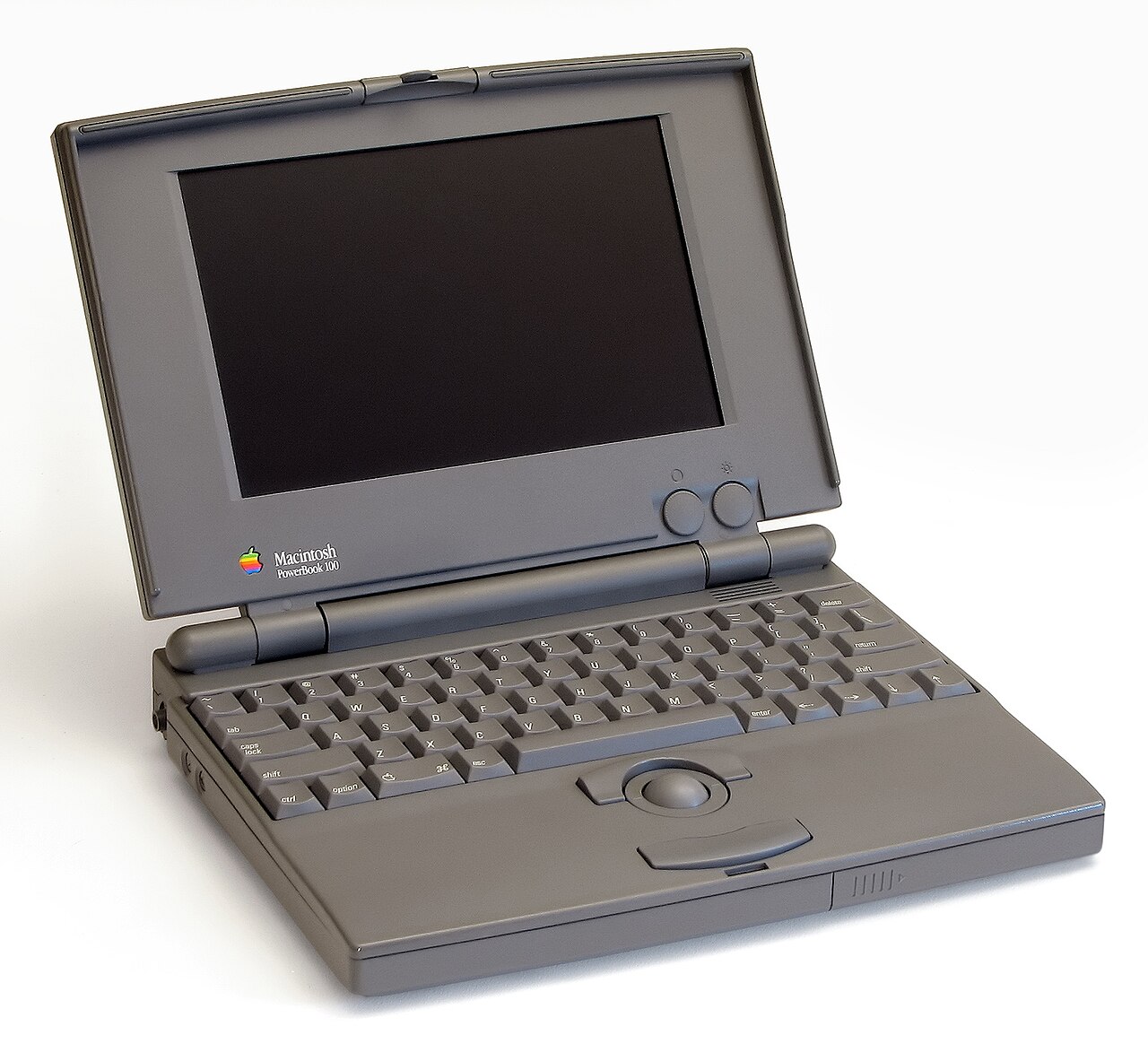
That same month Apple shipped the PowerBook line: the 100, 140 and 170. Apple had gone to Sony in late 1989 for the 100, because it did not have the engineering capacity to miniaturise the Macintosh Portable itself, and Sony’s engineers did the design between September and December 1990. The PowerBook 100 sold for $2,500 and weighed 5.1 pounds.
The layout was the lasting contribution. The keyboard was pushed toward the back of the case, leaving a palm rest in front with a trackball in the middle of it, so the machine could be typed on in a lap rather than only at a desk. Every notebook since has used some version of that arrangement, with the trackball replaced by a trackpad. Apple sold more than 100,000 PowerBooks by January 1992 and took a billion dollars in the first year, capturing about 40% of all laptop sales (see The Macintosh for the desktop line).
The ThinkPad
IBM launched the ThinkPad 700C on 5 October 1992 at $4,350: an IBM 486SLC at 25 MHz, a 120 MB removable hard drive, nickel-metal-hydride batteries good for close to four hours, and a 10.4-inch colour TFT display at 640×480 when most portables still had passive monochrome screens.
Richard Sapper had designed the case in 1990 as a plain black box modelled on a Japanese bento lunchbox, which shows nothing until it is opened. In the middle of the keyboard sat the red TrackPoint invented by Ted Selker, a pointing stick that let the hands stay on the home row. PC Magazine called the 700 and 700C the finest notebooks on the market and the line collected more than 300 design and quality awards. In December 1993 a ThinkPad 750 flew on Space Shuttle Endeavour during the Hubble repair mission, running a NASA test of whether radiation in orbit corrupted its memory.
What Actually Made Laptops Work
Three supply-side changes did more for portability than any individual product.
Sony began selling the first commercial lithium-ion cells in 1991, and their higher energy density replaced the nickel-cadmium and nickel-metal-hydride packs that made early portables heavy. Active-matrix LCD production scaled through the 1990s until a colour screen stopped being the most expensive part of the machine. And in March 2003 Intel’s Centrino platform bundled the low-power Pentium M, a matching chipset and an 802.11 radio under one brand, which put Wi-Fi in essentially every laptop sold and gave four to five hours of battery life on a 48 watt-hour pack.
The result showed up in the shipment figures. In the third quarter of 2008, worldwide notebook shipments reached 38.6 million units against 38.5 million desktops, the first quarter in which portable machines outsold stationary ones.
Dead End: The Netbook
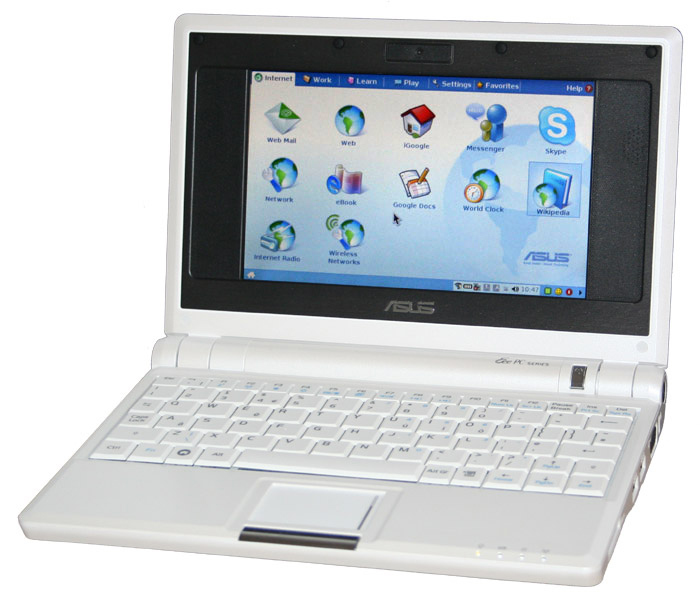
Asus shipped the Eee PC 701 on 16 October 2007: a 922-gram machine with a 7-inch 800×480 screen, a 4 GB solid-state disk, Xandros Linux, and a retail price of up to €500. It sold over 300,000 units in four months, every manufacturer copied it, Intel built the low-power Atom processor for the segment, and by 2008 and 2009 netbooks were about 20% of the portable computer market.
Then it collapsed. The netbook had been defined by a price, and the components underneath that price got better slowly while the things attacking it got better quickly. Apple’s iPad arrived in 2010 and tablet sales passed netbook sales in 2011; ultrabooks took the buyers who wanted a small machine that was actually fast; Chromebooks took the cheap end with a better answer to the same question. Manufacturers left in order: Dell in December 2011, Toshiba in May 2012, Asus, Acer and MSI in September 2012. By late 2012 the word had gone out of use.
The lesson the industry drew was about what a cheap portable is for. Apple had already made the opposite bet with the MacBook Air, announced on 15 January 2008 at 19 mm thick and pulled out of a manila envelope on stage, criticised at the time for having one USB port, no optical drive and no Ethernet. The 2010 redesign with standard solid-state storage set the shape of the thin laptop for the following decade. Both products removed things; the netbook removed capability to hit a price, and the Air removed legacy parts to hit a shape.
Portable computing then stopped being about laptops at all, which is the subject of The Mobile Computing Revolution.
📚 Sources
- IBM 5100 — Wikipedia (announced 9 September 1975, $8,975 to $19,975, 25 kg, the integrated CRT and tape drive, the optional carrying case, and the mains requirement)
- Epson HX-20 — Wikipedia (Yokozawa’s July 1980 concept, COMDEX 1981, mass-market release July 1982 at $795, 1.6 kg, two Hitachi 6301 CPUs at 614 kHz, the 4×20 LCD at 120×32 pixels, and about 50 hours on nickel-cadmium cells)
- GRiD Compass — Wikipedia (April 1982 launch at $8,150, Bill Moggridge, the magnesium clamshell as the first of its kind, 5 kg, the 320×240 electroluminescent display, and the NASA, special forces and NSA customers)
- TRS-80 Model 100 — Wikipedia (26 April 1983, $1,099 and $1,399, 1.4 kg, the 8×40 LCD, twenty hours on four AA cells, the 300-baud modem and ROM applications, Kyocera’s design and the Kyotronic 85, the firmware written by Bill Gates with Jey Suzuki as the last Microsoft product Gates developed personally and his quotation about it, over six million units, Newsday’s 500 machines and the 1989 San Francisco Examiner earthquake edition)
- Radio Shack TRS-80 Model 100 — Computer History Museum (the most successful flat-top design, over six million sold)
- Toshiba T1100 — Wikipedia (1985, $1,899, 4.1 kg, 80C88 at 4.77 MHz, 256 KB, 720 KB 3.5-inch drive, 640×200 LCD, MS-DOS 2.11, and Toshiba’s “world’s first mass-market laptop computer” claim)
- Milestones: Toshiba T1100, a Pioneering Contribution to the Development of Laptop PC, 1985 — IEEE Engineering and Technology History Wiki (the April 1985 European launch, the IBM-compatible specification, and Toshiba’s roughly 40% share of the 130,000 portable PCs shipped in Europe by 1987)
- Atsutoshi Nishida — Wikipedia (his role running Toshiba Europe’s PC sales from 1984, the push for laptops, and the promise to sell 10,000 T1100s in the first year)
- Macintosh Portable — Wikipedia (20 September 1989 at $5,799, 15.8 pounds, the lead-acid battery and active-matrix screen, the Los Angeles Times verdict, 10,000 units against a 50,000 forecast, and discontinuation on 21 October 1991)
- PowerBook — Wikipedia (the October 1991 launch of the 100, 140 and 170, Sony’s design of the 100 from Macintosh Portable schematics, the palm-rest and trackball layout becoming the industry standard, and 40% of laptop sales)
- PowerBook 100 — Wikipedia (21 October 1991 at COMDEX, $2,500, 5.1 pounds, 68000 at 16 MHz, Sony’s work from September to December 1990, 100,000 PowerBooks sold by January 1992 and $1 billion in the first year)
- ThinkPad 700 — Wikipedia (5 October 1992 at $4,350, the 486SLC at 25 MHz, the 120 MB removable drive, nickel-metal-hydride batteries, and the 10.4-inch colour TFT)
- ThinkPad — Wikipedia (Richard Sapper’s 1990 bento-box design, Ted Selker’s TrackPoint, over 300 design and quality awards, and the ThinkPad 750 on Space Shuttle Endeavour in December 1993)
- Lithium-ion battery — Wikipedia (Sony’s 1991 commercialisation of the first rechargeable lithium-ion cells)
- Centrino — Wikipedia (March 2003 launch bundling the Pentium M, the 855 chipset and a Wi-Fi adapter, and four to five hours on a 48 watt-hour battery)
- Notebook PC shipments exceeded desktops for first time in Q3, iSuppli reports — EDN (38.6 million notebooks against 38.5 million desktops in the third quarter of 2008)
- Bill Moggridge — Wikipedia (the Compass as the first laptop, its $8,150 price, Shuttle missions from 1983 to 1997, the 1991 founding of IDEO with David Kelley and Mike Nuttall, and the coining of “interaction design” with Bill Verplank)
- Asus Eee PC — Wikipedia (the 701 on 16 October 2007 in Taiwan, Xandros Linux, 4 GB solid-state storage, 7-inch 800×480 display, 922 grams, and retail up to €500)
- Netbook — Wikipedia (the 2007 Eee PC at 0.9 kg with a 7-inch screen, 300,000 units in four months, Intel Atom, about 20% of the portable market in 2008–2009, tablets passing netbooks in 2011, and the exits by Dell in December 2011, Toshiba in May 2012 and Asus, Acer and MSI in September 2012)
- MacBook Air — Wikipedia (announced 15 January 2008 at 19 mm thick, the missing FireWire, Ethernet and optical drive, and the 20 October 2010 redesign with standard solid-state storage)
- Image: GRiD Compass 1101 (1).jpg by jmdo (CC BY-SA 4.0), via Wikimedia Commons
- Image: Compaq Portable 1.jpg by Dmitry Brant (CC BY-SA 4.0), via Wikimedia Commons
- Image: Toshiba T1100 In Betrieb.jpg by Johann H. Addicks (CC BY-SA 3.0), via Wikimedia Commons
- Image: ASUS Eee White Alt.jpg by Red at English Wikipedia (CC BY 3.0), via Wikimedia Commons