The Commodity PC
Abstract
In 1990 a personal computer was a considered purchase from a dealer, with a margin structure that supported salespeople. By 1999 it was a boxed product on a supermarket shelf, or a configuration typed into a web form, built after the money arrived, at a price that left the assembler a few percent. The decade in between is the one that decided the PC’s economics: Compaq abandoned premium pricing, Dell removed the dealer, Gateway sold by post from South Dakota, Packard Bell put PCs in Sears, Intel taught buyers to ask for a component by name, and eMachines sold a working computer for $399. The product stopped being interesting and became a commodity, and the profit moved to the two suppliers every assembler had to buy from.
Compaq Stops Charging a Premium
Compaq had been built on the argument that a clone could be better engineered than IBM’s original and priced accordingly. That argument stopped working when the clone market filled up with machines assembled from the same parts. In 1991 the board removed co-founder Rod Canion and installed Eckhard Pfeiffer, who reversed the strategy: cut costs, cut prices, chase volume.
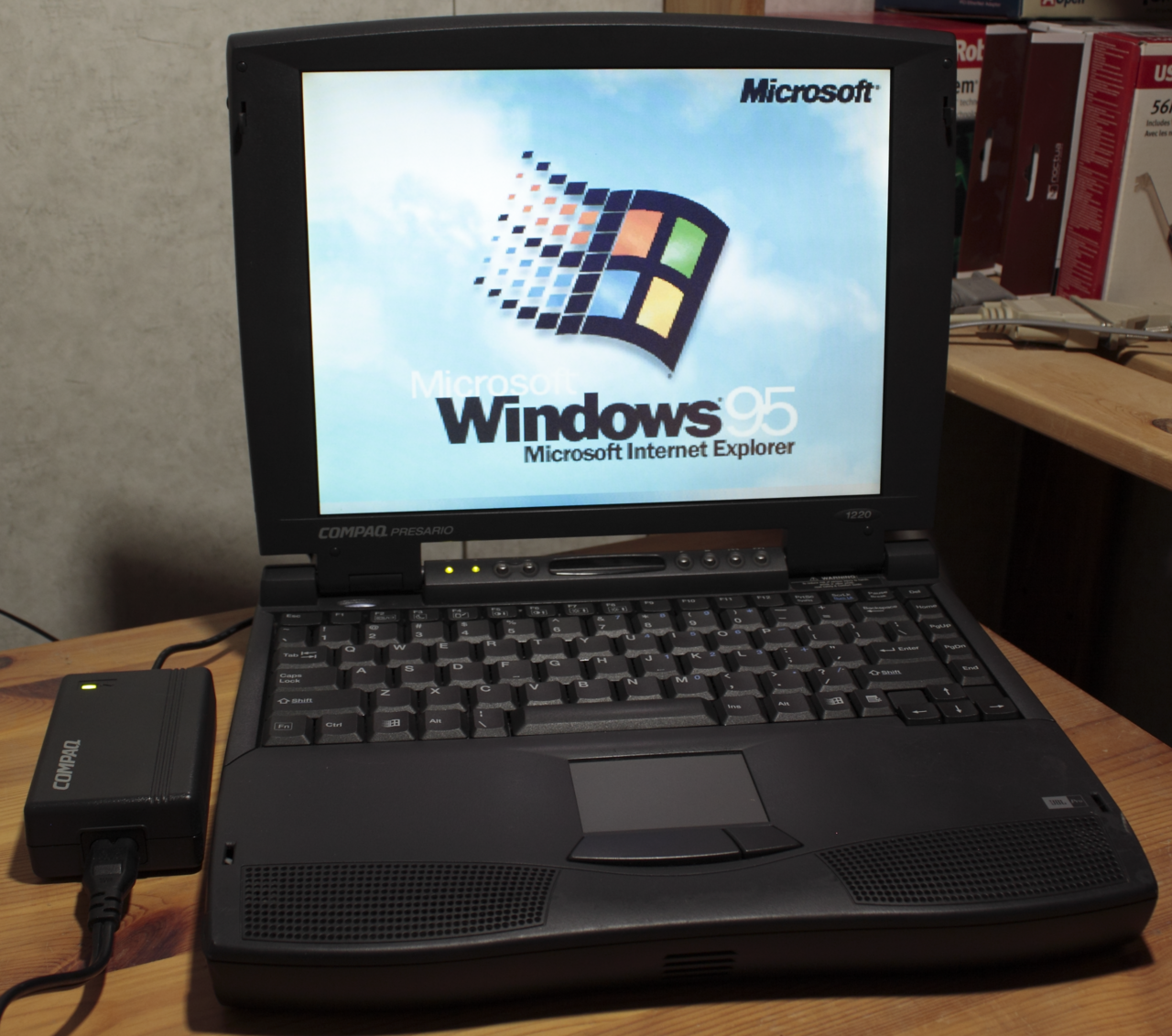
The consumer line that came out of it, the Presario, made Compaq one of the first tier-one manufacturers to sell a PC under $1,000, and Compaq did it partly by buying processors from AMD and Cyrix instead of only Intel (see AMD and the x86 Underdog). In 1994 Compaq passed IBM and Apple to become the largest PC maker in the world. The price war it started ran through the rest of the decade and took out most of the companies that had grown up alongside it.
Dell Removes the Dealer
Michael Dell registered PC’s Limited on 3 May 1984, in his first year at the University of Texas at Austin, with about $1,000 from his family and a dorm room at the Dobie Center. He dropped out after the freshman year. The company’s own machine, the Turbo PC, appeared in 1985 at $795, and the first year grossed over $73 million.
The idea was not the computer. It was that a customer who phoned in an order could describe what they wanted, and the machine would be built after the payment cleared. No dealer took a cut, no distributor held stock, and the inventory in the building was parts rather than finished computers, which mattered in an industry where a component lost value every week it sat on a shelf. Renamed Dell Computer Corporation in 1987, the company went public on 22 June 1988 at $8.50 a share, raising $30 million at an $85 million valuation, and entered the Fortune 500 in 1992 with the youngest CEO on the list.
The web made the model cheaper still: the order form that had required a person on a telephone became a page. Dell passed Compaq in 1999 and was the largest PC vendor in the world by 2001, selling a product it did not design any of the important parts of.
Gateway Sells by Post
Ted Waitt and Mike Hammond started the company as the TIPC Network in September 1985, in an empty upper floor of Waitt’s father’s cattle brokerage in Sioux City, Iowa, on a $10,000 loan from Waitt’s grandmother. The company shipped mail-order PCs in white boxes with black Holstein markings, an advertisement that arrived at the customer’s door and sat in the hallway until someone asked about it.
The revenue line reads like a chart of the whole market: $275 million in 1990, $626 million in 1991, $1.1 billion in 1992, $2.7 billion in 1994, $3.7 billion in 1995, $6.29 billion in 1997. The company moved across the state line to North Sioux City, South Dakota, in January 1990 for the absence of state income tax, and to San Diego in 1998 to be near the industry. It peaked near 25,000 employees in 2000 and was bought by Acer in October 2007 for $710 million.
Packard Bell Puts a PC in Sears
Packard Bell Electronics was incorporated in Chatsworth, Los Angeles, in 1986 by Beny Alagem, Jason Barzilay and Alex Sandel, who bought the rights to a dormant radio brand from Teledyne for just under $100,000. The name was the product: a company nobody had heard of would have trouble getting shelf space in a department store, and a name customers half-remembered from their parents’ living room would not.
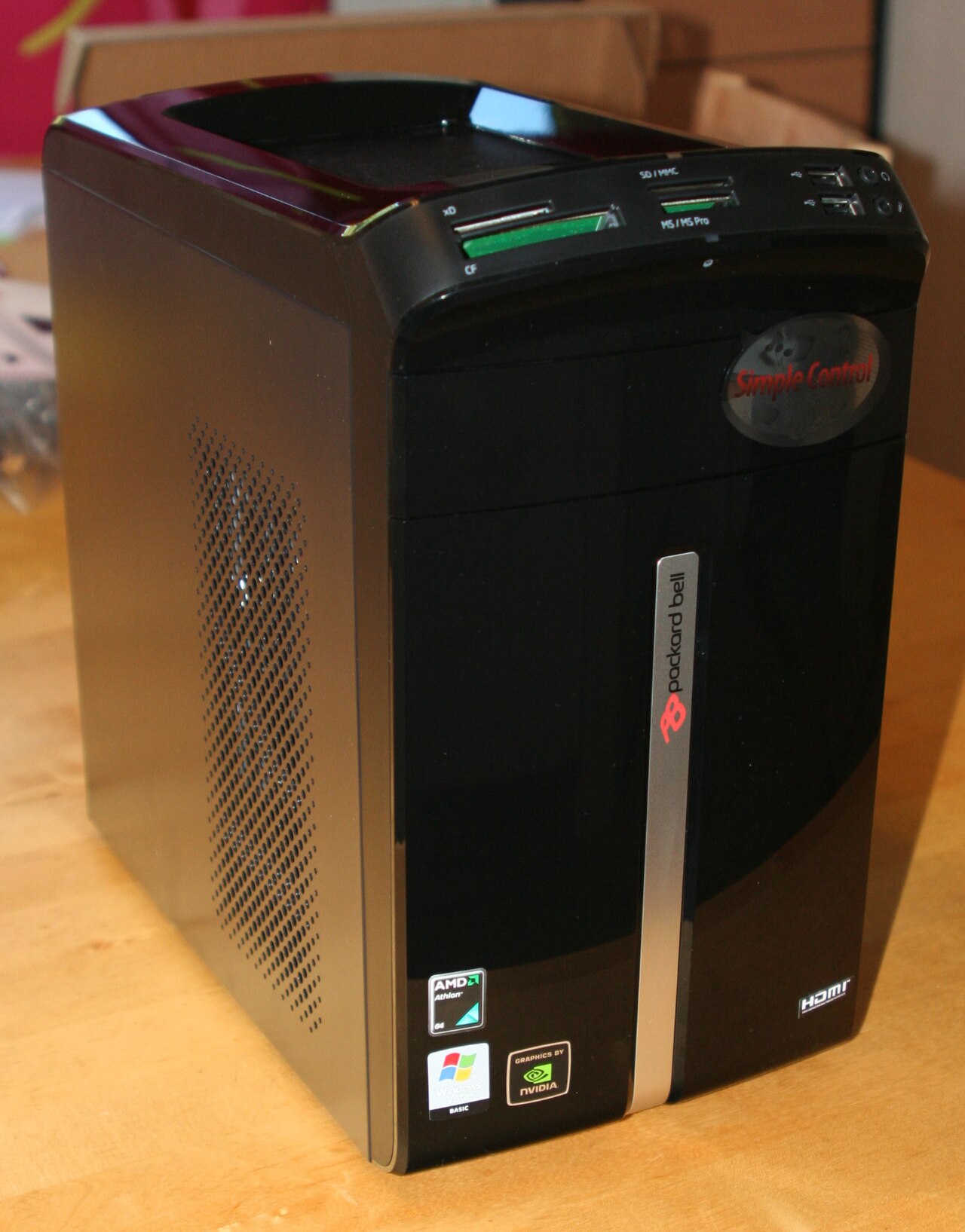
Packard Bell sold through Sears, warehouse clubs and consumer electronics chains at a time when competitors sold by mail order or through computer dealers, and it worked. By 1995 it had passed Compaq for first place in the American market with 13% of sales. The machines came pre-loaded and ready to plug into a television-shaped monitor, aimed at a household buying its first computer.
Intel Inside
In 1991 a San Jose court ruled that a number like “386” could not be trademarked, which meant AMD and Cyrix could sell a 386 and Intel’s advertising had been building a category rather than a brand. Andy Grove (see Andy Grove and Intel) gave Dennis Carter the weekend to come up with something.
Carter had already run the answer as a test. In Denver, Intel had bought billboards and print advertising showing the 286 logo crossed out in red spray paint and explaining why the 386 was worth more, and planned 386 purchases in that market went from 10 or 15 percent to about two-thirds. The generalisation was Intel Inside: a fund holding 3% of Intel’s microprocessor revenue, which a PC maker could draw on to cover up to half the cost of its own advertising, provided the advertisement carried Intel’s logo.
IBM ran one of the first such advertisements in the Wall Street Journal in 1991. By the end of that year 300 PC makers had signed up; by the end of 1992 more than five hundred had, and 70% of eligible advertisements carried the logo. The effect was to make the one component a buyer could not see the one component a buyer asked for, which is the opposite of what commoditisation normally does to a supplier. Intel’s margins stayed while the assemblers’ margins went.
The $799 PC
In July 1997 Compaq put the Presario 2200 on sale at $799, at a time when the average selling price of a PC was around $2,000. By August 1997 machines under $1,000 were close to 40% of American retail desktop sales, a segment that was itself under a tenth of the world market but set the price expectation for all of it.
eMachines, founded in September 1998 by Lap Shun Hui as a joint venture of the South Korean manufacturers Korea Data Systems and TriGem, went further: the eTower 266 and 300 sold at $399 and $499 without a monitor. Six months after launch, in March 1999, eMachines was the fourth-largest PC seller in the United States with 9.9% of the market. It went public on 24 March 2000, at the top of the bubble; by May 2001 the stock was at 38 cents and delisted. Gateway bought the brand in 2004 and Acer discontinued it on 17 January 2013.
At $399 the assembler’s margin is a rounding error. What kept the price falling was that none of the parts were scarce: motherboards, cases, drives and power supplies came from Taiwanese manufacturers who sold to everyone at similar terms (see Taiwan’s Tech Ecosystem), and the same parts were sold loose to the local shop that would build a white-box PC to order for the customer standing at the counter.
Wintel
Two suppliers were not commodities. Every one of these machines ran Microsoft Windows on an x86 processor, and the pairing acquired a name, Wintel. Microsoft’s licence terms charged manufacturers per processor shipped rather than per copy of Windows installed, which meant a manufacturer paid for Windows on a machine sold with something else, and made shipping an alternative operating system economically pointless. Regulators in the United States and Europe made Microsoft abandon the practice, and the antitrust case that followed is covered in The Platform Antitrust Story and The Windows Story.
By 1996 Intel had two competitors in its core market and Microsoft had none. The hardware business had been competed down to a few points of margin, and the money stayed with the two companies that every competitor in that business had to pay.
Dead End: The Retail Channel
Packard Bell’s position depended on shelf space, and shelf space punishes returns. The machines were built to a price and sold to buyers who had never owned a computer, the support lines could not cope, and the quality reputation collapsed while the market share was still at its peak. Groupe Bull and NEC put money in, Packard Bell absorbed Zenith Data Systems in early 1996, and the merger with NEC’s PC business closed that July, with NEC taking a controlling stake in 1998. NEC began pulling the name out of the American market in 1999 and was gone from North America by about 2000, four years after being number one.
The retail channel itself went the same way for PCs. It rewarded whoever could hit a shelf price, which meant cutting the parts a first-time buyer could not evaluate, which produced returns and support costs that the shelf price did not cover. Dell’s direct model won because it could charge for the configuration the customer chose and took no inventory risk, and by the time retail mattered again it was Apple selling its own machines in its own shops at its own margin (see The Macintosh).
What Was Left
The commodity PC did what commodities do: it spread. The average machine sold for around $2,000 in 1997 and the cheap end of the same year’s retail shelf was $799, and the software industry got an installed base to sell to that no vertically integrated platform could have delivered. It also ended the idea that a PC maker was a technology company. Compaq, which had beaten IBM at its own standard, sold itself to HP in 2002; IBM sold its PC division to Lenovo in 2005; Gateway and eMachines became brand names owned by Acer. The companies that had made the boxes were, by then, in the business of buying parts from Taiwan, an operating system from Redmond and a processor from Santa Clara, and finding somewhere to put a sticker.
📚 Sources
- Dell — Wikipedia (PC’s Limited founded 3 May 1984 with about $1,000 while Michael Dell was at the University of Texas at Austin, the Dobie Center dorm room, the 1985 Turbo PC at $795, over $73 million in the first year, the 1987 rename, the 22 June 1988 IPO at $8.50 raising $30 million on an $85 million valuation, the Fortune 500 entry in 1992, passing Compaq in 1999, and the worldwide lead in 2001)
- Gateway, Inc. — Wikipedia (founded as the TIPC Network in September 1985 by Ted Waitt and Mike Hammond with a $10,000 loan from Waitt’s grandmother, the room above his father’s Sioux City cattle brokerage, the Holstein-spotted boxes, revenues from $275 million in 1990 to $6.29 billion in 1997, the January 1990 move to North Sioux City and the 1998 move to San Diego, the 25,000-employee peak in 2000, and the October 2007 Acer acquisition for $710 million)
- Packard Bell — Wikipedia (incorporated in Chatsworth in 1986 by Alagem, Barzilay and Sandel, the trademark bought from Teledyne for just under $100,000, the Sears and warehouse-club channel, 13% of US sales and first place in 1995, the quality and support problems, the Zenith Data Systems deal and the Groupe Bull and NEC stakes in early 1996, the July 1996 merger into Packard Bell NEC and NEC’s controlling stake in 1998, and the withdrawal from North America by about 2000)
- Eckhard Pfeiffer — Wikipedia (the 1991 boardroom change that replaced Rod Canion, the Presario as one of the first sub-$1,000 PCs from a tier-one maker, the use of AMD and Cyrix processors, driving Packard Bell out of the market, Compaq passing IBM and Apple in 1994, and Pfeiffer’s resignation on 17 April 1999)
- Dennis Carter: Behind the Intel Inside campaign — EE Times (the 1991 San Jose ruling that “386” could not be trademarked, Grove’s instruction to Carter, the crossed-out 286 test campaign in Denver and the shift in planned 386 purchases from 10–15% to about two-thirds, the fund holding 3% of microprocessor revenue covering up to half of a maker’s advertising, IBM’s early Wall Street Journal advertisement in 1991, 300 PC makers enrolled by the end of 1991 and more than five hundred by the end of 1992, with 70% of eligible advertisements carrying the logo)
- Intel — Wikipedia (the 1991 launch of Intel Inside and its effect in making a component supplier a household name, with David House credited for the slogan)
- EMachines — Wikipedia (founded September 1998 by Lap Shun Hui as a joint venture of Korea Data Systems and TriGem, the eTower 266 and 300 at $399 and $499 without monitors, fourth place in US sales with 9.9% share by March 1999, the 24 March 2000 IPO, the 38-cent share price and delisting by May 2001, the 2004 Gateway acquisition, and the brand’s discontinuation on 17 January 2013)
- Sub-$1000 PCs and the retail market — Microprocessor Report editorial, 9 March 1998 (the Computer Intelligence figure of nearly 40% of US retail desktop sales for sub-$1,000 machines in August 1997, and the caveat that US retail desktops are under 10% of the world market)
- Compaq: Gone But Not Forgotten — TechSpot (the Presario 2200 at $799 in July 1997 against an average selling price near $2,000)
- Wintel — Wikipedia (the Windows and x86 pairing, the per-processor royalty terms and the regulatory undertaking to end them, and the note that by 1996 Intel had two competitors in its core market while Microsoft had none)
- Image: Packard Bell computer.jpg by David J (CC BY 2.0), via Wikimedia Commons
- Image: Compaq Presario 1220.png by Pirozhkebab (CC BY-SA 4.0), via Wikimedia Commons