Germany's Computing Pioneers
Abstract
Germany’s contribution to computing spans four centuries: from Leibniz’s binary arithmetic through the Z3 to the invention of the stack, Petri nets, and LSTM. The country produced the world’s first data protection law and helped define the vocabulary of the discipline itself, the German word Informatik was coined in 1957 and spread across every language that is not English. Germany’s computing history is not a single narrative but a collection of individuals who worked in isolation, in war, in divided institutions, and in a culture that valued engineering depth over entrepreneurial speed. This article profiles the most significant German figures from academia, industry, and the policy arena that shaped how computers work, how they are programmed, and how their social consequences are governed.
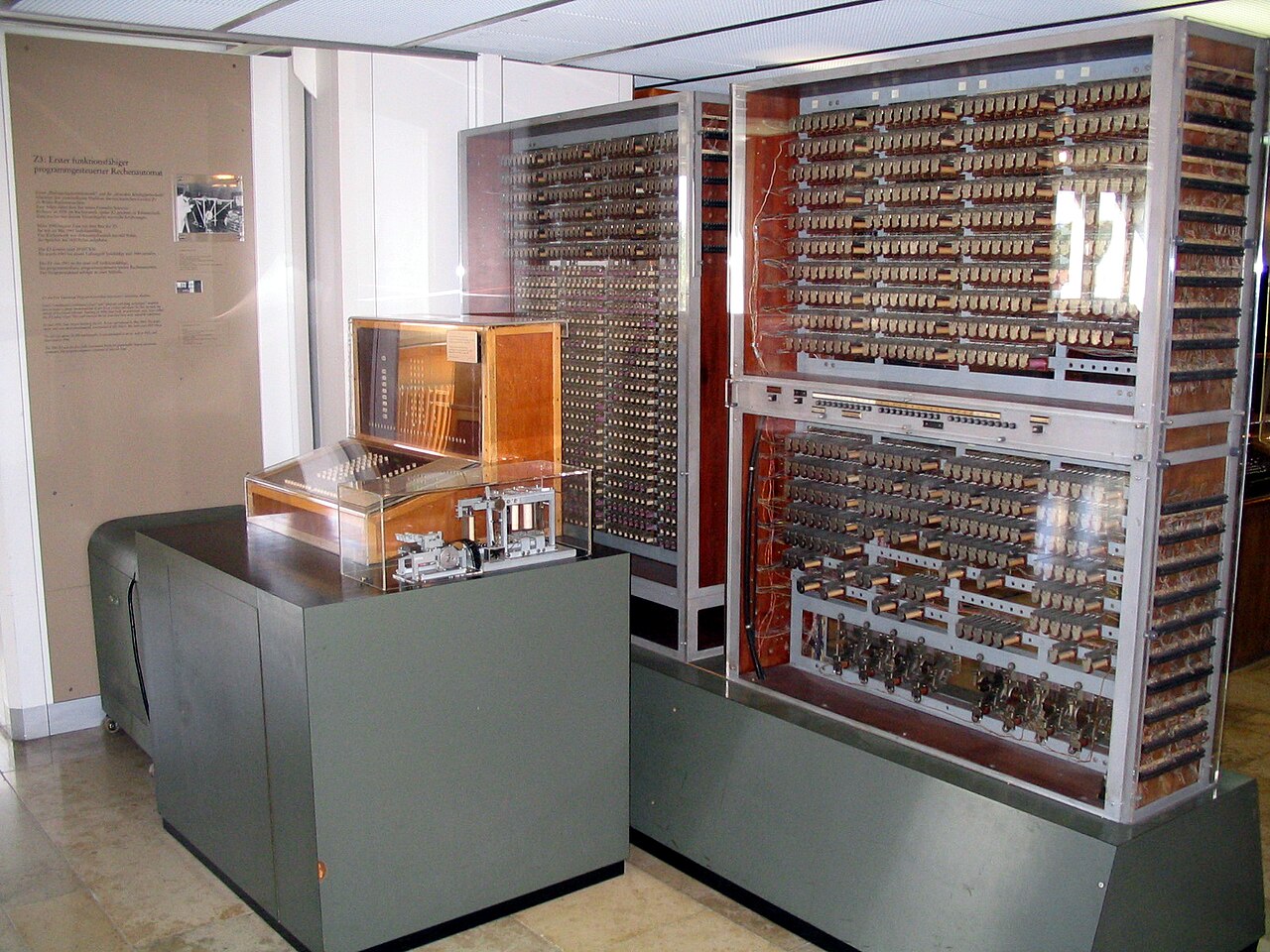
The Calculating Ancestors
German computing prehistory begins with two figures whose work predates electronics by centuries.
Wilhelm Schickard (1592–1635), a professor at the University of Tübingen, built the first mechanical calculator in 1623, a “Rechenuhr” (calculating clock) designed to assist his friend Johannes Kepler with astronomical computations. Schickard’s device could add six-digit numbers automatically and ring a bell on overflow. He described it in letters to Kepler and had a copy built for the astronomer by a clockmaker, but it was destroyed in a fire before delivery. Schickard died of plague in 1635, during the Thirty Years’ War. No working copy survived; the machine was reconstructed from his letters in 1960. Schickard’s priority over Blaise Pascal’s better-known Pascaline (1642) was not established until those letters were rediscovered in the twentieth century, a pattern of delayed recognition that would repeat in German computing history.
Gottfried Wilhelm Leibniz (1646–1716) went further. Between 1671 and 1694 he built the Staffelwalze (Stepped Reckoner), a mechanical calculator capable of multiplication and division, not merely addition. More consequential than the machine was the mathematics behind it. Leibniz independently developed binary arithmetic (the representation of all numbers using only 0 and 1) which he published in 1703 in Explication de l’Arithmétique Binaire. He saw in binary a philosophical elegance: all of creation expressed through two symbols. He did not connect this insight to computing machinery; that connection would take two more centuries. But when Zuse, Shannon, and Turing converged on binary as the natural language of computation, they were working within a framework that Leibniz had laid.
The Enigma Builder
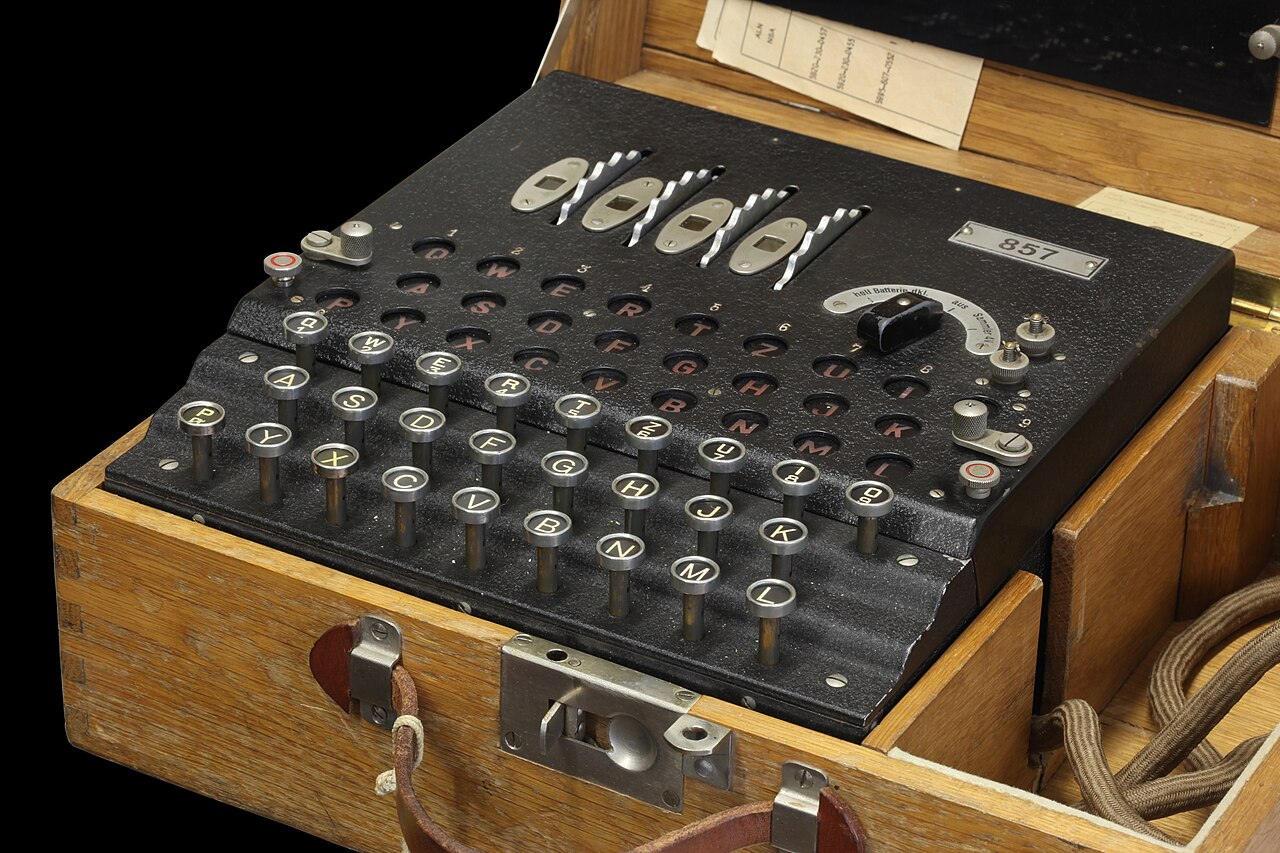
Arthur Scherbius (1878–1929) was an electrical engineer in Berlin who, in February 1918, patented a rotor-based cipher machine he called Enigma. The device used a series of rotating electrical rotors to substitute each typed letter through an ever-changing polyalphabetic cipher, breaking it required knowing not only the machine’s wiring but the daily key settings chosen from a codebook. Scherbius tried and failed to sell Enigma to the German military immediately after the First World War; the Navy adopted it in 1926, the Army in 1928.
Scherbius died in a horse-carriage accident in 1929, before he could see his machine become the most consequential cipher device in history, and before he could see it broken. The British decryption effort at Bletchley Park, building on work by Polish cryptanalysts, broke Enigma with the electromechanical Bombe designed by Alan Turing. The separate effort against the German Lorenz cipher produced Colossus (the first programmable electronic digital computer) laying a foundation for modern computing as a side effect of wartime cryptanalysis. The Enigma’s legacy is thus doubly German: Scherbius’s invention drove an enemy to mechanize codebreaking on an industrial scale. The full story of Enigma’s breaking is told in Alan Turing and the Enigma.
Naming the Discipline: Karl Steinbuch
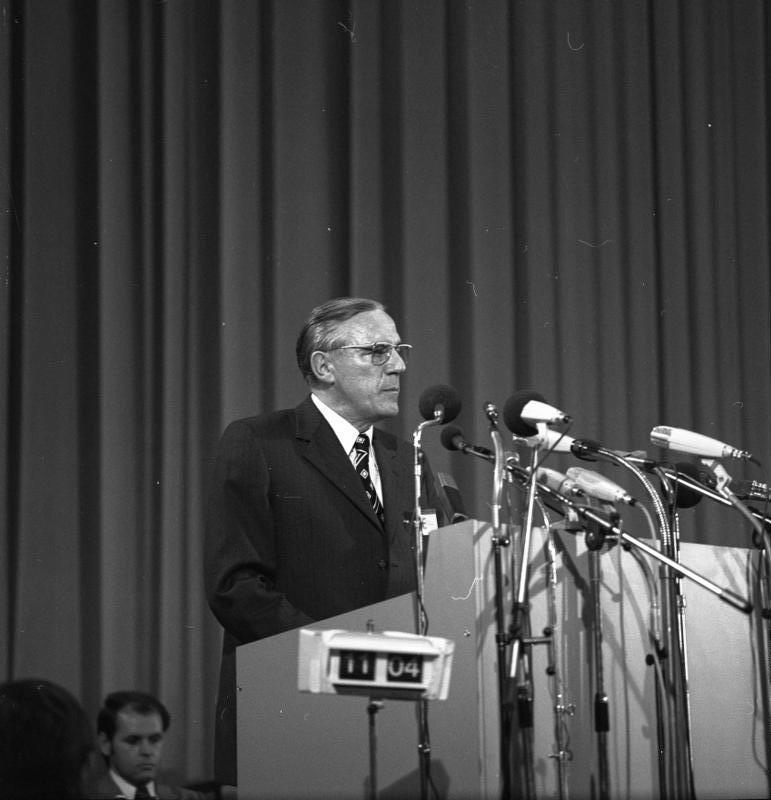
Karl Steinbuch (1917–2005) was a professor at the Karlsruhe Institute of Technology who, in 1957, published a technical report titled “Informatik: Automatische Informationsverarbeitung”, the first use of Informatik as a term for the science of automatic information processing. The word is a portmanteau of Information and Automatik. It spread rapidly through German-speaking Europe and was adopted in French (informatique), Russian (informatika), Spanish (informática), Italian (informatica), and dozens of other languages. English alone kept “computer science”, a machine-centric term that Steinbuch considered less precise.
Steinbuch’s contributions went beyond terminology. In 1961 he published his design for the Lernmatrix, a hardware neural network model in which a matrix of connections could be adjusted by experience to recognize patterns. The Lernmatrix anticipated key ideas in machine learning more than two decades before the field existed as a discipline. Steinbuch understood what his device was doing: “The Lernmatrix learns,” he wrote, “it does not merely execute.” He spent the latter part of his career warning that automation would transform labor markets in ways society was unprepared to manage, a warning ignored in his lifetime and increasingly urgent after his death.
Inventing the Stack: Friedrich Bauer and Klaus Samelson
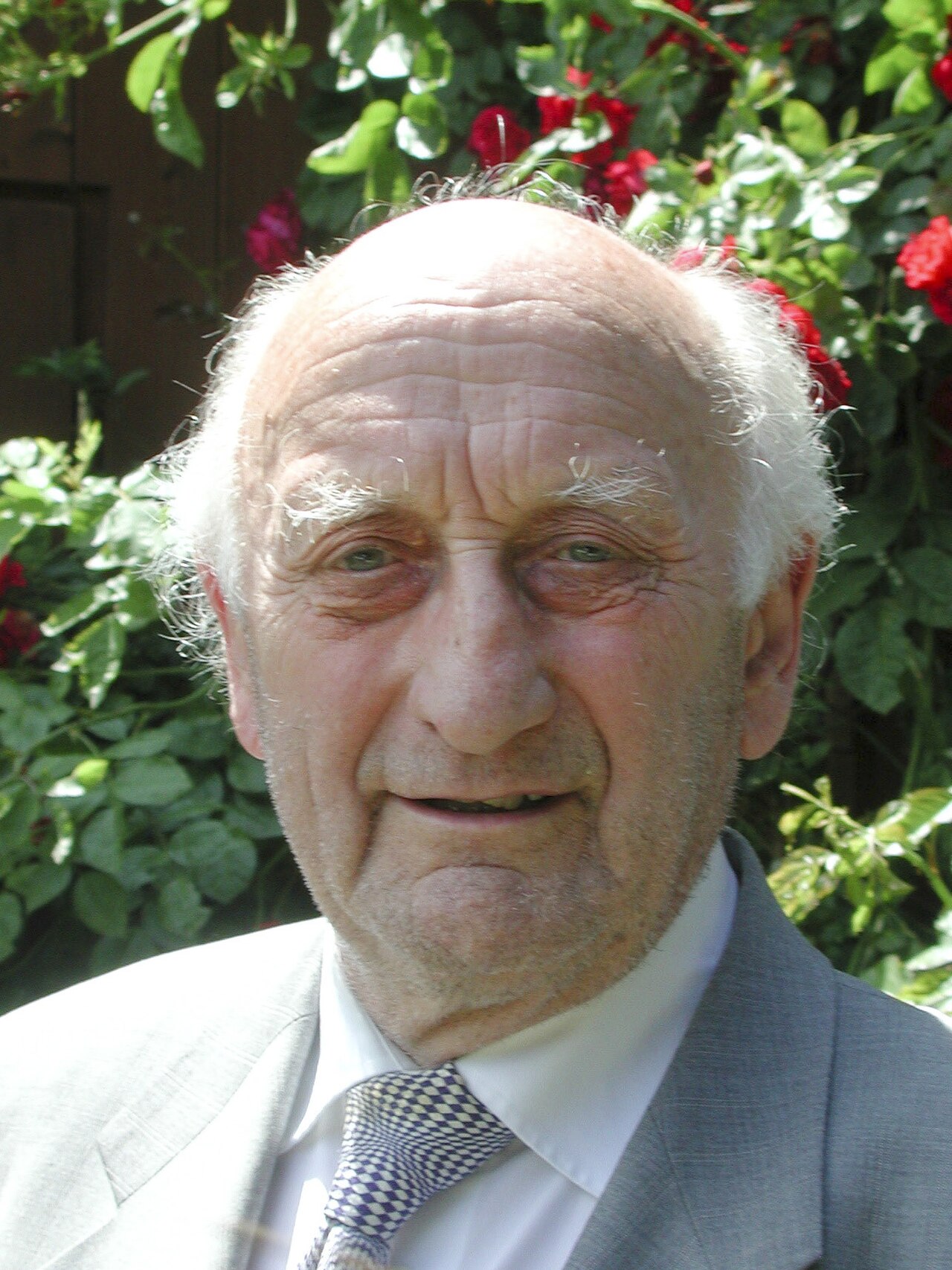
The call stack (the data structure that underlies every function call in every programming language) was invented at the Technical University of Munich.
Klaus Samelson (1918–1980) and Friedrich Ludwig Bauer (1924–2015) developed the concept between 1955 and 1957, calling it the Kellerspeicher (cellar store, or push-down store). Their insight was that nested computational expressions (arithmetic with parentheses, function calls within function calls) could be evaluated correctly and efficiently by maintaining a last-in, first-out stack of intermediate values and return addresses. This provided the mechanical basis for recursive programming, for compilers that translated high-level code to machine instructions, and eventually for the structured programming paradigm.
Bauer and Samelson filed a patent on the concept in 1957 and published it in 1959, and implemented it in their work on ALGOL, the language that established structured programming conventions still present in every mainstream language today. Their design influenced the ALGOL 60 compiler, which in turn influenced every compiler that followed. Bauer went on to co-found the Gesellschaft für Informatik (GI) in 1969 (Germany’s computer science professional society) and to establish the Munich school of programming theory, which shaped a generation of German computer scientists.
Bauer’s influence reached well beyond the stack. He served on the committees that designed both ALGOL 58 and ALGOL 60, and on October 11, 1968, at the NATO Science Committee conference in Garmisch that he had helped instigate, he gave the lecture that coined the term software engineering, the founding moment of the discipline (see The Software Crisis). He later defined it as the “establishment and use of sound engineering principles to economically obtain software that is reliable and works on real machines efficiently.” Bauer was also one of Germany’s leading academic cryptologists: his textbook Entzifferte Geheimnisse (Decrypted Secrets), which ran through four editions, connected the mathematical tradition of cryptology to computer science teaching. The IEEE honored him with the Computer Pioneer Award in 1988.
Info
The stack is so fundamental that it is easy to forget it was invented. Every time a program calls a function and returns from it correctly (maintaining local variables, passing arguments, resuming execution at the right point) it relies on the Bauer-Samelson stack. The concept appears in hardware (the x86 stack pointer), in virtual machines (the JVM operand stack), and in every recursive algorithm. It was not obvious before 1955.
Concurrent Systems: Carl Adam Petri
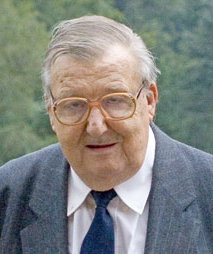
Carl Adam Petri (1926–2010) solved a problem that von Neumann architecture sidesteps: how to model systems where multiple processes happen simultaneously and interact with shared resources.
Petri’s 1962 doctoral dissertation at TH Darmstadt, “Kommunikation mit Automaten” (Communicating with Automata), introduced what became known as Petri nets, a mathematical formalism using places (states), transitions (events), and tokens (resources) to model concurrency. A Petri net can represent deadlock, livelock, and race conditions formally, making them analyzable rather than merely observable. The formalism proved applicable to operating systems, communication protocols, manufacturing processes, biological systems, and workflow modeling.
Petri spent most of his career at the Gesellschaft für Mathematik und Datenverarbeitung (GMD) in Bonn, developing the theoretical foundations of concurrent computation in a period when the field was dominated by sequential models. His nets became a standard tool for formal verification of distributed systems, the mathematical apparatus that makes it possible to prove that a concurrent system cannot deadlock, not just test that it has not deadlocked yet.
The Forgotten Mouse: Rainer Mallebrein
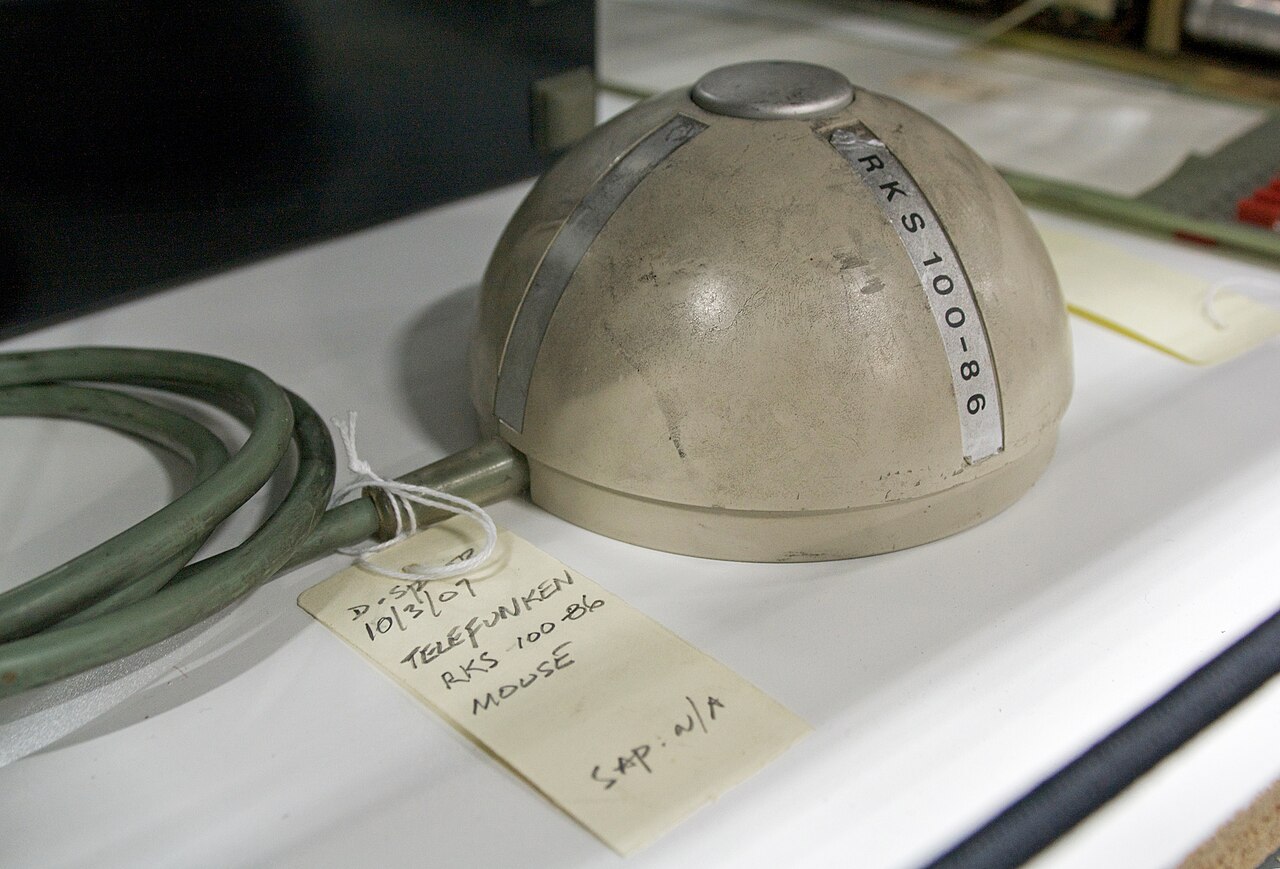
Rainer Mallebrein (born 1934) led a Telefunken team in Konstanz that built a trackball console for the Bundesanstalt für Flugsicherung (German air-traffic control). In 1966, prompted by a university customer, he “reversed” the trackball into a movable device, a mouse, developed with no knowledge of Douglas Engelbart’s parallel work at SRI. The Rollkugel RKS 100-86 was finished in early 1968 and publicly offered on October 2, 1968 (two months before Engelbart’s Mother of All Demos) as an optional input device (price: 1,500 DM) for the SIG 100-86 vector terminal of Telefunken’s TR 86 and TR 440 computers.
Technically it was ahead of its American cousin: where Engelbart’s mouse ran on two perpendicular wheels, the Rollkugel already used the rolling ball that Bill English would introduce at Xerox PARC only in 1972, the standard design until the optical mouse. But Telefunken’s patent application was reportedly rejected for “mangelnde Erfindungshöhe” (insufficient inventive step), only 46 systems were sold (mostly to German universities) and the invention was forgotten for decades. In 2019, Mallebrein donated one of the four known surviving Rollkugeln to the Heinz Nixdorf MuseumsForum in Paderborn. The episode compresses this article’s recurring pattern into a single object: German engineering that was early, excellent, commercially marginal, and unrecognized until it reached a museum.
The Cipher Foundation: Horst Feistel
Horst Feistel (1915–1990) was born in Berlin, emigrated to the United States, and spent his career at IBM Research. In the early 1970s he designed the Feistel cipher, a symmetric encryption structure in which plaintext is divided into two halves and processed through multiple rounds of mixing, with each round using a subkey derived from the master key. The structure is invertible: encryption and decryption use the same algorithm with the keys applied in reverse order.
The Feistel structure became the basis for DES (Data Encryption Standard), adopted by the US National Institute of Standards and Technology in 1977 as the first standardized encryption algorithm for civilian use. DES’s architecture, including its Feistel network, influenced every major symmetric cipher that followed: 3DES, Blowfish, Twofish, and the structural thinking behind AES. The Feistel construction (an elegant solution to making encryption reversible without requiring the reverse function to be trivially simple) remains in active use fifty years after Feistel developed it. The full history of cryptographic development is covered in Cryptography: The Secret Science.
Industry Builders
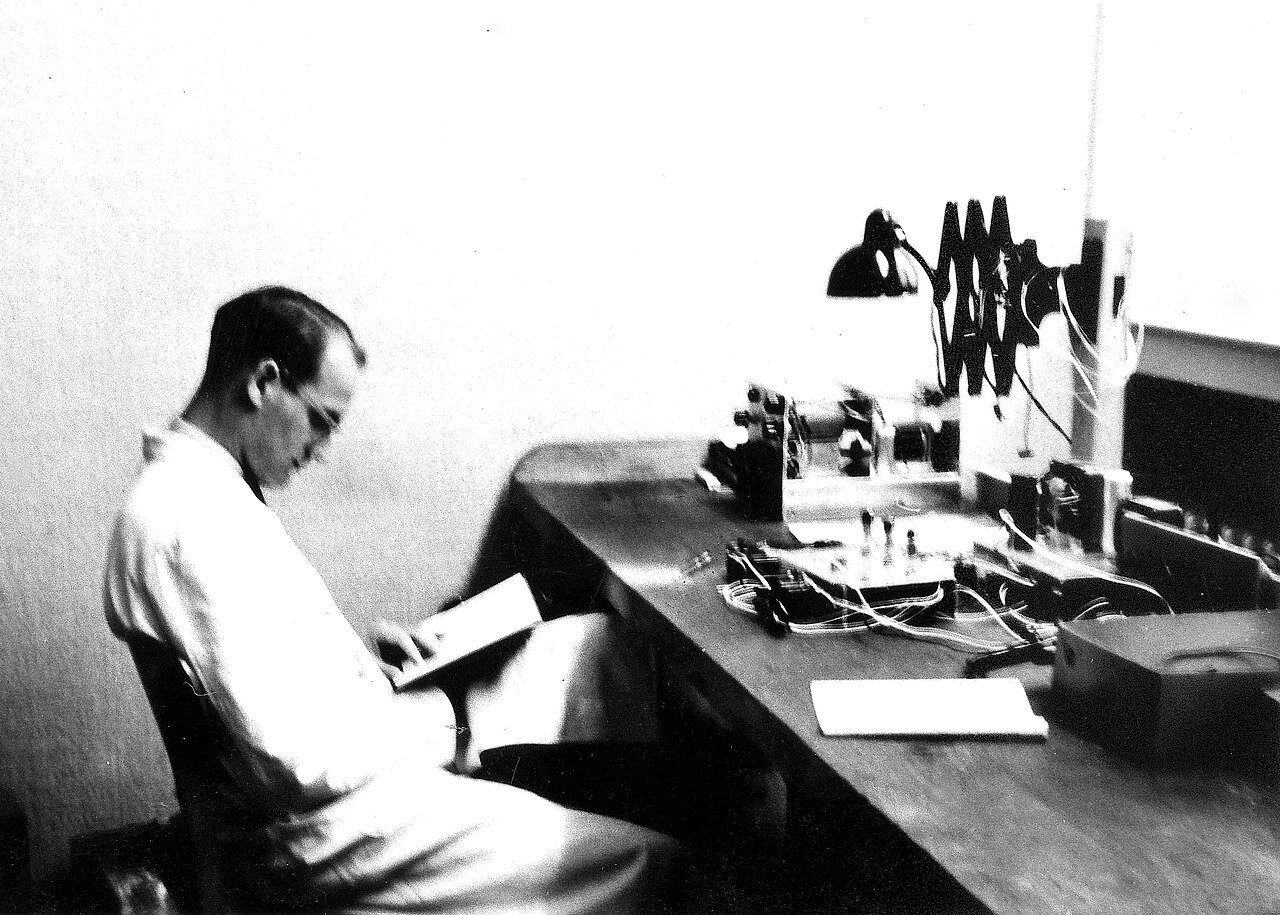
Heinz Nixdorf (1925–1986) founded the Labor für Impulstechnik in Essen in 1952 (bankrolled by a DM 30,000 advance from the utility RWE) and grew it into Germany’s most successful independent computer company; in 1968 he acquired Wanderer-Werke and renamed the firm Nixdorf Computer AG, headquartered in his native Paderborn. Nixdorf specialized in minicomputers and point-of-sale systems, reaching annual revenues of nearly DM 4 billion by the mid-1980s. His business philosophy was distinctly German: deep domain expertise, long customer relationships, and engineering that served specific industrial needs rather than platform ambitions. Nixdorf died of a heart attack at the CeBIT trade fair in 1986; after heavy losses under his successor, the company merged into Siemens Nixdorf Informationssysteme in 1990 (the fuller story is in Germany’s IT Industry).
The SAP founders (Dietmar Hopp, Hasso Plattner, Hans-Werner Hector, Klaus Tschira, and Claus Wellenreuther) left IBM Germany in 1972 to build integrated business software. Hasso Plattner (born 1944) became the most publicly visible of the five, shaping SAP’s technical vision through the transition from mainframe to client-server (SAP R/3, 1992) and later to in-memory computing (SAP HANA, 2010). Plattner was the internal advocate for the HANA architecture, a column-store, in-memory database that eliminated the performance bottleneck separating transactional and analytical systems. SAP’s story as a company is covered in Germany’s IT Industry; here it is worth noting that SAP’s founding was an act of technical judgment as much as entrepreneurship: five engineers who had seen IBM’s internal systems decided they could build something better, and were correct.
Connecting Germany to the Internet: Werner Zorn
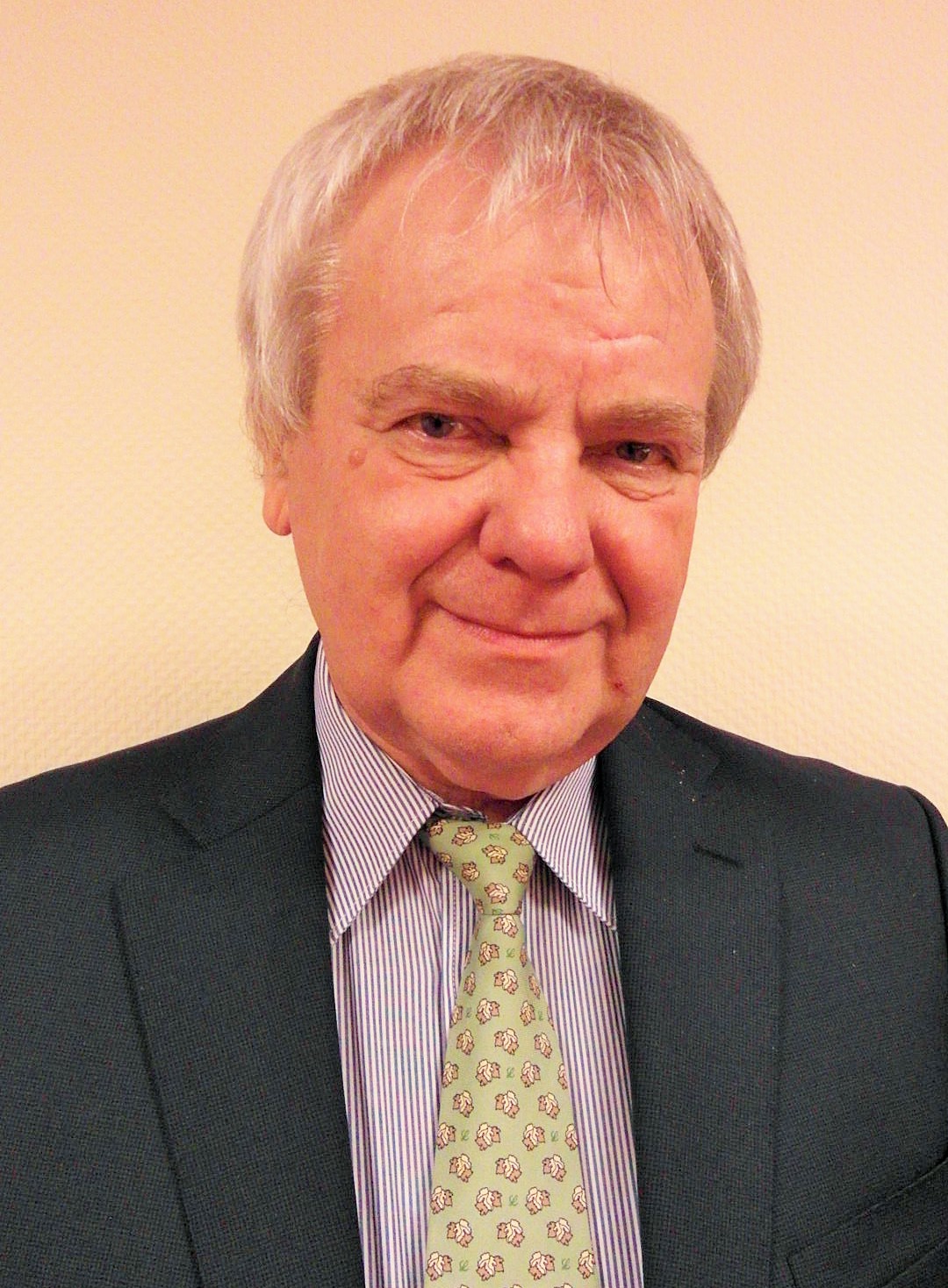
On August 2, 1984, Germany received its first connection to the international internet. The link (to CSNET, the Computer Science Network that predated the public internet) was established at the University of Karlsruhe under Werner Zorn, a professor who had persistently pursued international connectivity against institutional resistance and the telecommunications monopoly of the Deutsche Bundespost.
Zorn’s effort was not merely technical. The Bundespost treated data communication as a postal monopoly and was suspicious of external network connections that bypassed its infrastructure. Zorn negotiated, lobbied, and demonstrated that academic collaboration required international connectivity, arguments that succeeded incrementally. The 1984 CSNET connection was followed by a full TCP/IP connection in 1989 and by Germany’s participation in the public internet’s rapid growth in the early 1990s. Germany was not early to the internet (the US and UK were years ahead) but Zorn’s work ensured that the delay was measured in years rather than decades.
Privacy as Technology Policy: Simitis and Steinmüller
Germany’s most distinctive contribution to the social governance of computing came not from engineers but from legal scholars who understood that the emerging technology required new rights, not merely new regulations.
Wilhelm Steinmüller (1934–2013), a professor at the University of Regensburg, developed the concept of informationelle Selbstbestimmung (informational self-determination) which holds that individuals have a fundamental right to control how information about themselves is collected, stored, and used. This framing, grounded in the German constitutional tradition of human dignity (Menschenwürde), was more philosophically radical than American privacy law, which treated privacy primarily as freedom from government intrusion. Steinmüller argued that data about a person is part of that person’s identity; to collect and use it without consent is to appropriate something that belongs to them.
Spiros Simitis (1934–2023) translated this philosophy into law. As Hessian Data Protection Commissioner from 1975 to 1991, he administered the Hessisches Datenschutzgesetz, the Hessian Data Protection Act of 1970, the world’s first comprehensive data protection statute. Under Simitis, Hesse became a testing ground for data protection enforcement: he challenged corporate data collection practices, advised European legislators, and argued consistently that the distinction between public and private sector data collection was artificial, since both threatened individual autonomy.
The ideas that Steinmüller and Simitis developed became the philosophical foundation of Germany’s 1977 federal data protection law (Bundesdatenschutzgesetz), of the 1983 German Federal Constitutional Court ruling on the census (Volkszählungsurteil) that enshrined informational self-determination as a constitutional right, and ultimately of the European Union’s General Data Protection Regulation (GDPR) of 2018. When the GDPR imposed data protection requirements on every company serving European users (effectively reshaping the data practices of Google, Facebook, Apple, and Amazon) it was applying principles that Steinmüller theorized and Simitis enforced in Hesse fifty years earlier.
Warning
The German historical context behind this legal tradition is not abstract. The Nazi regime’s Volkskartei (population register) was used to identify and persecute Jews, Roma, and political opponents. The East German Stasi maintained files on approximately one in three citizens of the GDR, using informants, intercepted mail, and physical surveillance at an intensity unmatched by any other state. German privacy advocates were not being paranoid when they argued that data collection was inherently dangerous; they had specific historical evidence.
Modern AI Pioneers
Germany’s contribution to contemporary artificial intelligence comes primarily from two researchers whose work spans the boundary between German academia and international research institutions.
Jürgen Schmidhuber (born 1963 in Munich) developed, with his student Sepp Hochreiter, the Long Short-Term Memory (LSTM) architecture, published in 1997. LSTMs solved the vanishing gradient problem that had prevented recurrent neural networks from learning long-range dependencies in sequences: gradients used to train the network shrank exponentially as they propagated backward through time, making early inputs irrelevant to the training signal. The LSTM’s gating mechanism (learned controls over what to remember and what to forget) maintained information across long sequences. LSTMs became the dominant architecture for speech recognition, machine translation, and time-series prediction through the 2010s, and were directly used in Google’s speech recognition, Apple’s Siri, Amazon’s Alexa, and early neural machine translation systems. Schmidhuber’s broader body of work includes early work on meta-learning, artificial curiosity, and program search, ideas that anticipate several directions in contemporary AI research.
Bernhard Schölkopf (born 1968), director of the Max Planck Institute for Intelligent Systems in Tübingen, built foundational work on kernel methods (mathematical techniques for learning patterns in high-dimensional data) that enabled support vector machines (SVMs) to become practical tools for classification and regression. His work on the kernel trick (representing data implicitly in very high-dimensional spaces without computing those representations explicitly) gave practitioners powerful methods for pattern recognition that did not require deep networks. Schölkopf has more recently focused on causality in machine learning: the difference between correlation, which statistical models learn, and causal relationships, which enable reliable generalization to new conditions. This work addresses one of the deepest problems in applied AI: why models that perform well on training data fail in deployment when the world changes.
Kurt Mehlhorn (born 1949), longtime director at the Max Planck Institute for Informatics in Saarbrücken, is Germany’s most decorated algorithmist. His work spans computational geometry, graph algorithms, and algorithm engineering, the science of implementing theoretical algorithms so that they perform well in practice, not just in asymptotic analysis. With Stefan Näher he created LEDA (Library of Efficient Data Types and Algorithms), a software library that demonstrated how theoretically sound algorithms could be packaged for practical use. Mehlhorn’s influence on European computer science is structural as well as technical: he shaped the research agenda of the MPI for Informatics for decades and trained many of the researchers who now lead European algorithms research.
The GI and the Academic Infrastructure
The Gesellschaft für Informatik (GI), founded in 1969 by Bauer and colleagues, institutionalized German computer science in the way that the ACM and IEEE did for American computing. The GI established standards for the discipline, organized conferences, published research, and lobbied for computer science’s recognition as an independent academic field, at a time when German universities classified computing as a branch of mathematics or engineering. This institutional work, less visible than individual research breakthroughs, made possible the careers of Mehlhorn, Schölkopf, and the generation that followed.
Germany also houses two of the world’s most productive computing research institutions: the Fraunhofer Society (applied research, with a computing division that spans embedded systems, security, and AI) and the Max Planck Society (basic research, with institutes for informatics in Saarbrücken, software systems in Kaiserslautern, and intelligent systems in Tübingen). Both institutions operate on a model unusual outside Germany: state-funded, with academic independence, pursuing research with long time horizons. They produce results that industry eventually uses but is unwilling to fund directly. Schölkopf’s causality work and Mehlhorn’s algorithm engineering came out of this system.
A Pattern of Delayed Recognition
Looking across these figures, a structural pattern emerges. Schickard’s calculator was lost for centuries. Leibniz’s binary arithmetic waited two hundred years for application. Zuse’s Plankalkül was unpublished for twenty-seven years. Steinbuch’s Lernmatrix predated its field by two decades. Bauer and Samelson’s stack was fundamental but anonymous. Simitis’s privacy framework was implemented globally forty years after he developed it.
German computing history is repeatedly characterized by technical depth that arrived before its institutional context existed to receive it. The ideas were correct; the recognition came late. This pattern reflects the same structural features that explain why Germany never produced a Google or a Microsoft: patient depth rather than rapid diffusion, institutional thoroughness rather than platform speed. The pioneers profiled here shaped computing in ways that often became visible only after others built on their foundations, sometimes without knowing whose foundations they were.
📚 Sources
- Wikipedia: Wilhelm Schickard
- Wikipedia: Gottfried Wilhelm Leibniz — Binary System
- Wikipedia: Arthur Scherbius
- Karl Steinbuch — coined the term Informatik (1957, “Informatik: Automatische Informationsverarbeitung,” SEG-Nachrichten)
- Wikipedia: Friedrich Ludwig Bauer
- Wikipedia: Klaus Samelson
- Wikipedia: Stack (data structure) — History
- Wikipedia: Carl Adam Petri
- Wikipedia: Petri net
- Wikipedia: Horst Feistel
- “Rollkugel-Erfinder gibt allererste PC-Maus nach Paderborn” — heise online (2019)
- Wikipedia: Computer mouse — Telefunken Rollkugel RKS 100-86
- Wikipedia: Feistel cipher
- Wikipedia: Heinz Nixdorf
- The First German Internet Email (Werner Zorn, 1984) — KIT Department of Informatics
- Wikipedia: History of the Internet in Germany
- Wikipedia: Spiros Simitis
- Wikipedia: Hessisches Datenschutzgesetz
- Wikipedia: Informationelle Selbstbestimmung
- Long short-term memory — Wikipedia
- Wikipedia: Jürgen Schmidhuber
- Wikipedia: Bernhard Schölkopf
- Wikipedia: Kurt Mehlhorn
- Max Planck Institute for Intelligent Systems: Bernhard Schölkopf
- Gesellschaft für Informatik — Wikipedia
- Image: Z3 Deutsches Museum.JPG by Venusianer at German Wikipedia (CC BY-SA 3.0), via Wikimedia Commons
- Image: Enigma-IMG 0487-black.jpg by Rama (CC BY-SA 2.0 fr), via Wikimedia Commons
- Image: Bundesarchiv B 145 Bild-F046476-0002, München, CSU-Parteitag, Steinbuch.jpg by Storz (CC BY-SA 3.0 de), via Wikimedia Commons
- Image: FriedrichLudwigBauer.jpg by Hcii (CC BY-SA 3.0), via Wikimedia Commons
- Image: Carl adam petri.jpg by Michael Krapp; derivative work: AwOc (CC BY-SA 3.0), via Wikimedia Commons
- Image: Telefunken Rollkugel RKS 100-86.jpg by Marcin Wichary (CC BY 2.0), via Wikimedia Commons
- Image: Heinz Nixdorf RWE Essen 1952.JPG by Heinz Nixdorf MuseumsForum (CC BY-SA 3.0 de), via Wikimedia Commons