Manfred Mohr
Abstract
Manfred Mohr (born 1938) is a German artist who taught himself Fortran in Paris in 1969, persuaded the French weather service to let him use its CDC 6400 and plotter at night, and in 1971 had the first one-person museum show of art calculated by a computer and drawn by a plotter. Since 1973 he has worked on a single subject, the cube, followed into four, six and eventually eleven dimensions, with every work generated by an algorithm he writes himself. He has lived in New York since 1980.
Jazz, Action Painting and Bense
Mohr was born in Pforzheim on 8 June 1938. He studied painting at the city’s Kunst- und Werkschule from 1957 to 1961 and earned money as a jazz musician on tenor saxophone and oboe. His paintings of 1960 were abstract expressionist action paintings. In 1961 he read the information aesthetics of the Stuttgart philosopher Max Bense, the same theory that shaped the first computer artists in Stuttgart (see Georg Nees and Frieder Nake). “Bense influenced my whole thinking,” Mohr said in 2012. What he took from Bense was the demand for a rational art in a technological age; his own geometric signs of the early 1960s, he later said, were rational in execution but not in content.
In 1962 he moved to Barcelona and gave up colour; for the next 36 years he worked only in black and white. From 1963 he had a studio in Paris, studied lithography at the École des Beaux-Arts from 1964 to 1967, and moved towards hard-edge geometric painting. His first one-person exhibition was at the Galerie Daniel Templon in Paris in 1968.
Fortran and the Weather Service
In 1967 Mohr met Pierre Barbaud, a French composer who was already writing music with a computer. Their conversations convinced him that the rules behind his pictures could be written down as a program, and in 1969 he taught himself Fortran IV. That year he was a founding member of the seminar “Art et Informatique” at the new University of Vincennes, and published Artificiata I, a book of visual poetry that was his last hand-drawn work.
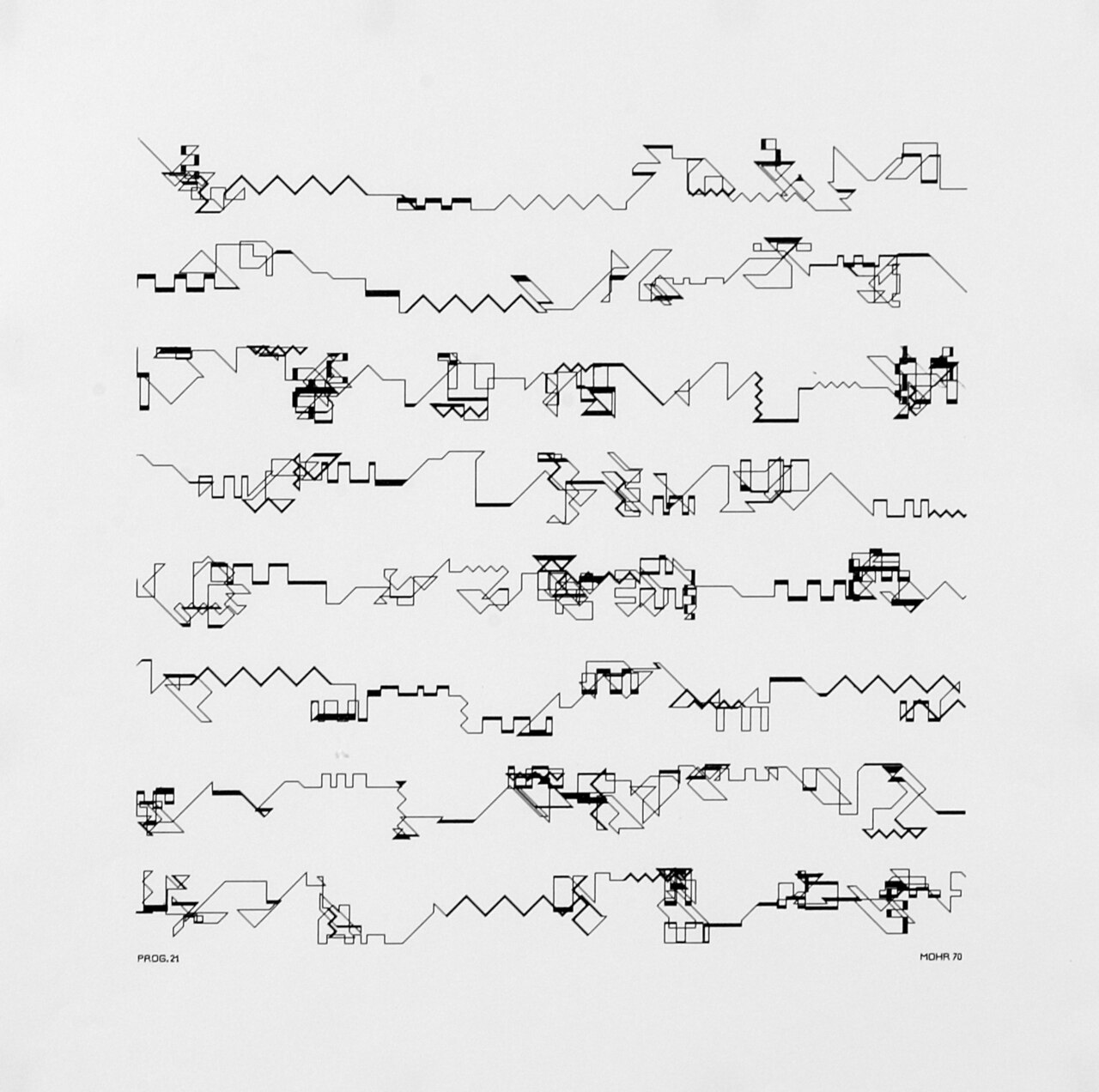
His first programs ran on an SDS computer at Vincennes that had no plotter, so he drew the results by hand from the printed numbers. A friend ran one program on a light-beam plotter at Brookhaven National Laboratory; in 1970 he plotted P-21 on a Zuse plotter driven by an IBM 7040 at the university in Darmstadt.
The machine he needed stood at the Météorologie Nationale, France’s weather service, in Paris. Mohr had seen its automatic drawing table on French television. The service turned him down, so he wrote to the Ministry of Transport, which oversaw it, and was invited to see the minister, who told him, by Mohr’s account: “Young man, when I was young, I also wanted to be an artist.” From June 1970 he was allowed to work there at night and at weekends, on a CDC 6400 and a Benson flatbed pen plotter with a drawing area of about one metre by 1.3 and a resolution of a tenth of a millimetre. He kept coming almost every night until 1983. On 6 November 1973 the TF1 channel broadcast an interview with him.
Paris 1971
From 11 May to 6 June 1971 the ARC, the experimental department of the Musée d’Art Moderne de la Ville de Paris, showed Manfred Mohr: Computer Graphics, Une Esthétique Programmée, curated by Pierre Gaudibert. It was the first one-person museum exhibition of works calculated entirely by a digital computer and drawn by a plotter. Besides more than twenty framed drawings, Mohr installed a Benson 1284 plotter with its tape drive in the gallery, and put up a large white panel on which visitors could write what they liked.
Not everyone liked the idea. “People threw eggs at me,” Mohr told The White Review in 2012. “They said I was destroying art, that I was using military equipment to make art.” In the art world of the time, he said, “computer was a bad word.”
Numbering
Mohr’s works carry P-numbers in order of creation, often with a letter for variants: P-21 is one of the random-walk drawings of 1970, P-021-G one of its versions, P-133 a 1972 drawing that was made into a printed circuit. The numbering runs on across five decades and every change of hardware.
The Cube
In 1973 Mohr fixed his subject. Cubic Limit treated the twelve edges of a cube as an alphabet: the program chose and combined edges by rules, and each drawing was one sentence in that language. The short film Cubic Limit (1973–1974), three minutes long, took him six months to compute and plot. Cubic Limit II (1976–1977) cut the cube into windows and clipped views.
In 1977 he moved to the four-dimensional hypercube, using graph theory to pick “diagonal paths” through it and projecting them onto the page. He extended the system to five and six dimensions in 1989 and later to eleven, the basis of klangfarben (2007) and parallelResonance (2010). In 1991 he had diagonal paths cut from steel plate with a laser (Laserglyphs). In 1998, after 36 years, he brought colour back. The Sun workstations he had been using could not be modified, so in 2002 he designed and built small PCs to run space.color as slow animations on flat screens; space.color.motion was first shown that year on a Windows XP computer.
He insists that none of this is mathematical art. “The idea of developing a logic with an algorithm that results in a visual outcome is the basis of my art,” he said in 2018, and the mathematician Estarose Wolfson, his partner since they met in Paris in 1969, checks his programs for logical errors.
New York and Recognition
Mohr moved to New York in 1980, though he kept using the weather service’s computer until 1983; in 1983 he set up his first computer studio at home, with a DEC LSI-11/23 and a plotter. The Wilhelm-Hack-Museum in Ludwigshafen gave him his first retrospective in 1987. In 1990 he received the Golden Nica of the Prix Ars Electronica in Linz, the festival Herbert W. Franke had co-founded, and the Camille Graeser Prize in Zurich. The Kunsthalle Bremen showed him in 2007, and in 2013 the ZKM in Karlsruhe, then directed by Peter Weibel, mounted The Algorithm of Manfred Mohr, 1963–Now. The same year ACM SIGGRAPH gave him its Distinguished Artist Award for Lifetime Achievement in Digital Art. His work is held by the Centre Pompidou and the Stedelijk Museum, among others (see Computer Art and Generative Art).
📚 Sources
- Manfred Mohr: Biography (artist’s site: birth, education, music, Barcelona, Paris, Barbaud, Vincennes, Wolfson, New York, awards, retrospectives)
- Manfred Mohr: Algorithms, works and computers, 50-year timeline (artist’s site: SDS at Vincennes, P-133, Brookhaven, Darmstadt Zuse plotter and IBM 7040, CDC 6400 and Benson plotter from June 1970 to 1983, LSI-11/23, self-built PCs, Cubic Limit, hypercube dimensions)
- Manfred Mohr: Paris 1971 and Météorologie Nationale (artist’s site: ARC exhibition dates, curator, Benson 1284 plotter, guest-book panel, TF1 broadcast of 6 November 1973)
- Gerhard Schimpf, “Artist Manfred Mohr talks about the Digital Transformation” (16 May 2018) (German Chapter of the ACM: Bense, Barbaud, the ministry and the minister’s remark, Wolfson, the algorithm quote)
- Alice Hattrick, “Interview with Manfred Mohr”, The White Review (December 2012) (Bense quote, eggs, Cubic Limit film)
- Wikipedia: Manfred Mohr (collections, retrospectives)
- Rhizome: “The Algorithm of Manfred Mohr. 1963–now, ZKM Karlsruhe, June 8 – Sept 1, 2013”
- Image: Manfred Mohr P021G.jpg by Manfred Mohr, New York (CC BY-SA 4.0), via Wikimedia Commons