Aaron Swartz: The Internet's Own Boy
Abstract
Aaron Swartz was a prodigy who helped build the open internet before he was old enough to drive, and a martyr who died defending the principle that publicly funded knowledge should be publicly accessible. At 14 he co-authored the RSS 1.0 specification. At 19 he worked with Lawrence Lessig on Creative Commons. At 24 he helped kill SOPA, the most serious legislative threat to internet freedom in a decade. At 26 he was facing 35 years in federal prison for downloading academic articles from a university library. On January 11, 2013, he hanged himself in his Brooklyn apartment. The prosecution that drove him to that choice (disproportionate, punitive, and widely condemned) became the defining case study in how the law fails to understand the internet, and what that failure costs.
A Prodigy Arrives Early
Aaron Hillel Swartz was born on November 8, 1986, in Highland Park, Illinois. His mother was a teacher; his father had founded a software company. Aaron was reading at three and writing HTML at ten. By twelve he had built a website called “The Info Network”, an encyclopedia that let users contribute articles, predating Wikipedia by several years and demonstrating, even then, the instinct toward building open, collaborative information systems.
At thirteen, he found the RDF Site Summary (RSS) working group, a collection of mostly adult engineers and web developers who were trying to standardize a format for syndicating web content. He read the technical discussions, identified inconsistencies in the draft specification, and began contributing corrections. The group’s participants did not initially know he was thirteen. When they found out, some were skeptical; most, encountering the quality of his contributions, decided it didn’t matter.
In 2001, at fourteen, Aaron Swartz was listed as a co-author of the RSS 1.0 specification, a web standards document that defined how news feeds, podcast subscriptions, and content syndication would work for the following two decades. The contributions of Dave Winer to the parallel RSS 0.9x/2.0 track ran concurrently; the RSS standards world was fractious, but Swartz’s technical contribution to the RDF-based branch was substantive and documented.
He skipped most of high school, enrolling at Stanford in 2004 at seventeen. He lasted one year before leaving; the social and intellectual rhythms of university life did not suit a person who had been operating as a peer contributor to serious technical projects for half his teenage years.
Creative Commons and the Architecture of Openness
After Stanford, Swartz caught the attention of Lawrence Lessig, the legal scholar who was building Creative Commons, a set of copyright licenses designed to give creators a middle ground between full copyright and public domain. The standard copyright system’s default (all rights reserved) was increasingly unsuited to the remix culture of the web, where building on others’ work was technically trivial but legally fraught.
Swartz worked with Lessig and the Creative Commons team on the technical infrastructure underlying the licenses, including the RDF metadata that allowed CC-licensed works to be machine-readable and searchable. He was not merely a code contributor; he was a substantive participant in thinking through how the licenses should work and how they should be expressed in markup.
The Creative Commons collaboration deepened Swartz’s already-formed conviction that the default legal regime for information was broken: that copyright law, designed in the pre-internet era, was being used to restrict access to knowledge in ways that served no one’s legitimate interests and harmed the public’s interest enormously. This was not an abstract belief. It would drive every major project of his adult life, and eventually provide the theory of the case for the federal prosecution that killed him.
Reddit, Infogami, and a Brief Acquisition
In 2005, Swartz applied to Y Combinator, the startup accelerator just being established by Paul Graham. He was accepted and worked on a web framework project called Infogami. When Infogami failed to gain traction, Graham arranged a merger with Reddit, the social link-sharing site that two other Y Combinator founders, Steve Huffman and Alexis Ohanian, were building.
Swartz was brought in as a programmer, not a founder, the “Reddit co-founder” label that appeared in some obituaries was technically imprecise and was contested by the actual founders. What was accurate was that Swartz wrote code for Reddit during a critical period and was part of the company when Condé Nast acquired it in 2006. The acquisition gave him a small financial stake and then, as he put it, drove him slightly mad: he found the work of maintaining a commercial website for a media company profoundly incompatible with his sense of what mattered.
He left Reddit within a year of the acquisition. He was twenty years old and already impatient with anything that did not advance the project of building a more open information ecosystem.
PACER, Open Library, and the Public Domain Raid
The federal court system maintained a database called PACER (Public Access to Court Electronic Records) which charged eight cents per page to access documents that were public records of a public institution. In September 2008, the Government Printing Office ran a pilot program giving free PACER access through public libraries.
Swartz wrote a Perl script that, running on cloud servers with credentials from a participating library during the free-access window, downloaded roughly 2.7 million documents (nearly 20 million pages) of federal court records and uploaded them to make them freely available (the documents later seeded the RECAP project at the Internet Archive). A New York Times report claimed he had grabbed about 20% of PACER’s database; with PACER then holding some 500 million documents, the real share was under 1%. The documents were public records. The free access period was legitimate. He had violated no law.
The FBI investigated for two months and concluded he had not committed a crime. The investigation was closed.
Swartz seemed to have internalized no warning from this. His 2008 “Guerrilla Open Access Manifesto” stated his position plainly: “Information is power. But like all power, there are those who want to keep it for themselves. The world’s entire scientific and cultural heritage, published over centuries in books and journals, is increasingly being digitized and locked up by a handful of private corporations.” He called for people with database access to download and share everything, a romantic and illegal vision that he appeared to take literally.
The JSTOR Affair
In September 2010, Swartz registered for a guest account at MIT (he was then a fellow at Harvard’s Edmond J. Safra Center for Ethics) and connected a laptop to MIT’s network in a wiring closet. He wrote a script that systematically downloaded articles from JSTOR, a digital library of academic journals. Over four months, the script downloaded approximately 4.8 million articles, a substantial fraction of JSTOR’s entire database.
MIT discovered the hidden laptop on January 4, 2011, and set up a camera. Swartz was filmed entering the wiring closet that day, and again on January 6, 2011, when he was spotted on the live feed and arrested near the Harvard campus by MIT police and a Secret Service agent.
JSTOR’s response was notable. After Swartz returned the downloaded files, JSTOR declined to pursue civil or criminal action against him. The organization stated explicitly that it considered the matter closed.
The federal government did not.
The Prosecution
The Department of Justice, under US Attorney Carmen Ortiz in Massachusetts and line prosecutor Stephen Heymann, pursued the case despite JSTOR’s non-participation. The first indictment, in July 2011, charged Swartz with four counts of wire fraud and computer fraud under the Computer Fraud and Abuse Act (CFAA), a 1986 law originally designed to prosecute malicious hackers. The CFAA’s broad language (criminalizing “unauthorized access” and “exceeding authorized access” to computer systems) was being stretched to cover conduct that most legal scholars argued was at most a civil violation.
A superseding indictment in September 2012 added nine charges, bringing the total to thirteen felony counts and raising his theoretical maximum exposure to roughly 50 years in federal prison and $1 million in fines. (The figure most cited at the time, including in many obituaries, was the 35 years of the original four-count indictment.) Heymann reportedly offered a plea deal requiring six months in prison; Swartz’s lawyers indicated he was willing to accept a deal involving no prison time. No agreement was reached.
The prosecution attracted immediate and sustained criticism from legal scholars, computer scientists, and civil liberties advocates. The CFAA’s application (treating JSTOR’s terms-of-service violation as a federal computer crime) was widely characterized as prosecutorial overreach. Swartz had arguably violated MIT’s network terms of service. He had arguably violated JSTOR’s terms of service. He had not broken into a government facility, stolen classified information, disrupted critical infrastructure, or profited from his actions. JSTOR’s database was not physically damaged. JSTOR itself wanted the matter dropped.
For comparison: convicted rapists, armed robbers, and corporate executives who had defrauded investors of millions frequently received sentences shorter than the thirty-five years Swartz faced.
The Computer Fraud and Abuse Act
The CFAA’s defining problem, demonstrated starkly by the Swartz prosecution, is its reliance on the concept of “unauthorized access”, a phrase that can be read so broadly that any violation of a website’s terms of service becomes a federal crime. Academic lawyers including Orin Kerr had argued for years that this interpretation was wrong, dangerous, and constitutionally suspect. Post-Swartz, legislative reform proposals (including “Aaron’s Law,” introduced by Rep. Zoe Lofgren and Sen. Ron Wyden in 2013) attempted to narrow the CFAA’s scope. As of 2025, Aaron’s Law has never passed.
January 11, 2013
Aaron Swartz hanged himself in his Brooklyn apartment on January 11, 2013. He was twenty-six years old.
His partner Taren Stinebrickner-Kauffman, his family, and his friends described someone who had been in severe depression, terrified of prison, and exhausted by two years of legal proceedings. His father, Robert Swartz, stated at the memorial: “Aaron is dead. Wanderers in this crazy world, we have lost a mentor, a wise elder. Hackers for right, we have lost one of our own. Nurturers, carers, listeners, feeders, engineers of dostoyevskian depth, we have lost a soul before its time.”
Lawrence Lessig, who had mentored Aaron since he was a teenager, wrote a post the next day (January 12, 2013) titled “Prosecutor as Bully,” describing the prosecution as “so incredibly misguided, so wildly disproportionate” that the government bore moral responsibility for what had happened. Hundreds of thousands of people read it within hours.
The internet’s grief was volcanic and specific. Unlike many deaths that generate online mourning, this one came with a precise assigned cause: a prosecution that reasonable people, including legal experts, widely characterized as unjust. MIT commissioned an independent review; the report led by professor Hal Abelson (Report to the President: MIT and the Prosecution of Aaron Swartz, released July 2013) found that MIT had stayed neutral throughout and “missed an opportunity” to speak out against the prosecution, but stopped short of condemning the institution directly. Carmen Ortiz, whose career had been widely expected to lead to higher office, never recovered politically. A petition demanding her removal drew tens of thousands of signatures, and she stepped down as US Attorney in 2017 without the higher office once predicted for her.
The Legacy
The grief resolved, over time, into concrete action.
SecureDrop, the encrypted whistleblower submission system that journalist Kevin Poulsen and Swartz had begun working on before his arrest, was completed and deployed by the Freedom of the Press Foundation. It is now used by major news organizations worldwide (the New York Times, the Washington Post, the Guardian, and dozens of others) to allow sources to transmit sensitive documents anonymously. It is perhaps the most durable artifact of Swartz’s thinking about the relationship between information freedom and institutional power.
The Internet Archive and the Open Library project (which Swartz had contributed to) continued and expanded. The Internet Archive’s “controlled digital lending” programs and book digitization projects carried forward his vision of making accumulated human knowledge accessible without paywalls.
JSTOR itself, perhaps stung by the way the prosecution had highlighted the absurdity of paywalling publicly funded academic research, began in 2011 to offer free access to archived journals for registered users. The irony was not lost on observers: what Swartz had tried to do illegally, the institution eventually made legal and free.
The broader open-access movement in academic publishing (the push toward making peer-reviewed research freely available rather than locked behind subscription paywalls) accelerated after Swartz’s death. The European Union, research funders including the Wellcome Trust, and eventually the US federal government issued mandates requiring that publicly funded research be published in open-access formats. These were not causes Aaron Swartz invented; they were causes he had championed and for which he had died. The world moved, partly, in the direction he had been pushing.
“The Internet’s Own Boy”
The 2014 documentary The Internet’s Own Boy: The Story of Aaron Swartz, directed by Brian Knappenberger, presented the definitive account of Swartz’s life and prosecution. The film argued (convincingly to most viewers) that the prosecution was a political act by ambitious prosecutors who did not understand what they were punishing, in service of institutional interests (copyright holders, academic publishers) that had captured law enforcement. The title, which became the definitive shorthand for Swartz’s legacy, captured the double meaning: he was both the product of the early internet’s idealism and the victim of the forces that that idealism had always been fighting.
See also: Alexandra Elbakyan and Sci-Hub.
📚 Sources
- Swartz, Aaron: “Guerrilla Open Access Manifesto” (2008)
- Knappenberger, Brian: The Internet’s Own Boy: The Story of Aaron Swartz (2014) — documentary film
- Lessig, Lawrence: “Prosecutor as Bully” — lessig.org (January 12, 2013)
- MIT Report: “Review of MIT’s Role in the Prosecution of Aaron Swartz” — Hal Abelson et al. (July 26, 2013)
- Aaron Swartz — Wikipedia
- Wyden, Ron & Lofgren, Zoe: “Aaron’s Law Act” — H.R. 2454 and S. 1196, 113th Congress (2013)
- Nolo, Brian: “Aaron Swartz and the Computer Fraud and Abuse Act” — Electronic Frontier Foundation analysis
- SecureDrop — Wikipedia
- JSTOR: “JSTOR Access Initiative” — statement on free access programs (2012)
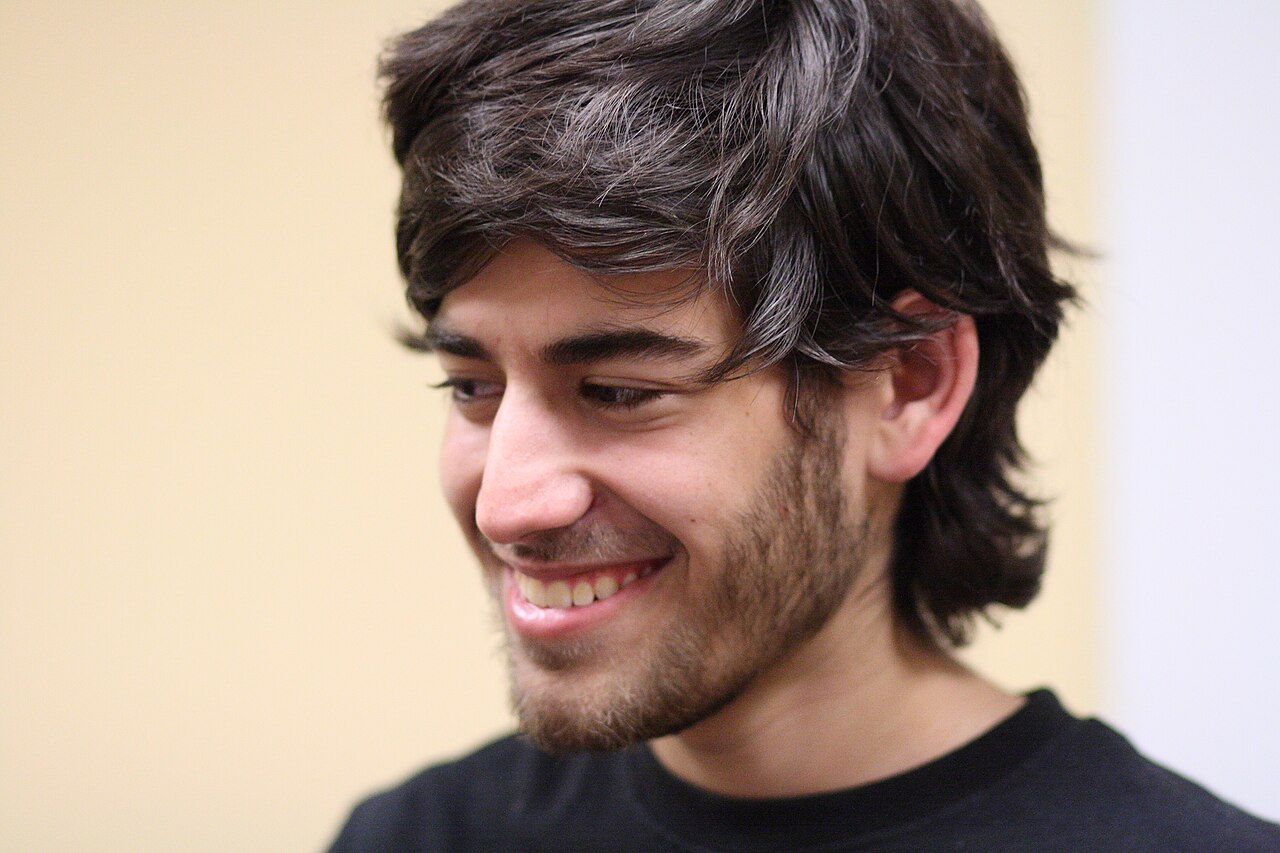
- Image: Aaron Swartz 2 at Boston Wikipedia Meetup, 2009-08-18.jpg by Sage Ross (CC BY-SA 2.0), via Wikimedia Commons