George Boole and Boolean Logic
Abstract
George Boole was a self-taught English mathematician who, in two works published in 1847 and 1854, showed that the rules of logical reasoning could be expressed as algebraic equations operating on a set with only two values: true and false. He died in 1864 without knowing that his algebra would become the mathematical foundation of every electronic computer ever built. Seventy-three years after his death, a twenty-one-year-old MIT graduate student named Claude Shannon proved that Boolean algebra and electrical switching circuits were structurally identical, and the digital age began.
The Self-Made Mathematician
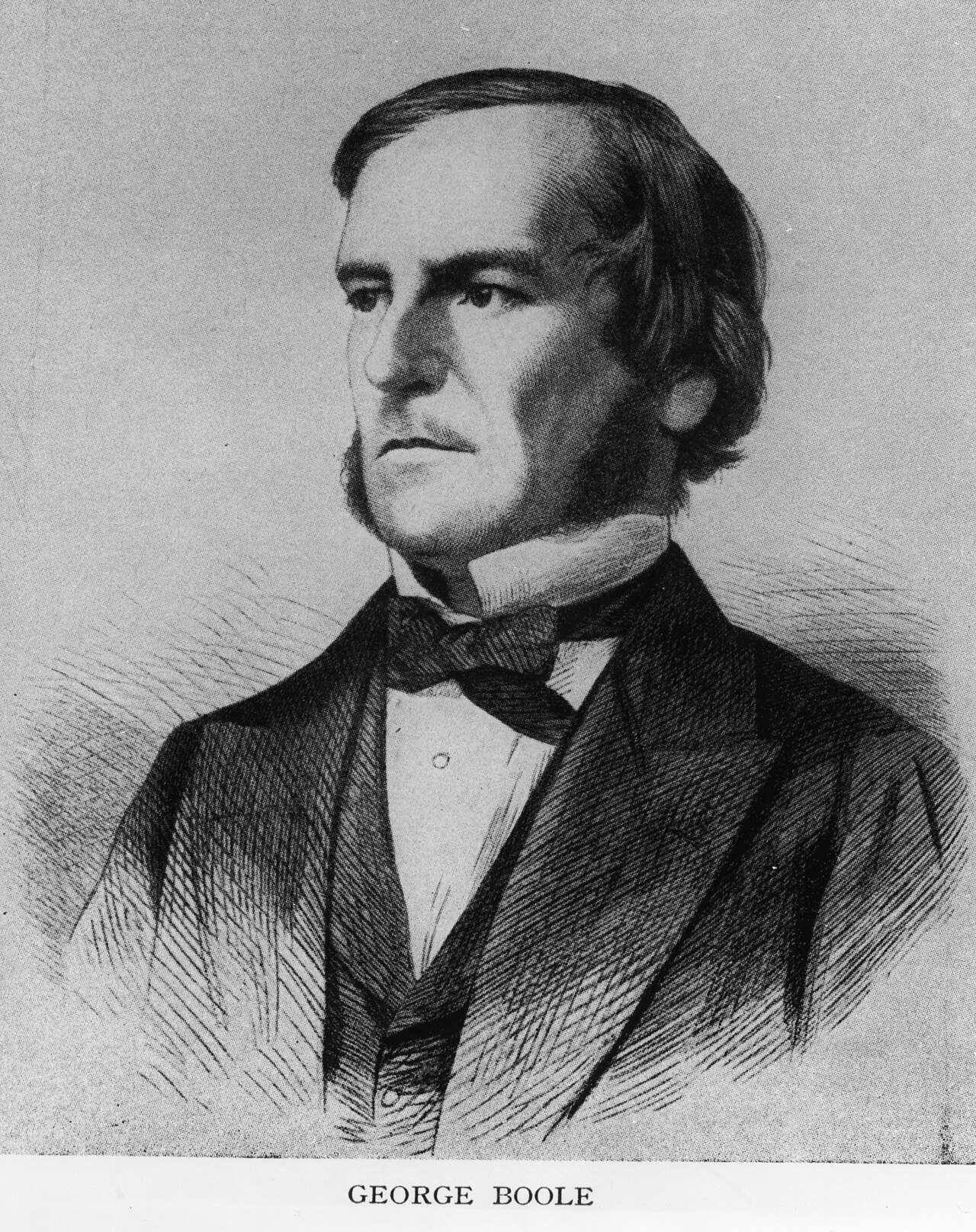
George Boole was born on November 2, 1815, in Lincoln, England, the son of a cobbler. His father, John Boole, was an intellectually curious man who taught his son mathematics and the basics of optics, but the family had neither the money nor the social standing to send George to university. He left school at sixteen to help support his family, working as an assistant teacher and later as a school owner.
What he could not get from institutions he built himself. He taught himself Latin, Greek, French, German, and (most consequentially) advanced mathematics, working through Laplace and Lagrange without instruction. By his mid-twenties he was contributing original papers to the Cambridge Mathematical Journal. In 1849, despite having no university degree, he was appointed the first professor of mathematics at Queen’s College, Cork (now University College Cork), a recognition of published work that institutional credentialing had no way to account for.
The Algebra of Logic
The problem Boole set himself was one of the oldest in philosophy: how to make logical reasoning rigorous and mechanical, rather than subject to the ambiguity of natural language. Aristotle’s syllogisms had been the first systematic attempt; Leibniz had dreamed of a calculus of thought. Boole succeeded.
In 1847 he published The Mathematical Analysis of Logic, demonstrating that logical propositions could be treated as algebraic expressions. In 1854 his major work, An Investigation of the Laws of Thought, developed the complete system.
The core insight: if logical classes (sets of things satisfying a proposition) are represented by letters, and if two operations are defined, AND (intersection, written as multiplication: x · y) and OR (union, written as addition: x + y), then the laws governing these operations mirror algebraic laws, with one crucial addition. In Boolean algebra, x · x = x (a class intersected with itself is itself) and x + x = x (a class joined with itself is itself). The only values a logical variable can take are 0 (false/empty class) and 1 (true/universal class), and a third operation, NOT, maps each to the other.
From these primitives, all of classical logic follows: De Morgan’s laws, the distributive property, complement, and the construction of complex logical expressions from simple ones. Boole showed that logical reasoning was a special case of algebra, not a separate faculty of the mind but a mathematical structure.
Info
Boole’s system was not immediately accepted as he formulated it. He used standard algebraic notation (multiplication, addition, subtraction) in ways that made mathematicians uncomfortable, what does it mean to “add” two logical classes? Augustus De Morgan, working contemporaneously on a different approach to logic, was skeptical. The definitive algebraic formulation was completed by William Stanley Jevons (1864) and Ernst Schröder (1890–1895), who cleaned up the notation and developed the system into a mature form now recognizable as Boolean algebra.
The Gap: 1854 to 1937
Boole’s algebra was recognized as a significant mathematical achievement, but its practical application was not obvious. Logic was a philosophical concern; mathematics was a tool for physics and engineering. The two did not obviously intersect.
The connection waited for a technology and a researcher. In 1937, Claude Shannon submitted his master’s thesis at MIT: A Symbolic Analysis of Relay and Switching Circuits. Shannon, then twenty-one, recognized that electrical switching circuits, circuits in which switches are either open (no current) or closed (current flows), obeyed exactly the laws of Boolean algebra. A closed switch corresponded to logical 1; an open switch to logical 0. Switches in series implemented AND; switches in parallel implemented OR; a normally-closed switch implemented NOT.
Shannon’s thesis showed that any Boolean expression could be implemented as an electrical circuit, and conversely, that any switching circuit could be analyzed as a Boolean expression. Complex logical computations could be built from simple electrical components; the complexity of the computation was a matter of circuit design, not fundamental physics.
Shannon’s insight, published in the Transactions of the American Institute of Electrical Engineers (1938), is now considered one of the most significant master’s theses in the history of science. It transformed Boolean algebra from a branch of mathematical logic into the design language of digital electronics.
From Relays to Transistors to VLSI
The path from Shannon’s thesis to modern computing runs through hardware generations:
Relay computers (1940s): The Harvard Mark I and the early Bell Labs relay computers implemented Boolean logic in electromechanical relays, physical switches opened and closed by electromagnets. These were slow (milliseconds per operation) and loud, but they worked.
Vacuum tube computers (1945–1955): ENIAC and its contemporaries used vacuum tubes as electronic switches, faster than relays, but hot, large, and failure-prone. A vacuum tube in the on-state represented 1; off-state represented 0. Boolean operations were implemented in circuits of tubes.
Transistor computers (1955–1965): The transistor replaced the vacuum tube with a solid-state switch, smaller, cooler, more reliable. Boolean logic gates implemented in transistors became the building blocks of all subsequent computers.
Integrated circuits (1960s–present): Jack Kilby and Robert Noyce’s integrated circuit placed multiple transistors on a single silicon substrate, allowing Boolean logic gates to be miniaturized and mass-produced. A modern processor contains tens of billions of transistors implementing Boolean operations at speeds measured in gigahertz.
At every level, the mathematical structure is identical to what Boole described in 1854: two values, three operations, the same algebraic laws.
Boole’s Death and Legacy
George Boole died on December 8, 1864, at age forty-nine. The circumstances were mundane and poignant: he had walked the two miles to the college in drenching rain, lectured in wet clothes, and caught a feverish cold that settled on his lungs. His wife, Mary Everest Boole, herself a significant mathematical educator, is said to have held that a remedy should resemble the cause, and to have put him to bed and thrown buckets of water over it. The story does not appear in the earliest account of his death and cannot be treated as certain, but it has followed the family ever since.
He did not live to see his algebra applied to electrical circuits, to digital computers, or to the internet. He did not know that every search query typed into a search engine, every database query, every logical branch in every program ever written, would be expressed in the algebra he developed in a school in Cork.
The Boole Centre for Research in Informatics and the Boole Library at University College Cork, a schools prize for mathematics in his name, a lunar crater, and streets and buildings in Lincoln and Cork all carry it. In his own lifetime the recognition came too: the Royal Society’s first gold medal for mathematics in 1844, and the Royal Society of Edinburgh’s Keith Prize in 1857. More substantively, every logic gate on every chip manufactured anywhere in the world is a physical instantiation of his 1854 algebra. The legacy is not institutional but architectural: Boolean logic is not a technique computing uses; it is the level at which computing exists.