Adele Goldberg and Smalltalk
Abstract
Alan Kay dreamed Smalltalk; Adele Goldberg made it something the world could actually use. At Xerox PARC from 1973, she co-built the Smalltalk-80 system, co-authored with Kay the 1977 manifesto Personal Dynamic Media that described the tablet computer three decades early, and led the books-and-licensing campaign that carried object-oriented programming and the windowed user interface out of the lab. She is also at the center of one of computing’s most storied scenes: ordered in December 1979 to demonstrate Smalltalk to Steve Jobs, she refused (telling her bosses they were about to give away “the kitchen sink”) and was overruled. She served as ACM’s president (1984–1986), only the second woman to hold the office, and founded ParcPlace Systems to sell the environment her team had built. The company lost to Java; the ideas (classes and message passing, overlapping windows, the IDE itself) won everywhere.
From Theorem Provers to PARC
Adele Goldberg (born July 22, 1945 in Cleveland, Ohio, raised in Chicago) studied mathematics at the University of Michigan (B.S. 1967), then information science at the University of Chicago (Ph.D. 1973), with a dissertation on computer-assisted instruction. Education was the thread: in 1973 she joined the Xerox Palo Alto Research Center (see The Xerox PARC Revolution), where Alan Kay’s Learning Research Group was building a wild proposition: that children, not data-processing departments, were the right first users of personal computers, and that a sufficiently malleable programming environment was the medium they needed.
Goldberg ran the group’s experiments with actual children, co-taught Smalltalk to Palo Alto schoolkids, and rose to manage the System Concepts Laboratory after Kay’s departure. In 1977 she and Kay published Personal Dynamic Media, the paper that compressed the Dynabook vision into prose: a notebook-sized personal computer for reading, writing, drawing, composing music, and simulating worlds, a description a modern reader recognizes instantly as a tablet.
Smalltalk-80: Releasing the Future
Inside PARC, Smalltalk and the hardware around it accumulated the furniture of modern computing: overlapping windows, pop-up menus, the bitmapped display treated as a canvas, an environment where the debugger, browser, and editor were live objects in the same world, the prototype of every IDE since. But through the 1970s all of it was visible only inside Xerox.
Goldberg led the project to change that. The Smalltalk-80 release (1980–1983) was as much publishing as programming: with David Robson she wrote Smalltalk-80: The Language and Its Implementation (1983), the “Blue Book,” whose precise virtual-machine specification let outsiders build their own implementations, followed by companion volumes documenting the interactive environment. Tapes went to review teams at DEC, HP, Apple, and Tektronix. The diaspora was immense: Objective-C began as a Smalltalk-inspired C extension (the lineage that runs to the iPhone; see Swift and the Post-Objective-C Era); Java, Python, and Ruby absorbed its object model; design patterns, refactoring tools, unit testing (Kent Beck’s SUnit, parent of JUnit), and extreme programming all grew up in Smalltalk before migrating everywhere else.
The Demo
In December 1979, Steve Jobs negotiated access to PARC as part of a deal letting Xerox invest in pre-IPO Apple. When the order came down to show Apple’s team Smalltalk, Goldberg (by her own delighted retelling) refused, arguing to Xerox management that they were about to hand a competitor “the kitchen sink”: the crown jewels of a decade of research, for nothing. She was overruled by executives who, as she put it, had no idea what they were giving away; she fetched the demo disk herself, furious. Dan Ingalls drove the demo; Jobs later said he was so dazzled by the GUI that he barely registered the other two things he was shown, object-oriented programming and networked computing. The Lisa and Macintosh followed; Xerox’s own products did not (see Fun Fact: the Xerox Star’s price). Goldberg’s protest became the canonical illustration of Xerox fumbling the future, though she always added the uncomfortable codicil that being right changed nothing, because the decision-makers couldn’t evaluate what they owned.
President, Founder, CEO
Goldberg was president of the ACM from 1984 to 1986 (only the second woman in the role, after Jean Sammet) while still running her PARC lab. In 1987 she shared the ACM Software System Award with Kay and Dan Ingalls for Smalltalk. In 1988 she did what Xerox wouldn’t: co-founded (with Xerox’s blessing and equity) ParcPlace Systems, serving as CEO and chair, to commercialize Smalltalk-80 as ObjectWorks and VisualWorks, cross-platform, JIT-compiled, beloved in finance and telecom for modeling complex systems. Later ventures (Neometron, Bullitics) and board work returned to her first loves, education and process knowledge; her honors run from ACM Fellow (1994) to Computer History Museum Fellow (2022). See Women in Computing for the larger story she belongs to.
⚠️ Dead End: Commercial Smalltalk
By the early 1990s Smalltalk looked like the future of enterprise software: IBM backed it, analysts projected it would overtake C++, and ParcPlace was the leading vendor. By 2000 the commercial market was a husk. The autopsy lists: per-developer licenses costing thousands of dollars in the era when free was becoming the default; the image-based deployment model (your application lives inside a Smalltalk memory snapshot) that baffled IT departments raised on files and linkers; vendor fragmentation, culminating in the value-destroying 1995 ParcPlace–Digitalk merger of the two main rivals; and, above all, Java, free, C-like in syntax, marketed with Sun’s full might, and arriving in 1995 with the web behind it (see The JVM and Java Ecosystem). Java’s HotSpot VM was literally built by Smalltalk-lineage engineers; the language that lost contributed the engine of the language that won. Open-source descendants (Squeak, by Kay and Ingalls themselves, and Pharo) keep the environment alive, and its ideas need no keeping: every IDE with live debugging and refactoring, every unit-test framework, every object-oriented mainstream language is Smalltalk’s heir. The product died; the worldview won.
Fun Fact: Read the Manual
Goldberg’s Blue Book did something almost unheard of for a commercial technology: it published the complete specification of the Smalltalk-80 virtual machine, bytecodes and all, in a bookstore paperback, effectively open-sourcing the design decades before the term existed. Generations of language implementers learned how to build a VM from it; the authors of Java’s and JavaScript’s engines grew up on its chapters.
📚 Sources
- Wikipedia: Adele Goldberg (computer scientist) · Smalltalk · ParcPlace Systems
- Computer History Museum: Adele Goldberg, 2022 Fellow
- Kay & Goldberg: Personal Dynamic Media (IEEE Computer, 1977, PDF)
- Goldberg & Robson: Smalltalk-80 — The Language and Its Implementation (1983, “Blue Book”, PDF)
- Goldberg: The Community of Smalltalk (oral history / HOPL retrospectives)
- PBS, Triumph of the Nerds (1996): the PARC demo, with Goldberg’s account
- ACM: Adele Goldberg — past ACM President, ACM Fellow
- Goldberg, Adele: “Why Smalltalk?” — Communications of the ACM 38(10): 105–107 (1995)
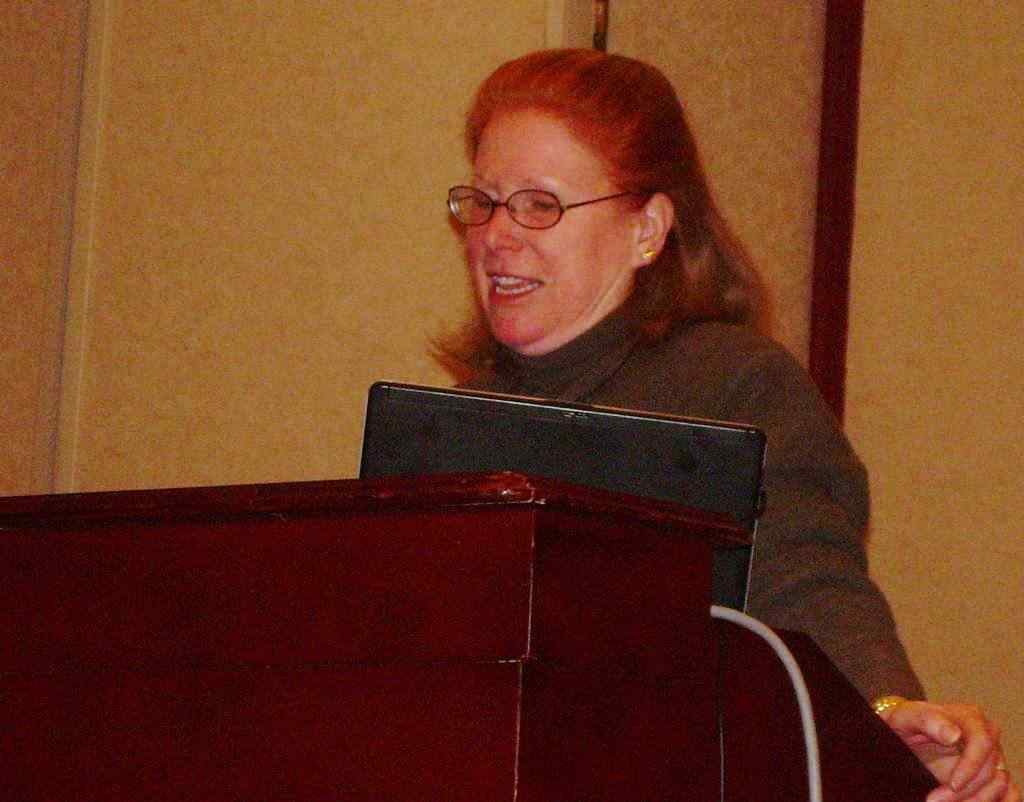
- Image: Adele Goldberg at PyCon 2007.jpg by Terry Hancock (CC BY-SA 2.5), via Wikimedia Commons