Leslie Lamport and the Science of Distributed Systems
Abstract
Leslie Lamport turned the chaos of computers communicating over unreliable networks into a mathematical discipline. His 1978 paper “Time, Clocks, and the Ordering of Events in a Distributed System” gave the field its founding abstraction (logical time) and remains one of the most cited papers in computer science. He named and formalized the Byzantine Generals Problem, defined sequential consistency, and invented Paxos, the consensus algorithm that quietly coordinates the data centers of Google, Amazon, and Microsoft. On the side, he wrote LaTeX, the document system in which most of the world’s scientific papers are typeset. His decades-long crusade to make engineers specify systems mathematically produced TLA+, now used at AWS to find bugs no test could reach. For all of this he received the 2013 Turing Award, and along the way he taught the field its darkly perfect definition of a distributed system: one in which “the failure of a computer you didn’t even know existed can render your own computer unusable.”
A Mathematician in Industry
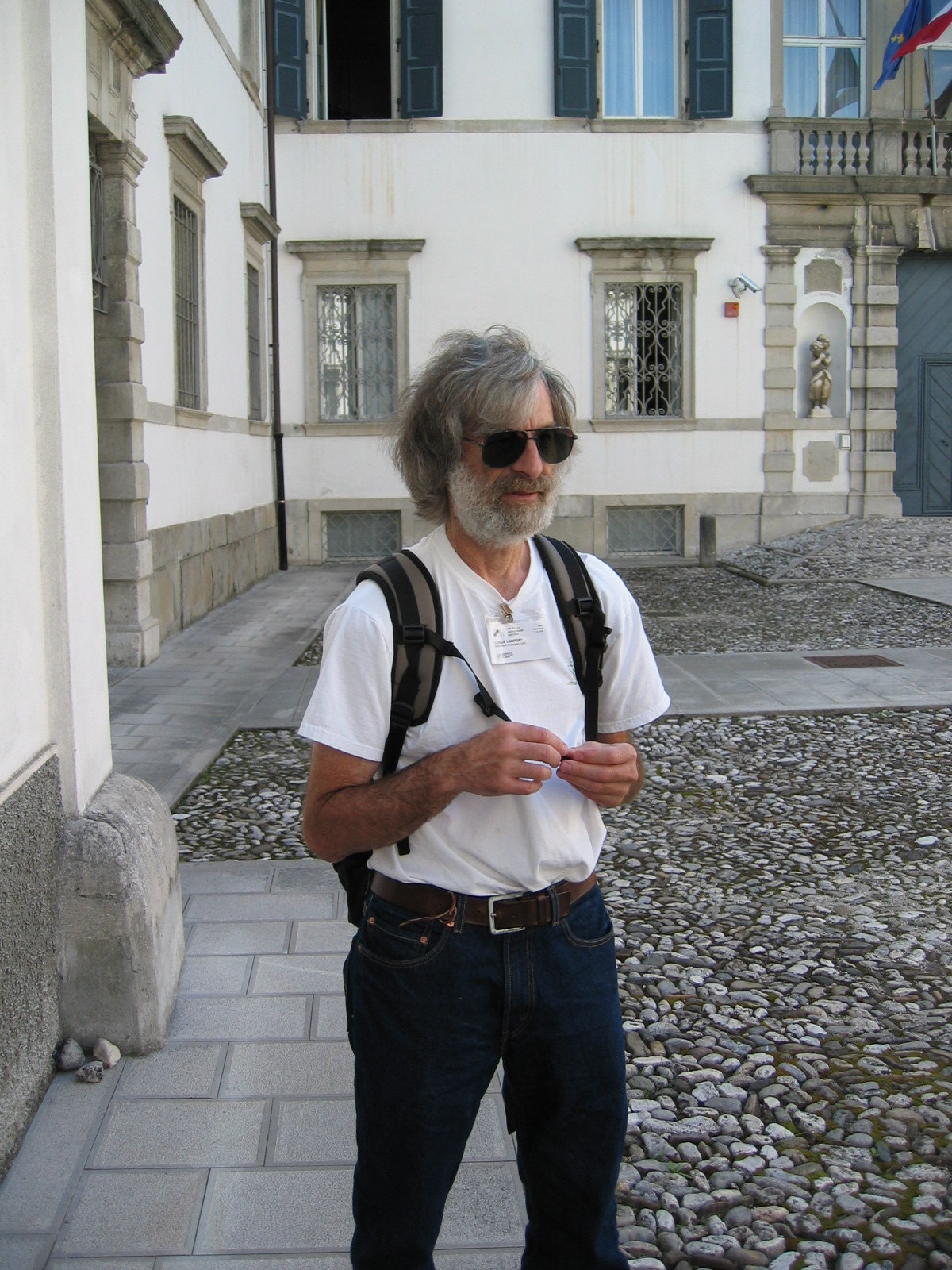
Leslie Lamport (born February 7, 1941 in New York City) took a B.S. in mathematics at MIT (1960) and a Ph.D. at Brandeis (1972) with a dissertation on partial differential equations, pure mathematics, nothing to do with computers. He then spent his entire career outside academia: at Massachusetts Computer Associates (1970–1977), SRI International (1977–1985), the Digital Equipment Corporation’s Systems Research Center in Palo Alto (1985–2001, latterly Compaq), and finally Microsoft Research (2001 until his retirement in early 2025). He liked to point out that industry kept handing him real problems; the theory followed.
The first came in 1974: the bakery algorithm, a solution to Dijkstra’s mutual exclusion problem in which processes take numbered tickets as in a bakery. Its distinction (Lamport’s favorite among his own results) is that it works even without atomic hardware operations, anticipating by decades the question of what memory guarantees a multiprocessor actually gives (see Concurrency and Parallelism). His 1979 definition of sequential consistency gave that question its standard vocabulary.
Time, Clocks, and the Founding of a Field
Lamport’s 1978 CACM paper “Time, Clocks, and the Ordering of Events in a Distributed System” began with a deceptively simple observation borrowed from special relativity: in a distributed system there is no universal “now.” Messages are the only way information travels, so the only meaningful order between events on different machines is the happened-before relation: an event can influence another only if a chain of messages connects them. Lamport showed how simple counters (now called Lamport clocks) assign timestamps consistent with that causal order, and how any distributed synchronization problem can be solved on top of such an ordering by having every machine replay the same commands in the same order: the state machine replication idea on which essentially all modern replicated systems rest (see Distributed Systems).
The paper won every retrospective honor the field offers and is among the most cited works in computer science. Lamport noted ruefully that many people seemed to know only the clocks and missed the state machines, the part he considered the point.
The Byzantine Generals
At SRI, working on SIFT (a fault-tolerant flight-control computer for NASA) Lamport, Robert Shostak, and Marshall Pease confronted the nastiest failure mode: components that don’t crash cleanly but lie, sending conflicting information to different parts of the system. Their 1982 paper dressed the problem in a story about generals coordinating an attack through possibly treacherous messengers, and proved the fundamental bound: tolerating m traitorous components requires 3m + 1 components in total. Lamport invented the Byzantine Generals framing deliberately; he had seen how the bakery analogy made an algorithm unforgettable. The gambit worked beyond all expectation: “Byzantine fault tolerance” is today a load-bearing concept everywhere from aircraft avionics to blockchain consensus.
Paxos: Consensus for an Unreliable World
In the late 1980s, Lamport set out to prove that a fault-tolerant distributed consensus algorithm (getting machines to agree on a value even as some of them crash and recover, with no false step ever) was impossible. Instead he found one. Paxos lets a cluster of unreliable machines behave as one reliable state machine, and it sits, usually wrapped in layers of engineering, at the bottom of Google’s Chubby lock service and Spanner, Microsoft’s Azure infrastructure, and the coordination services behind the cloud generally. Apache ZooKeeper and the Raft algorithm (2014), designed explicitly to be easier to understand than Paxos, carry the same idea through most open-source infrastructure.
LaTeX: The Side Project
In the early 1980s, while writing a book, Lamport built a macro package on top of Donald Knuth’s TeX typesetting system, adding the things an author actually wants (document classes, sections, cross-references, bibliographies) so that writers could think in logical structure rather than typography. He assumed it would be a minor convenience for himself and colleagues. LaTeX, first released in 1984 and documented in his 1986 manual, became the universal standard for writing mathematics, computer science, and physics; decades later, most of the scientific literature (and nearly every paper about distributed systems) is typeset in a Turing laureate’s side project.
TLA+: Mathematics for Engineers
Lamport’s last great campaign was against the way engineers design systems: in prose, whiteboard sketches, and hope. His Temporal Logic of Actions (1994) and the specification language TLA+ (with the 2002 book Specifying Systems) let designers state precisely what a system must do and let a model checker search for executions that violate it, before any code exists. He called the effort a “quixotic attempt to overcome engineers’ antipathy towards mathematics.” The windmill eventually yielded: Amazon Web Services reported in CACM in 2015 that TLA+ had found subtle, catastrophic bugs in DynamoDB, S3, and other services (including one requiring a 35-step trace to trigger) that no testing regime would plausibly have caught.
⚠️ Dead End: The Paper Nobody Would Read
Paxos nearly died of its own presentation. Continuing his Byzantine success with storytelling, Lamport wrote it up as “The Part-Time Parliament”, a mock-archaeological account of a consensus protocol used by the parliament of the ancient Greek island of Paxos, submitted in 1990, complete with pseudo-Greek names for the legislators. The field did not get the joke. Readers found the algorithm impenetrable inside the costume; referees wanted the Indiana Jones framing removed; Lamport, who thought the humor essential, let the paper sit. It was finally published, essentially unchanged, in 1998, eight years during which the industry’s most important consensus algorithm circulated as folklore (engineers at DEC who needed it had to be taught it personally). Lamport capitulated with the pointedly titled “Paxos Made Simple” (2001), whose abstract reads, in its entirety: “The Paxos algorithm, when presented in plain English, is very simple.” The episode became the field’s standard cautionary tale that an idea’s packaging can cost a decade, and the lasting demand for Paxos tutorials suggests the costume was never the whole problem.
Fun Fact: The “La” in LaTeX
The name LaTeX is conventionally explained as “Lamport TeX”, though Lamport himself, asked how to pronounce it and what it stands for, has maintained an amused refusal to legislate either question. Knuth provided the “TeX”; the laureate provided the “La” and lets posterity argue about the rest.
📚 Sources
- Wikipedia: Leslie Lamport · Paxos · Byzantine fault
- ACM A.M. Turing Award: Leslie Lamport (2013) — citation and profile
- Lamport: “My Writings” — annotated bibliography with the stories behind each paper
- Time, Clocks, and the Ordering of Events in a Distributed System (CACM 1978, PDF)
- The Byzantine Generals Problem (TOPLAS 1982, PDF)
- The Part-Time Parliament (TOCS 1998, PDF) · Paxos Made Simple (2001, PDF)
- Newcombe et al.: How Amazon Web Services Uses Formal Methods (CACM, April 2015)
- Microsoft Research: Leslie Lamport Receives Turing Award
- LaTeX — Wikipedia
- Image: Leslie Lamport September 2006.jpg by Andrej Bauer (CC BY-SA 2.5 SI), via Wikimedia Commons