GPS and Satellite Navigation
Abstract
The Global Positioning System is one of the great dual-use technologies of the computing age: a U.S. military project of the 1970s that became invisible civilian infrastructure underpinning everything from ride-hailing and food delivery to aviation, agriculture, financial-market timestamps, and the clock on your phone. Its core trick is astonishing in its precision, a receiver determines its position by measuring, to within billionths of a second, how long radio signals took to arrive from satellites 20,000 kilometers overhead, and solving for the one point in space-time consistent with all of them. Doing this correctly requires accounting for Einstein’s relativity, because the satellites’ clocks tick measurably faster than clocks on the ground. From a Cold War navigation aid GPS grew into a free global utility, then into one member of a family of competing constellations. This article covers the technology and history of satellite navigation, the location layer beneath the mobile computing revolution.
Before GPS: From Sputnik to Transit
Satellite navigation began, fittingly, the day after Sputnik launched in 1957. Two physicists at Johns Hopkins University’s Applied Physics Laboratory, William Guier and George Weiffenbach, tracked Sputnik by listening to the Doppler shift of its radio beacon, the signal rose in pitch as the satellite approached and fell as it receded. They realized they could compute the satellite’s entire orbit from this shift. Their colleague Frank McClure then posed the inverse question: if you know the satellite’s orbit precisely, you could work backward from the Doppler shift to find your own unknown position on the ground.
That insight produced the U.S. Navy’s Transit system (operational from 1964), the first satellite navigation system, used primarily to fix the positions of Polaris submarines before launching missiles. Transit worked but was slow, a fix could take many minutes, and the satellites passed overhead only intermittently. It proved the concept; GPS would make it continuous, instantaneous, and three-dimensional.
NAVSTAR GPS: The System Takes Shape
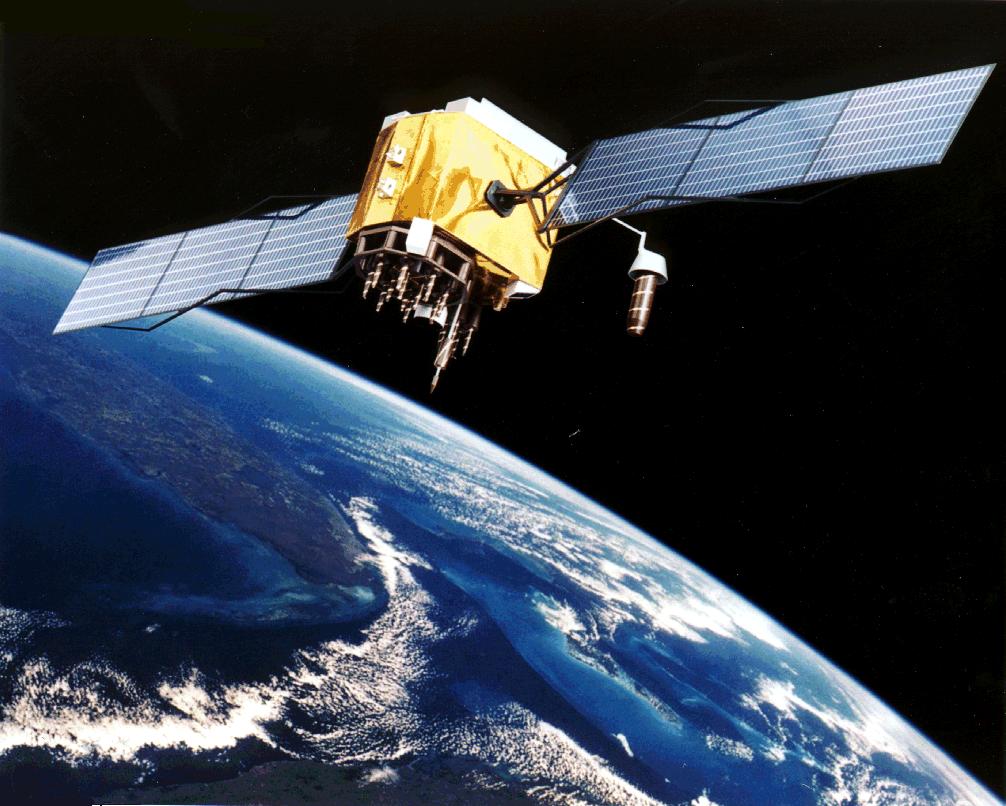
The U.S. Department of Defense consolidated competing service proposals into a single program in 1973, led by Air Force colonel (later general) Bradford Parkinson, who is widely regarded as GPS’s chief architect, alongside contributors including Roger Easton of the Naval Research Laboratory (whose timing-based work was foundational) and Ivan Getting of Aerospace Corporation. The official name was NAVSTAR GPS. The first satellite launched in 1978. The full constellation (nominally 24 satellites in six orbital planes, ensuring at least four are visible from anywhere on Earth at any time) was declared fully operational in 1995.
The architecture has three segments:
- Space segment, the satellites, each carrying multiple highly stable atomic clocks (rubidium and cesium) and broadcasting timing signals.
- Control segment, ground stations that track the satellites, compute their precise orbits (“ephemerides”) and clock corrections, and upload this data so each satellite can broadcast exactly where it is and what time it is.
- User segment, the receivers, which are passive: they only listen. A GPS receiver transmits nothing, which is why the system supports unlimited users and why a receiver reveals nothing about itself to the satellites.
How It Works: Trilateration and the Fourth Unknown
Each satellite continuously broadcasts a signal encoding two things: the precise time the signal left the satellite, and the satellite’s exact position. A receiver compares the broadcast time to its own clock to compute the time of flight, and multiplies by the speed of light to get the distance to that satellite. One distance places the receiver on the surface of a sphere; a second distance narrows it to a circle; a third to two points (one of which is absurd). This is trilateration, distance-based, not angle-based “triangulation,” a common misnomer.
The brilliant complication is the clock. Satellites carry atomic clocks, but a consumer receiver cannot, an atomic clock would be enormous and expensive. So the receiver’s cheap quartz clock has an unknown offset, which corrupts every distance measurement equally. The solution: treat time itself as a fourth unknown. With signals from four satellites, the receiver solves four equations for four unknowns, latitude, longitude, altitude, and the exact correction to its own clock. A profound side effect is that every GPS receiver is also a free, atomically accurate clock, which is why GPS timing (not positioning) silently synchronizes cellular base stations, power grids, and financial-transaction timestamps worldwide.
Relativity Is Not Optional
GPS is the most famous everyday confirmation of Einstein’s theories of relativity, because the system simply does not work if relativity is ignored. Two effects act on the satellite clocks:
- Special relativity: the satellites move at roughly 14,000 km/h, so their clocks run slower than ground clocks by about 7 microseconds per day.
- General relativity: the satellites sit higher in Earth’s gravitational well, where time runs faster; this makes their clocks gain about 45 microseconds per day.
The net effect is that a satellite clock gains roughly 38 microseconds per day relative to the ground. That sounds trivial, but light travels about 30 centimeters per nanosecond; 38 microseconds of uncorrected drift would introduce position errors of about 10 kilometers per day, growing without bound. GPS satellites’ clocks are deliberately tuned to run at a slightly offset frequency to compensate, and receivers apply further relativistic corrections. GPS works to the meter precisely because its designers built Einstein into the engineering.
From Military Secret to Civilian Utility
GPS was conceived for the military, and for years the best accuracy was reserved for it. A deliberate degradation called Selective Availability (SA) dithered the civilian signal to limit accuracy to about 100 meters, useful but coarse. The 1983 downing of Korean Air Lines Flight 007, which had strayed into Soviet airspace, prompted President Reagan to commit to making GPS freely available to civilian aviation once operational. The decisive moment came on May 1, 2000, when President Clinton ordered Selective Availability switched off, instantly improving civilian accuracy roughly tenfold (to around 5–10 meters). That single policy decision unleashed the commercial GPS economy: car navigation, geocaching, fitness tracking, precision agriculture, and eventually the location services in every smartphone.
Accuracy can be pushed much further with augmentation. Differential GPS (DGPS) and satellite-based augmentation systems (like the FAA’s WAAS) use fixed reference stations at known locations to broadcast corrections, reaching meter or sub-meter accuracy. Real-Time Kinematic (RTK) techniques, exploiting the carrier-wave phase, reach centimeter accuracy for surveying, construction, and autonomous machinery.
A Crowded Sky: The Global Constellation Family
GPS is no longer alone. Strategic dependence on a U.S.-controlled system motivated other powers to build their own:
- GLONASS (Russia/Soviet Union), begun in the 1980s, restored to full operation in the 2010s.
- Galileo (European Union), a civilian-controlled system, declared operational in stages from 2016, designed for high accuracy.
- BeiDou (China), completed to global coverage in 2020.
- Regional systems: NavIC (India) and QZSS (Japan).
Modern phone chips are multi-constellation, listening to several systems at once (the generic term is GNSS, Global Navigation Satellite System). Using satellites from multiple constellations means more signals visible at once, which improves accuracy and reliability in cities where buildings block much of the sky.
Dead End: The Vulnerability Nobody Designed Away
GPS’s greatest weakness is the very thing that made it universal: the signals are extraordinarily weak by the time they reach the ground, roughly comparable to seeing a car headlight from thousands of kilometers away. This makes the system trivially easy to disrupt. Cheap jammers can drown out GPS over a wide area, and spoofing (broadcasting counterfeit signals to feed a receiver false positions) has been demonstrated against ships, drones, and aircraft, and is now used in electronic warfare. Because so much critical infrastructure quietly depends on GPS not just for position but for time, a GPS outage would ripple far beyond lost driving directions into telecommunications and finance.
This fragility has driven renewed interest in approaches GPS was once expected to render obsolete: enhanced terrestrial systems like eLORAN, inertial navigation that needs no external signal, and emerging techniques that navigate by the Earth’s magnetic field or by signals of opportunity. The lesson is a recurring one in computing infrastructure: a utility so cheap and ubiquitous that everyone builds on it becomes a single point of failure precisely because everyone built on it.
📚 Sources
- Global Positioning System — Wikipedia · system architecture, history, and Selective Availability; the 2019 QEPrize awarded to the GPS architects
- Johns Hopkins APL: The Origins of GPS / Transit · Guier and Weiffenbach’s Sputnik Doppler work and the Transit system
- Why does GPS depend on relativity? — Ohio State / Astronomy, the 38-microsecond relativistic clock correction explained
- Selective Availability — Wikipedia, the policy decision and its accuracy impact
- GNSS constellations: GPS, GLONASS, Galileo, BeiDou — EUSPA, overview of the competing satellite navigation systems
- GPS signals — Wikipedia, on GPS as critical timing infrastructure and its vulnerabilities