Masayoshi Son and SoftBank
Abstract
Masayoshi Son contributed no technology to computing; he contributed leverage. The grandson of Korean immigrants who grew up bullied under a Japanese alias, he built SoftBank from a Tokyo software distributor (1981) into the industry’s most aggressive capital machine: a $20 million bet on Alibaba that became $60 billion, a $15 billion bet that brought the iPhone to Japan, the $32 billion purchase of ARM, and the $100 billion Vision Fund that reshaped startup economics worldwide. He briefly held the world’s largest paper fortune in 2000, then lost about $59 billion of it in the crash. At nearly 70 he bet the company again, this time on OpenAI and half-trillion-dollar AI data centers.
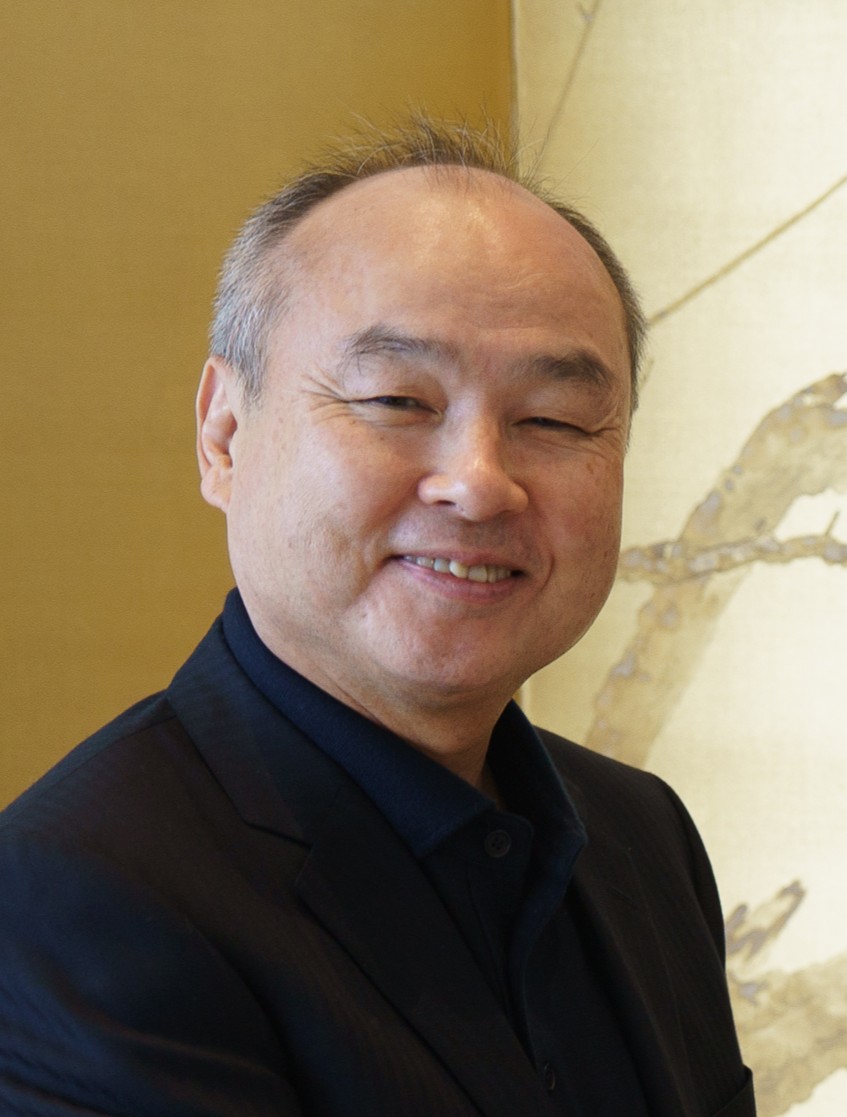
Yasumoto
Masayoshi Son was born on August 11, 1957, in Tosu on Kyushu, into a family of Zainichi Koreans; his grandfather had come from Daegu as a laborer during the colonial period. Like most Koreans in Japan the family lived under a Japanese alias, Yasumoto, and Son grew up poor and bullied for his ancestry. At 16 he moved to California, finished high school in weeks by arguing his way into the exams, and studied economics at Berkeley (BA 1980). The pattern of his career appeared there fully formed: he commissioned an electronic pocket translator, mostly engineered by professors he hired, and sold it to Sharp for $1.7 million; imported used Space Invaders cabinets from Japan and cleared another $1.5 million; and sold his campus software venture, Unison World, for $2 million. Back in Japan he registered under his Korean family name, Son, a public statement in a country where most Zainichi Koreans still kept their aliases.
SoftBank
In 1981 Son founded SoftBank in Tokyo as a distributor of packaged PC software. The founding legend, told by Son himself, has him standing on an apple crate on day one and announcing to his two part-time employees that the company would one day count revenue in trillions of yen; in his telling, both quit soon after. Distribution threw off cash, a publishing arm followed, and in the mid-1990s Son went shopping in America at the top of the market: the Ziff-Davis computer magazines for $2.1 billion (agreed in late 1995, completed February 1996) and the COMDEX trade show in a deal valuing it at $862 million, a purchase whose punchline belongs to the trade-fair story. The investment that justified everything came the same year: an early stake in Yahoo! and the 1996 Yahoo! Japan joint venture, which dominated the Japanese web for two decades and made SoftBank an internet company.
Then came the crash. At the bubble’s peak in February 2000, SoftBank’s stake-collecting had made Son, on paper and (by his own count) for three days, richer than Bill Gates; the collapse erased roughly $59 billion of that fortune and 99% of SoftBank’s share price. The company survived on Yahoo! Japan’s cash flow and one leftover investment about to mature.
Six Minutes with Jack Ma
In 2000 Son met a former English teacher from Hangzhou who had raised half a million dollars for a business-to-business web directory. The meeting, both men agree, lasted about six minutes before Son decided to invest $20 million in Alibaba (Jack Ma and Alibaba). At Alibaba’s 2014 IPO the stake was worth about $60 billion, the most profitable venture investment ever made, and for years it was the collateral that financed everything else Son did.
Telecom
Son spent the 2000s turning SoftBank into a carrier. Yahoo! BB (2001) attacked Japan’s overpriced ADSL market, famously handing out modems on street corners, and forced national broadband prices down. In March 2006 SoftBank bought Vodafone Japan for about $15.1 billion, then Asia’s largest leveraged buyout, taking on a distant third-place mobile network. What saved the bet was a relationship: Son had courted Steve Jobs before the iPhone existed, and in 2008 SoftBank launched the iPhone in Japan as its exclusive carrier, an exclusivity that lasted years and pulled millions of subscribers from NTT DoCoMo and KDDI. The same playbook applied to America failed: SoftBank took roughly 80% of Sprint (about $20 billion, completed 2013) intending to attack the US duopoly, found the price war unwinnable, and exited through Sprint’s 2020 merger into T-Mobile.
ARM and the Vision Fund
In July 2016 SoftBank bought ARM for $32 billion, the largest acquisition of a European technology company to that date, on the thesis that every connected device of the coming decades would carry an ARM core (The ARM Architecture tells the chip side, including the collapsed $40 billion Nvidia sale and the 2023 Nasdaq IPO at $54.5 billion).
The Vision Fund (2017) scaled Son’s style into an institution: roughly $100 billion, $45 billion of it from Saudi Arabia’s Public Investment Fund (Middle East’s Tech Industry), deployed in checks so large they redefined late-stage venture capital. Founders who pitched Son for half an hour left with hundreds of millions and instructions to grow faster; competitors raised defensively; valuations inflated across an entire startup generation, from Grab to Rappi. The fund produced real wins (Coupang, DoorDash, Uber’s recovery) and, in the fiscal year ending March 2021, the largest annual profit in Japanese corporate history, $45.9 billion. It then produced the losses: for the fiscal year ending March 2023 the Vision Fund segment reported a record $32 billion loss, and Son himself owed SoftBank $5.1 billion on co-investment schemes.
Dead End: WeWork
One name became shorthand for the model’s failure mode. SoftBank and the Vision Fund put over $10 billion into WeWork, an office-subletting company priced like a software platform, and marked it up to a $47 billion valuation in January 2019. The September 2019 IPO filing exposed the economics and the governance to public arithmetic; the offering died within weeks, founder Adam Neumann left with an exit package initially valued near $1.7 billion (parts of it later cut in renegotiation), and SoftBank took control in a rescue that valued the company below the capital it had consumed. WeWork filed for Chapter 11 on November 6, 2023. Son’s own verdict to shareholders was that his judgment had been poor and the lesson expensive. The episode did lasting analytical damage to the Vision Fund thesis: capital at sufficient scale can crown a market’s winner, but it cannot make a business out of a valuation.
The 300-Year Plan
Son has always framed the volatility as noise on a longer signal: his 2010 “Next 30-Year Vision” sketched SoftBank as a 300-year company, and his stated unit of planning is the technology platform shift, caught early and bought into at whatever the price. The latest iteration began after ChatGPT: SoftBank led OpenAI’s 2025 funding with a commitment of up to $40 billion, fully funded by December 2025, for roughly an 11% stake, second among outside shareholders only to Microsoft and Son took the chairmanship of Stargate (announced January 2025), the OpenAI-Oracle-SoftBank venture planning some $500 billion of US AI data centers. In June 2026 the AI rally briefly made him Asia’s richest person, at $100.7 billion, a title he had held and lost once before, a quarter century earlier. Whether the AI bet ends like Alibaba or like WeWork is, at this writing, the largest open position in technology finance.
📚 Sources
- Masayoshi Son — Wikipedia
- SoftBank Group — Wikipedia
- WeWork — Wikipedia
- Alibaba Group (SoftBank investment) — Wikipedia
- SoftBank shares drop after Vision Fund posts a $32 billion record loss — CNBC (May 2023)
- Announcement Regarding Follow-on Investments in OpenAI — SoftBank Group press release (April 2025)
- Image: Masayoshi Son (P066533-522034, cropped).jpg by European Communities, 2025 / EC - Audiovisual Service (CC BY 4.0), via Wikimedia Commons