Jean Sammet and COBOL
Abstract
Jean Sammet co-designed COBOL in 1959, invented FORMAC (one of the first computer algebra systems) in 1962, wrote the first comprehensive survey of programming languages in 1969, and became the first woman to serve as ACM president (1974–1976). She spent her entire professional career at IBM, where she was simultaneously a practitioner building real systems and a historian documenting the field she helped create. COBOL, the language she helped design in six months at a government-sponsored committee meeting, now runs more lines of active production code than any other language (estimates range from 220 to 800 billion lines) and processes more than $3 trillion in daily financial transactions.
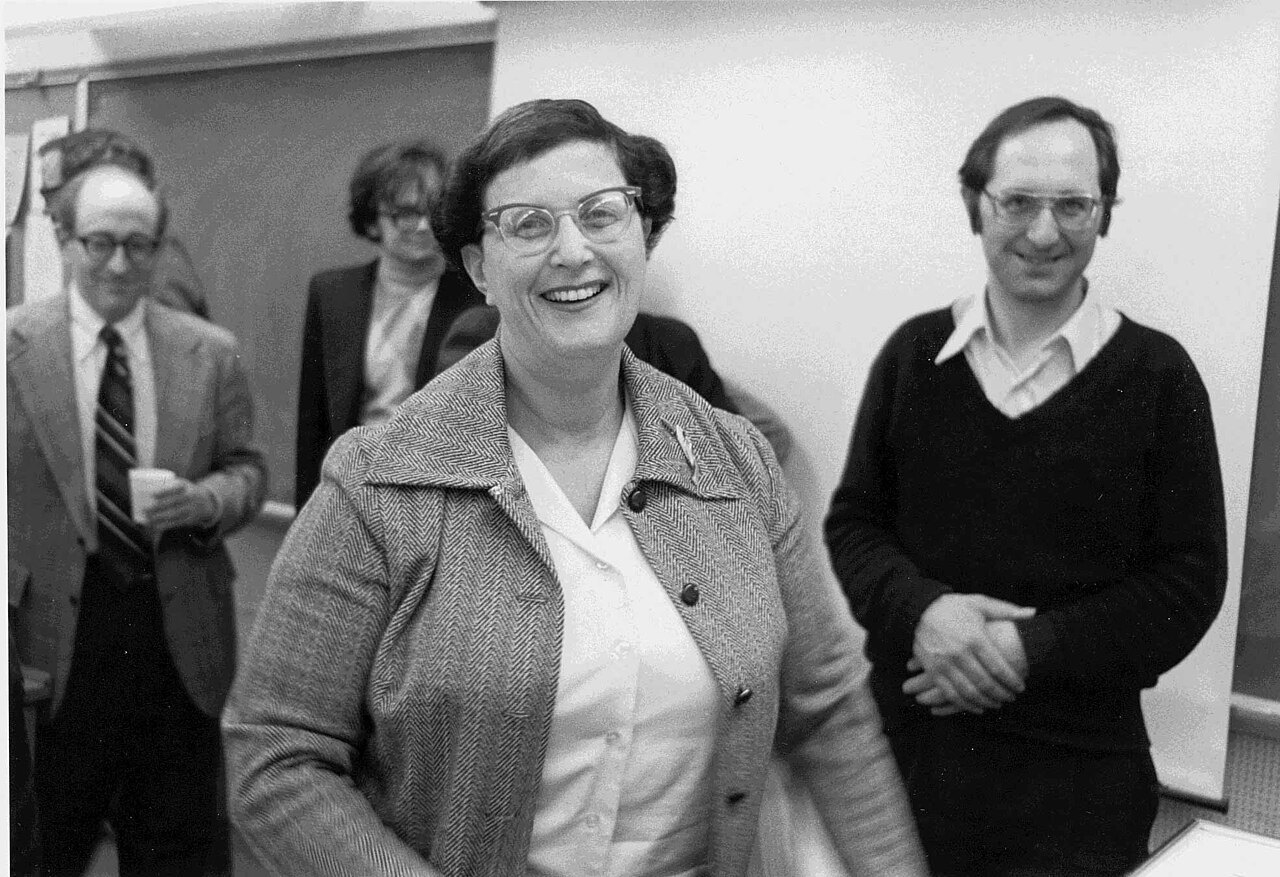
The Path to COBOL
Jean Elaine Sammet was born on March 23, 1928, in New York City, and grew up in a family that valued intellectual achievement. She earned a BA in mathematics from Mount Holyoke College in 1948 and an MA in mathematics from the University of Illinois in 1949. Unable to find a university faculty position at a time when women were not expected to pursue mathematical careers, she worked as an actuary and then as a programmer.
By the late 1950s she was at Sperry Gyroscope Company, programming in machine language and assembly, and had become convinced that programming needed better tools. She joined IBM in 1961, but her path to COBOL came before IBM: in 1959 she was a member of the CODASYL (Conference on Data Systems Languages) committee that created COBOL.
COBOL: Design Under Pressure
The COBOL (Common Business-Oriented Language) design was not an academic exercise; it was a government mandate. The US Department of Defense had observed that different computers ran programs written in mutually incompatible languages, making programs unportable and creating vendor lock-in. The DoD threatened to stop buying computers from manufacturers who did not support a common business-oriented language.
This threat convened the CODASYL committee in May 1959. Grace Hopper (whose FLOW-MATIC language provided the clearest model) was the dominant intellectual influence. Sammet was among the designers who turned the conceptual framework into concrete language specification.
The key design principles that Sammet advocated:
- English-like syntax: programs should be readable by business managers, not just programmers. A COBOL statement reads:
MOVE CUSTOMER-BALANCE TO TOTAL-AMOUNT. This verbosity was deliberate, the intended users were business data processors, not mathematicians. - Self-documentation: program structure, including explicit IDENTIFICATION, ENVIRONMENT, DATA, and PROCEDURE divisions, should make programs understandable without separate documentation
- Decimal arithmetic: business computing required exact decimal arithmetic, not floating-point approximations that could introduce rounding errors in financial calculations
- Record-oriented data: business data came in fixed-format records (like punched cards and tape files), and the language should handle them natively
The first COBOL specification was published in April 1960. The first COBOL compilers appeared later that year. The DoD mandated COBOL for its systems, and adoption spread rapidly through government contractors and financial institutions.
Info
COBOL’s English-like verbosity is often mocked by programmers familiar with more terse languages. The mockery misunderstands the design intent. COBOL was designed for an audience that included business analysts and managers who would review but not write code, the readability was a feature, not a bug. A COBOL program could be handed to a non-programmer business stakeholder for review in a way that a FORTRAN or assembly program could not. Whether this goal was achieved is debatable; what is not debatable is that it was the explicit design goal.
FORMAC: Computer Algebra
Sammet’s second major contribution came at IBM, where she designed FORMAC (FORmula MAnipulation Compiler) in 1962. FORMAC was one of the first programming languages designed for symbolic mathematical computation, manipulating algebraic expressions as symbolic objects rather than computing numerical values.
Where FORTRAN computed 2 + 3 = 5, FORMAC could compute d/dx(x² + 3x) = 2x + 3, differentiating an algebraic expression symbolically. This capability was essential for physicists, mathematicians, and engineers who needed to manipulate formulas algebraically before numerical computation.
FORMAC was the earliest widely used computer algebra system, predating Macsyma (1969), Reduce (1968), Maple (1982), and Mathematica (1988). The concept it demonstrated (that computers could manipulate symbols as well as numbers) opened an entire computational domain that remains active. Modern computer algebra systems are used in scientific computation, mathematics research, physics, and engineering.
Programming Languages: History and Fundamentals
In 1969, Sammet published “Programming Languages: History and Fundamentals” (Prentice-Hall), the first comprehensive survey of the field. The book described 120 programming languages, their design rationale, features, implementation status, and historical context. It was a definitive reference that no subsequent work has equaled in systematic coverage of the field’s first two decades.
Sammet maintained this historical perspective throughout her career. She understood that programming languages were cultural and historical artifacts as much as technical specifications: that understanding why a language was designed the way it was required understanding the context, the designers, and the problems they were trying to solve. This historiographic sensibility was unusual among researchers who were themselves active participants in the field they were documenting.
ACM Presidency
Jean Sammet served as ACM president from 1974 to 1976, the first woman to hold the position. The ACM list of past presidents confirms this; the role was meaningful rather than ceremonial, involving genuine organizational leadership and public representation of the computing profession.
Her presidency coincided with the period when computing was beginning to expand from institutional and industrial use into broader professional and eventually personal contexts. The ACM under her leadership engaged with professional education standards and with the emerging question of computing’s social responsibilities, questions that would become more urgent in subsequent decades.
COBOL’s Stubborn Immortality
Sammet died on May 20, 2017, at age eighty-eight. COBOL had by then outlived numerous predictions of its demise and was, if anything, more entrenched than when she designed it.
The reasons are structural. Financial institutions that built systems in COBOL in the 1960s and 1970s have 50-year-old COBOL codebases that have been debugged, extended, and tested over thousands of institutional lifetimes. Migrating them to newer languages would require replicating exactly the business logic encoded in those programs, logic that is often underdocumented, embedded in decades of edge cases, and understood by programmers who are retired or dead.
The Y2K remediation of 1999 required identifying and fixing two-digit year handling throughout banking and government COBOL code, producing the largest organized effort to understand and modify existing COBOL codebases in history, and demonstrating that substantial COBOL expertise still existed.
When US states struggled to process unemployment claims during the COVID-19 pandemic in 2020 (with systems collapsing under demand) New Jersey Governor Phil Murphy made national news by publicly asking for COBOL programmers. The state’s unemployment system ran on COBOL. New Jersey was not unusual; most state unemployment systems do.
COBOL’s persistence is not nostalgia. It is the compound interest of 60 years of investment in a system that works, accumulated to a level where the cost of change is higher than the cost of maintenance. The language that Jean Sammet helped design in six months in 1959 will be running critical financial infrastructure in 2059.
📚 Sources
- Wikipedia: Jean Sammet
- ACM Turing Award history and past presidents
- Jean Sammet — Wikipedia
- COBOL — Wikipedia
- Wikipedia: FORMAC
- Reuters: Cobol — the language at the heart of modern finance (2020)
- Image: Jean Sammet UMD 1979.jpg by Ben Shneiderman (CC BY-SA 4.0), via Wikimedia Commons