Deep Blue and Computer Chess
Abstract
On May 11, 1997, in a midtown Manhattan office building, world chess champion Garry Kasparov resigned the sixth and final game of a match against IBM’s Deep Blue, and for the first time, a reigning world champion had lost a match to a machine under standard tournament conditions. It was a landmark moment in the public imagination: the symbolic fall of a citadel of human intellect. Yet the story of computer chess is far older and stranger than that single match. It runs from Charles Babbage and Claude Shannon through decades of brute-force search engineering, a hoax automaton that fooled Napoleon, and a deep irony: that the machine which “thought” like no human ever could went on to teach humans to play better. This article traces computer chess from theory to Deep Blue to the neural-network engines that eclipsed it, a story closely tied to the broader history of AI.
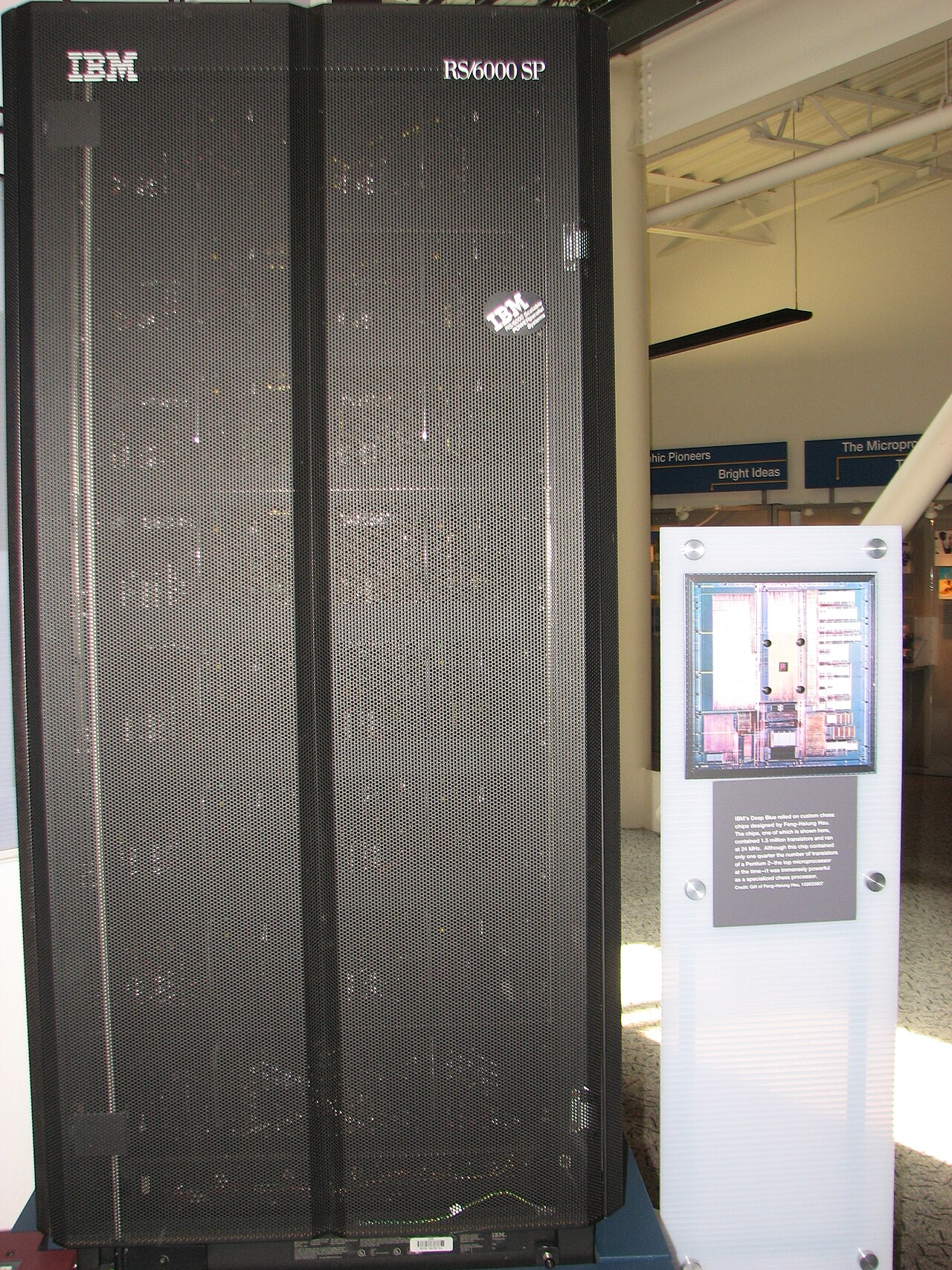
The Drosophila of AI
Chess was, for the first decades of artificial intelligence, what the fruit fly was to genetics: the standard organism on which everyone experimented. It was complex enough to be a genuine intellectual challenge, yet formal enough to be programmed, a finite game of perfect information with clear rules and a clear goal. If a machine could play chess well, many early researchers believed, it would have demonstrated something essential about machine intelligence.
The theoretical foundation was laid by Claude Shannon in his 1950 paper “Programming a Computer for Playing Chess,” which framed the problem precisely: a chess program needs an evaluation function to score a position and a search procedure to look ahead through possible moves. Shannon distinguished Type A strategies (brute-force search of all moves to a fixed depth) from Type B strategies (selective search of only promising moves, more like human thought). Alan Turing wrote a chess algorithm, “Turochamp,” around 1948–1950 that he executed by hand on paper, since no computer could yet run it. The conceptual problem was the combinatorial explosion: chess has roughly 35 legal moves per position and games last dozens of moves, so the tree of possibilities is astronomically large, far too big to search exhaustively.
Brute Force Wins
For decades the dominant approach combined Shannon’s Type A search with the minimax algorithm and the crucial efficiency of alpha-beta pruning, which lets a search skip branches that cannot affect the result. Progress tracked hardware: faster machines searched deeper, and deeper search beat shallower search. The field largely abandoned attempts to make computers reason about chess “like humans” in favor of searching more positions per second than any human could contemplate.
The line that led to Deep Blue began at Carnegie Mellon University with a project called ChipTest and its successor Deep Thought, built by graduate students including Feng-hsiung Hsu and Murray Campbell. Deep Thought used custom VLSI chips to evaluate chess positions in hardware, achieving search speeds far beyond general-purpose computers. IBM hired the team in 1989 and gave them the resources to scale the idea into Deep Blue.
The Kasparov Matches
Deep Blue’s confrontation with Garry Kasparov (widely considered one of the strongest players in history) came in two acts. In February 1996 in Philadelphia, Kasparov won the match 4–2, though Deep Blue won the first game (the first time a computer beat a reigning world champion in a regular game under tournament time controls). IBM upgraded the machine substantially.
In the May 1997 rematch in New York, the upgraded Deep Blue, a parallel system reportedly evaluating around 200 million chess positions per second using hundreds of custom chess chips, won 3½–2½. The turning point was psychological as much as technical. Although Kasparov won Game 1, Deep Blue’s puzzling 44th move in that game baffled him; he concluded it must reflect deep strategic insight, and some accounts suggest he suspected human intervention. Years later it emerged that the move may have stemmed from a software bug: when Deep Blue couldn’t settle on a move, it reportedly fell back to a near-random one, a glitch Kasparov read as genius. Unsettled, he played worse in Game 2, which he lost after resigning a position later shown to be a draw (he missed a perpetual-check saving line). His play never recovered. (This episode is covered in the fun fact on the Deep Blue bug.)
Crucially, Deep Blue was not a general intelligence and made no pretense of being one. It was a chess-specific machine, a triumph of specialized hardware, parallel search, and an evaluation function hand-tuned with the help of grandmasters. It “understood” nothing. IBM dismantled it shortly after the match; the company’s stock and brand got the publicity it wanted, and the team moved on. Deep Blue proved that brute-force search plus enough hardware could exceed the best human at chess, but it told us little about how humans think, which was, in a sense, the original question.
Myth: Deep Blue beat Kasparov with human-like chess “intuition”
Deep Blue had no intuition and understood nothing about chess. It won by brute force, evaluating roughly 200 million positions per second with hundreds of custom chips and an alpha-beta search, then picking the move that scored best. The famous puzzling Game 1 move that convinced Kasparov he was facing deep strategic insight may itself have stemmed from a software-bug fallback, not genius. The machine’s strength was raw computation applied to one narrow game, the opposite of human understanding. See Myths and Misconceptions.
After Deep Blue: From Stockfish to AlphaZero
Computer chess did not stop in 1997; it ran away from humans entirely. By the 2000s and 2010s, free chess engines running on ordinary PCs, and later phones, could defeat any human grandmaster. Stockfish, an open-source engine, became the dominant program, still rooted in deep alpha-beta search with an extraordinarily refined, human-engineered evaluation function.
Then came a conceptual revolution. In 2017, DeepMind’s AlphaZero (a descendant of the AlphaGo lineage) learned chess entirely by playing against itself, starting from only the rules, using deep reinforcement learning and a neural network guided by Monte Carlo tree search. After a few hours of self-play, AlphaZero defeated a top version of Stockfish in a match, and (more strikingly) it played in a style observers described as creative, sacrificial, and intuitive, rediscovering and discarding human opening theory on its own. The Shannon “Type B” dream of selective, human-like search had finally arrived, but powered by learned pattern recognition rather than hand-coded rules. Stockfish later integrated neural-network evaluation (NNUE) and reclaimed the top spot, fusing both traditions.
The deepest irony is that superhuman engines made humans better. Modern grandmasters train with engines, study computer-discovered ideas, and play opening lines no human would have trusted before a machine validated them. The machine that was supposed to make human chess obsolete instead became its most powerful teacher.
Dead End: The Turk and the Dream of “Thinking” Machinery
Before any real chess computer existed, there was “The Turk”, a chess-playing automaton built by Wolfgang von Kempelen in 1770 that toured Europe and America for decades, defeating opponents reportedly including Napoleon and Benjamin Franklin. It was a famous fraud: a human chess master hid inside the cabinet, operating the mechanical “player” through a clever sliding-seat mechanism. The Turk’s significance is as a cautionary tale that frames the whole field, for over 80 years people believed a machine could play chess because they wanted to, projecting intelligence onto a box that contained only a hidden person. (Amazon later named its crowd-work platform “Mechanical Turk” after exactly this idea: humans doing work disguised as automation.) The genuine article came in 1912, when Leonardo Torres Quevedo built El Ajedrecista, a real, hidden-human-free automaton that played the king-and-rook endgame by electromechanical logic, arguably the first machine to make a decision in a game on its own.
The Turk’s lesson recurred at Deep Blue: Kasparov, like the Turk’s nineteenth-century audiences, projected human-like intention onto a machine, convinced its bug-driven move was the work of a hidden genius. The genuine dead end, though, was the early-AI assumption that chess mastery would imply general intelligence. Deep Blue’s victory decisively refuted it. A machine could conquer the game considered the pinnacle of human reasoning while possessing no understanding, no common sense, and no ability to do anything else whatsoever. Chess turned out to be the wrong fruit fly: solving it taught the field that narrow, brute-force competence and general intelligence are entirely different things, a humbling realization that redirected AI away from games of perfect information toward the messy, uncertain problems of perception and language.
📚 Sources
- Claude Shannon, “Programming a Computer for Playing Chess” (1950), the founding paper defining evaluation, search, and Type A/B strategies
- IBM: Deep Blue (IBM Icons of Progress) · IBM’s official history of the Deep Blue project and the Kasparov matches
- Feng-hsiung Hsu, Behind Deep Blue (Princeton University Press), the lead engineer’s account of ChipTest, Deep Thought, and Deep Blue
- Nate Silver / FiveThirtyEight and Kasparov on the Game 2 “bug” move · Wired on the software glitch behind the move that rattled Kasparov
- DeepMind: AlphaZero (Science, 2018) · “A general reinforcement learning algorithm that masters chess, shogi, and Go through self-play”
- The Turk — Wikipedia, von Kempelen’s chess-playing hoax automaton (see also Tom Standage, The Turk)
- Image: Say hello to Deep Blue (2586059148).jpg by Erik Pitti (CC BY 2.0), via Wikimedia Commons