The Compiler: Translating Human Intent into Machine Code
Abstract
A compiler is a program that reads a program. When Grace Hopper first proposed that a machine could translate human-readable instructions into its own binary code, her managers told her computers could only do arithmetic. The compiler made every other piece of software in this encyclopedia possible: without automatic translation from high-level languages to machine code, programming would have remained the manual transcription of binary that it was in the 1940s. This is the story of how the act of translation became an engineering discipline, from Hopper’s A-0 and Backus’s FORTRAN through the dragon-book theory of the 1970s to LLVM and the modern compiler-as-infrastructure.
What a Compiler Does
A computer’s processor executes machine code, raw binary instructions specific to its architecture (see Assembly, Machine Code and Bytecode). Humans cannot productively write large programs in machine code. A compiler bridges the gap: it takes source code written in a high-level language and produces an equivalent program in a lower-level form, machine code, assembly, or an intermediate bytecode.
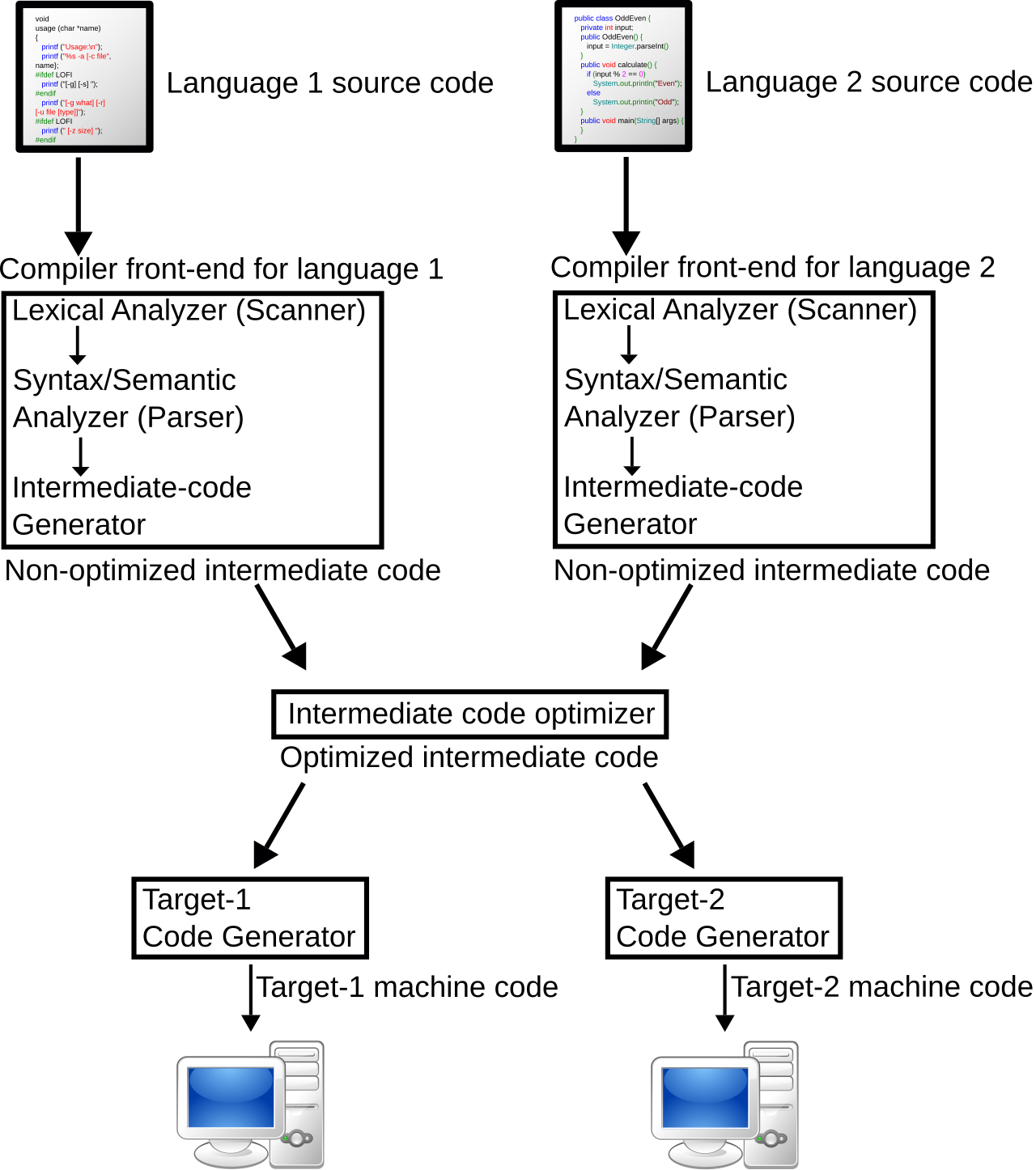
The classical compiler is organized as a pipeline, and the structure has been remarkably stable for fifty years:
- Lexical analysis (lexing), break the source text into tokens (keywords, identifiers, numbers, operators).
- Parsing (syntax analysis), assemble tokens into a tree structure (an abstract syntax tree) according to the language’s grammar. This is where the formal-language theory of the Chomsky Hierarchy meets practice (see The History of Parsing).
- Semantic analysis, check that the tree makes sense: types match, variables are declared, scopes are respected (see Type Systems).
- Intermediate representation (IR), translate into a machine-independent middle language that is easier to analyze and transform than either the source or the target.
- Optimization, rewrite the IR to run faster or smaller without changing its meaning.
- Code generation, emit machine code for the specific target processor.
The split between a language-specific front end and a machine-specific back end, connected by a shared IR, is the single most important structural idea in compiler design. It means N languages and M machines require N + M components rather than N × M.
Grace Hopper and the First Compilers
The word “compiler” and the idea behind it come from Grace Hopper (see Grace Hopper: The Queen of Code). In 1952 she built the A-0 system, which assembled subroutines from a library by their call numbers, a “compiler” in her original sense of compiling together existing pieces of code. It was a long way from a modern optimizing compiler, but it was the first program whose job was to generate another program from a higher-level description.
Hopper’s deeper contribution was ideological. The prevailing belief was that computers were arithmetic engines and that programming them in anything resembling English was impossible or pointless. Hopper argued the opposite: that the machine should adapt to the human, not the reverse. That conviction led directly to COBOL and the entire premise of high-level languages.
FORTRAN: Proving It Could Be Fast
The skeptics’ real objection was performance. Surely a machine-translated program would be hopelessly slower than one hand-coded in assembly by an expert? John Backus and his IBM team set out to disprove this with FORTRAN (1957) (see John Backus and FORTRAN and The Rise of High-Level Languages).
The FORTRAN compiler was one of the most ambitious software projects of its era precisely because it had to be good enough to win the argument. It pioneered serious optimization (register allocation, common-subexpression elimination, loop handling) to produce code competitive with hand-written assembly. It succeeded, and in succeeding it ended the debate: high-level languages were not a toy. FORTRAN’s compiler is arguably the moment compilation became an engineering discipline rather than a curiosity.
The Theory: Parsing, Grammars, and the Dragon Book
Through the 1960s and 1970s, compiler construction acquired a rigorous theoretical foundation. Noam Chomsky’s formal grammars gave a precise vocabulary for describing language syntax (see The Chomsky Hierarchy). John Backus and Peter Naur gave us BNF (Backus–Naur Form) for writing grammars down, first used to define ALGOL. Algorithms for LL and LR parsing turned grammar specifications into mechanical parsing procedures, and tools like Yacc (Stephen Johnson) and Lex (Mike Lesk and Eric Schmidt) at Bell Labs in the 1970s let programmers generate parsers and lexers automatically instead of writing them by hand.
The canonical text was Compilers: Principles, Techniques, and Tools by Aho, Sethi, and Ullman (1986), universally called “the Dragon Book” for its cover art. It codified the front-end-to-back-end pipeline as the standard mental model for a generation of computer-science students.
Beyond Translation: Optimization
As the front-end problem became well understood, the intellectual center of compiler research shifted to the middle end, optimization. A modern optimizing compiler performs dozens of transformations: inlining function calls, unrolling loops, eliminating dead code, propagating constants, vectorizing operations to use SIMD hardware, and reordering instructions to suit the processor’s pipeline.
The crucial enabling representation was SSA (Static Single Assignment) form, developed at IBM in the late 1980s, in which every variable is assigned exactly once. SSA makes data-flow analysis dramatically simpler and is the backbone of essentially every serious optimizing compiler built since.
LLVM and the Compiler as Infrastructure
The modern era is defined by LLVM, begun by Chris Lattner as a graduate project in 2000 (see The LLVM and Modern Compiler Infrastructure). LLVM took the front-end/back-end split to its logical conclusion: a clean, well-specified intermediate representation (LLVM IR) and a reusable, modular back end that any language could target. Write a front end that emits LLVM IR, and you inherit a world-class optimizer and code generators for dozens of processors for free.
The result reshaped the field. Clang (LLVM’s C/C++ front end) challenged the long-dominant GCC (see Richard Stallman and GNU). Swift, Rust, Julia, and WebAssembly toolchains were all built on LLVM. The compiler stopped being a monolithic per-language program and became shared infrastructure, a platform on which new languages could be built cheaply.
Variations on the Theme
Not every compiler fits the batch model of “source in, machine code out”:
- Interpreters execute source directly without producing a standalone binary.
- Bytecode compilers target a portable intermediate format run by a virtual machine: Java’s JVM, .NET’s CLR (see Assembly, Machine Code and Bytecode).
- JIT (Just-In-Time) compilers compile bytecode to machine code at runtime, optimizing based on actual execution behavior. The JVM’s HotSpot and JavaScript’s V8 are the canonical examples; they blur the line between interpreter and compiler entirely.
- Transpilers (source-to-source compilers) translate between high-level languages: TypeScript to JavaScript, or modern JavaScript to older dialects.
Dead End: Backus’s Own Disavowal
The most striking footnote in compiler history is that the man who proved high-level compilation could work came to believe the resulting languages were a dead end. In his 1977 Turing Award lecture, John Backus argued that the entire family of imperative languages FORTRAN had launched (assignment statements, the “von Neumann bottleneck” of shuffling words between CPU and memory) was a fundamentally limited way to think about computation, and championed functional programming as the way out (see The Rise of Functional Programming).
His functional-programming language FP never achieved mainstream use, and in that narrow sense his critique led to a dead end of its own. But his diagnosis aged remarkably well: the multicore era made the imperative model’s hidden assumptions about sequential, mutable state into a genuine liability, and functional ideas about immutability and pure functions flowed into every mainstream language. The compiler’s inventor was, characteristically, arguing against his own creation a full generation before the rest of the field caught up.
📚 Sources
- Aho, Lam, Sethi, Ullman — Compilers: Principles, Techniques, and Tools (“The Dragon Book”)
- John Backus — “Can Programming Be Liberated from the von Neumann Style?” (1977 Turing Lecture)
- The History of FORTRAN I, II, and III — Backus (1978)
- The LLVM Compiler Infrastructure Project
- Cytron et al. — Efficiently Computing Static Single Assignment Form (1991)
- Image: Compiler.svg by Surachit (CC BY-SA 3.0), via Wikimedia Commons