Tim Cook and Apple
Abstract
Tim Cook is the answer to a question almost nobody in 2011 thought had a good answer: who could possibly follow Steve Jobs? An industrial engineer from small-town Alabama, Cook joined Apple in March 1998 when the company was months from irrelevance, dismantled its factories and inventory mountains, and built the supply-chain machine that made the iPhone manufacturable at planetary scale. As CEO from August 2011, he was endlessly accused of not being a visionary, while Apple under his stewardship became the first US company worth $1 trillion, then $2 trillion, then $3 trillion, fought the FBI over encryption, turned privacy into a brand, and shipped Apple’s own silicon. His tenure also produced one of the most expensive product cancellations in history: the Apple Car.
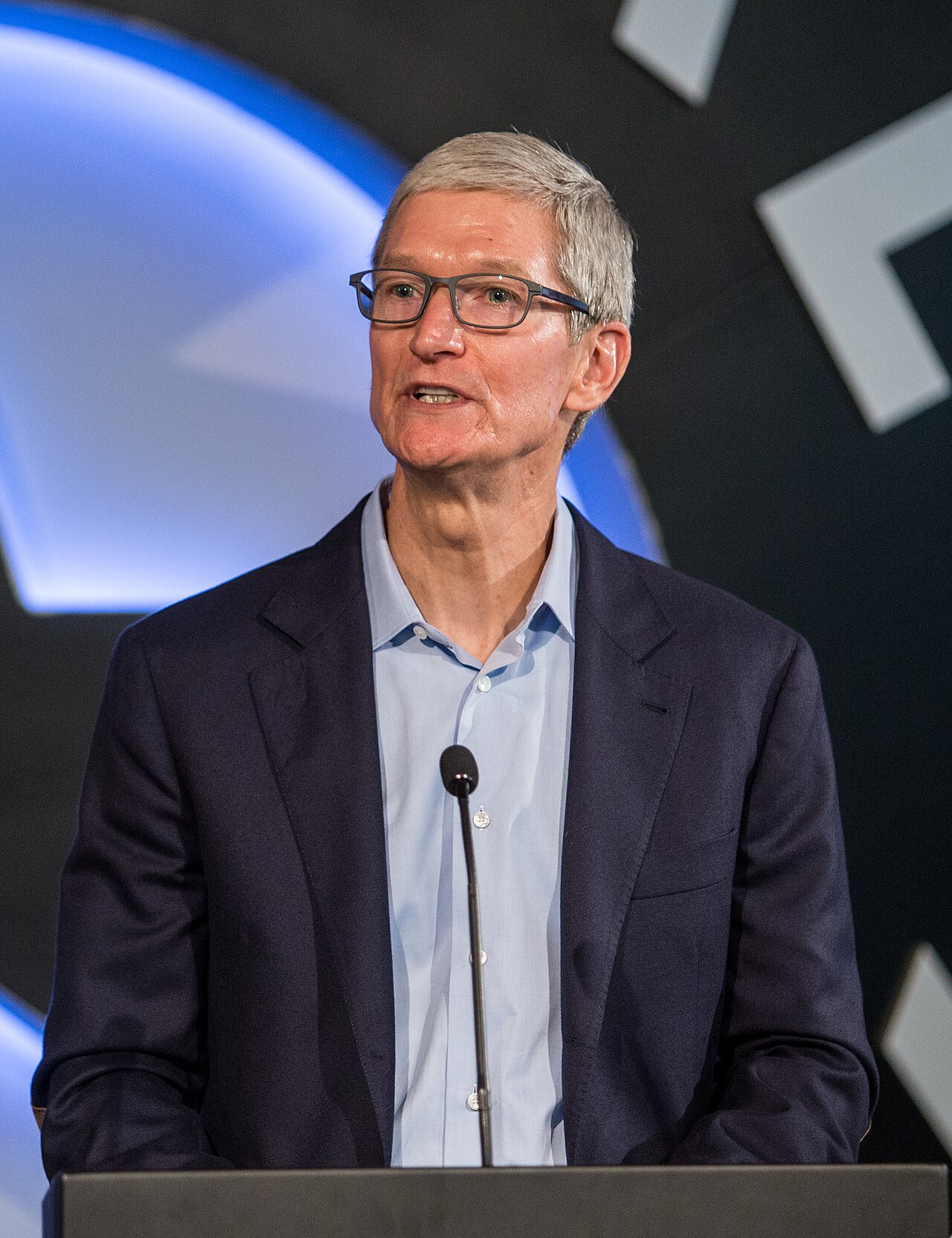
Robertsdale, IBM, and Twelve Minutes of Logic Ignored
Timothy Donald Cook (born November 1, 1960, in Mobile, Alabama) grew up in nearby Robertsdale, the son of a shipyard worker and a pharmacy employee. He studied industrial engineering at Auburn University (B.S. 1982) and later earned an MBA from Duke. Then came twelve years at IBM, running PC manufacturing and fulfillment for North America, a stint as COO of the reseller division at Intelligent Electronics, and barely six months at Compaq, then the world’s largest PC maker and, on paper, the obviously correct place to be in 1998.
That year Steve Jobs, freshly returned to a nearly bankrupt Apple, interviewed him. Cook later said that five minutes into the conversation he wanted to throw logic and caution to the wind and join Apple, against the advice of essentially everyone he asked. “Engineers are taught to make decisions analytically,” he wrote, “but there are times when relying on intuition is indispensable.”
The Operations Revolution
Cook arrived in March 1998 as senior vice president of worldwide operations and applied a simple doctrine: “Inventory is fundamentally evil.” He compared unsold electronics to dairy, past its freshness date in days. He closed Apple’s factories and warehouses, moved production to contract manufacturers (above all Foxconn in China), and drove inventory from months of stock down to days. Apple’s manufacturing became arguably its least visible and most decisive competitive weapon: when the iPhone needed to scale from prototype to hundreds of millions of units, the machine Cook had built was the reason it could (see Morris Chang and TSMC for the foundry side of that machine).
He was promoted to chief operating officer in 2005 and repeatedly ran the company during Jobs’s medical leaves (2004, 2009, 2011). The depth of the relationship showed in a detail that became public only later: Cook, who shares Jobs’s rare blood type, offered him part of his liver in 2009. Jobs refused, reportedly cutting him off with “I’ll never let you do that.”
CEO: August 24, 2011
Jobs resigned as CEO on August 24, 2011, recommending Cook as successor; he died six weeks later, on October 5. The consensus prediction was managed decline: Cook was the operations guy, not the product genius, and Apple without its founder was supposed to fade the way it had after 1985.
Instead, under Cook Apple became the most valuable company in the world, hitting $1 trillion in market capitalization on August 2, 2018 (the first US public company to do so), $2 trillion in August 2020, and touching $3 trillion in January 2022 (see Fun Fact: Apple’s First Trillion and The Rise of the Tech Giants). The strategy was distinctly Cook’s rather than an imitation of Jobs:
- New categories, entered late and patiently: the Apple Watch (announced September 2014, shipped April 2015) became the world’s best-selling watch; AirPods (2016) created the wireless-earbud market.
- Services: App Store, iCloud, Apple Music, Apple Pay, TV+, a recurring-revenue layer that grew into a business that would rank as a Fortune-50 company on its own (see The Rise of the App Store).
- Apple Silicon: the June 2020 announcement that Macs would abandon Intel for Apple’s own ARM-based chips, beginning with the M1 in November 2020, the culmination of a chip-design effort Cook had backed since the 2008 acquisition of P.A. Semi (see The ARM Architecture and Sophie Wilson and ARM).
Privacy as Product, Apple vs. the FBI
Cook turned privacy from an engineering preference into Apple’s loudest marketing claim: “if an online service is free, you’re not the customer, you’re the product” became his standard line against the advertising-funded model of Google and Facebook (see Surveillance Capitalism).
The defining test came in February 2016, when a federal court ordered Apple to build a weakened version of iOS so the FBI could unlock an iPhone used by one of the San Bernardino attackers. Cook published an open letter calling the demand “the software equivalent of cancer”: a backdoor built once cannot be built for only one phone. The FBI withdrew after buying a third-party exploit, leaving the legal question unresolved but Cook’s position unmistakable (see Cybersecurity: The Invisible War and The Privacy War). In April 2021, App Tracking Transparency in iOS 14.5 forced apps to ask permission before tracking users across apps; Meta told investors the change would cost it about $10 billion in 2022 revenue.
Cook also made personal history: in October 2014 he came out in a Bloomberg Businessweek essay, becoming the first openly gay CEO of a Fortune 500 company: “If hearing that the CEO of Apple is gay can help someone struggling to come to terms with who he or she is… then it’s worth the trade-off with my own privacy.”
The Harder Ledger: China, the App Store, Regulators
The same supply chain that made Apple unbeatable made it dependent on China for assembly and increasingly for sales, a dependence Cook managed through years of careful diplomacy and, after 2020, an expensive diversification toward India and Vietnam. The App Store’s 30% commission, once an afterthought, became the center of a global legal siege: the Epic v. Apple trial (2021) left the commission largely intact in the US but chipped at Apple’s anti-steering rules, while the EU’s Digital Markets Act forced sideloading and alternative app stores in Europe from 2024 (see The Platform Antitrust Story). The Vision Pro headset (launched February 2024 at $3,499) showed that Cook’s Apple could still ship audacious hardware, and that audacious hardware could still meet a shrug.
⚠️ Dead End: Project Titan
Around 2014, Apple began Project Titan, an effort to build an Apple-branded car, at peak involving thousands of employees and ambitions that oscillated for a decade between a full autonomous vehicle without steering wheel and a more conventional electric car. In February 2024, Apple canceled it outright, with reported cumulative costs of roughly $10 billion, and moved parts of the team to generative AI. The failure pattern was classic: the project never settled the basic question of what it was (car? autonomy platform? both?), autonomy proved far harder than the 2016-era industry consensus assumed (see The Autonomous Vehicle Race), and the automotive business offered margins Apple would never accept. A smaller cousin, the AirPower charging mat, holds the rarer distinction of being publicly announced (2017) and then publicly canceled (2019), by an Apple that under Jobs announced nothing it could not ship. Both cancellations cut against the caricature of Cook as a mere optimizer: he was willing to take large bets, and equally willing to kill them.
📚 Sources
- Wikipedia: Tim Cook
- Apple Press Release: Steve Jobs Resigns as CEO of Apple; Tim Cook Named CEO (August 24, 2011)
- Tim Cook: A Message to Our Customers (Apple, February 16, 2016) — the FBI/San Bernardino letter
- Tim Cook: “I’m Proud to Be Gay” (Bloomberg Businessweek, October 30, 2014)
- Apple announces Mac transition to Apple silicon (June 22, 2020)
- CNBC: Apple becomes first US company to reach $3 trillion market cap (January 3, 2022)
- Bloomberg: Apple Cancels Work on Electric Car (February 27, 2024)
- Facebook (Meta) Q4 2021 earnings call — ~$10B App Tracking Transparency impact
- Walter Isaacson: Steve Jobs (2011) — Cook’s hiring and the liver offer
- Image: Tim Cook (2017, cropped).jpg by Austin Community College (CC BY 2.0), via Wikimedia Commons