Whitfield Diffie and Martin Hellman: The Key Exchange That Unlocked the Internet
Abstract
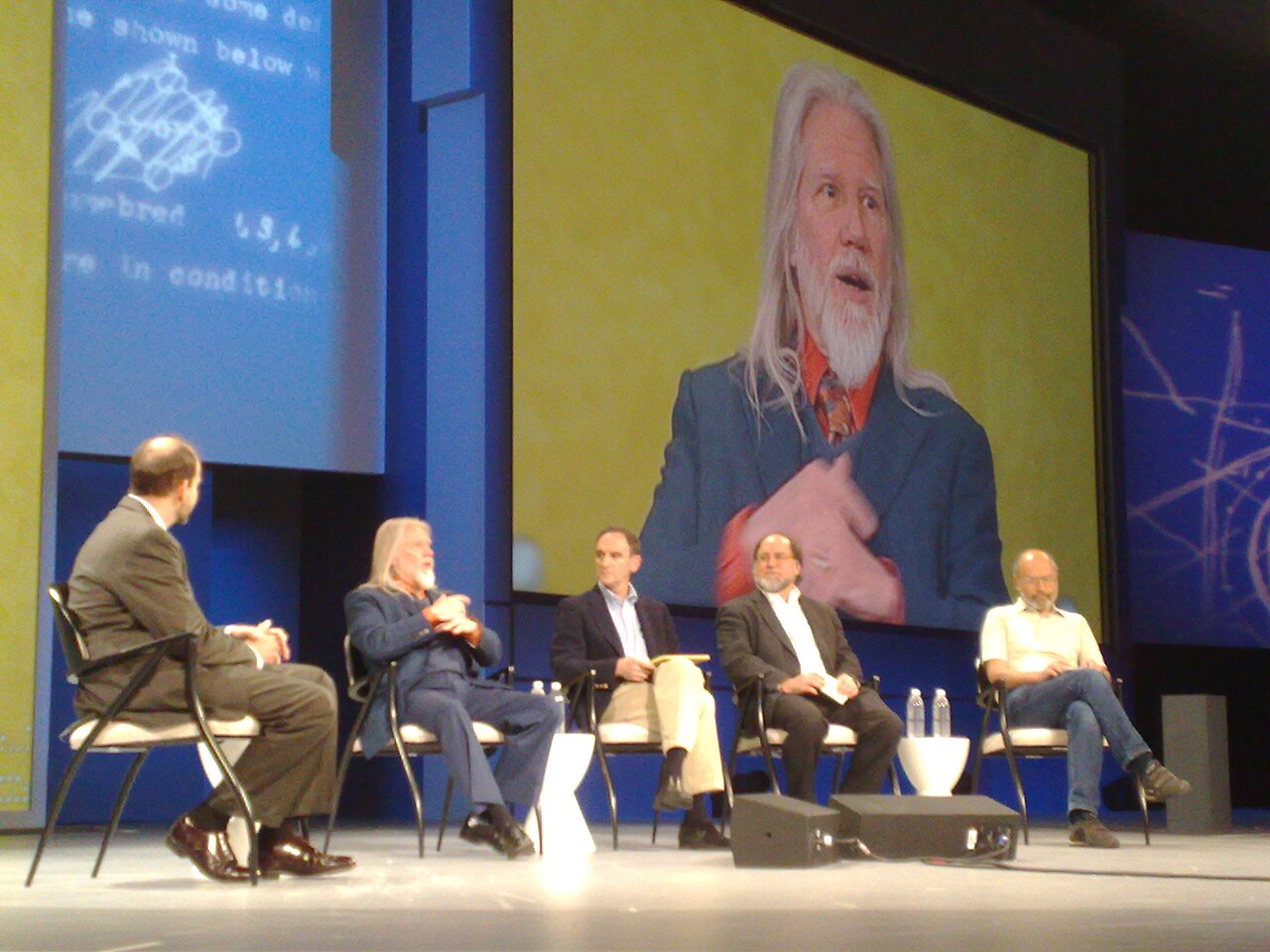
In November 1976, two Stanford researchers published a paper that solved a problem cryptographers had considered insoluble: how can two strangers establish a shared secret over a public channel, without ever meeting or exchanging a secret in advance? Whitfield Diffie and Martin Hellman’s answer (public-key cryptography and the Diffie-Hellman key exchange) became the mathematical foundation of the internet’s security infrastructure. Every HTTPS connection, every encrypted email, every secure payment made online depends on insights first articulated in that paper. The Turing Award committee waited thirty-nine years to give them the prize.
The Problem That Would Not Go Away
For most of cryptographic history, secure communication required a logistical miracle: sender and receiver had to share a secret key before they could encrypt anything. During World War II, this meant couriers carrying codebooks, elaborate key distribution systems, and the constant risk that a captured codebook would compromise everything it protected. In the commercial world, it meant that two businesses wanting to exchange encrypted messages had to first arrange a secure meeting, defeating much of the purpose of electronic communication.
By the early 1970s, as computers began to transform banking and commerce, the key distribution problem had sharpened into something approaching a crisis. The National Bureau of Standards was soliciting designs for a Data Encryption Standard; it was obvious that digital commerce would require encryption; it was equally obvious that digital commerce involved millions of parties who had never met and could not realistically pre-share keys.
Whitfield Diffie came to this problem from an unusual angle. He was not a credentialed academic; he had a mathematics degree from MIT (1965) but had spent his early career wandering through the fringes of the computing world, reading obsessively about cryptography, at the MITRE Corporation from 1965 and then, from 1969, as a programmer at the Stanford Artificial Intelligence Laboratory. Cryptography was, at the time, almost entirely classified; the serious work happened at the NSA, and the academic literature was thin. Diffie was, in effect, self-taught in a field that barely had public textbooks. He was, by his own later description, obsessed with one question: could two people who had never met construct a secret that eavesdroppers could not learn?
Martin Hellman was Diffie’s temperamental opposite: a Stanford electrical engineering professor, methodical and credentialed, who had been thinking about information-theoretic approaches to cryptography since his graduate work. The two met in the summer of 1974 at IBM’s Watson Research Center, where a scheduled half hour ran into many; by spring 1975 Hellman had hired Diffie as a part-time research programmer. The combination proved catalytic. Hellman provided institutional standing, mathematical rigor, and access to graduate students; Diffie provided the central obsession and the willingness to think past the assumptions everyone else had taken for granted.
New Directions in Cryptography
The paper they published in November 1976 (“New Directions in Cryptography,” in IEEE Transactions on Information Theory) ran to eleven pages and introduced two concepts that neither had existed in public cryptographic literature.
The first was public-key cryptography: the idea that a cryptographic system could work with two mathematically linked keys, one public and one private. Anything encrypted with the public key could only be decrypted with the private key, and the private key could not be derived from the public key in any feasible computation. This made the key distribution problem dissolve: Alice could publish her public key openly, and Bob could encrypt a message to her that only she could read. Eavesdroppers learning Alice’s public key gained nothing.
The second was the Diffie-Hellman key exchange protocol: a specific mathematical construction that let two parties compute a shared secret over a public channel. The security depended on the discrete logarithm problem, given a prime p, a generator g, and a value g^x mod p, finding x is computationally hard even when p and g are known. Alice and Bob could each choose private exponents, exchange their public values (g^a mod p and g^b mod p), and independently compute the same shared secret (g^ab mod p), while an eavesdropper who had intercepted both public values could not compute it without solving the discrete logarithm problem.
Diffie and Hellman were explicit that they had solved the key exchange problem conceptually but had not yet found a complete implementation of the general public-key encryption idea. That would be supplied, within months, by three MIT mathematicians.
GCHQ’s Secret Priority
In 1997, GCHQ declassified documents revealing that British intelligence researchers (James Ellis, Clifford Cocks, and Malcolm Williamson) had independently discovered public-key cryptography between 1969 and 1973. Clifford Cocks had described an algorithm mathematically equivalent to RSA in 1973. The work was classified, buried, and unused for two decades. Ellis died in November 1997, just weeks before the declassification, never having received public credit for what may have been his greatest intellectual achievement.
RSA and the Completion of the Vision
Ron Rivest, Adi Shamir, and Leonard Adleman at MIT read Diffie and Hellman’s paper and spent months searching for the trapdoor function the paper had called for, a computation easy to perform one way but hard to reverse. They found it in April 1977: the RSA algorithm, based on the fact that multiplying two large prime numbers together is trivial, while factoring the resulting product back into its primes is, for numbers of sufficient size, computationally infeasible with any known method.
RSA could do everything Diffie and Hellman had described in the abstract: encrypt messages, create digital signatures, and establish shared secrets. Martin Gardner described the scheme in Scientific American in August 1977 and offered readers the technical memo by post; thousands wrote in. Within weeks an NSA employee, Joseph Meyer, was writing to the IEEE warning that presenting cryptographic papers might breach arms-export law. The key distribution problem that had haunted cryptography for centuries had, in the space of eighteen months, been solved twice.
For the story of how RSA and public-key cryptography became deployed infrastructure, see Cryptography: The Secret Science.
The NSA’s Unhappy Response
The publication of “New Directions in Cryptography” alarmed the National Security Agency. Strong cryptography in civilian hands threatened the NSA’s core mission: signals intelligence depended on the ability to intercept and decrypt communications. An academic paper describing how to make encryption unbreakable by anyone lacking the private key (including the NSA) was, from the agency’s perspective, close to a national security problem.
The NSA’s response was clumsy. The Meyer letter of 1977 argued that publishing cryptographic research might violate export control law, a position that, if accepted, would have meant academic cryptography papers required government approval before publication. The scientific community reacted with fury. The American Council on Education ultimately issued a statement asserting that academic freedom and export control laws were in tension and that the government’s position was untenable.
The NSA backed down, but the conflict established the pattern for every subsequent round of the “crypto wars”: government agencies seeking control over cryptographic tools and publications, the academic and civil liberties communities resisting, and the mathematics ultimately escaping any attempt at containment. Diffie, in particular, became a consistent and vocal opponent of government attempts to restrict cryptographic research, a role he would reprise repeatedly over the following decades.
The Clipper Chip and the Crypto Wars
In 1993, the Clinton administration proposed the Clipper chip: a hardware encryption device with a built-in backdoor, a “key escrow” mechanism that split the decryption key between two government agencies, allowing law enforcement to decrypt communications with a court order. The proposal was presented as a reasonable balance between privacy and law enforcement.
Diffie testified before Congress against the Clipper chip in terms that were both technical and political. His core argument was that key escrow was not a balance: it was a fundamental weakening of encryption for everyone, because the escrow keys represented a high-value target that adversaries would inevitably attempt to compromise. A backdoor built for law enforcement was a backdoor available to anyone who could obtain the escrowed keys, whether through legal process, corruption, or theft.
The Clipper chip was abandoned by 1996, partly because cryptographer Matt Blaze published a paper demonstrating a flaw in the escrow mechanism. But the arguments Diffie had made: that cryptographic security was mathematically indivisible, that backdoors were always double-edged, that the question was not whether to allow strong encryption but whether to forbid it, became the canonical response to government backdoor proposals for the next three decades.
For the subsequent history of the Crypto Wars, including PGP and the export control battles, see Phil Zimmermann and PGP and The Privacy War.
After Stanford: Diverging Paths
Hellman remained at Stanford, building a distinguished academic career in cryptography and, later, in nuclear risk analysis, applying the probabilistic frameworks of information theory to the question of accidental nuclear war. He and his wife Dorothie became peace activists; Hellman has argued that the risk of accidental nuclear war is systematically underestimated, roughly as the risk of public-key cryptography being unnecessary was systematically overestimated in 1976.
Diffie’s path was less linear. He ran secure systems research at Northern Telecom from 1978 to 1991, then spent eighteen years at Sun Microsystems (1991–2009), arriving as a Distinguished Engineer and leaving as chief security officer, a Sun Fellow, and something between company cryptographer and public intellectual. From 2010 to 2012 he was ICANN’s vice president for information security and cryptography. He consulted widely, continued publishing, and testified before Congress and parliamentary committees on cryptography policy. Throughout, his public voice, skeptical of government cryptographic claims, insistent on the right to strong encryption as a civil liberty rather than a technical option, shaped the debate in ways his technical papers could not.
The Turing Award: Thirty-Nine Years Later
The ACM Turing Award for 2015 (announced in March 2016) went to Whitfield Diffie and Martin Hellman “for critical contributions to modern cryptography.” The award came thirty-nine years after “New Directions in Cryptography,” a gap that struck many in the field as embarrassingly long for what most considered one of the most consequential papers in the history of applied mathematics.
Part of the delay may have reflected the classified parallel discovery at GCHQ, which complicated any clean priority claim. Part reflected the NSA’s continued sensitivity about public recognition of civilian cryptographic achievement. And part simply reflected the Turing Award committee’s historically slow response to applied work, the award has tended to favor theoretical computer science and systems work over applied cryptography.
The recognition arrived in any case. Every HTTPS connection in the world uses key exchange protocols derived from Diffie-Hellman. The public-key infrastructure of the internet (certificate authorities, TLS, digital signatures) is the direct implementation of concepts first articulated in their 1976 paper. The two men who sat in a Stanford office arguing about a mathematical abstraction had, inadvertently, built the security foundation of the global economy.
The Key Exchange in One Sentence
The Diffie-Hellman key exchange works because mixing colors is easy but unmixing them is hard: Alice and Bob each mix a private color into a shared public color, exchange the results, and both add their private color to what they received, arriving at the same final color, which no eavesdropper who only saw the intermediate values can reproduce.
📚 Sources
- Diffie, W. & Hellman, M.: “New Directions in Cryptography,” IEEE Transactions on Information Theory, Vol. 22, No. 6, November 1976
- Levy, Steven: Crypto: How the Code Rebels Beat the Government — Saving Privacy in the Digital Age (2001), Viking
- Singh, Simon: The Code Book: The Science of Secrecy from Ancient Egypt to Quantum Cryptography (1999), Fourth Estate
- ACM Turing Award 2015 — Whitfield Diffie and Martin Hellman
- Hellman, Martin: “An Overview of Public Key Cryptography,” IEEE Communications Magazine, May 2002
- Coppersmith, Don: “The Data Encryption Standard (DES) and its strength against attacks,” IBM Journal of Research and Development 38(3): 243–250, 1994 — context on the DES era
- Diffie, Whitfield: “The First Ten Years of Public-Key Cryptography,” Proceedings of the IEEE, Vol. 76, No. 5, May 1988
- Burr, William E.: “Selecting the Advanced Encryption Standard,” IEEE Security & Privacy, 2003 — context on post-DH developments
- Image: Cryptographers-2008.jpg by Dan Spisak (CC BY-SA 2.0), via Wikimedia Commons