Larry Page and Sergey Brin: The Accidental Empire
Abstract
Larry Page and Sergey Brin met at Stanford in 1995, disagreed about almost everything at first, and then built together the most-used software system in human history. PageRank was a mathematical insight that turned the web’s own link structure into a relevance signal; Google was the company they nearly sold to anyone who would buy it, before deciding to run it themselves. Their story is one of accidental ambition, two graduate students who set out to improve web search and ended up controlling how the world accesses information.
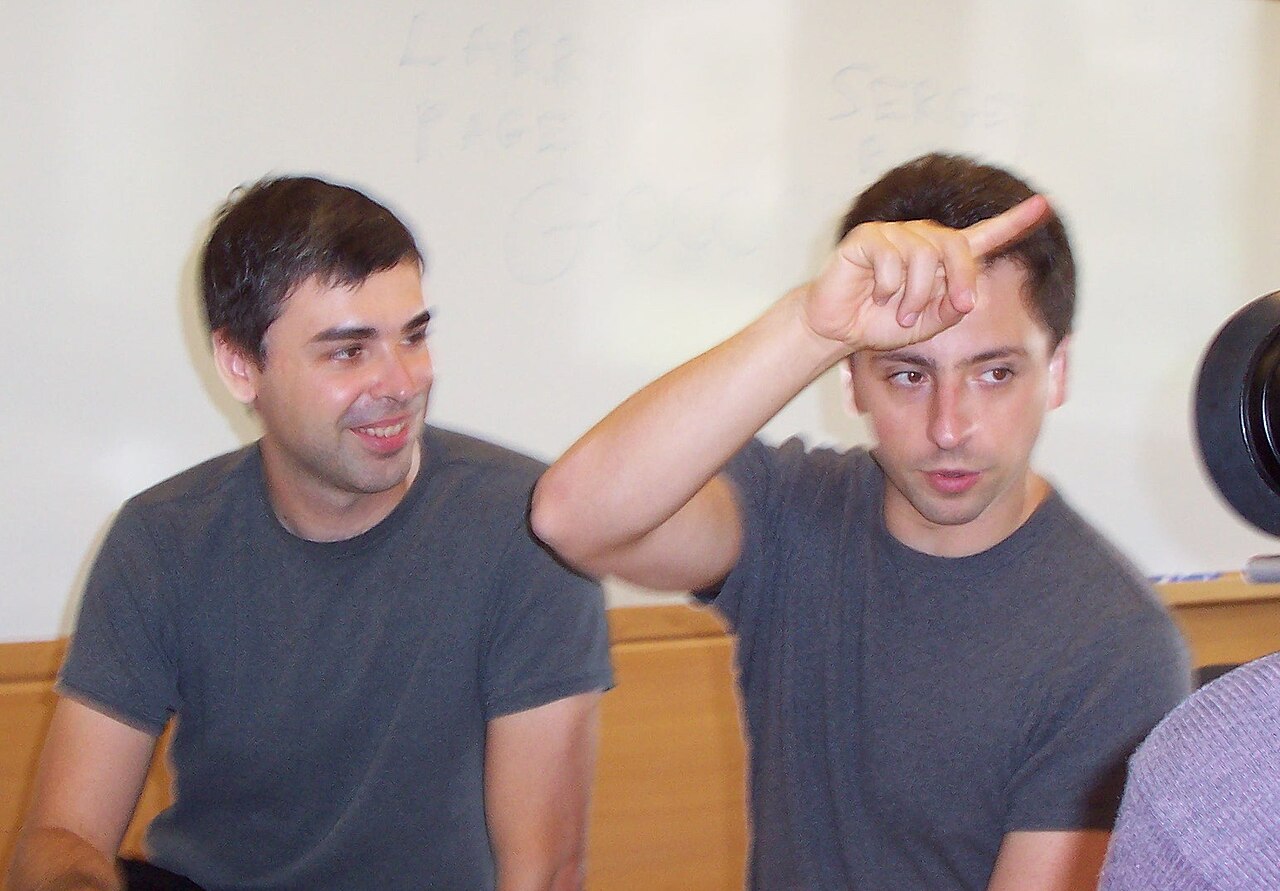
Two Families, Two Trajectories
Lawrence Edward Page was born on March 26, 1973, in East Lansing, Michigan. His father, Carl Page, was a professor of computer science at Michigan State University and one of the early figures in artificial intelligence research; his mother, Gloria, taught computer programming. The family home was scattered with computers and technology magazines from Page’s earliest years. He attended Montessori schools as a child, a fact he has credited multiple times with shaping his resistance to being told what to do. He earned a BS in computer engineering from the University of Michigan before arriving at Stanford.
Sergey Mikhailovich Brin was born on August 21, 1973, in Moscow, in what was then the Soviet Union. His father, Michael Brin, was a mathematics professor; his mother, Eugenia, worked as a researcher at NASA’s Goddard Space Flight Center. The family was Jewish, and in the Soviet Union this meant quiet discrimination: Michael Brin had been denied access to graduate programs in physics because of his religion. In 1977 Michael attended a mathematics conference in Warsaw and, meeting Western colleagues freely for the first time, came home convinced the family had to leave. They applied to emigrate; in May 1979, when Sergey was five, they were permitted to go. They settled in Adelphi, Maryland.
Sergey later said that the emigration was the formative fact of his childhood, and that his father’s experience of state anti-Semitism shaped his own values around openness and the free flow of information. He earned a BS in mathematics and computer science from the University of Maryland before arriving at Stanford’s PhD program in computer science.
Meeting at Stanford: “I Thought He Was Obnoxious”
In the summer of 1995, Stanford assigned Brin (already a second-year PhD student) to show incoming students around campus. Page was among the new arrivals. By multiple accounts, they argued about nearly everything on that first tour: urban planning, transportation policy, the value of various research approaches. Page later described Brin as “pretty obnoxious.” Brin described Page similarly.
They were assigned to work together on a research project, and the friction proved generative. Their debates were intense but symmetric, neither deferred, both listened. Page had arrived at Stanford with an interest in the mathematical structure of the World Wide Web. He wanted to understand the link graph: if you could download the entire web and treat it as a directed graph, what could you learn from the structure of the edges?
The initial project was called BackRub. Beginning in 1996, Page (with Brin’s mathematical assistance) built a web crawler that downloaded pages and recorded every link. The key insight was recursive importance: the importance of a page depended on the importance of the pages linking to it, which in turn depended on the pages linking to them. The algorithm required iterative computation over the whole graph to reach a stable solution, but the result was a measure of authority that no keyword-stuffing trick could fake. They called the algorithm PageRank, after Larry Page, and after the concept of ranking web pages.
The Name “PageRank”
The double meaning was intentional. Larry Page filed a patent for the PageRank algorithm; it was assigned to Stanford University, which licensed it to Google in exchange for 1.8 million shares of pre-IPO stock. Stanford sold those shares in 2005 for $336 million, the most valuable technology license in the university’s history. The patent expired in 2018.
The Decision Not to Sell
As their search engine improved, Page and Brin made serious attempts to sell or license it. They approached Yahoo!, AltaVista, and Infoseek without success. The established search companies were building portals (destinations) not tools that sent users away efficiently.
Failing to sell, they incorporated Google Inc. on September 4, 1998, in the Menlo Park garage of Susan Wojcicki, then a recent MBA working at Intel, whose sister Anne Brin married in 2007.
Even after incorporating they kept trying. The closest they came was Excite. In 1999, Kleiner Perkins partner Vinod Khosla, an Excite investor, brokered a sale at $1 million, then talked the founders down to $750,000; Excite’s CEO George Bell turned it down both times. The story usually told is that Bell feared a search engine that answered questions too fast would cut pageviews. Bell’s own account is different: Page insisted Excite rip out its existing search technology and run Google’s instead, and Excite’s tests did not show enough improvement to justify discarding years of engineering. Their first investor, Andy Bechtolsheim, wrote a $100,000 check before the company had a bank account.
The name came from a misspelling. The intended name was “Googol”, the mathematical term for 10¹⁰⁰, chosen to signal the scale of their web-indexing ambition. When a friend checked domain availability and registered “google.com” by mistake, they kept it.
The Garage Years and the Foosball Table
The early Google office culture was shaped by Page and Brin’s shared values, which were genuine if occasionally self-serving. They believed in hiring only the very best engineers, even when the company had no HR function and interviews were conducted by both founders simultaneously. They believed in flat structure: no private offices, no formal titles beyond “founder.” They brought in a foosball table and a hockey table, fed employees free meals, and insisted that the company not take external meetings that interrupted engineers’ work.
The “Don’t Be Evil” motto (coined by engineer Paul Buchheit at an early values meeting) captured something real about their early culture. They had built a search engine that explicitly did not sell placement in results, in deliberate contrast to GoTo.com. They had turned down acquisition offers from companies whose advertising practices they found ethically compromised. When they launched AdWords in 2000 and AdSense in 2003, they designed the systems to show clearly labeled ads that were genuinely relevant to user queries, not the garish banner advertising that dominated the web.
Whether this ethical commitment survived growth is a different question.
Eric Schmidt and the “Adult Supervision” Era
In 2001, venture investors (led by Kleiner Perkins’ John Doerr) insisted that Google hire an experienced CEO. Page and Brin resisted; they interviewed dozens of candidates and dismissed most after fifteen minutes. They eventually agreed on Eric Schmidt, the former CEO of Novell and CTO of Sun Microsystems.
Schmidt later described his role as providing “adult supervision”, handling the business, regulatory, and management functions that the founders found uninteresting, while Page and Brin remained focused on the product and engineering direction. The arrangement worked: under the Schmidt-Page-Brin triumvirate, Google went public in August 2004 (raising $1.67 billion in a Dutch auction IPO), launched Gmail, Google Maps, Google Earth, Google Video, and a dozen other products, acquired YouTube and Android, and grew from a few hundred employees to over 32,000.
The 2004 IPO S-1 filing contained a remarkable document: a founders’ letter from Page and Brin declaring that Google was “not a conventional company” and would not become one, that they had no intention of managing for quarterly earnings, that their employees had “a license to pursue dreams,” and that they would evaluate the company’s success by whether it “makes the world a better place.” The letter was received with skepticism on Wall Street and admiration in Silicon Valley. Both reactions were probably correct.
Page as CEO: 2011–2015
In April 2011, Page replaced Schmidt as CEO of Google. Schmidt moved to executive chairman. The transition signaled that Page felt confident enough to run the company himself, and that he had never entirely relinquished control.
Page’s tenure as CEO was marked by ambitious restructuring. He reorganized Google into a smaller number of larger products, demanded that managers show clear strategic vision, and personally championed a series of “moonshot” projects: Google Glass (augmented reality glasses, announced 2012, widely mocked for social intrusiveness, consumer version discontinued 2015 though enterprise versions continued), Project Loon (internet-beaming stratospheric balloons), and Waymo (self-driving cars, emerging from Google X under engineer Sebastian Thrun).
He also pushed Google’s most controversial social project: Google+, the social network intended to compete with Facebook. Page believed that Google’s failure to build a social identity layer was a structural vulnerability: Facebook knew who its users were; Google tracked behavior but not identity. Google+ launched in June 2011, briefly attracted over 400 million registered accounts (mostly through forced integration with other Google products), and failed to achieve genuine social engagement. It was quietly wound down beginning in 2018.
Alphabet and the Withdrawal
In August 2015, Page and Brin announced the creation of Alphabet Inc. as a restructuring of Google’s corporate organization. Google would become a subsidiary; Alphabet would be the parent holding company. Page would be Alphabet CEO; Brin would be Alphabet President; Sundar Pichai, the soft-spoken engineer who had risen to oversee Chrome, Android, and Google’s apps division, would be Google CEO.
The stated rationale was managerial clarity, letting each business unit run independently, with transparent financial reporting. The unstated rationale, widely observed, was that Page and Brin were less interested in managing a $500-billion-dollar advertising company than in directing longer-horizon research. Alphabet’s “Other Bets” structure gave the moonshot projects (Waymo, Verily, DeepMind, X) a formal place in the corporate structure without requiring them to justify themselves on Google’s advertising metrics.
In December 2019, Page and Brin announced they were stepping down from their executive roles entirely. Sundar Pichai became CEO of both Google and Alphabet. The founders retained control through their supervoting share structure (Page and Brin together held shares with approximately 51% of voting power) but removed themselves from day-to-day management.
After Alphabet: Diverging Paths
Sergey Brin and Larry Page have followed dramatically different trajectories since their withdrawal from management.
Page has become one of the most reclusive billionaires in the world. He reportedly spends much of his time on a superyacht and maintains residences in New Zealand, which he has visited repeatedly and reportedly considered a refuge in various scenarios involving global disruption. He has largely disappeared from public events and gives almost no interviews. His combined net worth, fluctuating with Alphabet’s share price, exceeded $120 billion as of 2024. He continues to invest through various vehicles and has reportedly funded research into extended human lifespan, an interest consistent with his broader pattern of pursuing technically ambitious goals with long time horizons.
Brin has been more publicly visible, though primarily through personal rather than professional news. His 2023 divorce from Nicole Shanahan, settled in confidential arbitration and reported in the press at roughly $1 billion, attracted heavy coverage; Shanahan then spent $4 million on a Super Bowl advertisement for Robert F. Kennedy Jr. through a supporting super PAC and became his running mate in 2024. More significantly, when OpenAI’s ChatGPT launch in November 2022 triggered an emergency response at Google, Brin reportedly returned to the office and began actively writing code for AI projects, particularly for Gemini. According to multiple accounts, his return was a genuine re-engagement rather than a ceremonial visit.
Their combined net worth (fluctuating with Alphabet stock) has consistently placed both men among the ten wealthiest people in the world, a position that has attracted scrutiny about concentrated wealth and the obligations it creates, scrutiny neither man has consistently engaged with publicly.
The Luck Question
Page and Brin have occasionally been asked how much of Google’s success was luck, the right idea at the right moment, the right investors, the right cultural context of an expanding web. Brin told ABC News in 2004: “Obviously everyone wants to be successful, but I want to be looked back on as being very innovative, very trusted and ethical and ultimately making a big difference in the world. So I hope that Google is seen as making a difference.” Whether that hope has been realized is a question the antitrust cases, the advertising empire, and the surveillance capitalism literature have complicated considerably.
For the company they built, see Google: From Dorm Room to Digital Infrastructure. For the advertising model and its implications, see Surveillance Capitalism: The Business Model That Monetized Human Behavior.
📚 Sources
- Vise, David A. & Malseed, Mark: The Google Story (2005, updated 2008), Bantam Dell
- Levy, Steven: In the Plex: How Google Thinks, Works, and Shapes Our Lives (2011), Simon & Schuster
- Auletta, Ken: Googled: The End of the World as We Know It (2009), Penguin Press
- Page, Larry & Brin, Sergey: “An Owner’s Manual for Google’s Shareholders” — Founders’ IPO Letter (2004), US SEC EDGAR
- Brin, Sergey & Page, Lawrence: “The Anatomy of a Large-Scale Hypertextual Web Search Engine” (1998), Computer Networks and ISDN Systems
- Schmidt, Eric; Rosenberg, Jonathan; Eagle, Alan: Trillion Dollar Coach: The Leadership Handbook of Silicon Valley’s Bill Campbell (2019), Harper Business
- Alphabet Inc. SEC filings and annual reports, 2015–2024, SEC EDGAR
- Sergey Brin — Wikipedia (his 2023 return to hands-on work on Google’s AI models)
- “The Real Reason Excite Turned Down Buying Google For $750,000 In 1999” — Internet History Podcast, interview with George Bell
- “When Google Wanted To Sell To Excite For Under $1 Million, And They Passed” — TechCrunch, 29 September 2010
- “How Nicole Shanahan rose through tech and law to RFK Jr.’s ticket” — NBC News, 2024, the divorce settlement reporting and her political spending
- Image: Google page brin.jpg by Ehud Kenan (CC BY 2.0), via Wikimedia Commons