Vannevar Bush and the Memex
Abstract
Vannevar Bush was the most powerful science administrator in American history, the man who organized the scientific mobilization of World War II, directed the Manhattan Project’s civilian oversight, and created the institutional framework that produced the modern research university. But he is remembered in computing history primarily for a 1945 essay describing a device he called the Memex: a hypothetical desk-mounted information machine that would let users store, retrieve, and navigate between documents through associative links. The Memex was never built. But the concept of linking documents by association rather than by hierarchy or sequential order directly influenced J.C.R. Licklider, [[Douglas_Engelbart_and_the_Mother_of_All_Demos|Doug Engelbart]], Ted Nelson, and Tim Berners-Lee, making Bush, through the force of a single speculative article, one of the intellectual ancestors of the World Wide Web.
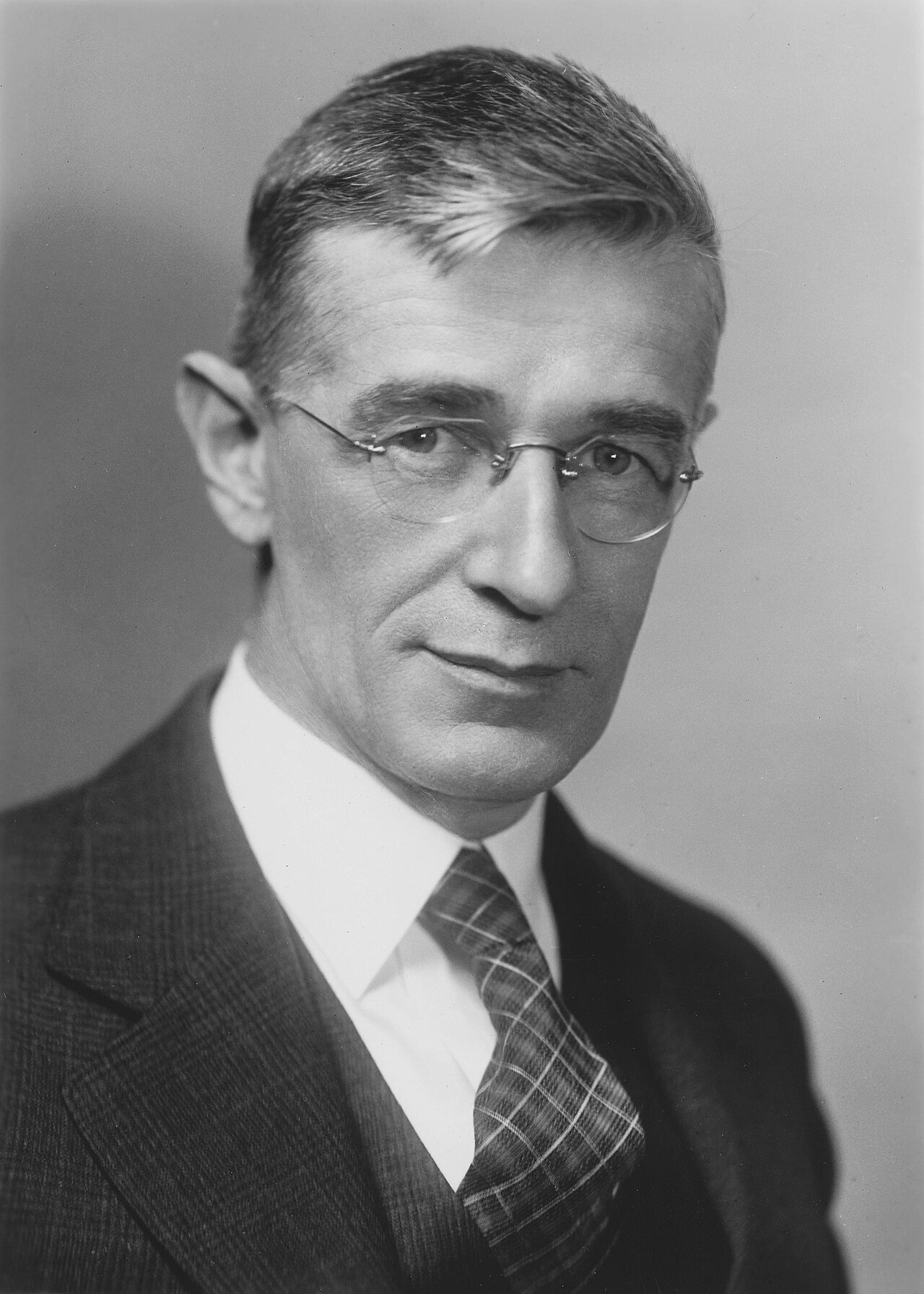
The Engineer Who Organized American Science
Vannevar Bush was born in 1890 in Everett, Massachusetts. He earned a doctorate in electrical engineering jointly from MIT and Harvard in 1916, a thesis written in a year, which impressed both institutions enough to grant the joint degree. He joined MIT’s faculty and became a professor of electrical engineering, developing analog computing devices that would shape the field for two decades.
Bush’s most important pre-war engineering achievement was the Differential Analyzer (1931), an analog mechanical computer that solved differential equations by using sets of rotating discs and integrating gears. The Differential Analyzer was the most powerful computational tool in the United States for its time, military ballistic tables, physics calculations, and engineering problems that would have taken human computers months could be solved in hours. It was a direct predecessor of the computers that would replace it, and it gave Bush a deep intuition for what computation could do if the mechanics were right.
Bush became Dean of Engineering at MIT in 1932 and then President of the Carnegie Institution of Washington in 1939. By 1940, when it was clear that the United States would eventually enter World War II, Bush had positioned himself as the obvious person to run the scientific mobilization.
The War: Organizing Scientific Power
In June 1940, Bush met with President Roosevelt and presented a single page describing his vision for a government agency that would coordinate military research and give civilian scientists authority to direct war-relevant projects. Roosevelt approved it in ten minutes. The National Defense Research Committee (NDRC) was established that day.
Bush understood something that most military officers did not: that modern war would be won by technology as much as by manpower, and that producing the right technology required giving scientists authority to set research agendas rather than merely executing engineering specifications. This was a radical proposition in 1940. The success of the model would prove it correct.
Under Bush’s direction, the NDRC (and its successor, the Office of Scientific Research and Development, created in 1941) funded: radar development at MIT’s Radiation Laboratory (which became the single most important technological factor in Allied victory in the air and at sea), proximity fuse development that made artillery far more effective, penicillin mass production that saved hundreds of thousands of lives, blood plasma research, and dozens of other projects. Bush served as the civilian overseer of the Manhattan Project (the most expensive research program in history to that point) though he delegated operational management to the Army’s Groves and the scientists themselves.
The war-time science program Bush organized was one of the most successful research mobilizations in history. It also created the template for peacetime science policy: federal funding of university research through competitive grants, distributed to researchers chosen by peer review rather than government administrators. This model (codified in the Endless Frontier report Bush submitted to Truman in 1945) created the NSF, shaped NIH’s grant-making, and remains the basic structure of American academic science.
“As We May Think”: The 1945 Essay
In July 1945, as the war ended, The Atlantic published Bush’s essay “As We May Think.” It was the most influential piece of speculative technology writing of the 20th century.
Bush began by observing that the accumulation of human knowledge had outpaced the tools for storing and retrieving it. Scientists were drowning in literature. Important work was being duplicated because researchers couldn’t find what had already been done. The existing tools for organizing knowledge (library catalogues organized by subject headings, alphabetical indices) imposed hierarchical classifications that forced users to guess which category the information had been filed under, even if they knew exactly what they were looking for.
Bush proposed an alternative organizing principle: association. The human mind, he wrote, operates by association. When you think of one concept, related concepts appear, not because they were filed nearby in some catalogue but because the mind has learned that they are connected. A good memory system, Bush argued, should work the same way.
He described the Memex:
“Consider a future device for individual use, which is a sort of mechanized private file and library. It needs a name, and to coin one at random, ‘memex’ will do. A memex is a device in which an individual stores all his books, records, and communications, and which is mechanized so that it may be consulted with exceeding speed and flexibility. It is an enlarged intimate supplement to his memory.”
The Memex as Bush envisioned it was a desk with two screens, a keyboard, and a collection of microfilm, the state-of-the-art storage medium of 1945. Users would store documents and create trails: chains of associative links between documents that represented a line of research or thought. These trails could be shared with other users. A researcher studying, say, antibiotic resistance could follow trails created by other researchers, seeing not just the documents they had consulted but the connections they had seen between them.
The technology Bush imagined (microfilm storage, dry photography for rapid copying, mechanical indexing) was wrong. The concept of associative links between documents was right.
The Hypertext Connection
Ted Nelson, who coined the term “hypertext” in 1965, explicitly credited Bush’s Memex as the inspiration. Doug Engelbart, whose “Mother of All Demos” in 1968 showed collaborative hypermedia, described reading “As We May Think” during the war as the formative experience that shaped his research agenda. Tim Berners-Lee cited Bush as a predecessor in his original Web proposal. The Memex was the conceptual prototype of the hyperlink.
The Postwar Years: From Power to Decline
Bush’s influence peaked in 1945 and declined steadily thereafter. He was a Republican in an increasingly Democratic science establishment, and his relationships with Truman’s administration were fraught. The question of who controlled nuclear weapons (civilian or military) became politically toxic, and Bush’s positions on civilian control were attacked from multiple directions.
His Endless Frontier report, which proposed a National Research Foundation with strong autonomy from political control, was transformed by Congress into the more government-directed NSF that actually emerged in 1950. Bush believed the political process had weakened the key institutional guarantee: that research agendas would be set by scientists, not politicians. He was probably right.
Bush spent his later years at the Carnegie Institution, writing books (Modern Arms and Free Men, 1949; Science Is Not Enough, 1967), serving on corporate boards, and watching the computing revolution he had helped catalyze develop in directions he had not anticipated. His Differential Analyzers were replaced by digital computers; the ENIAC and its successors operated on principles different from anything he had built. He understood the shift intellectually but was not a digital computing pioneer in any direct sense, his contributions were organizational and conceptual.
He died in 1974, two decades before the World Wide Web made the associative linking concept he had described in The Atlantic into the primary navigational structure of human knowledge on a global scale.
Legacy: The Idea That Outlasted the Technology
Bush’s legacy operates on two levels. The institutional legacy is the framework of federal research funding that created postwar American technological supremacy: the NSF, NIH’s extramural grant program, DARPA, and the university research system that trained the scientists who built the digital age.
The intellectual legacy is the Memex concept, which seeded a line of thinking about human-computer interaction and information retrieval that ran from Bush through Licklider through Engelbart through Nelson to Berners-Lee. The specific insight (that information should be organized by association between ideas rather than by hierarchical classification) was correct in 1945 and remains the dominant metaphor for how we navigate digital information today. Every hyperlink is a small Memex trail.
📚 Sources
- Bush, Vannevar: “As We May Think” — The Atlantic, July 1945
- Bush, Vannevar: Science: The Endless Frontier (1945), U.S. Government Printing Office — reprinted NSF, 1990
- Zachary, G. Pascal: Endless Frontier: Vannevar Bush, Engineer of the American Century (1997), Free Press
- Nelson, Ted: “Complex Information Processing: A File Structure for the Complex, the Changing and the Indeterminate” (1965) — cites Memex as direct inspiration
- Engelbart, Douglas: “Augmenting Human Intellect: A Conceptual Framework” (1962) — acknowledges Bush