Satya Nadella and Microsoft's Transformation
Abstract
Satya Nadella became Microsoft’s CEO in February 2014, inheriting a company that analysts widely described as having missed the mobile revolution, lost its relevance in consumer technology, and fallen behind Amazon and Google in cloud computing. In the decade that followed, Microsoft’s market capitalization grew from approximately $300 billion to over $3 trillion, making it briefly the world’s most valuable company. The transformation was strategic as much as technical: Nadella changed what Microsoft sold, how it sold it, and (most consequentially) what kind of company its employees and partners believed it to be.
Hyderabad to Redmond
Satya Narayana Nadella was born on August 19, 1967, in Hyderabad, India, the son of a civil servant. He studied electrical engineering at Manipal Institute of Technology, then moved to the United States, earning a master’s degree in computer science from the University of Wisconsin–Milwaukee (1990) and an MBA from the University of Chicago (1997).
After a brief early stint at Sun Microsystems, he joined Microsoft in 1992, at a time when the company was ascendant: Windows 3.1 had just been released, the IBM PC clone market was dominant, and Microsoft’s software was the platform on which the industry ran. Over the next twenty-two years he worked in various divisions, eventually leading the Bing search engine (which he helped rescue from technical irrelevance), Microsoft’s Server and Tools division, and then the Cloud and Enterprise group, where he presided over Azure’s initial growth.
“Mobile-First, Cloud-First”
Nadella became CEO on February 4, 2014. His first major strategic statement was “mobile-first, cloud-first”, a phrase that signaled a departure from Microsoft’s historical Windows-centric worldview. Under Steve Ballmer, Microsoft had viewed iOS and Android as platforms to be resisted or replicated; every important Microsoft application ran first (or only) on Windows. The result was that Microsoft’s software became unavailable on the devices people actually used.
Nadella reversed this. Microsoft Office launched on iPad on March 27, 2014, weeks after he became CEO, and his first major public product event in the role. Microsoft open-sourced the .NET framework. SQL Server was ported to Linux. Azure began running Linux workloads at a time when Microsoft had previously described Linux as a “cancer.” The shift was not philosophical capitulation; it was market analysis: Microsoft’s enterprise customers were using iPhones, iPads, and Linux servers regardless of Microsoft’s preferences, and Microsoft had to serve those environments or lose the customers.
Azure and the Cloud
When Nadella took over Microsoft’s Server and Tools business in 2011 (renamed Cloud and Enterprise in the 2013 reorganization), Azure was a distant third behind Amazon Web Services (launched 2006, dominant) and Google Cloud (launched 2008). Azure was Microsoft’s cloud platform but lacked the scale, reliability, and breadth of services that AWS offered. Enterprise customers evaluating cloud options typically chose AWS.
Under Nadella’s leadership, Azure grew in reliability, geographic footprint, and service breadth. More importantly, it grew in its relationship with Microsoft’s enterprise customer base: the companies that ran Microsoft Exchange, SQL Server, and Active Directory were natural customers for Azure infrastructure, cloud services could extend rather than replace their existing Microsoft investments.
By 2020, Azure was a credible #2 to AWS in cloud infrastructure, with particular strength in enterprise hybrid cloud environments (where customers ran workloads both on-premises and in the cloud) and in AI services. The government and financial services sectors, where Microsoft’s enterprise relationships were strongest, became Azure’s most significant cloud markets.
Acquisitions: LinkedIn, GitHub, Activision
Nadella’s Microsoft made three major acquisitions that defined its strategic scope:
LinkedIn ($26.2 billion, 2016): The professional social network was Microsoft’s largest acquisition to date. Skeptics questioned the price and the strategic fit; Nadella’s rationale was that LinkedIn’s professional identity data (over 400 million members at the time and their employment histories, skills, and professional connections) was a foundation for business productivity software. Integrating LinkedIn with Microsoft Office (showing LinkedIn profiles within Outlook, for example) and with Microsoft’s enterprise software would make LinkedIn data more useful and Microsoft software more indispensable.
GitHub ($7.5 billion, 2018): GitHub was the world’s largest code hosting platform, with 28 million developers using it when the acquisition closed. The software development community received the acquisition with suspicion: Microsoft had historically competed with open-source software and treated developers as a secondary market. Nadella’s response was to run GitHub as an independent subsidiary without integration into Microsoft’s existing developer tools, and to accelerate GitHub’s own roadmap. GitHub Copilot (2022), an AI coding assistant built on OpenAI’s models, became one of GitHub’s most successful products and a template for Microsoft’s AI strategy.
Activision Blizzard ($68.7 billion, 2023): Microsoft’s largest acquisition ever, bringing Call of Duty, World of Warcraft, Overwatch, and the entire Activision, Blizzard, and King portfolios into Microsoft. The strategic rationale was gaming infrastructure: Microsoft’s Xbox Game Pass subscription model needed content, and Activision’s franchises provided it. The acquisition faced intense regulatory scrutiny in the EU, UK, and US before being approved.
OpenAI and the AI Bet
Microsoft’s investment in OpenAI (beginning with $1 billion in 2019, expanding to $10 billion in 2023) became the defining strategic move of the Nadella era. Microsoft integrated OpenAI’s GPT-4 model into its products under the Copilot brand: Copilot in Microsoft 365 (Word, Excel, Outlook, Teams), GitHub Copilot for code, Copilot in Windows, Copilot in Azure AI services.
The AI integration gave Microsoft a first-mover advantage in enterprise AI adoption. Companies that already ran Microsoft 365 could add Copilot functionality without switching platforms; the integration was a cross-selling opportunity at unprecedented scale. Competitors, Google (with Gemini), Salesforce (with Einstein), and others, launched competing AI assistants, but Microsoft’s distribution advantage through the enterprise Office 365 base was significant.
The OpenAI investment also made Microsoft a participant in the competitive dynamics of frontier AI development, a market where the leading position changes and the stakes are measured in civilizational terms, not merely market share. Whether this participation proves beneficial, harmful, or simply expensive is a question that extends beyond any business analysis.
Cultural Transformation: From “Know-It-All” to “Learn-It-All”
Nadella’s diagnosis of Microsoft’s cultural problem was encapsulated in a phrase attributed to Carol Dweck’s research on growth mindset: Microsoft had become a company of “know-it-alls” (people who competed to demonstrate expertise) when it needed to become a company of “learn-it-alls”, people who competed to acquire new understanding.
The cultural shift had business implications. A “know-it-all” company is resistant to change because change implies that previous knowledge was wrong. A “learn-it-all” company can adopt new platforms (iOS, Android, Linux), new business models (subscription software), and new partner relationships (open-source ecosystems) without experiencing these changes as admissions of failure.
Whether this cultural change was genuine or aspirational is disputed among Microsoft employees, but its strategic effect was visible: Microsoft stopped fighting the ecosystems that had displaced it (mobile, Linux, open source) and started serving them.
📚 Sources
- Wikipedia: Satya Nadella
- Satya Nadella: Hit Refresh (2017) — HarperBusiness
- Microsoft Annual Reports 2014–2024 — microsoft.com/investor
- GitHub Acquisition — Microsoft Blog (2018)
- LinkedIn Acquisition — Microsoft Blog (2016)
- Microsoft-OpenAI Partnership — microsoft.com (2023)
- Carol Dweck: Mindset (2006) — Random House — intellectual foundation of Nadella’s culture framework
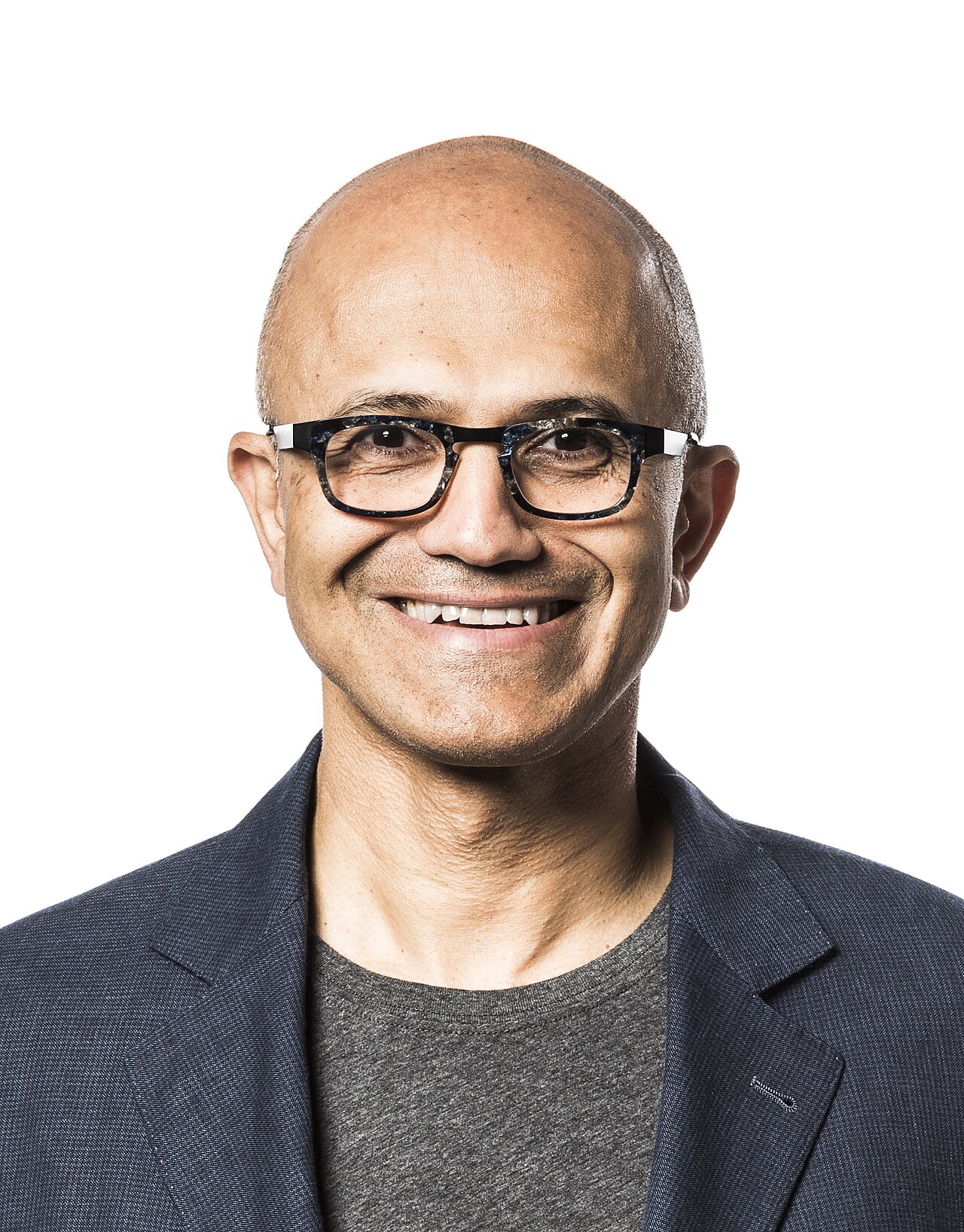
- Image: MS-Exec-Nadella-Satya-2017-08-31-22 (cropped).jpg by Brian Smale and Microsoft (CC BY-SA 4.0), via Wikimedia Commons