Vint Cerf and Bob Kahn: Fathers of the Internet
Abstract
Vinton Cerf and Robert Kahn are the two engineers who designed TCP/IP, the protocol suite that became the universal language of the internet. Their 1974 paper introduced a revolutionary approach to networking built on the principle that the network itself should be simple and dumb, and that intelligence should live at the endpoints. Their “Flag Day” of January 1, 1983, when every machine on ARPANET switched protocols simultaneously, was the moment the modern internet was born. Both men received the Turing Award in 2004 and the Presidential Medal of Freedom in 2005.
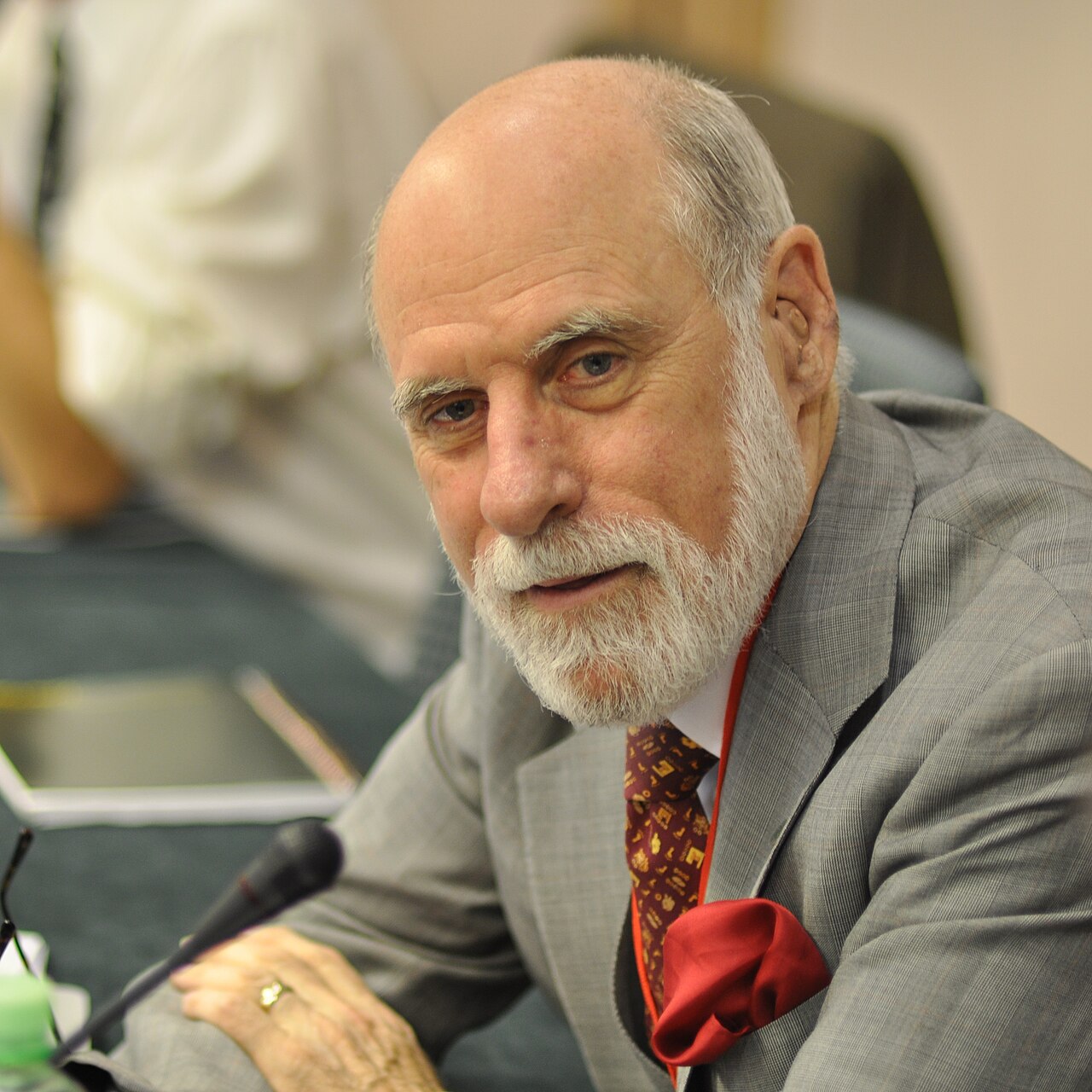
Two Engineers, Two Paths
The story of the internet’s architecture is the story of two men whose backgrounds complemented each other with unusual precision, one a theorist who loved language and communication, the other a builder who thought in systems and deployments.
Vinton Gray Cerf was born in 1943 in New Haven, Connecticut, and grew up in Los Angeles. He was profoundly deaf in one ear from childhood and would lose most of his hearing in the other as an adult. This detail is not incidental. Cerf has spoken repeatedly about how his difficulty with telephone calls shaped his enthusiasm for text-based communication. The telephone, by its nature, excluded him. Email did not. When he later helped design email as a core internet application, he was designing a medium that worked for people like himself, written, asynchronous, and indifferent to whether its users could hear.
Cerf studied mathematics at Stanford, graduated in 1965, worked at IBM, then returned to UCLA for graduate school in computer science. At UCLA in the late 1960s, he worked under Leonard Kleinrock on packet-switching theory (the foundational concept behind ARPANET) and was part of the team that implemented the first ARPANET connections. He was present, as a graduate student, when the first message was sent over the network on October 29, 1969. It was supposed to say “login.” The system crashed after the first two letters. The actual first internet message was “lo.”
Robert Elliot Kahn was born in 1938 in Brooklyn, New York. He studied electrical engineering at City College of New York, earned his doctorate from Princeton in 1964, and moved into research at Bell Labs and then MIT. In the mid-1960s he joined Bolt Beranek and Newman (BBN), the Cambridge firm that DARPA had contracted to build the physical hardware of ARPANET, the Interface Message Processors, or IMPs, the specialized computers that served as the network’s routers. Kahn was not a theorist who later got his hands dirty; from the start he was someone who built things that had to work at scale, at cost, and on deadline.
In 1972, Kahn left BBN to join DARPA as a program manager. The move transformed his role. Rather than building specific systems, he now controlled the funding that directed what others built. He had seen ARPANET from the inside and understood its limitations better than almost anyone.
ARPANET and the Limits of NCP
By 1972, ARPANET connected roughly thirty nodes at universities and research institutions across the United States. Email had emerged as an unexpected killer application. File transfers and remote logins were common. The network worked. But it worked only because it was a single, homogeneous network, every node ran the same software, spoke the same protocol (NCP, the Network Control Program), and connected over the same type of dedicated telephone-line infrastructure.
NCP’s fundamental limitation was that it assumed a closed world. It placed intelligence in the network itself: the network maintained connections, guaranteed delivery, handled errors. This worked beautifully as long as the network consisted of identical components. But DARPA’s other research programs were producing satellite packet links and ground radio networks, different physical media with different latencies, different error rates, different packet sizes. NCP had no mechanism for routing between networks with incompatible characteristics. It was a protocol for a network, not for a network of networks.
Kahn, as a DARPA program manager, felt this constraint directly. Military communications required the ability to work across satellite, radio, and wired links simultaneously. A message could not fail simply because it crossed the boundary between one network and another. He needed a protocol that treated the underlying physical network as a dumb carrier: that would route packets regardless of what those packets were traveling over.
He brought the problem to Cerf, who had moved to Stanford after completing his doctorate.
“A Protocol for Packet Network Intercommunication”
Cerf and Kahn began working together in 1973. They met repeatedly over several months, arguing through the architecture in detail. The intellectual core of their collaboration was the inversion of the prevailing networking philosophy.
The telephone network model (which had shaped NCP) embedded reliability in the network itself. The network maintained dedicated circuits, confirmed delivery, handled retransmission. Applications assumed the network was reliable. Cerf and Kahn proposed the opposite: the network should be maximally stupid. It should do one thing and only one thing (move packets from source to destination, doing its best but promising nothing. All reliability mechanisms) acknowledgment, retransmission, sequencing, error correction, should live at the endpoints, in the computers communicating with each other.
This was the end-to-end principle. It was not merely a technical decision; it was an architectural philosophy with profound consequences. By making the network itself ignorant of the traffic it carried, they ensured that any application (email, file transfer, voice, video, applications not yet imagined) could run on the network without the network needing to be modified to support it. The network would be a neutral carrier. The applications would contain all the intelligence.
Info
The end-to-end principle has had consequences far beyond networking. It is the architectural reason why the internet has been able to support applications its designers never imagined, from the Web to video streaming to cryptocurrency. Because the network doesn’t need to understand the traffic, any new application can run on top of it without asking anyone’s permission. Contrast this with the telephone network, where each new service (ISDN, frame relay, ATM) required network upgrades. The internet’s dumbness was its greatest strength.
In May 1974, Cerf and Kahn published their landmark paper in the IEEE Transactions on Communications: “A Protocol for Packet Network Intercommunication.” The paper described a Transmission Control Protocol (TCP). At this stage, TCP handled both the routing of packets across heterogeneous networks (what would later become IP) and the reliable end-to-end delivery of data (what would remain TCP). The two functions were bundled.
The paper did not arrive to fanfare. Networking was still a specialist discipline, and its full implications were not apparent even to most specialists. But engineers who read it carefully recognized something qualitatively different: not a solution to one specific problem but a framework flexible enough to accommodate networks that did not yet exist.
The TCP/IP Split
Implementation uncovered a structural problem. Bundling routing and reliability into a single protocol imposed a constraint that hurt certain applications. A real-time voice application, for instance, could tolerate packet loss, dropping a few milliseconds of audio was acceptable. What it could not tolerate was the delay introduced by TCP’s reliability mechanisms: detecting a lost packet, waiting for retransmission, reassembling the data in order. The delay made voice choppy and unusable.
By 1978, after several years of implementation experience across multiple research groups, the protocol had been formally split into two distinct layers. IP (the Internet Protocol) handled routing: giving each packet a source and destination address and moving it across heterogeneous networks. TCP (the Transmission Control Protocol) sat above IP and handled reliable, ordered delivery of data streams. A third protocol, UDP (User Datagram Protocol), allowed applications to send individual packets over IP without TCP’s reliability overhead.
This layered architecture proved extraordinarily durable. IP became the universal carrier layer. TCP sat above it for applications needing reliability. UDP sat above it for applications needing speed. And the application protocols (HTTP, SMTP, FTP, DNS) sat above TCP or UDP. The internet’s entire protocol stack, as it exists today, was established by this architectural decision in the late 1970s.
Flag Day: January 1, 1983
Converting a paper design into the infrastructure of the internet required years of parallel effort. DARPA funded TCP/IP implementation across multiple institutions. UC Berkeley embedded it into BSD Unix (work led substantially by Bill Joy) creating the reference implementation that most workstation and server vendors would eventually adopt. By the early 1980s, TCP/IP was running in parallel with NCP on ARPANET.
The coexistence was unsustainable. Two incompatible protocols on the same network created constant administrative complexity. The fundamental advantage of TCP/IP (its ability to interconnect networks with incompatible physical architectures) could not be fully realized while the primary network ran NCP.
DARPA set a date: January 1, 1983. Every machine on ARPANET would switch from NCP to TCP/IP simultaneously. No transition period. No compatibility layer. NCP would simply be turned off. Engineers managing ARPANET machines had months to prepare. Many were anxious. Some were not ready.
The cutover is known as “Flag Day”, a term borrowed from the single-day patriotic holiday, suggesting an event that happens precisely once, on one day, with no gradual approach. The preparation involved distributing software updates to dozens of sites, training administrators, and coordinating a simultaneous action across the entire network.
January 1, 1983 passed without catastrophe. Some machines stumbled; administrators fixed them in the days following. But the network came back up as a different network: a network of networks, able in principle to absorb any new network that agreed to speak TCP/IP. The ARPANET had become the internet.
Info
In retrospect, Flag Day was one of the most consequential single days in the history of technology. Every subsequent internet application (the World Wide Web, email at scale, streaming video, social media, cloud computing) runs on the protocol architecture that Cerf and Kahn designed. The transition of January 1, 1983 was the moment that architecture became the operational foundation of a global network.
After the Internet
Their subsequent careers diverged but remained intertwined with the infrastructure they had built.
Kahn left DARPA in 1986 to found the Corporation for National Research Initiatives (CNRI), a nonprofit research organization in Reston, Virginia. CNRI’s work focused on the information infrastructure underlying the internet, not the network itself but the systems that made digital information findable, citable, and persistent. His most lasting contribution from this period was the Handle System, a mechanism for assigning persistent identifiers to digital objects that do not change even when the objects move between servers. The Handle System became the foundation of the Digital Object Identifier (DOI) standard, which today identifies tens of millions of academic papers, datasets, and publications. Kahn remained at CNRI and continued working on digital object architecture through the 2020s, a quieter legacy than TCP/IP but one that shapes how the world’s scholarly record is organized.
Cerf’s path was more public. He joined MCI in 1982, where he helped build MCI Mail, one of the first commercial email services connected to the internet. He became a founding trustee of the Internet Society in 1992 and served as its president from 1992 to 1995, guiding the organization through the internet’s explosive commercial expansion. He joined ICANN (the Internet Corporation for Assigned Names and Numbers, the body that oversees domain names and IP addressing) as a board member and eventually chairman, serving through contentious years of domain name disputes, the expansion of top-level domains, and the long negotiation over ICANN’s eventual independence from U.S. government oversight.
In 2005, Cerf joined Google as Vice President and Chief Internet Evangelist. The title was partly a branding device, but it reflected a genuine role: traveling the world, speaking to governments and businesses, advocating for the internet as a public good, and warning about threats to the internet’s open architecture. He has testified before the U.S. Congress on network neutrality, spoken at the United Nations on internet governance, and engaged in public debate about the policies that should govern a network connecting billions of people.
The Digital Dark Ages
One of Cerf’s most persistent public concerns has been what he calls the “digital dark ages”, the risk that the twenty-first century will leave behind less recoverable history than the medieval period. A manuscript written on vellum in the thirteenth century can be read today with no special tools. A document stored in a 1990s word-processing format, on a 1990s magnetic disk, may already be effectively inaccessible, the disk has degraded, the format is unsupported, the software that created it no longer runs.
The problem is not limited to personal documents. Scientific data, medical records, government archives, cultural artifacts, all are increasingly stored in digital formats whose long-term readability depends on the survival of interpretive software and hardware that no one is systematically preserving. Cerf has argued that this requires what he calls “digital vellum”, a way to preserve not just the bits but the entire computational context needed to interpret them, including the operating system, the application, and the hardware architecture.
The concern is an unusual one for a man who helped build the technology that generates the world’s information. It reflects a seriousness about the full implications of the digital transition that his more celebratory peers have been slower to articulate.
Recognition and Legacy
In 2004, Cerf and Kahn jointly received the Turing Award (the highest honor in computer science) “for pioneering work on internetworking, including the design and implementation of the Internet’s basic communications protocols, TCP/IP.” In 2005, President George W. Bush awarded both men the Presidential Medal of Freedom. Cerf has received honorary doctorates from more than twenty universities and is a member of the National Academy of Engineering, the National Academy of Sciences, and numerous international learned societies. Kahn received the National Medal of Technology and Innovation from President Clinton in 1997.
But the truest measure of their work is not the medals. It is that every email sent, every web page loaded, every video streamed, every IoT sensor reporting, every financial transaction cleared over a network, all of it runs on the protocol stack they designed. The internet as a global communication system is, more than anything else, the deployment of their 1974 paper at planetary scale. They gave the protocols away. The world built on top of them. That exchange (free architecture for unlimited application) may be the most favorable terms in the history of technology.
The protocols they designed have outlasted every prediction of their obsolescence. IPv4 ran out of addresses. IPv6 was designed to replace it and is being gradually adopted. But TCP and IP as architectural layers, as the idea of a dumb network carrying smart applications, have never been replaced. They remain, fifty years after the paper that introduced them, the foundation on which the connected world is built.
The broader context of the internet’s development (the physical infrastructure, the governance battles, and the protocols that run above TCP/IP) is covered in The Connected World and Early Networking Failures.
📚 Sources
- Cerf, V. & Kahn, R.: A Protocol for Packet Network Intercommunication (1974), IEEE Transactions on Communications
- Hafner, K. & Lyon, M.: Where Wizards Stay Up Late: The Origins of the Internet (1996), Simon & Schuster
- Abbate, J.: Inventing the Internet (1999), MIT Press
- Saltzer, J.H., Reed, D.P., & Clark, D.D.: End-to-end arguments in system design (1984), ACM Transactions on Computer Systems
- Leiner, B. et al.: A Brief History of the Internet (2009), ACM SIGCOMM Computer Communication Review
- Internet Society: Brief History of the Internet (1997)
- Image: Vint Cerf - 2010.jpg by Veni Markovski (CC BY 3.0), via Wikimedia Commons