Australia's Tech Industry: Atlassian, WiFi, and the Tyranny of Distance
Abstract
Australia built globally significant technology companies from a market of 26 million people at the geographic edge of the world, twelve hours from London, seventeen hours from New York, culturally aligned with the English-speaking world but physically remote from every major technology center. The same country ran the fourth or fifth stored-program computer in the world in 1949, then let its inventor’s proposals lapse and imported its computers for the next four decades. The country that invented WiFi (the CSIRO’s 802.11 patent), produced Atlassian (Jira, Confluence, no venture capital to IPO), Canva (40 billion dollar design platform), and WiseTech Global (logistics software running at 24 of the world’s 25 largest freight forwarders) did so by solving specific, often unglamorous problems with engineering precision and an unusual patience for long-term capital compounding. The dominant pattern in Australian tech was not the blitzscaling ambition of Silicon Valley but a quieter thesis: build something genuinely useful, grow it globally, and don’t raise capital until the product works.
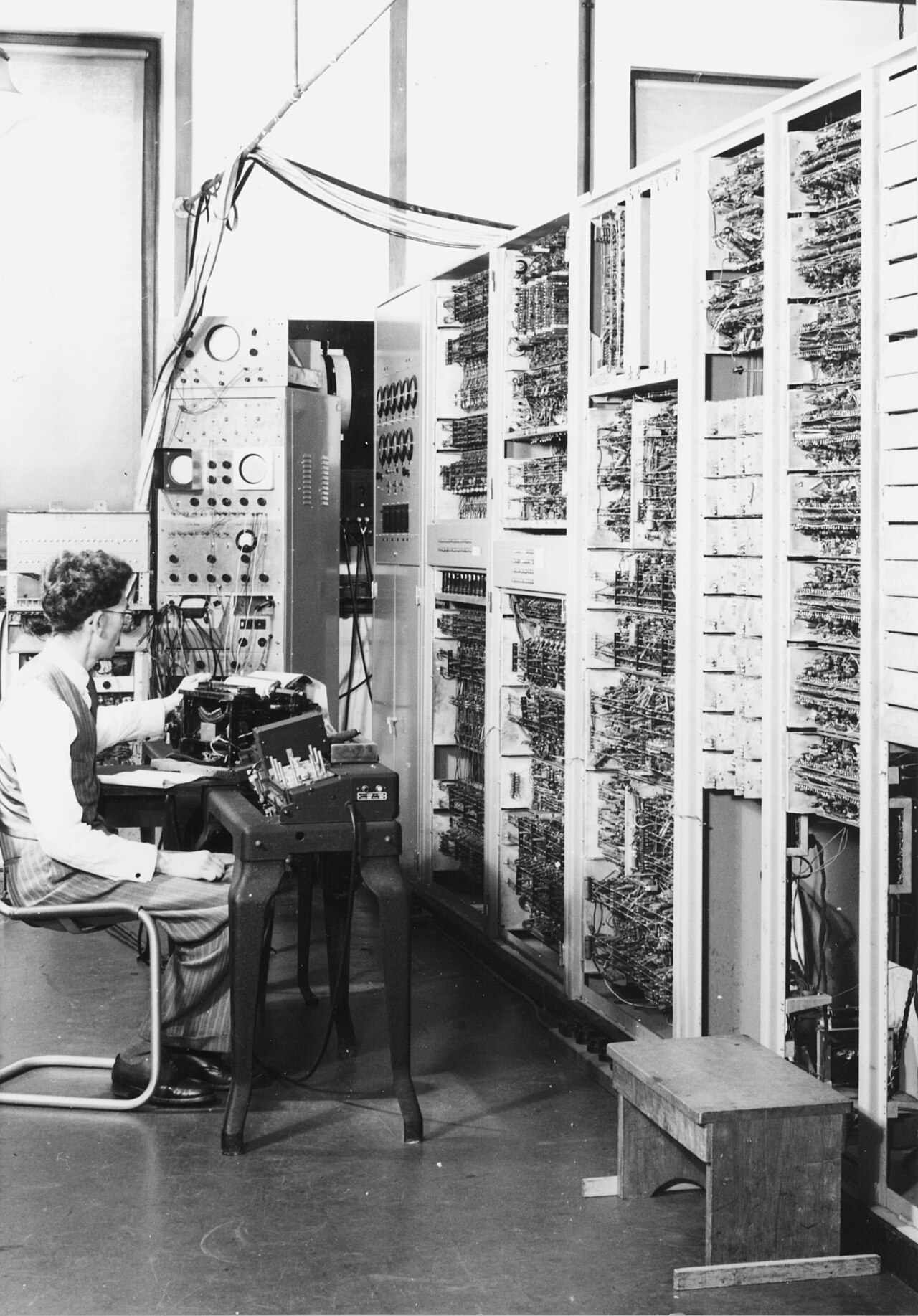
CSIRAC and the Machines of the 1950s
Australia’s computing history begins with a radar physicist. Trevor Pearcey, born in Woolwich in 1919, had worked on wartime radar in Britain and emigrated in 1945 to the Radiophysics Laboratory of the Council for Scientific and Industrial Research (CSIR) in Sydney. In 1946 he began the logical design of an “automatic computer”; Maston Beard took the engineering. In 1948, before the machine existed, Pearcey wrote in the Australian Journal of Science that “it is not inconceivable that an automatic encyclopedic service operated through the national teleprinter or telephone system, will one day exist.”
The CSIR Mk1 ran its first test program, a multiplication, in November 1949 in the Madsen Building at the University of Sydney. It was the fourth or fifth stored-program computer in the world, depending on who is counting, and the first outside Britain and the United States: about 2,000 valves, 768 words of 20 bits in mercury delay lines, a 1 kHz clock, 30 kilowatts. Restricted operation began in late 1950 and the machine was demonstrated in public in 1951, the year programmer Geoff Hill made it play “Colonel Bogey” through its audio output, the earliest known computer music (see Fun Fact: The First Computer Music).
CSIRO then decided that computing was not its business. In 1955, with the ruling that computer research lay outside the organisation’s purview, the machine was dismantled, trucked to Melbourne, renamed CSIRAC and recommissioned in June 1956 in the University of Melbourne’s Computation Laboratory under Frank Hirst. It did paid work for CSIRO, government departments and companies until it was switched off on 24 November 1964. Because nobody scrapped it, CSIRAC is the oldest first-generation electronic computer still intact anywhere (the Z4 is older but electromechanical). It was shown at the Caulfield Institute from 1980 to 1992, acquired by Museums Victoria in 2000 and has stood in Scienceworks in Spotswood since 2018.
Sydney’s second machine was paid for by a racehorse. Harry Messel and John Blatt at the University of Sydney’s School of Physics decided in late 1953 that they needed a computer, and Adolph Basser, whose horse Delta had won the 1951 Melbourne Cup, gave AU£50,000 of the AU£75,000 that SILLIAC, a copy of the University of Illinois ILLIAC built by Standard Telephones and Cables, finally cost. Its first computation ran in June 1956 (by PhD student Bob May, later Baron May of Oxford), it opened officially on 12 September 1956, and at about 13,000 additions a second it was more than ten times faster than CSIRAC. It ran until 17 May 1968. In the same years the NSW University of Technology imported an English Electric DEUCE and called it UTECOM, and the Weapons Research Establishment in South Australia took delivery of an Elliott 403, WREDAC.
Dead End: The Industry That Was Not Built
Pearcey’s 1948 article and CSIR’s 1949 machine put Australia level with Manchester, Cambridge and Philadelphia. Nothing followed. CSIRO’s 1955 ruling ended the country’s only computer-design group; the universities bought British and American designs; and the commercial market from the late 1950s went to IBM, ICT and Control Data. Pearcey went to Britain to work on programming languages, came back in 1959 to work on computer networks for CSIRO, and died in 1998; the Pearcey Foundation’s national ICT awards carry his name. What Australia kept from the decade was a museum piece and a policy pattern: the state funds a first, then declines to fund a second.
CSIRO and the WiFi Patent
The most commercially significant Australian technology contribution of the late twentieth century came from a government research agency, not a startup.
The Commonwealth Scientific and Industrial Research Organisation (CSIRO) traces to the Council for Scientific and Industrial Research, founded in 1926 and renamed CSIRO in 1949, funded by the federal government to conduct research in agriculture, manufacturing, and natural resources. In the 1990s, a team led by John O’Sullivan (a radio astronomer who had previously worked on detecting evaporating mini black holes) applied signal processing techniques from radio astronomy to the problem of indoor wireless local area networking.
The technical challenge was multipath interference: in an indoor environment, radio signals reflect off walls, floors, and furniture, arriving at the receiver via multiple paths with different delays. These delayed copies of the signal interfere with the original, degrading reception. O’Sullivan’s team developed a technique using inverse Fourier transforms to process the multipath signals, a method that formed the core of what became the 802.11 WiFi standard.
CSIRO filed its wireless LAN patent in 1992 and received US patent 5,487,069 in 1996. After the 802.11 standard was adopted and WiFi became ubiquitous, the CSIRO began licensing the patent to device manufacturers. When major manufacturers refused to pay licensing fees, CSIRO filed suits in US federal courts. The litigation concluded with settlements totaling approximately $430 million from companies including Dell, HP, Intel, Microsoft, Nintendo, T-Mobile, and AT&T, one of the largest patent licensing outcomes in Australian history.
The CSIRO’s WiFi patent is occasionally described as evidence that Australia “invented WiFi,” which is an oversimplification: WiFi’s development was a collaborative international standards process, and the 802.11 standard incorporated contributions from many researchers and companies. What the CSIRO’s patent captured was a specific and fundamental technique for dealing with multipath interference, which proved essential to practical indoor wireless networking.
Atlassian: Enterprise Software Without Venture Capital
Mike Cannon-Brookes and Scott Farquhar met as computer science students at the University of New South Wales in Sydney. In 2002, they founded Atlassian with AUD $10,000 charged on credit cards, from a spare room in Sydney. They wrote their initial product (Jira, a bug and issue tracking tool) to scratch their own itch and sold it online at a fraction of what comparable enterprise issue trackers cost, cheap enough for a small development team to buy without an approval process.
The business model Atlassian built was, at the time, genuinely unusual. Software was sold through a website; there was no sales force. Customers discovered the product, evaluated it, and purchased it without speaking to a sales representative. This meant Atlassian’s customer acquisition cost was close to zero, and the resulting margins were extraordinarily high by enterprise software standards.
Confluence (wiki for teams, 2004) followed Jira, then acquisitions: Bitbucket (repository hosting, bought in 2010) and HipChat (business messaging, bought in 2012 and sold on to Slack in 2018). Each was priced accessibly for small teams, generating high adoption that produced enterprise accounts when small-team users became advocates within larger organizations.
Atlassian raised no venture capital for its first eight years. By the time it took a $60 million investment from Accel Partners in 2010, it already had over 20,000 customers and was profitable. It listed on NASDAQ in December 2015 at a market capitalization of $5.8 billion, the largest Australian technology IPO at the time. By 2021, its market capitalization exceeded $100 billion, making it the most valuable Australian technology company in history.
Cannon-Brookes and Farquhar became two of Australia’s richest people and its most visible technology advocates, using their platforms to campaign for faster renewable energy transition, criticizing Australian governments’ technology infrastructure decisions (particularly the National Broadband Network), and demonstrating by example that world-class software companies could be built from Sydney without relocating to San Francisco.
Canva: Design for Everyone
Melanie Perkins was nineteen years old and studying communications at the University of Western Australia in 2007 when she started teaching other students how to use Adobe InDesign and Photoshop for design work. She observed that the software was complex, expensive, and primarily designed for professional designers, inappropriate for the casual design needs of students, small businesses, and anyone without design training.
She and co-founder Cliff Obrecht launched Fusion Books in Perth in 2007, a tool for designing school yearbooks that demonstrated the concept: design software simple enough for non-designers. The ambition was larger: Perkins wanted to build a general-purpose, cloud-based design tool accessible to anyone.
Raising capital in Perth for a design software startup was, in Perkins’s telling, an exercise in sustained rejection. She pitched over a hundred investors before meeting Cameron Adams and eventually securing funding from American investors including Bill Tai and Lars Rasmussen (co-creator of Google Maps). Canva launched publicly in August 2013 with a drag-and-drop interface, a library of templates, and a freemium pricing model that gave unlimited basic access for free while charging for premium features and assets.
By 2021, Canva had raised funding at a $40 billion valuation, the most valuable privately-held Australian company ever. It had over 60 million monthly active users across 190 countries. The product had expanded from graphic design into video editing, document creation, presentation tools, and a marketplace for design assets.
Canva’s growth demonstrated that consumer-grade design tools had massive latent demand once price and complexity barriers were removed. Adobe’s Creative Cloud, priced at $60 per month or higher, served professional designers; Canva’s freemium model served everyone else. The addressable market was measured in billions of users rather than millions.
WiseTech Global and the Unglamorous Opportunity
Richard White founded WiseTech Global in Sydney in 1994 to build logistics software, an industry so operationally complex and unglamorous that few technology companies chose to compete in it seriously.
International freight (the movement of goods across borders) requires navigation of customs regulations in 200+ countries, compliance with import/export documentation requirements, integration with carrier booking systems, and management of the entire chain from origin to destination. The software that managed this complexity was, in the early 1990s, largely proprietary systems built by logistics companies for their own use.
White’s thesis was that a single platform, built to handle the full complexity of international logistics compliance across all jurisdictions, could displace these proprietary systems. CargoWise (WiseTech’s platform) was designed from the start to handle global complexity rather than being extended from a single-country system. Each new regulatory environment, each new carrier integration, added to the platform’s network effect: every logistics company using CargoWise could transfer work to any other CargoWise user without data conversion.
WiseTech listed on the Australian Securities Exchange in 2016 at AUD $3.35 per share. By 2023, the share price had risen approximately twenty-fold. CargoWise ran at 24 of the world’s 25 largest freight forwarders and 47 of the top 50 third-party logistics providers, with more than 17,000 logistics organizations on the platform. The company had achieved near-monopoly in a market that most technology investors had never considered.
The NBN: A National Infrastructure Failure
Australia’s National Broadband Network (NBN) was announced on 7 April 2009 by Prime Minister Kevin Rudd as a fiber-to-the-premises network that would reach 90% of Australian homes and businesses at 100 Mbps, with wireless and satellite covering the remaining 10% at up to 12 Mbps. The project was budgeted at up to AUD $43 billion over eight years of construction.
What was built was different. The Abbott government, which took office in 2013, modified the NBN design to use existing copper telephone infrastructure for the final connection to homes, a technology called Fiber to the Node (FTTN), arguing it would be cheaper and faster to deliver. The resulting network was slower, less reliable, and ultimately more expensive than the original fiber design: copper degraded over distance, required ongoing maintenance, and could not be upgraded to match fiber’s potential speeds without replacement.
The NBN was completed at approximately AUD $51 billion, exceeding the original estimate, and delivered speeds that were slower than the fiber networks other developed countries were building. Australia fell from world-leading broadband speeds in the early 2000s to below-average among OECD nations by 2020. Atlassian’s founders were among the most vocal critics, arguing that inadequate digital infrastructure limited Australia’s ability to build and retain technology companies.
📚 Sources
- CSIRAC — Wikipedia
- Ward, Colin: “CSIRAC – Australia’s first computer” — CSIROpedia
- Ward, Colin: “Trevor Pearcey [1919-1998]” — CSIROpedia
- Trevor Pearcey — Wikipedia
- “CSIRAC, The First Computer in Australia, 1949-1964” — Museums Victoria Collections
- SILLIAC — Wikipedia
- English Electric DEUCE — Wikipedia (UTECOM)
- Elliott Brothers (computer company) — Wikipedia (Elliott 403 / WREDAC)
- Image: CSIRO ScienceImage 3539 Trevor Pearcey operating the CSIR Mk1 Computer.jpg by Archives, CSIRO (CC BY 3.0), via Wikimedia Commons
- CSIRO Wi-Fi — Wikipedia
- Atlassian — Wikipedia
- Canva: Company Background and Investor Information
- WiseTech Global: Annual Report 2023 and Company History
- Productivity Commission — Wikipedia
- NBN Co: Corporate Plan 2023–2026
- Startup Genome: Global Startup Ecosystem Report 2023 — Sydney chapter
- O’Sullivan, John et al.: “Multipath Resistant OFDM for Broadband Indoor Data Communications” — IEEE Vehicular Technology Conference (1992)
- “CargoWise supplies 21 of top 25 global freight forwarders” — Journal of Commerce
- WiseTech Global Investor Day 2020: “Penetration: Capturing the globals” (top-25 and top-50 customer counts)
- “The National Broadband Network in Australia” — Centre for Public Impact