Route 128: The Region That Lost to Silicon Valley
Abstract
For thirty years the ring road around Boston was the other capital of American computing. MIT’s Whirlwind and Lincoln Laboratory seeded it, defence money paid for it, and the minicomputer made it rich: Digital Equipment in a Maynard woollen mill, Data General in Hudson, Wang in Lowell, Prime in Natick, Apollo in Chelmsford, with Lotus, Thinking Machines and Symbolics in Cambridge. In 1957 there were 99 companies employing 17,000 people along the highway; by the 1980s Massachusetts unemployment had fallen from over 12 percent to under 3 and a governor ran for president on the “Massachusetts Miracle”. Between 1988 and 1994 every large minicomputer firm on the road collapsed or was sold, and the reasons why Route 128 lost and Silicon Valley won, set out in AnnaLee Saxenian’s Regional Advantage in 1994, became the standard theory of how technology regions work. The vault’s standing Dead End on a place rather than a product.

The Highway and the Laboratory
Route 128 existed as a surface road from 1927; the freeway that gave the region its name opened in stages from 1951, the first circumferential highway around a major American city, with the last southern segment finished in 1960. Business Week was calling it the “Magic Semicircle” by 1955, and the state named its western half “America’s Technology Highway” in October 1982. The count of firms along it went from 99 in 1957 to 574 in 1965 to 1,212 in 1973.
The engineering came from MIT. Jay Forrester’s Whirlwind, the real-time computer built for the Navy from 1944, became the prototype of the SAGE air-defence system and produced the magnetic-core memory that An Wang had patented and sold to IBM (see Whirlwind, SAGE, and Core Memory). To build SAGE, MIT set up Lincoln Laboratory in Lexington in 1951, and Lincoln’s transistorised research machines, the TX-0 and TX-2, taught a generation of engineers that a computer could be interactive. Two of them, Kenneth Olsen and Harlan Anderson, left in 1957 to found Digital Equipment Corporation in a Civil War-era woollen mill in Maynard on $70,000 of venture money. Raytheon, the region’s largest defence contractor, and Bolt Beranek and Newman in Cambridge, which built the ARPANET’s first routers in 1969 (see Larry Roberts and ARPANET), filled in the rest of the map. The pattern was set early: federal money in, MIT people out, a company on the ring road.
The Minicomputer Decade
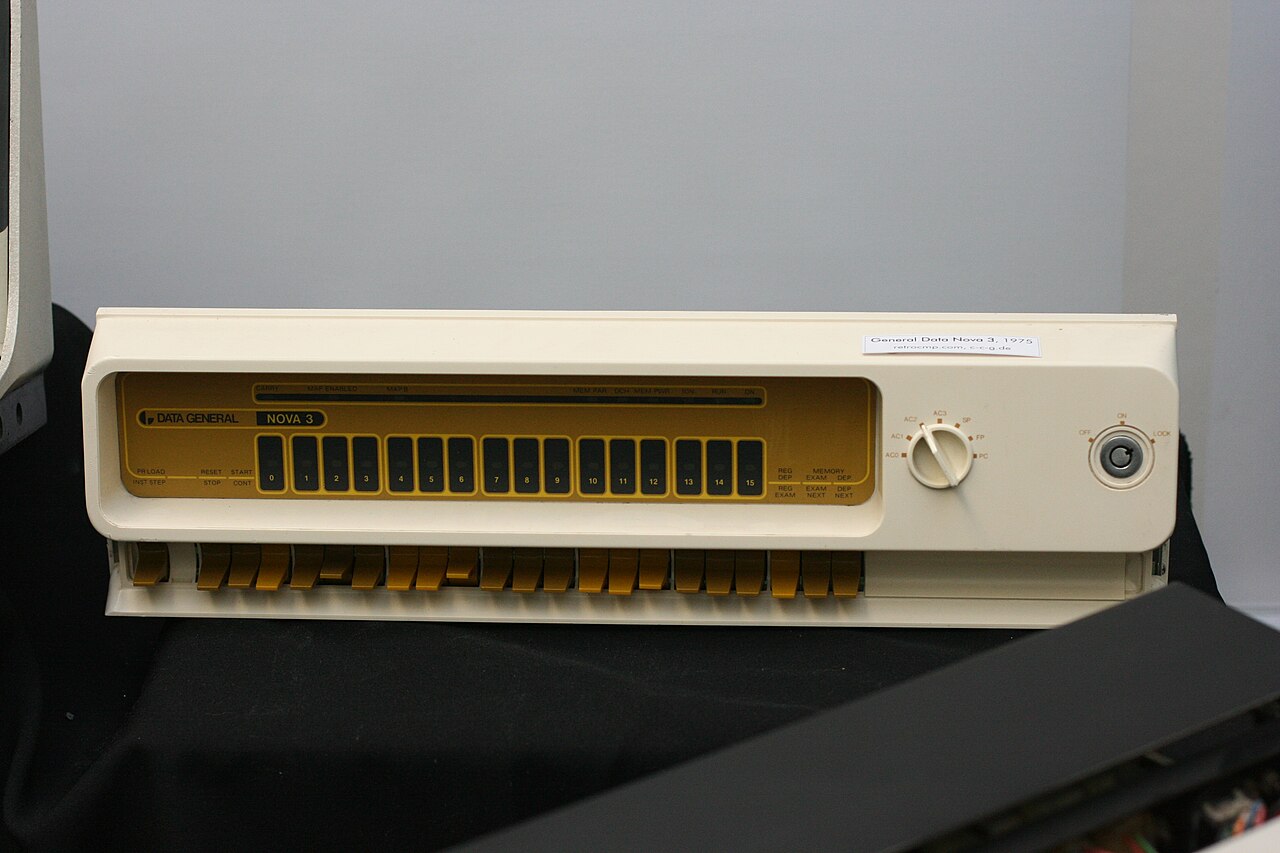
DEC’s PDP-8 of 1965 defined the minicomputer, and the road filled with its rivals and its defectors. In 1968 Edson de Castro, Henry Burkhardt and Richard Sogge left DEC with Herbert Richman of Fairchild and founded Data General in Hudson; their Nova of 1969 was a 16-bit machine built to beat the 12-bit PDP-8 on both performance and price. By 1975 the Nova line was doing $100 million a year at 20 percent growth, and by 1984 Data General’s sales passed a billion dollars. Its MV/8000, announced in April 1980, became the subject of Tracy Kidder’s The Soul of a New Machine (1981), which won the Pulitzer Prize and remains the best account of what building a computer on Route 128 felt like.
Wang Laboratories, founded by An Wang in Cambridge in June 1951, rode calculators, then word processors, then office minicomputers, and built the twin Wang Towers in Lowell as the symbol of the boom (see Dead End: Wang Labs). Prime Computer, founded in Natick in 1972 by seven engineers several of whom came from MIT’s Multics project, started with clones of Honeywell minicomputers, made its name with the PRIMOS operating system and the motto “Software First”, was the sixth-largest minicomputer maker by 1985 with $564 million in revenue, and reached $1.6 billion and the Fortune 500 in 1988. Prime’s co-founder William Poduska founded Apollo Computer in Chelmsford in 1980, which shipped the first standalone engineering workstation, the DN100, in 1981, and from 1980 to 1987 was the largest maker of networked workstations in the world, at one point holding twice the market share of Sun Microsystems.
Cambridge added the software and the exotica. Mitch Kapor’s Lotus shipped 1-2-3 in January 1983 and made $53 million in its first year (see The Lotus 1-2-3 Story). Symbolics, the MIT Lisp-machine spin-off, registered the first .com domain on 15 March 1985 (see The Lisp Machine Era). Danny Hillis’s Thinking Machines, founded in May 1983, built the Connection Machine with 65,536 processors and topped the first TOP500 list in 1993 (see Danny Hillis and the Connection Machine). Massachusetts unemployment, over 12 percent in 1975, fell below 3 percent, and Governor Michael Dukakis, re-elected in 1982, took the “Massachusetts Miracle” into the 1988 presidential campaign.
The Collapse, 1988–1994
The end came in a cluster. Prime, hit by a hostile bid from Bennett LeBow in 1988, escaped through a $1.3 billion leveraged buyout by J.H. Whitney and swallowed Computervision the same year, then saw revenue fall by a quarter to $1.2 billion by 1991; by 1992 it was no longer selling computers and had taken the Computervision name. Apollo, third in workstations behind DEC and Sun by the end of 1987, was bought by Hewlett-Packard in 1989 for $476 million and wound down between 1990 and 1997. Wang filed for Chapter 11 on 18 August 1992. Thinking Machines lost money from 1992 and filed in August 1994. Data General, a billion-dollar company in 1984, lived on through Unix servers and storage until EMC bought it for $1.1 billion in October 1999. DEC, the largest of them all, missed the PC and the workstation and was sold to Compaq in 1998 (its own Dead End is in DEC and the Minicomputer Era). The state’s unemployment rate went back up to nearly 9 percent by the summer of 1992.
Saxenian’s Answer
The obvious explanation is that the minicomputer died, and it did: the microprocessor and the Unix workstation ate the market from below. But Silicon Valley went through its own crisis in the same decade and came out of the 1980s larger. In Regional Advantage (Harvard University Press, 1994), the Berkeley planner AnnaLee Saxenian compared the two regions and argued that the difference was in how they were organised. Silicon Valley was a network: small firms, porous boundaries, engineers who changed jobs every few years, non-proprietary standards, information traded over lunch between competitors, venture capitalists who had been engineers. Route 128 was a set of vertically integrated, self-sufficient corporations in the New England mould, each with its own proprietary architecture, its own culture of secrecy, and a workforce that expected to stay. When the technology shifted, the Valley’s network recombined and the ring road’s hierarchies could not.
The law professor Ronald Gilson added the legal mechanism in 1999. California has not enforced post-employment non-compete covenants since the nineteenth century, so a Valley engineer could walk out of Fairchild or Sun and start a competitor the next morning; Massachusetts courts enforced them, so a Route 128 engineer’s knowledge stayed inside the firm that had paid for it. Gilson argued that the resulting knowledge spillovers were what let Silicon Valley firms thrive while Route 128’s deteriorated. Massachusetts eventually drew the conclusion: the Noncompetition Agreement Act signed by Governor Charlie Baker on 10 August 2018, effective 1 October 2018, capped new non-competes at twelve months and required “garden leave” pay of at least half the employee’s salary for the restricted period. It came twenty-six years after Wang.
The Other Clusters
Route 128 was the first American region to lose to Silicon Valley, not the only one to compete with it, and the vault’s coverage of the others is thinner than it should be. Seattle has Microsoft and Amazon, and its story is told through their founders (Bill Gates and Microsoft, Jeff Bezos and Amazon). Austin has Dell: Michael Dell founded PC’s Limited in a University of Texas dormitory with about $1,000, shipped the Turbo PC at $795 in 1985, renamed the company in 1987, went public in 1988 raising $30 million, became the world’s largest PC vendor in 2001, took it private in 2013 for $24.4 billion and bought EMC, the last big survivor of Route 128’s storage business, in 2016. Research Triangle Park in North Carolina was established in 1959 on 7,000 acres between three universities, drew IBM in 1965, and now holds over 300 companies and 65,000 workers, with SAS Institute and Red Hat as its home-grown software firms. None of them produced a Saxenian; Route 128 did, because it was the one that failed at the moment someone was watching.
Dead End: What the Ring Road Left
The buildings are still there. The Maynard mill is offices; the Wang Towers are Cross Point; Data General’s Westborough campus was sold. What survived of the industry was its second growth: the storage company EMC in Hopkinton, which bought Data General and was itself bought by Dell; the biotechnology cluster around Kendall Square, which took over Cambridge as the computer companies left; and the MIT venture base that kept producing companies without producing another industry. The state recovered from the 1990s recession faster than the rest of the Northeast and had unemployment under 3 percent again by the end of the decade. What did not come back was the position: Route 128 has not been the second centre of American computing since 1994, and the theory of why is its lasting contribution to the field.
📚 Sources
- Massachusetts Route 128 — Wikipedia
- Massachusetts Miracle — Wikipedia
- Data General — Wikipedia
- Prime Computer — Wikipedia
- Apollo Computer — Wikipedia
- AnnaLee Saxenian — Wikipedia
- Saxenian, AnnaLee: Regional Advantage: Culture and Competition in Silicon Valley and Route 128 (1994), Harvard University Press
- Gilson, Ronald J.: “The Legal Infrastructure of High Technology Industrial Districts: Silicon Valley, Route 128, and Covenants Not to Compete” — New York University Law Review 74(3), 1999
- “New Massachusetts Non-Compete Law Goes Into Effect October 1, 2018” — Mintz
- Kidder, Tracy: The Soul of a New Machine (1981), Little, Brown
- Dell — Wikipedia
- Research Triangle Park — Wikipedia
- Image: Cross Point Towers; northeast side; Lowell, MA; 2011-09-11.JPG by Emw (CC BY-SA 3.0), via Wikimedia Commons