Gabe Newell
Abstract
Gabe Newell (born 1962) dropped out of Harvard in 1983 to join Microsoft, spent thirteen years there producing the first three versions of Windows, and left in 1996, rich, to found a game studio with a colleague because id Software’s Doom had persuaded him that games were where the interesting programming was. Valve’s first game, Half-Life (1998), was a critical success; its second product, Steam (2003), became the store through which most PC games are sold and took 30 percent of each sale. The store made Valve one of the most profitable companies per employee in the world and Newell the richest person in the games industry. His public rule, that piracy is a service problem rather than a pricing problem, has been the industry’s working assumption since he said it in 2011. He now spends part of his money on ocean research ships and brain implants.
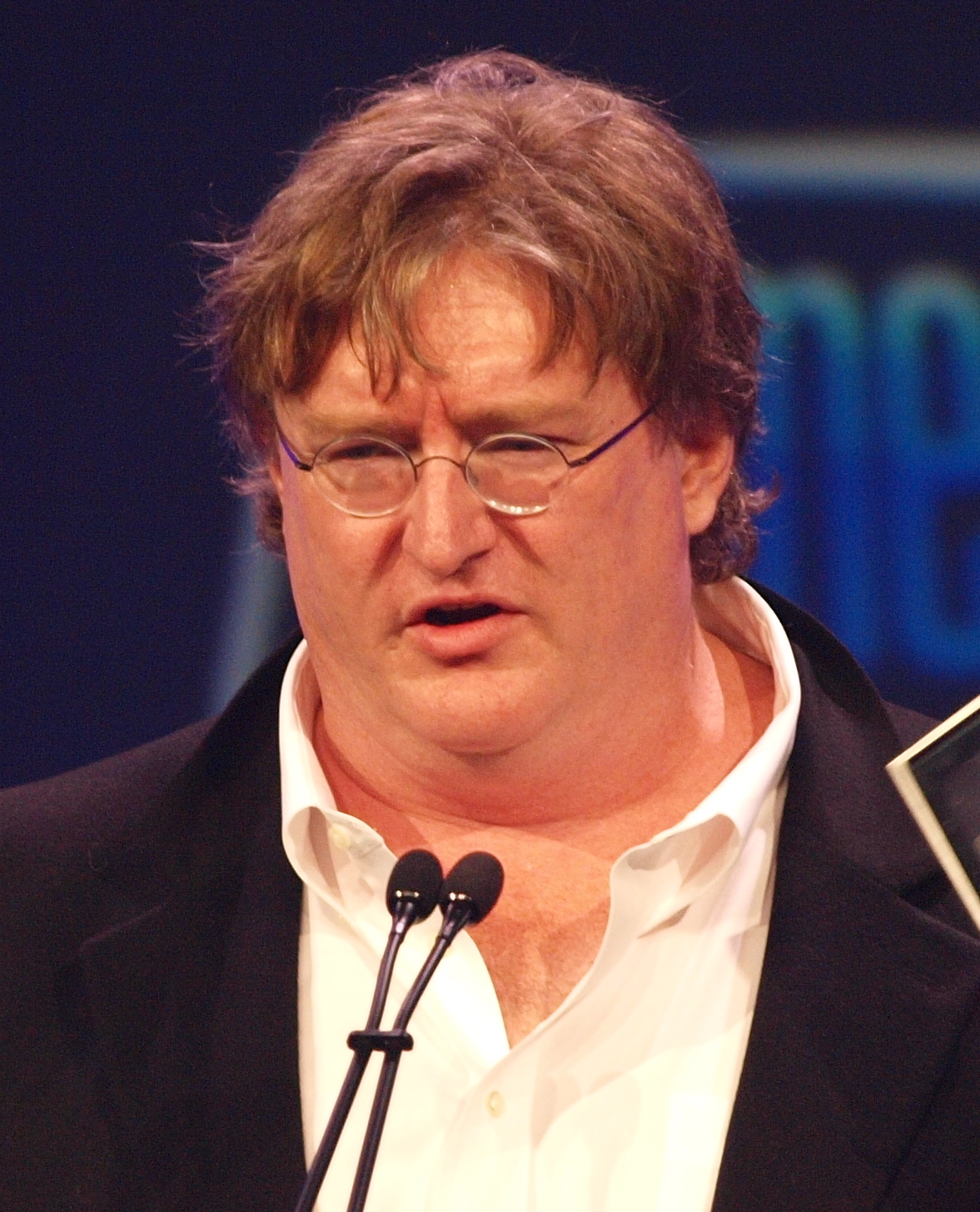
Harvard to Redmond
Gabe Logan Newell was born in Aspen, Colorado, on November 3, 1962, and grew up in Davis, California. He went to Harvard in 1980 and left in 1983 without a degree after visiting his brother, who worked at Microsoft, and being talked into joining by Steve Ballmer. He has said that he learned more in his first three months at Microsoft than in his entire time at Harvard.
He stayed thirteen years, most of them on Windows: he was a producer on the first three releases, from Windows 1.0 in 1985 to Windows 3.x, and reached the level of executive. In 1995 he led the project to port id Software’s Doom to Windows 95, which mattered to Microsoft because it showed that games, which ran on DOS to avoid Windows’ overhead, could run on the new system; Newell’s survey at the time found that Doom was installed on more PCs than Windows 95 was. Working with id’s Michael Abrash, who left Microsoft to write Quake, persuaded him that the games industry had the technical problems he wanted, and he left too.
Valve
Newell and Mike Harrington, another Microsoft veteran, founded Valve in Kirkland, Washington, on August 24, 1996, the day of Newell’s wedding, and funded it themselves. Neither had shipped a game. They licensed id’s Quake engine, hired people from the mod scene, and after throwing away a nearly finished first attempt, shipped Half-Life in November 1998, a first-person shooter told without cut-scenes, in which the player never left the character’s eyes; it sold in the millions and collected most of the year’s awards. Harrington left in 2000; Newell has run the company since, owning more than half of it.
The product that made Valve rich was not a game. Counter-Strike, a fan modification of Half-Life that Valve bought, needed constant patching, and the patches broke the player base into incompatible versions. Newell’s answer was a client that talked to Valve’s servers and kept the game current. Steam launched on September 12, 2003, as an updater; in 2004 every copy of Half-Life 2, including the ones sold on disc, required a Steam account to run, and players who had bought a box sat locked out on launch day while the servers fell over. They were furious and they kept the account. Steam opened to other publishers in 2005, took 30 percent of each sale, and by 2013 carried about three-quarters of PC game downloads. The store, the refund fight in Australia, the hardware detours that ended in the Steam Deck, and the managerless company that runs it all are told in Valve and Steam; the antitrust argument over the 30 percent, which Tim Sweeney’s Epic Games took to court against Apple in 2020, is in The Platform Antitrust Story.
A Service Problem
Newell’s public statements are rare and quoted for years. The best known was made at the Washington Technology Industry Association’s Tech-NW conference in October 2011: piracy is almost always a service problem and not a pricing problem; if a pirate offers a product anywhere in the world, 24 hours a day, purchasable from the couch, and the legal version is region-locked, delayed and encumbered, the pirate’s service is more valuable. Steam’s own evidence for it was Russia, where Valve sold games in roubles at local prices and the market he had been told was a waste of time was, he said in 2011, about to become Steam’s largest in Europe. Valve’s other principle under Newell was to fund its own hardware to protect the store from anyone else’s platform: Steam Machines (2015), which failed, Valve Index (2019), and the Steam Deck (2022), a handheld Linux PC that made Steam a console after all.
He was made a BAFTA Fellow and inducted into the Academy of Interactive Arts and Sciences Hall of Fame in 2013. Between 2006 and 2007 he had corneal transplants for Fuchs’ dystrophy, a degenerative eye condition, and has said the surgery ended years of getting by with failing vision. He spent 2020 in New Zealand, where he happened to be when the borders closed, and applied for residency before returning to Seattle.
Ships and Brains
Outside Valve his money has gone into two things. Inkfish, a marine research organisation he owns, operates research vessels and submersibles and in 2025 bought the Dutch yacht builder Oceanco. Starfish Neuroscience, which he co-founded in 2022, is developing small brain-computer interface chips; Newell has argued since the 2010s that the interesting future of games is direct neural input and output. He gave $20 million to OpenAI in 2018 and co-founded Foundry10, an education research group, around 2013. Forbes put his fortune at about $11 billion in 2025, almost all of it a private company whose accounts nobody outside it has seen.
📚 Sources
- Gabe Newell — Wikipedia
- Valve Corporation — Wikipedia (the August 24, 1996 founding, Harrington’s departure, Half-Life, Steam’s September 12, 2003 launch, the Half-Life 2 activation requirement, the 2005 opening to third parties)
- Gabe Newell: Piracy is an issue of service, not price — GamesRadar, November 2011 (the WTIA Tech-NW remarks and the Russia example)
- “Gabe Newell: I learned more in three months at Microsoft than entire time at Harvard”, Neowin
- “Newell: Piracy is almost always a service problem”, GameWatcher, November 28, 2011
- Gabe Newell — Academy of Interactive Arts & Sciences Hall of Fame, 2013
- Image: Gabe Newell GDC 2010 (cropped 2).jpg by Official GDC (CC BY 2.0), via Wikimedia Commons