How We Use Computers
Abstract
This is the history of computing told as a history of access: who was allowed near the machine, from where, how many people shared it, and how long they waited for an answer. In 1957 a computer filled a room, served an entire institution, and returned results the next day through an operator. In 1961 a few dozen people shared one through typewriters. By 1965 a laboratory could own one, by 1984 one household in twelve did, by 2000 half of them, and by 2024 nine American adults in ten carried one that was never switched off and was consulted about fifty times a day. The same fifty years took the wait for an answer from overnight to a second, moved the point of use from a machine room to a pocket, and dropped the cost of an hour of computing from the rental on a mainframe to ten cents and then to nothing visible at all. Each stage broke an assumption the previous one had been built on. The interface side of this story, the hands and the devices, is in Human-Computer Interaction as a Discipline; this article is about the institution, the room and the schedule.
The Counter
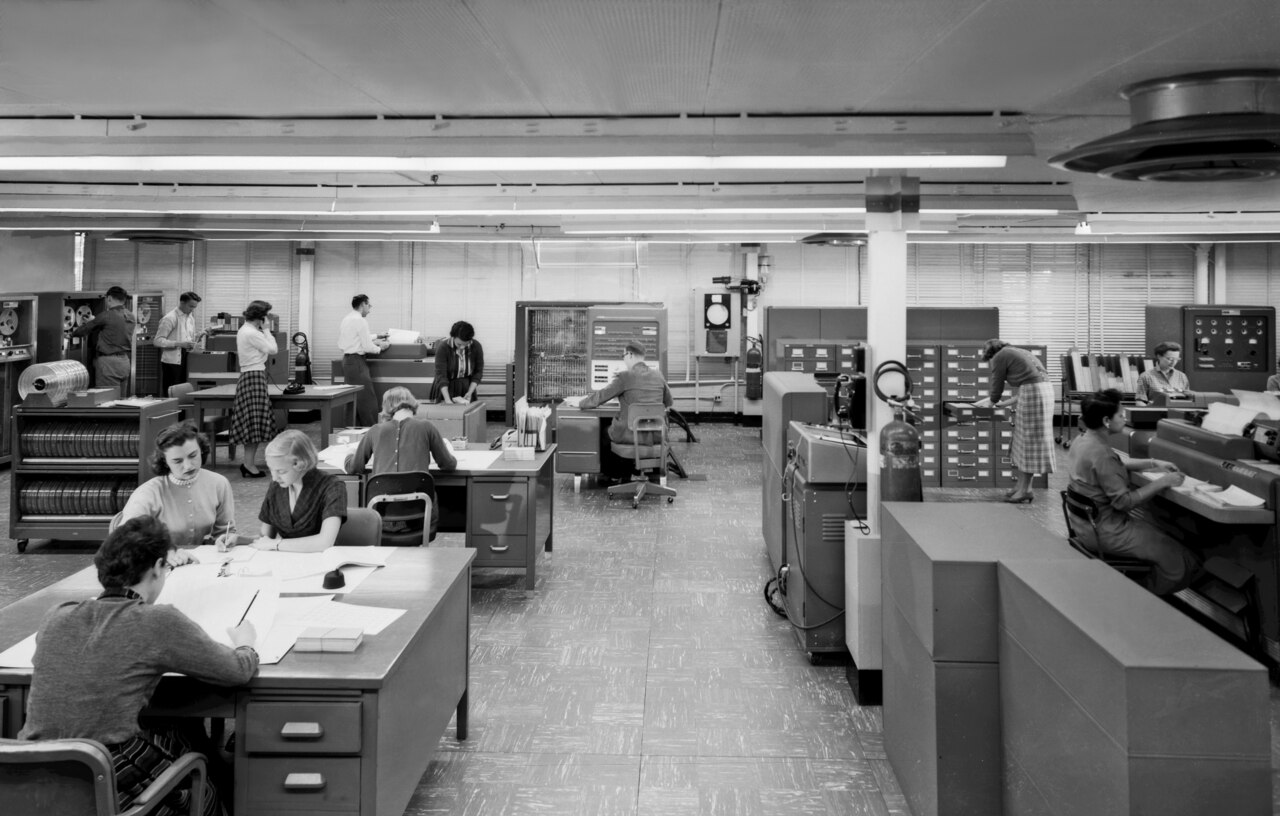
The first working model of use was that nobody used the computer. Programmers wrote code on coding sheets, had it punched onto cards, and handed the deck across a counter to an operator, who scheduled it with everyone else’s work, ran it, and returned a printout. The programmer might never see the machine. A syntax error cost a day, because the fix went back into the same queue: with batch processing, as the CTSS history puts it, “it then often took a day from submitting a changed code, to getting the results”. Debugging meant reading a memory dump on paper and thinking hard before spending the next submission.
The economics explain the arrangement. An IBM 7090, IBM’s large scientific machine of 1960, sold for $2.9 million or rented for $63,500 a month. Run around the clock, that rental works out to about $88 an hour, and the machine was the expensive part, so it was the machine’s time that was optimised, not the people’s. The operator existed to keep the processor busy; the users existed to supply it with work. One machine served an institution, and the ratio of users to machines was measured in the hundreds. The mainframe business built on this model is in The IBM Mainframe Era.
The Terminal Room
The assumption batch broke was that a person had to wait for the machine. Christopher Strachey proposed time-sharing in a paper in June 1959 and John McCarthy set it going at MIT with a memo the same year; Fernando Corbató demonstrated the Compatible Time-Sharing System on a modified IBM 709 in November 1961 with three users at Flexowriter typewriters, each with a private file tape and a dump tape. Routine service to the MIT Computation Center began in the summer of 1963, and the IBM 7750 front-end could in principle support 112 teleprinter terminals. The processor switched between users fast enough that each one felt alone with it. The full story is in Fernando Corbató and Time-Sharing, and the argument for it in J.C.R. Licklider and the Intergalactic Network.
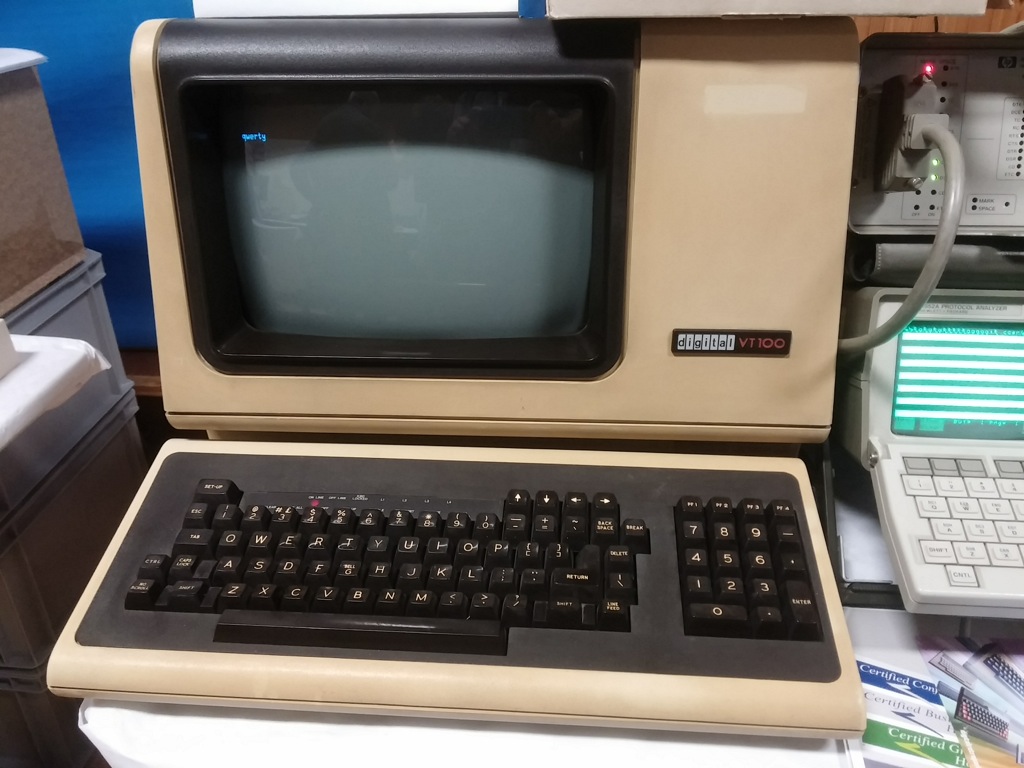
The place of use moved one room over. The user now sat in a terminal room, at a Teletype Model 33 (introduced 1963, about $1,000, ten characters per second, over half a million made by 1975) and later at a screen such as DEC’s VT100 of 1978, of which more than six million VT-series terminals were sold. Dartmouth’s system, opened in March 1964 for undergraduates who were not scientists, supported more than 100 simultaneous users by 1972, and 78% of its jobs needed one second or less of processor time. Turnaround had gone from a day to a second, and the ratio of users to machines from hundreds to dozens.
Time-sharing also became a product. The 1973 Auerbach Guide to Timesharing listed 125 services, among them Tymshare (1966) and National CSS (1967), which charged rent on the terminal, a fee per hour of connection, a fee per second of processor time and a fee per kilobyte-month of storage. Computing was, for the first time, something a small company could buy by the hour without owning a machine, an idea that came round again forty years later.
The Departmental Machine
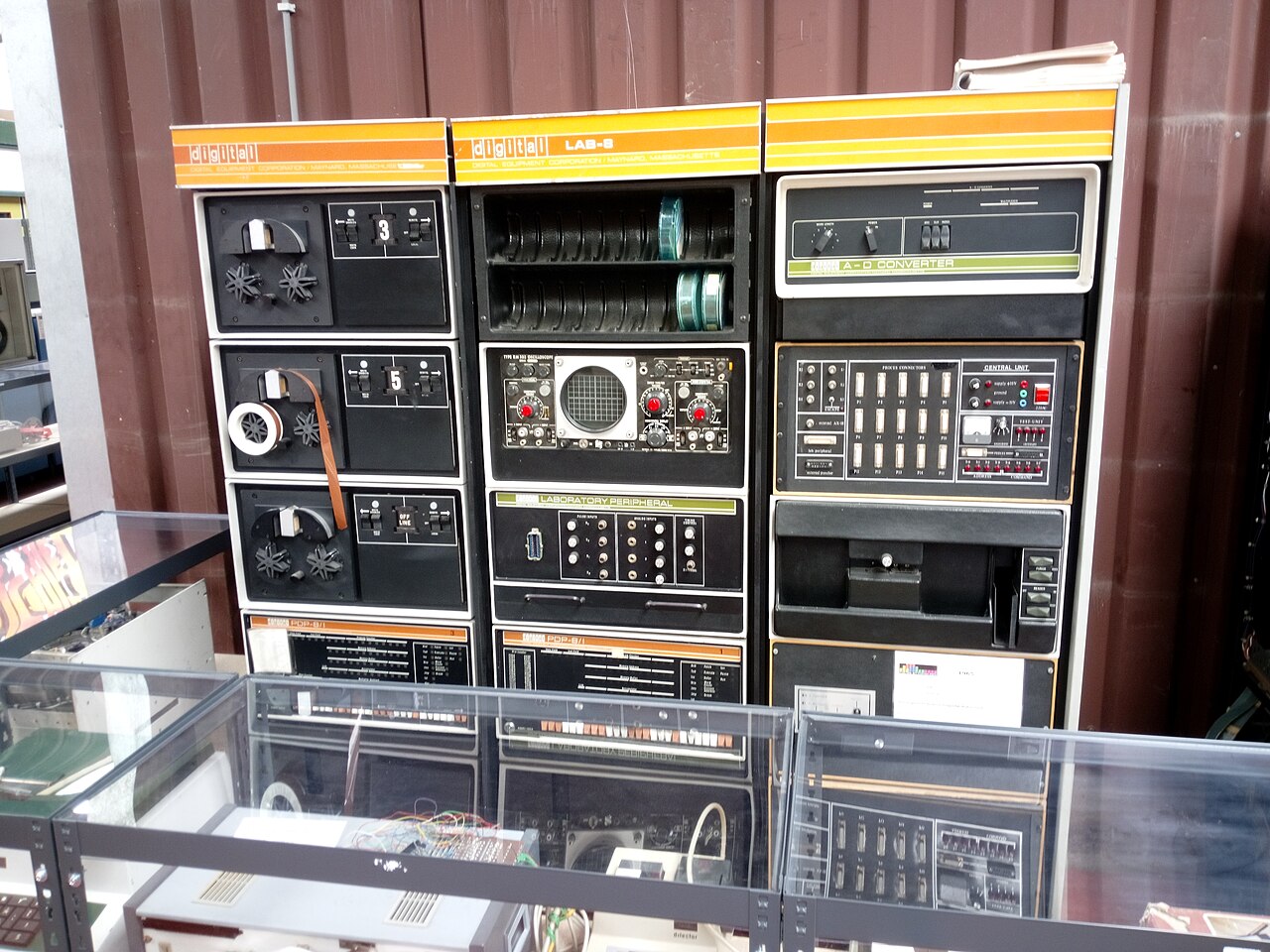
Time-sharing had assumed a computer was too expensive for anything smaller than an institution. DEC’s PDP-8, introduced on 22 March 1965 at $18,500, was the first computer sold for under $20,000, and over 50,000 were built. It inherited the laboratory-interface design of the LINC before it, and that is where it went: a physics group, a hospital department or a factory line could own its computer outright rather than book time on the university’s, and wire it to the instrument it served. The operator disappeared from the arrangement. The people who used the machine were the people who ran it, and if it needed a new interface board, they built it.
The user-to-machine ratio fell to a handful, the users were in the same room as the processor, and the cost was a capital purchase rather than an hourly charge. DEC and the Minicomputer Era covers the company and the PDP-11 and VAX that followed. The point for this article is what a departmental machine did to authority: for the first time the decision to compute did not go through a central computing service.
One User per Machine
The minicomputer’s assumption was that a computer belonged to an organisation. The Altair 8800 of 1975 belonged to whoever soldered it; the machines of 1977 belonged to whoever carried one home from the shop (see The Home Computer Boom); the IBM PC of 1981 belonged to a desk. The ratio reached one user per machine, and that user was operator, system administrator and technician at once, which is why the era’s folklore is about configuration files, memory managers and the person in the office who knew how to make the printer work.
The place of use became the home. The US Census Bureau first counted household computers in 1984 and found them in 8.2% of households; the figure was 15% in 1989, 22.8% in 1993, 36.6% in 1997 and 51% in August 2000. Turnaround was no longer a concept: the machine waited for the person. The cost per hour dropped toward the electricity, and the machine spent most of its life idle, an inversion of everything the batch operator had been employed to prevent. The machine-by-machine story is in The Personal Computing Explosion.
The Networked Desk
A personal computer assumed that one person working alone was the unit of computing. The network broke that. The ARPANET connected time-sharing systems from 1969, electronic mail became the reason people logged in, and from 1978 the bulletin board system let a home computer with a modem dial another one. By the 1990s the computer at work was a terminal onto a company’s network and the computer at home was a way into AOL and then the web.
The Census Bureau began measuring home internet access in 1997, when 18% of households had it; the figure was 26.2% in 1998 and 41.5% in 2000. In 1997 fewer than half of the households that owned a computer used it to go online; three years later the computer without a connection was the odd one. The machine on the desk was still one user’s, but what it was for had changed from computation to other people, and the ratio that mattered was no longer users per machine but machines per network. The Connected World follows that thread.
The Device That Is Never Off
Every earlier phase had assumed a session: a person went to the computer, did something, and left. The smartphone removed the going and the leaving. Pew Research Center found 35% of American adults owning a smartphone in 2011 and 91% in 2024. Deloitte’s 2018 survey put the average American’s phone checks at 52 a day, up from 47 the year before, some 14 billion glances a day across the country, and 63% of the people surveyed said they had tried to cut down.
Use became a matter of seconds rather than sessions, and the place of use became wherever the person was. The ratio inverted for good: instead of many users per machine there were now many machines per user. Cisco counted 2.4 networked devices and connections per person worldwide in 2018 and projected 3.6 for 2023, with North America at 13.4. The device history is in The Mobile Computing Revolution.
The Invisible Machine
The last assumption to go was that the user knew where the computer was. Amazon opened EC2 in limited beta on 25 August 2006 at ten cents per server-hour, and the time-sharing bureau of 1967 came back as a web form: rent by the hour, no machine to own, no room to visit. The work that had moved to the desk moved back to a machine room, only now the room was somewhere else and nobody who used it would ever see it (The Cloud Computing Era). The office followed the machine out of the building: the Census Bureau found 5.7% of American workers primarily working from home in 2019 and 17.9% in 2021 (The Remote Work Revolution).
The interface went the same way. A voice assistant took a sentence instead of a command (The Voice Assistant Revolution), and on 30 November 2022 OpenAI released ChatGPT, which reached a million users in five days and 100 million monthly users by January 2023, the fastest adoption of any consumer application to that date by UBS’s count (The Generative AI Revolution). The point of use is a text box; the cost per hour is invisible to the person typing; the machine answering could be anywhere; and the ratio of users to machines is once again in the hundreds of thousands per data centre, which is where the story started, with the operator replaced by a scheduler and the counter by an API.
Dead End: Calm Technology
Mark Weiser saw most of this coming and wanted something else. As Chief Technologist at Xerox PARC, the laboratory that had invented the personal computer he now considered a stage to be passed through, he coined the term ubiquitous computing in 1988, the year the tabs, pads and boards work began, and set it out in “The Computer for the 21st Century” in Scientific American in September 1991. Computers would come in three sizes, inch-scale tabs, foot-scale pads and yard-scale boards, would be everywhere, and would therefore have to stop demanding attention. “The most profound technologies are those that disappear,” the article began.
PARC built the prototypes. The ParcTab, a 215-gram palm-sized device with a 128×64 touch screen and three buttons, communicated by infrared with a transceiver in each room, so that the building knew which room each tab was in and the tab could behave accordingly. The first system went live in March 1993 with 20 users and 25 cells and the second, in April 1994, had about 41 users and 50 cells, running e-mail, a file browser, a weather display and a connection to the early web. Weiser and John Seely Brown then named the goal calm technology: computing that “informs but doesn’t demand our focus or attention”, a quiet, invisible servant.
The device forecast was close to exact. The tab became the phone, the pad the tablet, the board the wall display, and the building that knows where you are became every building with Wi-Fi. The calm did not arrive. The devices that fulfilled Weiser’s form factors were built by companies whose revenue depended on attention, and the result was a machine checked 52 times a day whose owners, by their own account, wished they checked it less. Weiser died of cancer on 27 April 1999, aged 46, eight years before the iPhone, having predicted the hardware of the following quarter-century and the opposite of its effect.
📚 Sources
- Compatible Time-Sharing System — Wikipedia (the November 1961 demonstration on the modified IBM 709 with three users and two tape units each, batch turnaround of “often a day”, routine service from summer 1963, the IBM 7750 supporting up to 112 teleprinter terminals, shutdown on 20 July 1973)
- Corbató, F. J., M. Merwin Daggett and R. C. Daley: “An Experimental Time-Sharing System”, Spring Joint Computer Conference, 3 May 1962 (originally written for the IBM 709, three foreground users each at a Flexowriter with a private file tape and a dump tape)
- Time-sharing — Wikipedia (the batch programmer who “might never see the computer”, Strachey’s June 1959 paper and McCarthy’s 1959 memo, Dartmouth from March 1964 with more than 100 simultaneous users by 1972 and 78% of jobs under one second, the 125 bureaus in the 1973 Auerbach Guide, Tymshare 1966 and National CSS 1967 and their four-part pricing, and the decline once hardware could sit idle)
- IBM 7090 — Wikipedia (first installation December 1959; a typical 1960 system at $2.9 million or $63,500 a month rental; the $88-an-hour figure in the text is that rental divided by a 720-hour month)
- Teletype Model 33 — Wikipedia (introduced 1963, about $1,000, 10 characters per second, over half a million made by 1975, the standard terminal for minicomputers and time-sharing)
- VT100 — Wikipedia (introduced August 1978; over six million VT-series terminals sold)
- PDP-8 — Wikipedia (introduced 22 March 1965 at $18,500, the first computer sold for under $20,000, over 50,000 sold, designed partly for laboratory use)
- Home Computers and Internet Use in the United States: August 2000 (P23-207) — US Census Bureau, September 2001 (households with a computer: 8.2% in 1984, 15.0% in 1989, 22.8% in 1993, 36.6% in 1997, 42.1% in 1998, 51.0% in 2000; with internet access: 18.0% in 1997, 26.2% in 1998, 41.5% in 2000; in 1997 fewer than half of computer households used the internet)
- Mobile Fact Sheet — Pew Research Center (35% of US adults owning a smartphone in 2011, 91% in 2024)
- Deloitte Survey: Smartphones Continue to Reign Supreme as Consumers’ Preferred Device — Deloitte 2018 Global Mobile Consumer Survey, US edition, 13 November 2018 (52 checks a day, up from 47; about 14 billion looks a day; 85% penetration; 63% had tried to limit their use)
- Deloitte: Americans Look at Their Smartphones More Than 12 Billion Times Daily — Deloitte 2017 Global Mobile Consumer Survey, US edition, 15 November 2017 (about 47 looks a day, nearly constant for three years)
- Cisco Annual Internet Report (2018–2023) — Cisco (devices and connections per capita: 2.4 globally in 2018 and 3.6 by 2023; North America 8.2 and 13.4)
- Amazon EC2 Beta — AWS News Blog, 25 August 2006 (“now open for limited beta testing”, “10 cents per clock hour”)
- Amazon Elastic Compute Cloud — Wikipedia (the limited public beta announced 25 August 2006)
- The Number of People Primarily Working From Home Tripled Between 2019 and 2021 — US Census Bureau, 15 September 2022 (5.7% to 17.9%)
- ChatGPT — Wikipedia (released 30 November 2022, one million users in five days, 100 million monthly users by January 2023 per UBS)
- Hu, Krystal: “ChatGPT sets record for fastest-growing user base - analyst note”, Reuters, 1 February 2023 (100 million monthly active users in January 2023, “the fastest-growing consumer application in history, according to a UBS study”)
- Mark Weiser — Wikipedia (23 July 1952 to 27 April 1999, Chief Technology Officer at Xerox PARC, the 1988 coinage, “The Computer for the 21st Century” in Scientific American September 1991, calm technology with John Seely Brown as “that which informs but doesn’t demand our focus or attention”, death from cancer-related liver failure at 46)
- Weiser, Mark: Ubiquitous Computing (ubiq.com home page) — archived (“tabs”, “pads” and “boards” built at Xerox PARC 1988–1994; mainframes “each shared by lots of people”, then the personal computer, then ubiquitous computing as the third wave)
- Ubiquitous computing — Wikipedia (the coinage around 1988 at PARC, tabs, pads and boards, the ParcTab, ParcPad and LiveBoard prototypes, the Dangling String as calm technology)
- Want, Roy, Bill N. Schilit, Norman I. Adams, Rich Gold, Karin Petersen, David Goldberg, John R. Ellis and Mark Weiser: “An Overview of the ParcTab Ubiquitous Computing Experiment”, IEEE Personal Communications, December 1995 (the 215-gram tab with a 128×64 touch screen and three buttons, infrared cells one per room, the March 1993 release with 20 users and 25 cells and the April 1994 release with about 41 users and 50 cells, the applications, and the goal of demanding less concentration than a desktop interface)
- Weiser, Mark: “The Computer for the 21st Century”, Scientific American, September 1991 — author’s preprint (the opening sentence “The most profound technologies are those that disappear”; tabs, pads and boards as inch-, foot- and yard-scale machines)