Spectrum Auctions
Abstract
Every mobile network runs on radio frequencies that a government licensed to it, and for most of the twentieth century governments gave those licenses away, first after hearings and then by lottery. Spectrum auctions replaced both. The economist Ronald Coase proposed them in 1959 and was asked whether he was joking; the US Congress authorized them in 1993, and the format that Paul Milgrom, Robert Wilson, and Preston McAfee designed for the Federal Communications Commission sold its first ten licenses in July 1994 for 617 million dollars. The idea spread worldwide and produced some of the largest sums ever paid by private companies to governments, and some of the most embarrassing failures in applied economics. By the 2016–17 incentive auction the hard part had become a computer science problem: deciding, thousands of times over, whether a set of television stations could be squeezed onto fewer channels, a question that is NP-complete and was answered by a SAT solver.
Hearings and Lotteries
In 1959 Ronald Coase published “The Federal Communications Commission” in the Journal of Law and Economics, arguing that radio frequencies were a resource like any other and should go to whoever would pay most for them. When he presented the idea to the FCC, a commissioner asked him: “Are you spoofing us? Is this all a big joke?” Another critic wrote that he knew of no country “except for a few corrupt Latin American dictatorships” where the sale of spectrum “could even be seriously proposed.”
The FCC kept the system Coase was attacking. Companies filed proposals, and the Commission held comparative hearings, a “beauty contest,” to decide which applicant would serve the public best. For the first cellular licenses this was slow: even with streamlined hearings, it took the FCC an average of two years to award thirty licenses. Congress then allowed lotteries, which were fast and worse. Licenses were worth millions and cost little to apply for, so the FCC received more than 400,000 applications for its cellular lotteries. The winners were whoever had been lucky, and it took years of private resale before licenses reached companies that could build a network. The value handed out this way went to license speculators rather than to the Treasury.
New Zealand’s Second-Price Lesson
New Zealand auctioned first. From December 1989 it sold spectrum rights by tender, and until 1991 it used the format economics textbooks recommended: a sealed-bid second-price auction, in which the highest bidder wins but pays the second-highest bid. William Vickrey had shown in 1961 that this rule makes bidding your true value the best strategy.
The theory said nothing about what happens when there is only one serious bidder and no reserve price. A firm that bid NZ$100,000 for a license paid NZ$6, the second-highest bid. Another that bid NZ$7 million paid NZ$5,000. In the 1990 television auction the government had expected to raise NZ$250 million and collected NZ$36 million. After the results drew complaints in the press, New Zealand dropped the format; from April 1993 its tenders were first-price. John McMillan, who reported the numbers in his 1994 paper “Selling Spectrum Rights,” was one of the economists who then advised the FCC.
The Simultaneous Ascending Auction

The Omnibus Budget Reconciliation Act of 1993 gave the FCC authority to auction licenses. The problem it faced was that licenses are not independent: a license for one city is worth more to a company that also wins the neighboring cities, and a company bidding on one region cannot know its value until it knows what it will win elsewhere. Selling the licenses one after another would force bidders to guess, and uncertain values invite the winner’s curse, the tendency of the most optimistic bidder to overpay.
Paul Milgrom and Robert Wilson of Stanford, partly with Preston McAfee, proposed the simultaneous multiple-round auction (SMRA). All licenses are open at once, in rounds; after each round every bidder sees the standing high bids and may raise any of them, and the auction ends only when a round passes with no new bids anywhere. Starting low and bidding over many rounds lets bidders learn from the prices as they go, which reduces the winner’s curse, and lets them switch to a substitute license when one gets expensive. To stop bidders from waiting in silence until the end, Milgrom and Wilson added an activity rule: a bidder’s eligibility for later rounds shrinks if it is not actively bidding on enough licenses now.
The FCC first used the format in July 1994, for ten nationwide narrowband licenses. It sold them in 47 rounds for 617 million dollars. From 1994 to 2014, FCC auctions in this format raised more than 120 billion dollars, and countries including Canada, Finland, Germany, India, Norway, Poland, Spain, Sweden, and the United Kingdom adopted it. In 2020 Milgrom and Wilson received the Nobel Memorial Prize in Economic Sciences “for improvements to auction theory and inventions of new auction formats.” The Nobel committee could not reach Milgrom by phone, so Wilson, his neighbor, walked over at about 2:15 in the morning and rang the doorbell. Milgrom’s doorbell camera recorded it: “Paul? It’s Bob Wilson. You’ve won the Nobel.”
Bidding in Code
Open, repeated bidding lets bidders talk to each other through their bids. In the FCC’s DEF block auction of broadband PCS licenses, bids ran into millions but were entered to the dollar, so some bidders used the last three digits to name a market number. A bidder would raise the price on a license a rival wanted and end the bid with the code of the license it wanted the rival to stop contesting. Peter Cramton and Jesse Schwartz found that six of the 153 bidders regularly signaled this way; they won 476 of the 1,479 licenses, about 40 percent of the population covered, and paid significantly less for them than other bidders did for comparable markets. The FCC’s fix was mechanical: a bid now had to be a whole number of bid increments, typically one to nine, above the standing high bid, which removed the trailing digits. It did not remove retaliatory bidding without codes, which could carry the same message.
The 3G Auctions of 2000
In 2000 European governments sold licenses for the third mobile generation (see Cellular Networks) at the top of the telecom boom, and the results varied by a factor of thirty for licenses of similar value.
The United Kingdom went first, in March and April 2000, with a design led by Paul Klemperer and Ken Binmore. It sold five licenses, one more than the number of incumbent operators, so at least one new entrant had to win, which drew nine entrants into the bidding. It raised 22.5 billion pounds, about 39 billion euros or 650 euros per head of population. Germany’s auction in July and August raised 98.8 billion Deutschmarks (50.8 billion euros).
The Netherlands copied the British format in July 2000 but had five licenses and five incumbents, so an entrant could only win by outbidding an established operator. The strongest potential entrants partnered with incumbents instead. One weak entrant, Versatel, stayed in until it received a letter from the incumbent Telfort threatening to hold it liable for damages if it kept bidding; it stopped. The auction raised less than 3 billion euros against the nearly 10 billion the government had forecast. Switzerland, in November and December 2000, did worse: with last-minute joint-bidding agreements allowed, the field for four licenses shrank from nine bidders to four in the week before the auction, and they paid little more than the reserve price, about 20 euros per head, one-thirtieth of the British level.
The prices were set at the top of a bubble (see The Dot-com Bubble). The Dow Jones European telecom index fell by more than a third between the British and Swiss auctions, and by the Danish auction in 2001 it stood at less than a third of its level during the British one.
Repacking Television
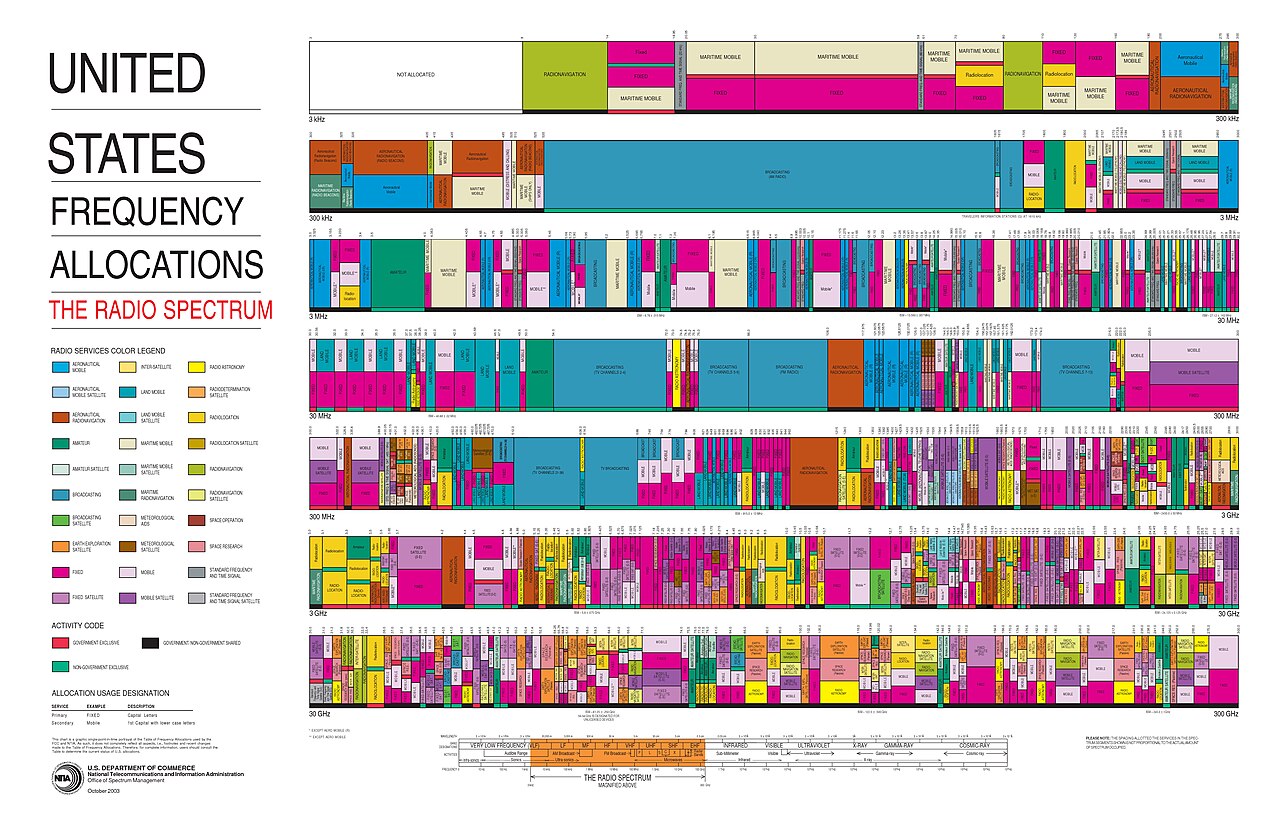
By the 2010s most useful spectrum had been assigned, and the most valuable remaining band was held by over-the-air television stations with shrinking audiences. A 2012 Act of Congress set up an incentive auction: a reverse auction would buy broadcast rights from stations willing to sell, the stations that stayed on the air would be moved (“repacked”) onto fewer channels, and a forward auction would sell the cleared band to mobile carriers. The FCC hired Milgrom’s firm Auctionomics in 2012; the design team included Ilya Segal, Lawrence Ausubel, Jonathan Levin, and the computer scientist Kevin Leyton-Brown.
The reverse auction lowered each station’s price offer step by step. Before every step it had to check whether the station, if it declined and stayed on the air, could still be assigned a channel together with all the other remaining stations without interference. That feasibility check is NP-complete, since it generalizes graph coloring (see P vs NP). The FCC’s interference data covered 2,990 US and Canadian stations and more than 2.5 million channel-specific constraints, and the check had to be run tens of thousands of times in sequence, each within a time limit on the order of minutes.
Leyton-Brown, Neil Newman, and Alexandre Fréchette at the University of British Columbia built the checker, SATFC, by encoding each question as a Boolean satisfiability problem (see SAT Solvers). A full problem at one clearing target came to 73,187 variables and 2,917,866 clauses. They used automatic algorithm configuration to assemble a portfolio of eight solver configurations run in parallel, and added caching so that solutions to earlier, similar problems could be reused. In simulations SATFC solved about 88 percent of problems in under a second and 96 percent within the one-minute cutoff. An unsolved check counted as “infeasible,” which kept the auction correct at the cost of paying some stations more than necessary.
The incentive auction ran from March 2016 to April 2017. It raised 19.8 billion dollars, of which 10.05 billion went to 175 broadcasters for giving up their licenses, and the government netted more than 7 billion after costs. T-Mobile was the largest buyer.
⚠️ Dead End: Buying Now, Paying Later
To help small businesses compete, the FCC’s 1996 C block auction let designated small bidders pay 10 percent down and the rest in installments, interest-only for six years at the ten-year Treasury rate. The terms favored whoever had the most speculative business plan. NextWave bid 4.7 billion dollars and put down about 500 million. When license prices fell, most of the large C block winners, NextWave among them, could not pay, and NextWave filed for Chapter 11 bankruptcy. The FCC cancelled its licenses and resold the spectrum in an auction that ended in January 2001 for about 17 billion dollars. NextWave sued. On 27 January 2003 the Supreme Court held in FCC v. NextWave that the Bankruptcy Code barred the FCC from revoking a debtor’s licenses for failing to pay, with only Justice Breyer dissenting, and NextWave kept its licenses. Much of the C block spectrum sat unused in bankruptcy litigation for years. The FCC stopped offering installment payments.
📚 Sources
- Nobel Prize in Economic Sciences 2020, popular science background: “The quest for the perfect auction,” NobelPrize.org (hearings and lotteries, the 1993 decision, SMRA, July 1994 auction of 10 licenses in 47 rounds for $617 million, $120 billion 1994–2014, adopting countries, prize citation)
- Statement of FCC Chairman Ajit Pai on Coase’s 1959 proposal (2017) (“Are you spoofing us? Is this all a big joke?”; the “corrupt Latin American dictatorships” critic)
- Coase, Ronald H.: “The Federal Communications Commission,” Journal of Law and Economics 2 (1959), 1–40
- Cramton, Peter: “Spectrum Auctions,” in Handbook of Telecommunications Economics (2002) (two years for thirty licenses, over 400,000 lottery applications, activity rule, code bidding in the DEF auction, 6 of 153 bidders winning 476 of 1,479 licenses, installment payments and C block defaults)
- McMillan, John: “Selling Spectrum Rights,” Journal of Economic Perspectives 8(3) (1994), 145–162
- “Going Once, Going Twice, Sold! Auctions and the Success of Economic Theory,” The Regional Economist, Federal Reserve Bank of St. Louis (January 1998) (NZ$100,000 bid paying NZ$6; NZ$7 million bid paying NZ$5,000)
- “New Zealand Spectrum Auction,” Cornell INFO 2040 course blog (2019) (NZ$250 million expected, NZ$36 million raised)
- Radio Spectrum Management New Zealand: “Completed spectrum rights tenders 1989–1995” (second-price tenders from December 1989, first-price from April 1993)
- Klemperer, Paul: “How (Not) to Run Auctions: the European 3G Telecom Auctions,” European Economic Review (2002), author’s version (UK design and 39 billion euros; 20 vs. 650 euros per capita; Netherlands and Versatel; Swiss field shrinking from nine to four)
- Spectrum auction — Wikipedia (UK £22.5 billion; Germany DM 98.8 billion; 2017 incentive auction results)
- Paul Milgrom — Wikipedia (Auctionomics hired in 2012; incentive auction design team)
- “Doorbell camera captures moment Nobel Prize winner is told he won,” NBC News (12 October 2020)
- Newman, Neil; Fréchette, Alexandre; Leyton-Brown, Kevin: “Deep Optimization for Spectrum Repacking,” Communications of the ACM (2018), arXiv:1706.03304 (2012 Act, NP-completeness, 2,990 stations and 2,575,466 constraints, SAT encoding size, eight-solver portfolio, solve rates, $19.8 billion / $10.05 billion / 175 broadcasters / $7 billion net)
- NextWave Wireless — Wikipedia ($4.7 billion bid, $500 million down payment, $17 billion re-auction ending January 2001)
- FCC v. NextWave Personal Communications Inc., 537 U.S. 293 (2003), syllabus, Legal Information Institute