Dead End: Short Cases
Abstract
Five failures that each fit in a few pages: RealNetworks, which owned internet streaming in 2000 and then made its own users distrust it; the netbook, a category defined by a price; the 3DO, a console standard nobody could afford; Microsoft’s Tay, a chatbot that Twitter taught to be a racist in sixteen hours; and Data General’s MV/8000, a superminicomputer built heroically for a market that was about to disappear. None of them needs a full article. Each one failed for a different reason.
RealPlayer and RealNetworks
Rob Glaser spent ten years at Microsoft from 1984, then founded Progressive Networks in Seattle in 1994. The company released the RealAudio Player on 3 April 1995, one of the first programs that played audio as it arrived over the network instead of after a full download. On 5 September 1995 it carried a Seattle Mariners game against the New York Yankees live over the internet. Video followed in 1997, the company renamed itself RealNetworks in September of that year and went public on Nasdaq in October. By 2000 it served roughly 85 percent of streaming content on the web, and a dial-up user who wanted to hear a radio station or watch a news clip installed RealPlayer, because there was nothing else.
The trouble began with what the software did once installed. In 1999 the security researcher Richard M. Smith found that RealJukebox, Real’s music-ripping companion, assigned each user a globally unique identifier and sent it back to the company with the titles of the CDs being played. RealJukebox had about 13 million registered users, and none had been told. The New York Times broke the story, and Real patched the behaviour. The player itself acquired a reputation for making itself the default media player, taking liberties with Windows settings and showing advertising in a “message center”. In 2006 PC World put RealPlayer at number 2 on its list of the 25 worst tech products of all time, for having “a disturbing way of making itself a little too much at home on your PC.”
Meanwhile Microsoft bundled Windows Media Player with Windows. Real sued, and on 11 October 2005 Microsoft settled for $761 million: $460 million in cash for the antitrust claims and $301 million in cash and promotion for a music and games partnership. By then the market it had been fighting over was moving to Flash video (see Dead End: Flash and the Plugin Web), and YouTube played clips in the browser page with no separate player to install, distrust, or uninstall. Real bought the Rhapsody subscription service in 2003 and spun it off in 2010, the year Glaser stepped down as chief executive. He came back in 2012, and on 21 December 2022 he took the company private at $0.73 a share.
RealNetworks lost to a bundled competitor and then to a technology shift, as many companies do. What was particular to Real is that users who had installed its software came to regard it as an intruder, and when a replacement appeared they uninstalled RealPlayer without regret.
The Netbook
Asus shipped the Eee PC 701 on 16 October 2007: 922 grams, a 7-inch screen, a 4 GB solid-state disk, Linux, and a US price of $399. It sold more than 300,000 units in four months, every PC maker copied it, Intel built its 2008 Atom processor for the segment, and at the peak netbooks were about a fifth of the portable computer market.
The category was defined by a price point, and nothing else about it improved fast enough. Underneath the $300 to $400 price the components got better slowly, while the machines attacking it got better quickly. The iPad arrived in 2010 and tablet sales passed netbook sales in 2011. Thin, fast ultrabooks took buyers who wanted a small computer, and Chromebooks took the cheap end. Dell left the market in December 2011, Toshiba in May 2012, and Asus, Acer and MSI in September 2012. The full story, next to the MacBook Air that made the opposite bet, is in The Portable Computer.
The 3DO
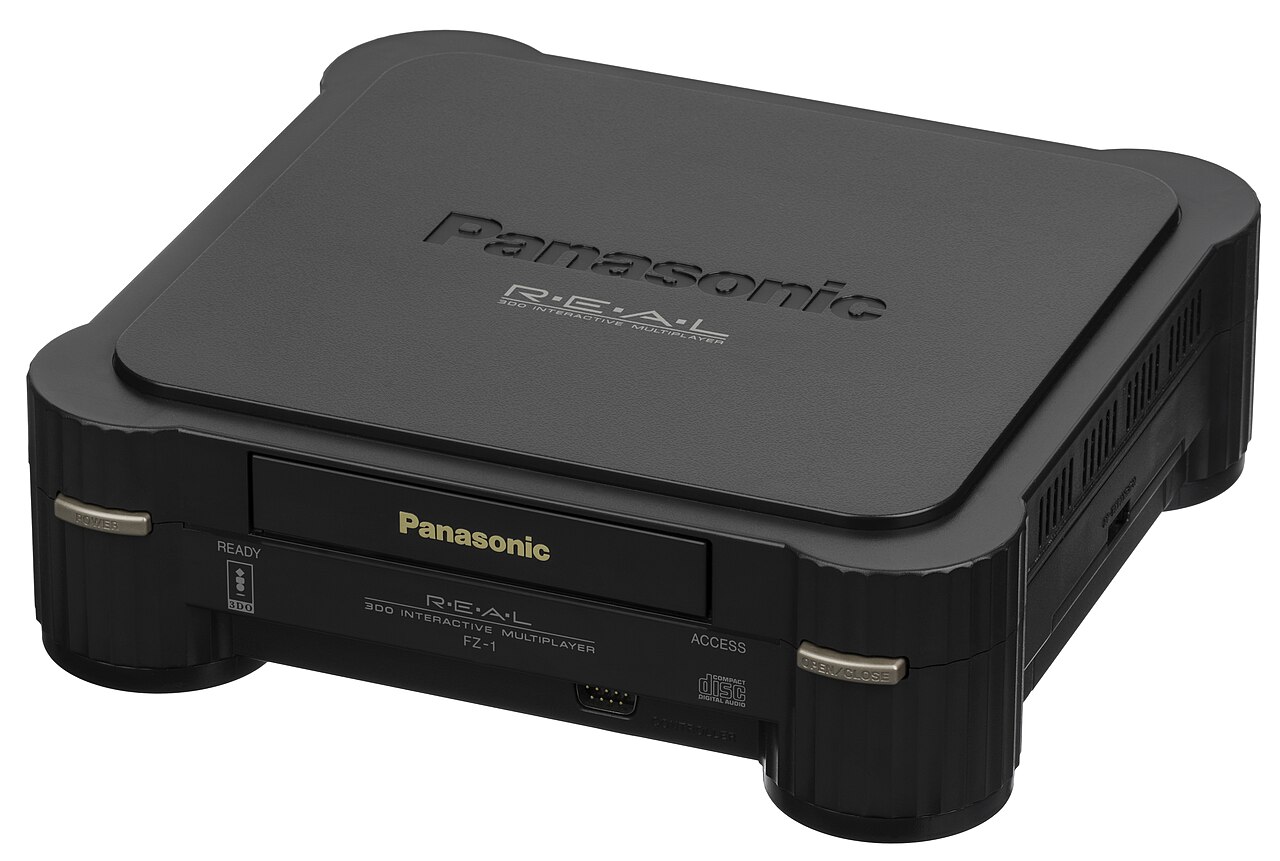
Trip Hawkins had been director of strategy and marketing at Apple before founding Electronic Arts in 1982. His complaint about the console business was the one every publisher had: Nintendo and Sega controlled manufacturing, charged high licence fees on every cartridge, and decided what shipped. On 12 September 1991 he spun off The 3DO Company from EA, with outside partners, to break that model. 3DO would design a CD-based console and license the specification, like VHS, to any electronics firm that wanted to build it. Publishers would pay a royalty of $3 per disc, far below what Nintendo and Sega charged.
Time named it product of the year for 1993. Panasonic shipped the first unit, the FZ-1, in North America on 4 October 1993 at $699.99. GoldStar, Sanyo and Creative Technology built versions; Samsung, Toshiba and AT&T took licences and never shipped. By mid-November about 30,000 had sold.
The price was the business model. A manufacturer licensing a standard earned nothing from the games, so it had to make its profit on the box, while Nintendo and Sega sold hardware near cost and recovered the money from software royalties. The low per-disc royalty that attracted publishers was the same thing that kept the console at $700. 3DO’s share price fell from $37 in November 1993 to $23 a month later, and in 1994 and 1995 the Sega Saturn and Sony PlayStation arrived with stronger 3D hardware at lower prices (see The Video Game Console Wars). The 3DO was out of production by 1996 after about 2 million units.
In January 1996 the company sold exclusive rights to its successor design, the M2, to Matsushita for $100 million, which produced 3DO’s first profitable quarter. Matsushita never released M2 as a console. 3DO sold its hardware business to Samsung for $20 million in 1997 and became a game publisher, with Army Men and the Might and Magic series; it filed for Chapter 11 on 28 May 2003, and its franchises were auctioned to Ubisoft, Take-Two, Microsoft and Namco. Hawkins had lent the company about $12 million. He had also sold EA stock and sheltered the gains in tax shelters the IRS later disallowed, and in 2006 he filed for personal bankruptcy with debts of about $28 million, nearly all owed to tax authorities. Apple repeated the licensed-console idea with the Pippin in 1996 (see Dead End: Apple Pippin).
Microsoft Tay
Microsoft’s research and Bing groups launched Tay on Twitter as @TayandYou on Wednesday, 23 March 2016. It was an experiment in conversational learning, modelled on the language of a 19-year-old American woman and based on XiaoIce, a Microsoft chatbot in China that had held more than 40 million conversations since 2014 without major incident. Tay learned from the people who talked to it, and one of its features was a “repeat after me” command that made it post whatever text a user supplied.
Groups of users set out to feed it racist, antisemitic and misogynist material, both through the repeat command and through ordinary conversation, which Tay then generalised into statements of its own. Microsoft took it offline about 16 hours after launch, after it had posted more than 96,000 tweets. On 30 March it was accidentally reactivated during testing, posted a stream of repetitive messages to its 200,000 followers, and was switched off again.
Peter Lee, a Microsoft corporate vice president, published the post-mortem on 25 March. Microsoft had “planned and implemented a lot of filtering and conducted extensive user studies” and stress-tested the bot, he wrote, but “a coordinated attack by a subset of people exploited a vulnerability in Tay,” and “we had made a critical oversight for this specific attack.” The company was “deeply sorry for the unintended offensive and hurtful tweets.” Its successor, Zo, launched in December 2016.
Tay learned from unfiltered public input in real time, on the platform where hostile users were easiest to organise. The system had worked in China, in a moderated environment. The chatbots of the 2020s were trained offline and tested against deliberate manipulation before release (see AI Ethics and Algorithmic Bias). Joseph Weizenbaum had been disturbed in the 1960s by how readily people confided in ELIZA (Joseph Weizenbaum and ELIZA); Tay showed the reverse problem, a program that absorbed the worst of what people said to it.
Data General and the MV/8000
Data General was founded in 1968 by engineers who had left DEC, and its 16-bit Nova of 1969 made the company rich (the founding story is in Route 128: The Region That Lost to Silicon Valley). In October 1977 DEC announced the 32-bit VAX-11/780, and Data General’s answer, a clean-sheet 32-bit design called the Fountainhead Project, fell behind schedule.
At the Westborough headquarters Tom West ran a second, unofficial project, code-named Eagle: a 32-bit machine that would run the existing 16-bit Eclipse software unchanged. He staffed it largely with engineers just out of college, who worked for the chance to build the next machine rather than for money. Kidder described that motivation as pinball: if you win this round, you get to play again. By late 1979 it was clear Eagle would ship before Fountainhead. Data General announced it as the Eclipse MV/8000 at the Roosevelt Hotel in New York on 29 April 1980, about two years after the project began.
Tracy Kidder had spent the project with the team, and The Soul of a New Machine came out in July 1981. It won the Pulitzer Prize for General Nonfiction and the National Book Award in 1982, and it remains the standard account of what building a computer felt like. When West and Kidder appeared together to promote the book, West said: “Had we known your book would be so successful, we might have done a few things differently, too.”
The machine sold. MV/8000 sales carried Data General past a billion dollars a year in 1984. By then the IBM PC had been on sale for three years, and the minicomputer customers who wanted more power were starting to buy networks of workstations and PCs instead. Data General’s portable, the Data General/One of 1984, did not change that, and neither did its move to Unix servers with the AViiON line in 1989. The one lasting success of the later years was the CLARiiON disk array. EMC bought the company for $1.1 billion, closing on 12 October 1999, and ended all development and production of Data General computers. The CLARiiON brand ran until 2012. The Eagle team had built a winning machine in a category that no longer existed twenty years later. West died at home on 19 May 2011, aged 71.
📚 Sources
- RealNetworks — Wikipedia (founding 1994 as Progressive Networks, the 5 September 1995 Mariners–Yankees broadcast, the September 1997 rename and October 1997 IPO, about 85% of streaming content by 2000, Rhapsody 2003–2010)
- RealPlayer — Wikipedia (release on 3 April 1995, PC World’s 2006 “25 Worst Tech Products” ranking and quote, Richard M. Smith’s RealJukebox finding)
- RealJukebox — Wikipedia (the GUID, about 13 million registered users, New York Times report)
- RealNetworks caught secretly swiping users’ jukebox data — The Register, 1 November 1999
- Rob Glaser — Wikipedia (ten years at Microsoft from 1984, CEO until 2010, return in 2012)
- Microsoft and RealNetworks Resolve Antitrust Case — Microsoft press release, 11 October 2005
- A breakdown of the Microsoft-RealNetworks settlement — The Seattle Times ($761 million: $460 million antitrust, $301 million partnership)
- RealNetworks merger agreement with Robert Glaser — SEC filing, July 2022 ($0.73 per share)
- Netbook — Wikipedia (Eee PC 701 launch, 300,000 units in four months, about 20% of the portable market, the 2011–2012 exits)
- 3DO Interactive Multiplayer — Wikipedia (launch 4 October 1993 at $699.99, licensees, $3 royalty, 30,000 by mid-November, Time product of the year, about 2 million units)
- The 3DO Company — Wikipedia (spin-off 12 September 1991, share price, M2 sale for $100 million in January 1996, hardware sale to Samsung, Chapter 11 on 28 May 2003, asset auction)
- Trip Hawkins — Wikipedia (Apple role, EA 1982, 3DO)
- Veteran Game Exec Hawkins Faces Over $20M In Tax Debt — Game Developer
- Video Gaming Pioneer Trip Hawkins Is Still On The Hook For Big Taxes — Forbes, 25 March 2011 (2006 filing, $28 million debts, loans to 3DO, tax shelters)
- The IRS isn’t playing games with Trip Hawkins — GamesBeat (the $12 million lent to 3DO, EA stock sales, KPMG tax shelters)
- Tay (chatbot) — Wikipedia (launch 23 March 2016, 16 hours, 96,000 tweets, “repeat after me”, 30 March relaunch, Zo)
- Learning from Tay’s introduction — Peter Lee, The Official Microsoft Blog, 25 March 2016
- Data General — Wikipedia (founding, $1 billion in 1984, Data General/One, AViiON, CLARiiON, EMC acquisition for $1.1 billion completed 12 October 1999)
- The Soul of a New Machine — Wikipedia (Eagle vs. Fountainhead, July 1981 publication, Pulitzer and National Book Award, the pinball metaphor)
- Eclipse MV/8000 Launched — Gil Press (29 April 1980 at the Roosevelt Hotel, West’s quote)
- Data General’s Tom West dies — The Register, 24 May 2011 (death on 19 May 2011, Eagle ahead of Fountainhead by late 1979, the billion-dollar year)
- VAX — Wikipedia (VAX-11/780 announced October 1977)
- Kidder, Tracy: The Soul of a New Machine (1981), Little, Brown