Michael Dell
Abstract
Michael Dell (born 1965) started selling upgraded PCs from a University of Texas dorm room in 1984 with $1,000 and built the company that carried his name into the largest PC vendor in the world by 2001. His contribution was a business model rather than a machine: build the computer after the customer has paid for it, sell it by telephone and later by web form, and hold parts instead of finished stock. He was the youngest CEO in the Fortune 500 at 27, handed the job to a lieutenant in 2004, took it back in 2007 when the model had stopped working, paid a $4 million SEC penalty in 2010 over undisclosed Intel payments, fought Carl Icahn to take the company private in 2013, bought EMC for $67 billion in 2016, and brought the enlarged Dell Technologies back to the stock market in 2018. The economics of the direct model are told in The Commodity PC; this is the biography.
Houston
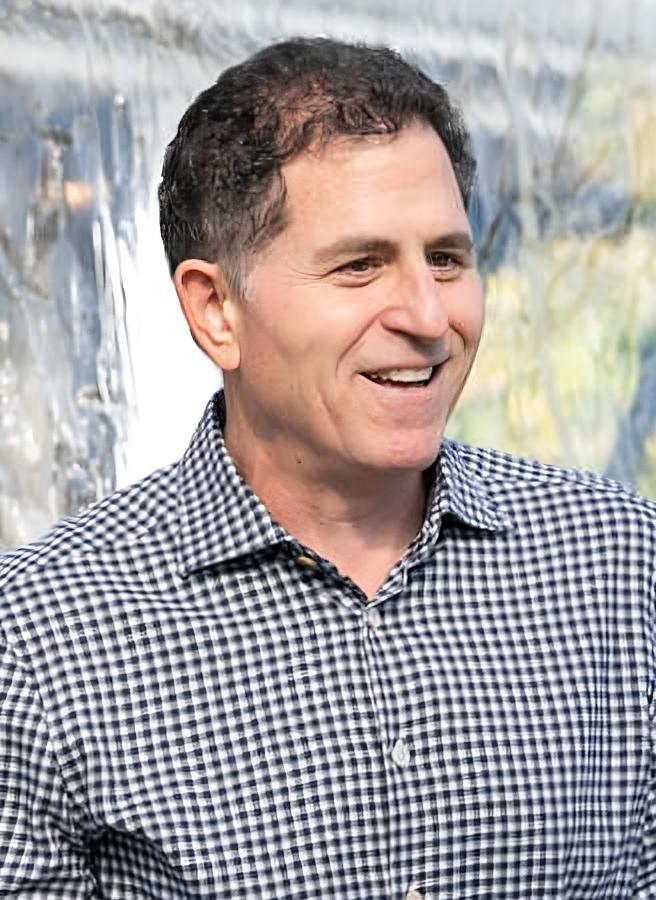
Michael Saul Dell was born in Houston, Texas, on February 23, 1965, to Alexander Dell, an orthodontist, and Lorraine Langfan, a stockbroker. He tried to sit a high-school equivalency exam at eight. At Memorial High School he sold subscriptions to the Houston Post and, having worked out that newlyweds and people who had just moved were the likeliest to subscribe, mined marriage-licence and mortgage records for addresses; that scheme earned him $18,000 in a year, more than some of his teachers made. His parents wanted a doctor. He enrolled at the University of Texas at Austin in 1983 as a pre-med student.
Dobie Center
The dorm room at Dobie Center was where the medical career ended. Dell bought surplus IBM PCs from dealers who had over-ordered, added memory and disk drives, and sold the upgraded machines at a discount to people who would otherwise have paid full retail. He registered the business as PC’s Limited in January 1984 with about $1,000 in capital and incorporated it on May 3, 1984. His parents had asked him to stop; he stopped for the summer, then did not go back for the sophomore year. The first year’s sales were about $6 million.
The insight that mattered was not about computers. A dealer had to hold inventory, pay salespeople, and earn a margin for both. A company that took the order first, built the machine afterwards, and shipped it direct had none of those costs and, in an industry where a component lost value every week it sat on a shelf, almost no stock to lose money on. The company’s first own-design machine, the Turbo PC, appeared in 1985 at $795. The name changed to Dell Computer Corporation in 1987 and the company went public on June 22, 1988, at $8.50 a share, raising $30 million.
Dell was 27 when the company entered the Fortune 500 in 1992, the youngest chief executive on the list. In the company’s early years Morton Meyerson, the former president of Electronic Data Systems, had coached him on running an organisation larger than he could oversee from his own desk.
dell.com
The web turned the telephone order into a form. Dell put its first sales pages online in 1996, and by March 1997 the company reported $1 million a day in sales through dell.com. Build-to-order was the same as before; the customer now typed the configuration instead of reading it to an operator, which removed one more cost. In the first quarter of 2001 Dell’s worldwide PC share reached 12.8 percent, and it passed Compaq to become the largest PC vendor in the world, selling a machine whose important parts were all designed by someone else: the processor by Intel, the operating system by Microsoft. The full account of how that model reshaped the industry, and what it did to everyone who still sold through dealers, is in The Commodity PC.
In October 1997, asked at a Gartner conference what he would do with Apple, then near bankruptcy, Dell said: “What would I do? I’d shut it down and give the money back to the shareholders.” Apple was profitable again the next year, and in 2006, when Apple’s market capitalisation passed Dell’s, Steve Jobs emailed his staff to point it out. Dell said in 2011 that he had declined to answer the question twice and had meant only that he could not imagine himself running any company but his own.
Rollins
On March 4, 2004, Dell stepped down as chief executive, keeping the chairmanship, and Kevin Rollins, who had run operations, took over. The next three years were the worst the company had had. Consumers were buying laptops in shops, where Dell had no presence and where Hewlett-Packard did; battery recalls and a customer-service reputation summarised online as “Dell Hell” did the rest. HP retook the number-one position in 2006. On January 31, 2007, the board asked Dell to come back, and he did.
The problems also had an accounting side. In July 2010 the Securities and Exchange Commission announced that Dell Inc. would pay $100 million to settle charges that it had failed to disclose payments from Intel and had used reserve accounting to make quarterly earnings look like they had come from operations. The payments were exclusivity rebates for keeping AMD processors out of Dell machines; by the SEC’s figures they made up 10 percent of Dell’s operating income in fiscal 2003, 38 percent in fiscal 2006, and 76 percent in the first quarter of fiscal 2007, the period when Dell finally began shipping AMD chips and the rebates stopped. Michael Dell paid $4 million and Rollins $4 million; the former chief financial officer paid $3 million. All settled without admitting or denying the allegations.
Going Private
Dell’s answer to the PC business shrinking under him was to stop being a PC business, and his answer to doing that under quarterly scrutiny was to stop being public. On February 5, 2013, he and the private-equity firm Silver Lake offered $13.65 a share, about $24.4 billion, to buy out the other shareholders, with a $2 billion loan from Microsoft. Carl Icahn, who had bought a large stake, spent the summer calling the price a steal and proposing alternatives. The offer was raised to $13.75 plus a special dividend, shareholders approved it on September 12, 2013, and the deal closed on October 30. Michael Dell owned about three-quarters of the private company.
On October 12, 2015, Dell announced it would buy EMC Corporation, the storage company that also controlled VMware, for about $67 billion, the largest technology acquisition to that date. The deal closed on September 7, 2016, and the combined company took the name Dell Technologies. Its business was now servers, storage, and the infrastructure of cloud computing, with PCs as the visible but not the profitable half. On December 28, 2018, Dell Technologies returned to the New York Stock Exchange by exchanging the tracking stock that had been issued for VMware, avoiding a conventional offering; it spun VMware off to shareholders in 2021. Fiscal 2026 revenue was $113.5 billion with about 97,000 employees, and the company had become one of the largest builders of the server racks that train large language models.
Outside the Company
Dell and his wife Susan set up the Michael & Susan Dell Foundation in 1999, focused on children’s health and education in the United States, India, and South Africa; by the foundation’s own count it had given more than $3 billion by 2025. His family office, MSD Capital, was founded in 1998. He has written two books, Direct from Dell (1999) and Play Nice But Win (2021), the second largely about the Icahn fight. His net worth was estimated at roughly $245 billion to $258 billion in 2026, most of it his stake in the company he started in a dorm room.
📚 Sources
- Michael Dell — Wikipedia
- Dell — Wikipedia (the 1984 registration, the 1985 Turbo PC, the 1988 IPO, the 2013 buyout terms and dates)
- Dell Technologies — Wikipedia (the EMC acquisition announced October 12, 2015 and closed September 7, 2016; the December 28, 2018 return to public markets; fiscal 2026 revenue and headcount)
- Dell Computer Corporation — Handbook of Texas Online (first-year sales of $6 million, the 1987 rename, the 1992 Fortune 500 entry)
- SEC Charges Dell and Senior Executives with Disclosure and Accounting Fraud — SEC press release 2010-131, July 22, 2010
- Morton Meyerson — Wikipedia (mentoring Dell in the company’s early years)
- Apple’s Jobs says Michael Dell should eat his own words — AppleInsider, January 16, 2006
- Dell takes top spot in PC market — CNN, April 23, 2001 (12.8 percent share in the first quarter of 2001)
- Michael Dell on his “I’d shut down Apple” quote — TechCrunch, October 2011
- Dell’s back at the helm, with his rep on the line — Fortune, January 31, 2007
- Dell, Michael, with Catherine Fredman — Direct from Dell: Strategies That Revolutionized an Industry, HarperBusiness, 1999
- Dell, Michael, with James Kaplan — Play Nice But Win: A CEO’s Journey from Founder to Leader, Portfolio, 2021
- Image: Michael Dell (52548152888) (cropped).jpg by Village Global (CC BY 2.0), via Wikimedia Commons