From MRP to ERP: Software for the Factory
Abstract
Material requirements planning (MRP) started as a calculation a tractor maker and a toolmaker ran on their own computers in the early 1960s: given what the factory has to ship and when, work backwards through the bill of materials to find which parts to order or build, and in which week. A trade association turned it into a campaign in 1971, IBM published a blueprint for it in 1972, and by 1981 about 8,000 companies used it. The software moved from mainframes to the minicomputers of mid-sized manufacturers (MANMAN on the HP 3000, MAPICS and J.D. Edwards on IBM’s midrange machines), grew accounting and capacity planning as MRP II, and in 1990 Gartner renamed the whole family enterprise resource planning (ERP). The 1990s ERP boom produced SAP’s dominance, Baan’s collapse, and implementation failures that took down a drug distributor and cost Hershey a Halloween. Most of the other brands that survived now belong to Oracle or Infor.
Reorder Points
Before MRP, a factory storeroom was run by reorder points. Every part had a minimum stock level and an economic order quantity; when the bin fell below the line, someone ordered more. The method treats each part as if its demand were independent and steady. In an assembly plant it is neither: the demand for a gearbox housing is exactly the number of gearboxes the plant intends to build, in the weeks it intends to build them. Reorder points therefore produced the classic factory of the 1950s, overstocked with parts nobody needed this month and short of the one part that stopped the line.
The alternative was known and simple to state. Start from the master schedule of finished products, explode each product through its bill of materials into components, subtract what is already in stock or on order, and offset each remaining requirement by its lead time. The result is a time-phased list of what to buy and make, and when. Done by hand for a product with thousands of parts it was hopeless. Rolls-Royce and General Electric computerized versions of it for aero engines in the early 1950s but did not sell them.
Orlicky, Wight and Plossl
Joseph Orlicky, a Czech-born engineer, built the system usually counted as the first MRP installation at the J.I. Case tractor company in Racine, Wisconsin, in the early 1960s; Vincent Mabert’s history of the period notes that earlier prototypes existed and the “father” title is a simplification. Black & Decker followed in 1964, with Dick Alban leading the project. At the Stanley Works in Connecticut, Oliver Wight and George Plossl built their own.
The three met through the American Production and Inventory Control Society (APICS) in the late 1960s and decided to use it as a pulpit. By 1971 APICS had formally launched what it called the “MRP Crusade”, with the three and a handful of early users as its crusaders. Orlicky, by then at IBM, published Material Requirements Planning: The New Way of Life in Production and Inventory Management in 1975. It sold more than 140,000 copies. The count of companies running MRP went from about 700 in 1975 to about 8,000 in 1981.
IBM’s Blueprint
In 1972 IBM published COPICS (Communications Oriented Production Information and Control System), twelve chapters in eight volumes describing an integrated manufacturing system for IBM’s mainframes, with material requirements planning as one of its applications and the shared database as the eighth volume. COPICS was deliberately not a finished product. It was a design that told a manufacturer’s executives and data-processing department what to build, and its orientation towards terminals and communication was new for 1972.
For customers who could not afford a mainframe project, IBM offered packaged software instead. MAPICS (Manufacturing, Accounting and Production Information Control System) appeared in 1977 for the System/34 and moved with IBM’s midrange line to the System/36, System/38 and AS/400. IBM sold it to Marcam in 1993.
The Minicomputer Factory
The market that made MRP a product rather than a consulting project was the minicomputer. A manufacturer too small for a mainframe project could buy a minicomputer and a package that ran on it.
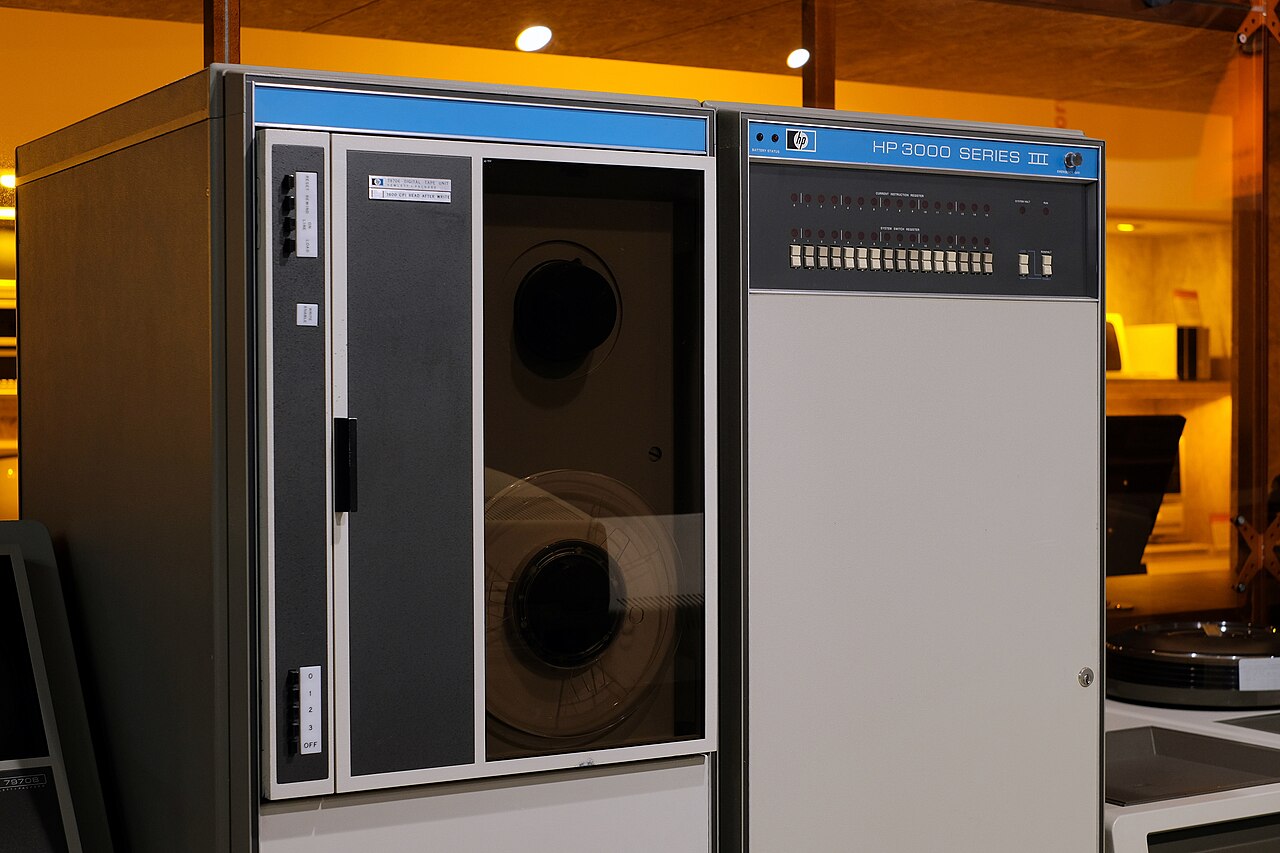
Sandra Kurtzig’s ASK Computer Systems wrote MANMAN (manufacturing management) for small manufacturers and ported it from the HP 2100 to the HP 3000 when HP made that machine its business computer. From 1978 ASK sold it as a turnkey system, software and HP hardware together, at $125,000 to $300,000, and later on DEC’s VAX (see Sandra Kurtzig and Hewlett-Packard). J.D. Edwards, founded in Denver in March 1977 by Jack Thompson, Dan Gregory, Ed McVaney and Chuck Hintze (the name comes from Jack, Dan and Ed), wrote for IBM’s System/34 and System/36, then the System/38 and the AS/400, and went public in September 1997. In Germany, five former IBM engineers had founded SAP in 1972 and built real-time financial accounting for mainframes; its R/2 (1979) added multiple currencies and languages (see DEC and the Minicomputer Era).
MRP itself grew in the same years. “Closed-loop MRP” fed capacity back into the plan, so that the schedule no longer assumed every machine had unlimited hours. Wight’s 1981 book Manufacturing Resource Planning: MRP II added the master schedule, capacity requirements, and above all the link to the general ledger, so that the plan was also a financial forecast. By 1989, by one estimate, MRP II software sold to American industry was worth $1.2 billion, about a third of the software industry.
Gartner Names It
In 1990 Lee Wylie of the Gartner Group coined enterprise resource planning as the name for the next generation of MRP II, and as a yardstick for how far a package really integrated the functions of a company, across departments as well as within them. By the mid-1990s ERP systems covered finance, human resources and distribution as well as manufacturing, and governments and non-profits bought them. The label arrived as the product to fit it did. SAP’s R/3 (1992) put the integrated suite on Unix client-server hardware, and in the mid-1990s it became the standard purchase of large corporations leaving the mainframe. PeopleSoft, founded in 1987 by Dave Duffield and Ken Morris, shipped a client-server human-resources suite in 1989 and expanded from there into ERP. The Year 2000 problem completed the boom: rather than repair old in-house systems, many companies replaced them with an ERP package that already handled four-digit years.
Implementations That Failed
The integrated suite came with integrated risk. Switching a company’s order processing, inventory and books to one system happened on one date, and if the system could not keep up there was no old system left to fall back on.
FoxMeyer Drug, a $5 billion company and the fourth-largest pharmaceutical distributor in the United States, bought SAP R/3 in December 1993, added warehouse automation from Pinnacle, and hired Andersen Consulting to integrate the two. The plan was $65 million and 18 months. In 1994 R/3 on HP 9000 servers could process 10,000 customer orders a night; FoxMeyer’s old mainframe system had handled 420,000. Workers left the three Ohio warehouses the automated one was to replace, disgruntled staff damaged inventory during the transition, costs passed $100 million, and FoxMeyer went bankrupt in 1996. In 1998 its trustee sued SAP and Andersen for $500 million each. Judy Scott’s case study quotes Pinnacle’s chief operating officer: “It was a management failure.”
Hershey Foods spent $112 million on a combined SAP, Siebel and Manugistics system and switched it on in 1999 as the Halloween orders were coming in. In September 1999 the chief executive told analysts that the company could not ship about $100 million of candy that had been ordered. The stock fell more than 8 percent that day. By autumn 2000 analysts had stopped treating it as a problem.
Baan
Jan Baan started a consulting firm in Barneveld in the Netherlands in 1978 and wrote its first program in BASIC on a Durango F-85. By the early 1990s Baan sold a manufacturing ERP suite with a configurable “Dynamic Enterprise Modeler” and became a real threat to SAP when it won Boeing in 1994 and listed in Amsterdam and on NASDAQ in 1995.
In 1998 it turned out that management had inflated revenue by booking software licenses “sold” to a distributor related to the company. The share price collapsed in late 1998. Invensys bought Baan in June 2000 for $700 million and sold it three years later to SSA Global for $135 million. The software survived as SSA ERP LN and later at Infor. The company went under at the moment ERP buyers were choosing suppliers for the next twenty years, and they would not choose one whose accounts they could not trust.
Consolidation
The 2000s turned the ERP market into a few holding companies. PeopleSoft bought J.D. Edwards in June 2003 for $1.8 billion. The same month Oracle launched a hostile bid for PeopleSoft; PeopleSoft answered with a customer-assurance programme promising refunds of two to five times the license fee if it were bought and support were cut, the U.S. Justice Department sued to block the deal, and a federal court rejected the suit in September 2004. Oracle closed the purchase in January 2005 for about $10.3 billion and cut about half of PeopleSoft’s staff (see Larry Ellison and Oracle). Two months later Duffield and Aneel Bhusri founded Workday to write human-resources software for the web.
Most of the minicomputer-era brands ended up at Infor, a company assembled from acquisitions after its spin-off as Agilisys in 2002: MAPICS in 2005 for $350 million; SSA Global, which already owned Baan and MANMAN, in 2006; Lawson in 2011. Koch Industries took two-thirds of Infor in 2017 for $2.68 billion and the rest in 2020 at an $11 billion valuation. MANMAN, MAPICS and Baan, rivals for the same factories in the 1980s and 1990s, ended up with one owner.
The next platform change came from outside. NetLedger, founded in 1998 by Evan Goldberg with about $125 million from Larry Ellison, sold accounting as a web service, renamed itself NetSuite in 2003, and was bought by Oracle for $9.3 billion in 2016 (see The Rise of SaaS). In 2010 Kurtzig started over with Kenandy, manufacturing ERP on the Salesforce platform: the problem she had first solved on borrowed HP minicomputers in the 1970s.
📚 Sources
- Material requirements planning — Wikipedia (reorder point and EOQ before MRP; Rolls-Royce and General Electric in the early 1950s; Black & Decker 1964 with Dick Alban; about 700 companies in 1975 and 8,000 in 1981; the 1989 estimate of $1.2 billion, a third of the software industry)
- Joseph Orlicky — Wikipedia (Czech-born, IBM, the 1975 book and its 140,000 copies)
- Mabert, Vincent A.: “The early road to material requirements planning”, Journal of Operations Management 25 (2007), 346–356 (Orlicky at J.I. Case in the early 1960s as the conventional first installation, with earlier prototypes reported; read via abstract and search excerpts)
- Waddell, Bill: “MRP R.I.P”, Superfactory, April 2006 (Orlicky at J.I. Case in Racine; Wight and Plossl at the Stanley Works; the three choosing APICS; the MRP Crusade launched by 1971; closed-loop MRP adding capacity planning)
- Wight, Oliver W.: Manufacturing Resource Planning: MRP II, Unlocking America’s Productivity Potential (CBI, 1981)
- Communications Oriented Production Information and Control System — Wikipedia (German) (COPICS 1972, twelve chapters in eight volumes, a design concept rather than finished software, communication-oriented)
- Infor XA (MAPICS) — Wikipedia (MAPICS 1977, System/34 to AS/400, sold to Marcam 1993, bought by Infor in 2005 for $350 million)
- JD Edwards — Wikipedia (founded March 1977 in Denver by four founders, the name, the IBM midrange platforms, IPO 24 September 1997, bought by PeopleSoft in June 2003 for $1.8 billion)
- Jacobs, F. Robert & Weston, F.C. “Ted”: “Enterprise resource planning (ERP)—A brief history”, Journal of Operations Management 25 (2007), 357–363 (the term coined by T. Lee Wylie of Gartner in 1990 as a criterion for how far software integrated across and within functional silos; read via abstract and search excerpts)
- Enterprise resource planning — Wikipedia (ERP as the extension of MRP and MRP II; all core functions and non-manufacturers by the mid-1990s; Y2K replacements)
- Scott, Judy E.: “The FoxMeyer Drugs’ Bankruptcy: Was it a Failure of ERP?”, AMCIS 1999 Proceedings, paper 80 ($5 billion and fourth largest; R/3 bought December 1993; Pinnacle and Andersen; $65 million plan; 10,000 against 420,000 orders a night; costs over $100 million; bankruptcy 1996; $500 million suits in 1998; the Pinnacle quote)
- “Supply Chain: Hershey’s Bittersweet Lesson”, CIO, 15 November 2002 ($112 million SAP/Siebel/Manugistics system; September 1999 announcement; $100 million of Halloween orders; stock down more than 8 percent)
- Baan Corporation — Wikipedia (1978 in Barneveld, Durango F-85 and BASIC, Boeing 1994, listing 1995, the 1998 revenue inflation, SSA ERP LN, Invensys $700 million in June 2000, SSA Global $135 million in June 2003)
- PeopleSoft — Wikipedia (founded 1987 by Duffield and Morris; client-server HRMS 1989; Oracle’s June 2003 bid, the customer-assurance refunds, the DOJ suit rejected September 2004, the $10.3 billion close in January 2005 and the layoffs)
- Workday, Inc. — Wikipedia (founded March 2005 by Duffield and Bhusri)
- Infor — Wikipedia (Agilisys 2002; MAPICS 2005, SSA Global 2006, Lawson 2011; Koch’s $2.68 billion for two-thirds in 2017 and the 2020 buyout at $11 billion)
- NetSuite — Wikipedia (founded 1998 by Evan Goldberg as NetLedger, about $125 million from Ellison, renamed 2003, Oracle’s $9.3 billion purchase in 2016)
- ASK Group — Wikipedia (MANMAN on the HP 2100 and HP 3000, turnkey prices, MANMAN to SSA Global in 2002 and Infor in 2006)