Virginia Rometty
Abstract
Virginia “Ginni” Rometty (born 1957) joined IBM as a systems analyst in 1981 and ran it from January 1, 2012, to April 2020, the first woman to do so in the company’s history. Her tenure is the one in which IBM stopped being the largest technology company in the world: revenue fell for 22 consecutive quarters, from about $107 billion in 2011 to $77 billion in 2019, while she sold the x86 server business and the chip fabs, bet the company’s public image on Watson and lost, and, in her last full year, paid $34 billion for Red Hat to buy the hybrid-cloud position IBM had failed to build. She was ranked the most powerful woman in American business by Fortune three years running while the stock went sideways and ProPublica documented the removal of some 20,000 older American employees. Both records are hers.
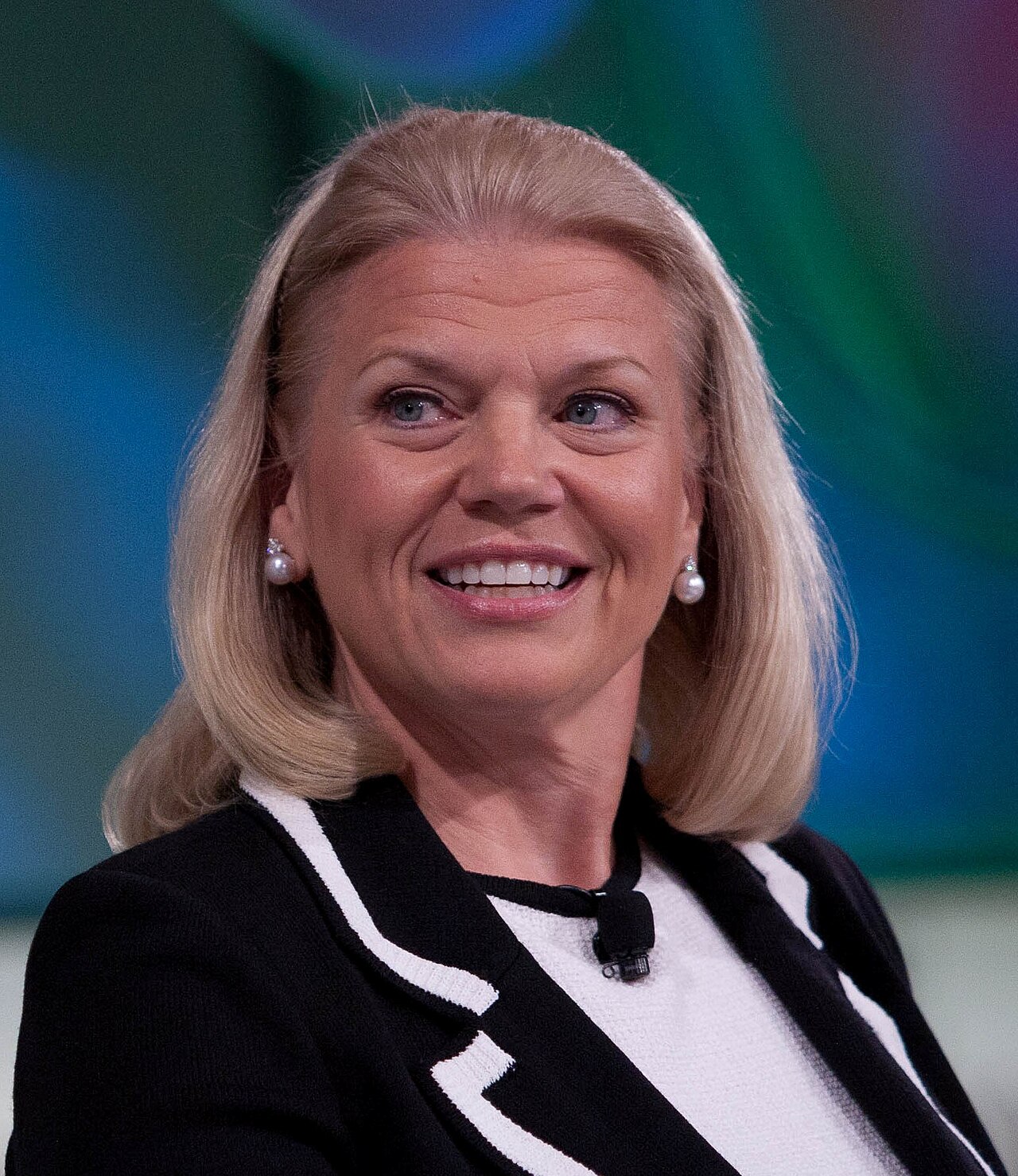
Chicago
Virginia Marie Nicosia was born in Chicago on July 29, 1957, the eldest of four. Her father left when she was fifteen or sixteen (her own accounts vary), and her mother, who had never worked outside the home, went back to school and took several jobs while the teenager ran the house; the family was on food stamps for a time, as she has described in her memoir. A General Motors scholarship took her to Northwestern, where she graduated in 1979 with high honours in computer science and electrical engineering, and to the General Motors Institute in Flint, where the scholarship required her to work. She married Mark Rometty the same year. In 1981 she moved to IBM’s Detroit office as a systems analyst.
Thirty Years Up
She spent the 1990s in IBM’s consulting and services arm, the business Louis Gerstner built to save the company after its 1993 loss of $8 billion, and her defining move before the top job was the purchase of PricewaterhouseCoopers Consulting for $3.5 billion in 2002, a deal she helped negotiate and then integrated as head of the combined unit: about 30,000 PwC consultants absorbed into IBM’s services business. From 2010 she was senior vice president and group executive for sales, marketing and strategy, the job from which IBM chief executives are usually chosen. Sam Palmisano’s board named her president and chief executive on October 25, 2011, effective January 1, 2012, and she added the chairmanship on October 1, 2012. The company she inherited had about 433,000 employees and had just posted its record revenue, $106.9 billion for 2011.
The Long Decline
Palmisano had left her a promise: a “2015 Roadmap” committing IBM to $20 of operating earnings per share by 2015. The route to it was buybacks and cost cuts, and the roadmap was abandoned in October 2014, ten quarters into a run of revenue declines that had begun in 2012 and ended only with the fourth quarter of 2017: 22 consecutive quarters. Rometty’s strategy was to shed the hardware businesses that no longer earned IBM’s margins and to sell what she called “strategic imperatives”, cloud, analytics, mobile, security and social. The x86 server business went to Lenovo for $2.1 billion in 2014; the semiconductor fabs went to GlobalFoundries in 2015, with IBM paying $1.5 billion to be rid of them. The strategic imperatives grew, but they grew more slowly than the old businesses shrank, and the stock ended her tenure below where it had started while the Nasdaq roughly tripled.
Warren Buffett’s Berkshire Hathaway, which had bought $10.7 billion of IBM in 2011, sold a third of its stake in 2017, Buffett telling CNBC he had “revalued it somewhat downward”, and was out entirely by early 2018. Revenue in 2019 was $77.1 billion.
Watson
The public face of the strategy was Watson, the question-answering system that had won Jeopardy! in February 2011 (see Fun Fact: Watson on Jeopardy). Rometty made it the company’s brand for artificial intelligence and, from 2015, put it into a separate business, Watson Health, built on $4 billion of acquisitions of medical-data companies. She called healthcare IBM’s “moon shot”. The applications, above all the oncology advisor developed with MD Anderson Cancer Center, did not deliver what the advertising said; MD Anderson had spent $62 million on it by the time a University of Texas audit, published in February 2017, ended the project. The business was sold to a private-equity firm in January 2022 for a reported $1 billion. The full account is in Dead End: IBM Watson Health. The gap that sank it was the one between what IBM’s marketing promised and what its research could support, and Rometty had approved the marketing.
Cutting Old Heads
On March 22, 2018, ProPublica and Mother Jones published “Cutting ‘Old Heads’ at IBM”, an investigation based on internal documents and interviews with more than 1,000 former employees. It estimated that IBM had eliminated more than 20,000 American employees aged 40 and over in the previous five years, about 60 percent of its estimated US job cuts in that period, by converting layoffs into “retirements”, requiring remote workers to relocate or resign, and lowering performance ratings to justify terminations, and that after 2014 IBM had stopped giving laid-off workers the age data that federal law lets them use to assess a discrimination claim. IBM said it complied with the law and was proud of its employees’ ability to reinvent themselves. The company’s US headcount was never published; worldwide it fell from about 434,000 at the end of 2012 to about 353,000 at the end of 2019. Rometty’s public line throughout was the need to hire for “new collar” jobs, skills without degrees, and she backed it with the P-TECH school model, six-year high schools combining a diploma with an associate degree, which IBM launched in Brooklyn in 2011 and which by 2020 had spread to more than 200 schools in over twenty countries.
Red Hat
On October 28, 2018, IBM announced it would buy Red Hat, the largest open-source company in the world, for $34 billion, $190 a share, a 63 percent premium and by far IBM’s largest acquisition. The rationale was hybrid cloud: IBM had missed public cloud to Amazon, Microsoft and Google (see The Cloud Wars), and Red Hat’s Linux and OpenShift ran in every data centre and every cloud. The deal closed on July 9, 2019, with Red Hat kept as a separate unit under its own management. It was Rometty’s last major decision and the one her successor built on; the business model of the company she bought is described in The Open Source Business Model.
She announced on January 30, 2020, that she would step down as chief executive on April 6, in favour of Arvind Krishna, who had run the cloud and cognitive software business and had led the Red Hat deal, and she retired as executive chairman on December 31, 2020, after 39 years at the company. Krishna spun the managed-infrastructure business off as Kyndryl in 2021 and sold Watson Health in 2022. Rometty’s memoir, Good Power, appeared in 2023.
📚 Sources
- Ginni Rometty — Wikipedia
- IBM — Wikipedia (22 consecutive quarters of revenue decline 2012–2017, the Lenovo x86 sale, GlobalFoundries, Red Hat announced October 2018 and closed July 2019, Kyndryl, the January 2022 Watson Health sale)
- Gosselin, Peter and Ariana Tobin — “Cutting ‘Old Heads’ at IBM”, ProPublica, March 22, 2018
- Strickland, Eliza — “How IBM Watson Overpromised and Underdelivered on AI Health Care”, IEEE Spectrum, April 2, 2019
- IBM to Acquire Red Hat, Completely Changing the Cloud Landscape — joint press release, October 28, 2018 ($190 a share, about $34 billion)
- IBM Closes Landmark Acquisition of Red Hat for $34 Billion — press release, July 9, 2019
- Arvind Krishna Elected IBM Chief Executive Officer — IBM news release, January 30, 2020 (effective April 6, 2020; Rometty executive chairman to year end)
- IBM 2011 Annual Report (2011 revenue of $106.9 billion)
- IBM number of employees 1991–2025 — StockAnalysis (433,362 in 2011, 434,246 in 2012, 352,600 in 2019, from IBM’s 10-K filings)
- “IBM to buy PwC Consulting for $3.5B” — CNN Money, July 30, 2002 (price, about 30,000 employees, Rometty to run the combined unit)
- “Warren Buffett says Berkshire Hathaway has sold completely out of IBM” — CNBC, May 4, 2018
- “Ginni Rometty named Fortune’s 2014 most powerful woman in business” — Northwestern McCormick news, September 2014 (No. 1 for the third year running)
- “Cultivating good power with longtime IBM CEO Ginni Rometty” — ReThinking with Adam Grant, TED podcast transcript (her father leaving, food stamps)
- Rometty, Ginni — Good Power: Leading Positive Change in Our Lives, Work, and World, Harvard Business Review Press, 2023
- Image: Ginni Rometty at the Fortune MPW Summit in 2011.jpg by Asa Mathat / Fortune Live Media (CC BY 2.0), via Wikimedia Commons