The Cypherpunks: From Chaum to Bitcoin
Abstract
The cypherpunks were a mailing list and a Bay Area discussion group, founded in 1992 by Eric Hughes, Timothy C. May and John Gilmore, whose members set out to build privacy with cryptography instead of asking governments for it. Their slogan was “cypherpunks write code.” Their starting material was David Chaum’s research of the 1980s on untraceable payments and anonymous mail; their products included anonymous remailers, the political defence of PGP, and a sequence of designs for digital money without a bank: Adam Back’s Hashcash (1997), Wei Dai’s b-money and Nick Szabo’s bit gold (1998), and Hal Finney’s reusable proofs of work (2004). When Satoshi Nakamoto published Bitcoin in 2008, it cited Back and Dai, and the first person to receive a bitcoin was Finney. The list also carried the movement’s darker line, from May’s “liquid market for any and all material” to Jim Bell’s plan for anonymous assassination markets, and several of its members lived to see their tools used for things they had predicted and not wanted.

Chaum’s Toolbox
The ideas came from one academic. Between 1981 and 1985 David Chaum published the mix network, which hides who is writing to whom by passing encrypted mail through a chain of relays; the blind signature, which lets a bank certify a digital coin without being able to recognise it when it is spent; and a 1985 article in Communications of the ACM with the subtitle “Transaction Systems to Make Big Brother Obsolete.” Public-key cryptography, published by Whitfield Diffie and Martin Hellman in 1976, made all of these possible in principle. What was missing in the late 1980s was anyone outside universities and intelligence agencies writing the software.
Timothy C. May had retired from Intel in 1986, at 35, after discovering that alpha particles from the radioactive traces in ceramic chip packages were flipping bits in memory chips. In 1988 he wrote “The Crypto Anarchist Manifesto,” which began: “A specter is haunting the modern world, the specter of crypto anarchy.” Anonymous communication and payment, he wrote, “will create a liquid market for any and all material which can be put into words and pictures,” and “the State will of course try to slow or halt the spread of this technology, citing national security concerns, use of the technology by drug dealers and tax evaders, and fears of societal disintegration.” The prediction on both sides came true.
The List
In late 1992 May, the mathematician Eric Hughes and John Gilmore, a co-founder in 1990 of the Electronic Frontier Foundation, began holding monthly meetings in the Bay Area at the offices of Gilmore’s company. The writer and hacker Jude Milhon called them “cypherpunks,” from cipher and cyberpunk. A mailing list on Gilmore’s machine, toad.com, followed at once; it had about 700 subscribers in 1994 and about 2,000 at its peak in 1997, and much more traffic than a small group would suggest. Hughes posted “A Cypherpunk’s Manifesto” on 9 March 1993: “Privacy is necessary for an open society in the electronic age. […] Privacy is not secrecy.” And: “Cypherpunks write code. We know that someone has to write software to defend privacy, and since we can’t get privacy unless we all do, we’re going to write it.”
In 1993 Wired put Hughes, May and Gilmore on its cover wearing masks, over a feature by Steven Levy called “Crypto Rebels.” May compiled the list’s ideas in 1994 into a long FAQ, The Cyphernomicon. The membership over the years included Adam Back, Wei Dai, Nick Szabo, Hal Finney, Bram Cohen, who later wrote BitTorrent, Phil Zimmermann, and from about 1993 a young Australian named Julian Assange.
Remailers
The first things the cypherpunks built were remailers. A remailer receives an encrypted message, removes the sender’s identity, and forwards it; chains of remailers run by different people meant that no single operator knew both ends. Members, Hal Finney among them, ran the first cypherpunk remailers, and later versions padded and batched messages to hide their timing, as Chaum’s mix design required.
The best-known anonymous service was not a cypherpunk remailer at all. Johan Helsingius in Finland opened anon.penet.fi in 1993, a simpler pseudonymous server that kept a table linking each user to a reply address. It grew to about 700,000 registered users. In February 1995 the Church of Scientology, claiming that stolen internal documents had been posted through it, went through Interpol and the Finnish police, and Helsingius was made to reveal one user’s identity. He closed the service in 1996. The lesson the cypherpunks drew was the one Chaum had built in: a service that can reveal identities will be ordered to. The later onion-routing networks followed the remailer design and not Penet’s.
The Crypto Wars
The list’s politics were set by the US government’s attempts to control cryptography, told in The Crypto Wars of the 1990s. Strong encryption software counted as a munition under export law, so the cypherpunks published it in forms the law had not imagined. In 1995 Adam Back printed an implementation of RSA in a few lines of Perl on a T-shirt, which made the shirt, in principle, an export-controlled weapon; others put it in their email signatures. When the government proposed the Clipper chip in April 1993, with a key-escrow field for law enforcement, the list was among its loudest opponents, and in 1994 Matt Blaze of AT&T showed that the escrow field was protected by a 16-bit checksum short enough to forge. By 1996 Clipper was dead. Zimmermann’s criminal investigation over PGP’s spread abroad ended without charges the same year.
Digital Cash Without a Bank
Chaum’s DigiCash depended on a bank that issued and redeemed its coins, and it went bankrupt in 1998. The cypherpunks’ question was whether money could exist without any issuer. The pieces came one at a time, most of them posted to the list or its successors.
Hashcash, which Adam Back proposed in 1997 as a defence against spam, made a sender compute a small puzzle whose answer anyone could check cheaply. It was the first widely known proof of work: a way to show that a certain amount of computation had been spent. In November 1998 Wei Dai published b-money, which began: “I am fascinated by Tim May’s crypto-anarchy. Unlike the communities traditionally associated with the word ‘anarchy’, in a crypto-anarchy the government is not temporarily destroyed but permanently forbidden and permanently unnecessary.” It proposed that money be created by solving computational problems and that every participant keep a copy of the ledger of who owned what. It was never built. Nick Szabo conceived bit gold around 1998 and described it publicly in 2005: proof-of-work strings, each timestamped and used as the challenge for the next, forming a chain whose ownership was recorded in a registry of digital signatures. The starting problem, he wrote, was that “our money currently depends on trust in a third party for its value.” In 2004 Hal Finney built RPOW, reusable proofs of work, a working server that let a Hashcash token be spent and passed on; it still relied on a trusted server whose honesty could be checked by remote attestation.
Bitcoin
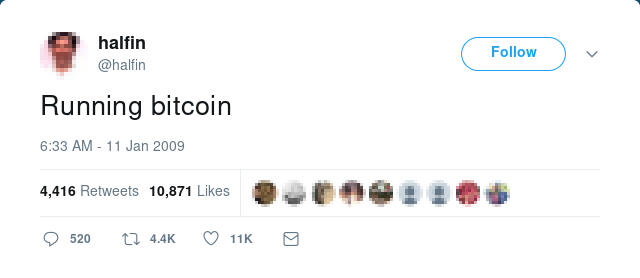
On 31 October 2008 a person or group calling itself Satoshi Nakamoto posted “Bitcoin: A Peer-to-Peer Electronic Cash System” to the Cryptography mailing list at metzdowd.com. The paper combined the parts the cypherpunks had built: proof of work, citing Back’s Hashcash; a ledger held by all participants, citing Dai’s b-money; and a chain of timestamped blocks. Its addition was the rule that the chain with the most accumulated work counts as the truth, which removed the need for any trusted server. Finney was one of the first to take it seriously. He ran the software on its release in January 2009, posted “Running bitcoin,” and on 12 January received ten bitcoins from Nakamoto in the first transaction between two people. What happened next is in The Cryptocurrency Revolution.
Dead End: Crypto Anarchy
The cypherpunks predicted that strong cryptography and anonymous money would make the state unable to tax, regulate or watch its citizens. Most of that did not happen, and some of what did was worse than they intended.
Jim Bell, an engineer on the list, wrote a ten-part essay from 1995 to 1996 called “Assassination Politics,” proposing an anonymous betting pool in which people would wager on the date of an official’s death; whoever “predicted” correctly would collect, which made it a way to pay for murders without a contract. Most of the list treated it as a thought experiment; Bell did not. He was arrested in 1997 over an IRS dispute, pleaded guilty to obstructing IRS agents and using false Social Security numbers, and after his release was convicted in 2001 of stalking federal agents; he was freed in March 2012. Ross Ulbricht’s Silk Road, a drug market paid in bitcoin, and ransomware paid in cryptocurrency were the “liquid market” of May’s manifesto in practice.
The state adapted. Bitcoin’s public ledger made payments traceable by anyone patient enough to follow them, and exchanges became regulated gateways that asked for passports. End-to-end encrypted messaging reached billions of people through companies such as WhatsApp and Apple, which operate under national law. The list itself declined after a dispute over moderation in early 1997 moved it off toad.com to a set of linked servers. Hal Finney, diagnosed with ALS in 2009, kept programming as the paralysis advanced, died on 28 August 2014 and was cryopreserved. Timothy May died on 13 December 2018; the New York Times obituary noted that in his later years he had posted racist views online.
📚 Sources
- Cypherpunk, Wikipedia (founders, late-1992 meetings, Milhon’s name, toad.com, about 700 subscribers in 1994 and 2,000 in 1997, the Wired cover, The Cyphernomicon, notable members, the 1997 move)
- Levy, Steven, “Crypto Rebels”, Wired 1.2, 1993
- May, Timothy C., “The Crypto Anarchist Manifesto”, 1988, posted to the list 22 November 1992
- Hughes, Eric, “A Cypherpunk’s Manifesto”, 9 March 1993
- Timothy C. May, Wikipedia (alpha particles, retirement at 35 in 1986, death 13 December 2018, the New York Times obituary)
- Chaum, David, “Security without Identification: Transaction Systems to Make Big Brother Obsolete”, Communications of the ACM 28 (10), 1985
- Penet remailer, Wikipedia (Helsingius, 1993, about 700,000 users, the February 1995 Scientology case, 1996 closure)
- Hal Finney (computer scientist), Wikipedia (remailers, RPOW 2004, 12 January 2009, ALS, death 28 August 2014, Alcor)
- Back, Adam, “Perl RSA ‘munitions’ T-shirt” (1995) and Adam Back, Wikipedia (Hashcash 1997)
- Clipper chip, Wikipedia (April 1993, the LEAF and its 16-bit hash, Blaze 1994, defunct by 1996)
- Dai, Wei, “b-money”, November 1998
- Szabo, Nick, “Bit Gold”, 29 December 2005 (conceived about 1998)
- Nakamoto, Satoshi, “Bitcoin: A Peer-to-Peer Electronic Cash System”, 31 October 2008 (references to b-money and Hashcash)
- Jim Bell, Wikipedia (“Assassination Politics” 1995–1996, the 1997 arrest and plea, the stalking conviction, release in March 2012)
- Image: John Gilmore 2009.jpg by Joi Ito (CC BY 2.0), via Wikimedia Commons