Ann Hardy
Abstract
Ann Hardy (1933–2023) wrote the time-sharing operating system that Tymshare, one of the first commercial time-sharing companies, sold computer hours on from 1966. Before that she had programmed IBM’s 704, 705 and Stretch, found out as a new manager that she earned less than the lowest-paid man reporting to her, and written a Fortran compiler at Livermore. At Tymshare she was given fewer stock options than the men who worked for her because, as her boss explained, it “would be immoral to tempt a woman to continue to work instead of stay home and have children.” She became the company’s first woman vice president, ran a division for eight years, and after McDonnell Douglas bought Tymshare in 1984 spun out its secure operating system as her own company, Key Logic, before co-founding Agorics.
Evanston and Pomona
Ann Caryl Haley was born in Chicago on 20 April 1933 and grew up in Evanston, Illinois, the eldest of five children in a very conservative Methodist family. A high-school chemistry teacher encouraged her, and she went to Pomona College in California in 1951 intending to major in chemistry. Her adviser, the chairman of the chemistry department, refused to sign her up: “Women in advanced chemistry labs are too distracting, and I will not have a woman chemistry major in my school.” She majored in physical education instead, because it let her take the science courses she could not take as a science major, and graduated in 1955. A biology teacher suggested physical therapy, and she went east to Columbia to study it.
The Computer in the Window
In New York a friend told her IBM was hiring and sent her to the company’s world headquarters at 57th Street and Madison Avenue to take its programmer aptitude test. She passed and joined IBM in 1956. The training class had about twenty people, three of them women, and covered the punched-card machines first: sorters, keypunches, and the plugboards that had to be wired by hand. Then came programming on the IBM 650 and the 705, the business computer that stood in IBM’s ground-floor showroom behind glass. “The good news about being a woman, for once there was good news,” Hardy said later, “is that they wanted to make it look easy to use a computer.” The women did their debugging and testing on the 705 in the window, and got more machine time than the men.
The class had been told that the top ten percent in the final test would go into sales. Some of the women finished in the top ten percent. IBM’s answer was a letter from Thomas Watson Jr., read aloud to the women, explaining that he could not send a woman alone into the office of a corporate officer. The alternative offered was “system service girl”, IBM’s term for the field engineer who wired customers’ plugboards. Hardy chose programming.
She went first to IBM Research in Poughkeepsie and then the Lamb Estate in Ossining, programming circuit-analysis algorithms on the 704 for Paul Roth, mostly at night because the engineers designing IBM’s next machines had the computer during the day. From Research she moved to the Stretch project and its NSA variant, Harvest, where she led a small group writing the assembler, the Fortran compiler and other tools, alongside Frances Allen. After about a year IBM sent the two of them to management school, the first women to go through management training in IBM engineering.
Fifteen Percent Less
Management school taught two things IBM may not have meant to teach. Managers, the instructors said, earned a few percent more than the best-paid person reporting to them. And IBM would pay for promising managers to take a Harvard MBA. Back at work Hardy saw the salaries of the men in her group for the first time: she would have needed a 50 percent raise to earn as much as the lowest-paid of them. Her manager got her a 35 percent raise, which she called beyond belief at IBM, and she still earned 15 percent less than the lowest-paid man working for her. Harvard Business School did not admit women.
Around 1961 she left IBM and enrolled at Berkeley, taking what she called “a random assortment of classes”. That year IBM delivered a Stretch to the Lawrence Radiation Laboratory at Livermore, and Hardy was, in her words, practically the only person in California who knew how to program one. Livermore hired her to write its Stretch Fortran compiler; she later wrote an editor for the lab’s CDC 6600, worked with its time-sharing system, and shared an office with Barbara Shell, who later worked for her at Tymshare. There she married Norman Hardy, a Livermore programmer who had been lent to IBM to make sure Stretch would suit the lab.
The Operating System at Tymshare
In 1966 Norm Hardy took a job at IBM in Menlo Park, and Ann Hardy read a short notice in Datamation about a new time-sharing company called Tymshare, founded in 1964 by two former General Electric men, Tom O’Rourke and Dave Schmidt. She called to ask whether she could have one of their teletypes at home. After a long talk with Schmidt she called back the next week and told him what he needed was to hire her to write the operating system, “because you don’t have anybody who knows anything about it.” She started in February 1966, Tymshare’s fifth employee counting the founders.
Tymshare had bought the SDS 940, Scientific Data Systems’ version of the machine Berkeley’s Project Genie had built, with Berkeley’s operating system (see Butler Lampson and Xerox PARC). The Berkeley system swapped users to magnetic tape, which made it slow with more than a few people on it. The machine did not arrive until September, so Hardy spent the summer reading the listings. She then rewrote the monitor for drums and disks; by her account she replaced every instruction while keeping Berkeley’s architecture, and took the system from one or two simultaneous users to about forty. Customers, mostly aerospace engineers, began finding ways to crash it before the end of 1966.
In June 1967 SDS wanted to sell a 940 to Harvard, which had a long acceptance test. Five companies were running 940s with the Berkeley system, and SDS sent each to Harvard with two weeks to pass. The other four failed. Hardy went for Tymshare, failed one item on the first day, fixed it that night, and passed on the second. SDS took Tymshare’s system as its own.
Fewer Options
None of this made her a manager. Schmidt, she said, could never convince himself a woman could manage. When she became pregnant in 1967, Tymshare hired Norm Hardy without an interview and made him the manager of the operating-system work, on the assumption that her husband had written it. She worked on the monitor until midnight before her daughter’s due date, from the teletype at home; the baby was born at nine the next morning, and at three that afternoon Schmidt rang the hospital to ask whether he could bring her a terminal, because the best customer wanted one more feature. She said she would fix it when she got home in two days.
The year before, Tymshare had handed out stock options. Hardy received fewer than half what any of the men got, including men who were in effect working for her. Schmidt explained that options were meant to keep people interested in the company, and “it would be immoral to tempt a woman to continue to work instead of stay home and have children.” When she answered a General Electric advertisement for a programmer with her experience, the personnel officer told her that her résumé fitted better than any other received, but that GE did not hire women in technical positions and could not ask a GE man to work for a woman. Hardy stayed friends with Schmidt and put it down to “the time, the culture”.
Schmidt left in 1969. LaRoy Tymes, a Livermore colleague (no relation to the company’s name), had proposed in 1966 a network that would let customers reach the computers with a local telephone call; with Norm Hardy he built it from 1968, and Tymnet was fully running by 1970, one of the first commercial packet networks. Ann Hardy moved into management on the applications side and from 1976 was vice president of the Integrated Systems Division, which built travel-industry systems for airlines and travel agents on top of Tymnet. She was Tymshare’s first woman vice president. Her mother’s reaction to the promotion was: “How can you do this to me? How can you embarrass me in front of my friends?”
Key Logic and Agorics
McDonnell Douglas bought Tymshare in 1984. At the first annual meeting of the new parent’s vice presidents she was, by her count, the only woman among about a hundred, and the speakers opened their talks with jokes about women. McDonnell Douglas suggested she take Gnosis, a capability-based operating system Tymshare had developed for IBM mainframes, and spin it out with its team. The company became Key Logic and the system KeyKOS. By her account it ran IBM’s CMS workloads at least five times faster than IBM’s own control program; it was licensed to the ANZ Bank in Australia and a firm in Japan, and passed a security evaluation by the National Computer Security Center. Key Logic did not find enough customers and closed in the early 1990s.
Around 1994 Mark Miller, one of the Key Logic engineers, won a Sun Microsystems research contract on market-based resource allocation, and Sun would only sign with a company. The same team founded Agorics, named after the Greek agora, and worked on secure electronic commerce, including Sun’s part of a bank consortium’s electronic-check project. Hardy retired in 2004 and co-chaired the Computer History Museum’s software industry special interest group.
She died in Palo Alto on 7 December 2023, aged 90. Asked in her oral history why women left computing, she said she was not the right person to ask, because she had never been tempted to drop out. She had, she added, been prepared for a world even more unfair than the one she found: “That doesn’t mean it was easy to deal with the lack of respect and the unfair compensation, but it was easier than it is for women today who expect to be treated fairly.”
📚 Sources
- Oral History of Ann Hardy, Computer History Museum, sessions of 11 and 22 July 2016, interviewed by David C. Brock, Marc Weber and Hansen Hsu · session 1 transcript PDF · session 2 transcript PDF (birth date and family, the Pomona chemistry adviser and physical education, the aptitude test at 57th and Madison, the class of twenty with three women, the 705 in the window, Watson’s letter, Paul Roth and the 704, Stretch and Harvest with Fran Allen, the management school, the 50 and 35 and 15 percent, Harvard, Berkeley around 1961, the Livermore Fortran compiler and 6600 editor, the Datamation notice and the teletype, February 1966 start and September delivery, rewriting the Berkeley monitor, the June 1967 Harvard acceptance test, Norm hired without interview, the hospital call, the stock options quote, the GE letter, Schmidt leaving in 1969, the Integrated Systems Division 1976 to 1984, the McDonnell Douglas VP meeting, Gnosis and KeyKOS, ANZ Bank, the NCSC evaluation, Agorics and the Sun contract, the closing quote)
- Oral history interview with Ann Hardy, IEEE History Center, 15 July 2002, interviewed by Janet Abbate (ETHW) (fifth employee, scaling the 940 system to about forty users, Tymnet I and II, the vice presidency, her mother’s reaction)
- David C. Brock, “If Discrimination, Then Branch: Ann Hardy’s Contributions to Computing”, CHM blog, 25 March 2019
- Math Whizzes and Computing Pros, Computer History Museum (the stock-options quote, first woman vice president, KeyLogic and Agorics)
- Ann Hardy — Wikipedia (née Haley; Evanston Township High School 1951; Pomona 1955; Tymshare 1966 to 1985; retirement in 2004; death in Palo Alto on 7 December 2023)
- Tymshare — Wikipedia (founded 1964 by O’Rourke and Schmidt; Tymnet developed from 1968 by LaRoy Tymes and Norm Hardy and fully operational in 1970; McDonnell Douglas acquisition in 1984)
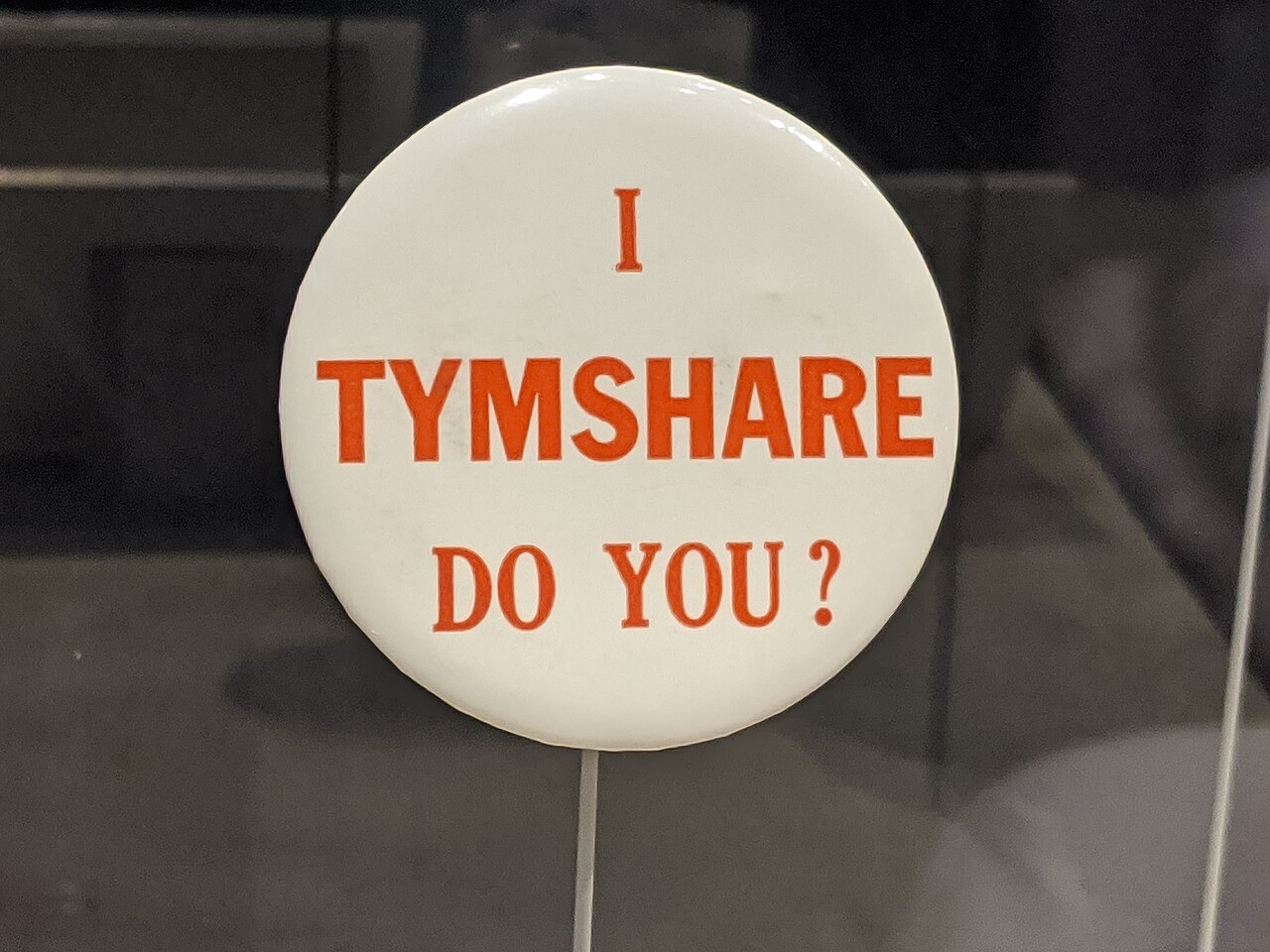
- Image: I Tymshare Do You badge, Computer History Museum, Mountain View, California, USA (49502014672).jpg by Cory Doctorow (CC BY-SA 2.0), via Wikimedia Commons