Curt Herzstark and the Curta
Abstract
Curt Herzstark (1902–1988), son of the founder of Austria’s first calculating-machine factory, worked out a four-function mechanical calculator small enough to hold in one hand before the Second World War. The Nazis classed him as a “half-Jew”, arrested him in 1943 and sent him to Buchenwald, where the managers of the camp’s armaments works let him draw the machine in his spare time, promising to present it to Hitler after the victory. He finished the drawings as the war ended. Built in Liechtenstein from 1948 as the Curta, about 140,000 were made until electronic calculators ended production in the early 1970s. Herzstark himself was out of the company by 1952.
The Family Firm
Herzstark was born in Vienna on 26 January 1902. His father, Samuel Jakob Herzstark, was Jewish; his mother was not. In 1905 the father founded the Rechenmaschinenwerk “Austria” in Vienna, the first calculating-machine factory in the country, which built improved versions of the Thomas arithmometer (see Before the Computer: Mechanical Calculation). Curt was demonstrating the firm’s machines at a Vienna office exhibition by the age of eight. His first invention, a mechanical memory that held subtotals, reached the market at the Berlin office exhibition of 1928 (his father registered the patent), and from 1930 he ran the business.
Customers, he said later, kept asking for a calculator they could carry in a pocket. The machines of the day added with rows of stepped drums or pinwheels, one per digit, and weighed several kilograms. Herzstark’s solution used a single stepped drum, the mechanism Leibniz had invented in the 1670s (see Gottfried Wilhelm Leibniz), turned by a crank on top, with the input sliders arranged around it. Subtraction was done by adding the nines complement, which spared the machine the mechanism for borrowing. By 1938, he told the Charles Babbage Institute, he knew in principle how to build such a machine, and on 19 August that year he filed a German patent for a calculator with a single stepped drum.
Arrest and Buchenwald
After the annexation of Austria in March 1938 the firm was no longer allowed to make calculators. It made precision gauges for the Wehrmacht, including instruments for measuring the distance between holes in tank armour, and Herzstark, who stayed on as an employee while his mother held the company to keep it from confiscation, patented several of them.
In 1943 two of his workers were arrested for listening to British radio and copying the news on a typewriter; one of them was beheaded. Herzstark went to the Gestapo to plead for them and was thrown out for the impudence of a half-Jew speaking up. A week later he was summoned as a witness and arrested himself. He was never tried. A protective-custody order charged him with supporting Jews and with “indecent relations with Aryan women”, on the evidence of postcards and letters. After a transport through several prisons, he reached Buchenwald concentration camp near Weimar in November 1943 and was first put to work in a gardening detail in prison clothes and wooden clogs.
The camp’s armaments plant, part of the Gustloff-Werke, knew his family’s machines and his gauge work and moved him into its precision workshop. Its production planners also knew he had been working on a small calculator. They offered him a deal: he could draw it on Sundays and in the evenings after lights-out, and if it worked, it would be presented to the Führer after the victorious war, and Herzstark would surely be declared an Aryan. “How honest that was, I am not sure,” he said in 1987. “But for me, at that time, it was naturally a ‘saving anchor’.” He finished complete dimensioned pencil drawings just as the war ended.
From Weimar to Liechtenstein
Buchenwald was liberated by American troops in April 1945. A few days later Herzstark walked into Weimar and looked up a former office-machine dealer he knew, who saw the drawings and called in the management of Rheinmetall’s office-machine works at Sömmerda. Rheinmetall’s engineers built three prototypes from his drawings within eight weeks. When the Soviet army took over Thuringia and engineers he knew from Zeiss were taken east, Herzstark fled with the prototypes dismantled in a box, made his way through Czechoslovakia to Vienna in December 1945, assembled them there and filed further patents.
In the spring of 1946 he went to Liechtenstein at the invitation of Prince Franz Joseph II, who agreed to finance production. Contina AG in Mauren built a fully integrated factory, with its own machine shop and plating plant. Herzstark remembered the first saleable machines leaving it in the autumn of 1948 or 1949, he was not sure which; the Curta was shown at the Basel fair in May 1949, and the HNF dates the start of sales to November that year.
The Machine
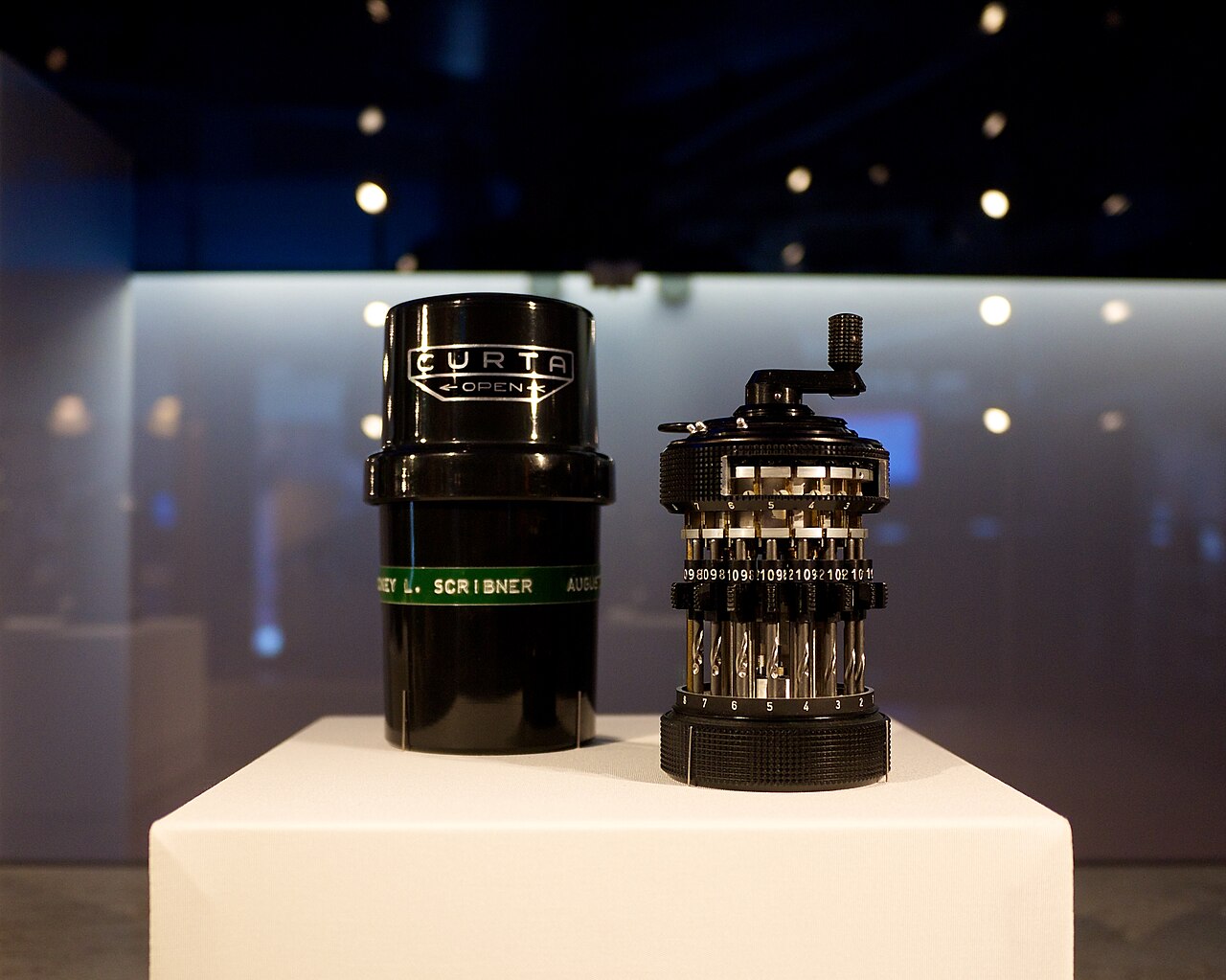
The Curta Type I was a black cylinder 85 millimetres tall weighing about 230 grams. It took eight-digit inputs, had a six-digit revolution counter and an eleven-digit result register, and could add, subtract, multiply and divide. The larger Type II (1953/54) handled eleven-digit inputs and fifteen-digit results. In the United States the Type I cost $125 and the Type II up to $175. Rally navigators and pilots favoured them because they were accurate, small and needed no batteries.
Losing the Company
Herzstark ran the factory but every purchase and every hire had to go through the prince’s administrative office in Vaduz. He was promised shares and did not get them; after a dispute he was sent on leave and from December 1951 never entered the plant again. In 1952 he signed a contract handing his patents to Contina for 350,000 Swiss francs, paid, he said, in instalments over several years. After that he worked as a consultant.
The prince sold Contina to the tool maker Hilti in 1966, having invested, by estimates Herzstark had heard, about 12 million Swiss francs. Hilti dropped the company’s other products and kept the Curta, which stayed in production until 1972 (the HNF gives 1971). About 140,000 were built, roughly 80,000 of the Type I and 60,000 of the Type II (Herzstark himself put the total at 150,000 to 160,000). Electronic pocket calculators ended the line (see The Pocket Calculator).
In September 1987 Tomash recorded a two-day oral history with Herzstark in Nendeln for the Charles Babbage Institute (see Interviews and Oral Histories). He died in Nendeln on 27 October 1988. Liechtenstein put the Curta on a postage stamp in 2006.
📚 Sources
- Charles Babbage Institute: Oral history interview with Curt Herzstark (OH 140), conducted by Erwin Tomash, 10–11 September 1987, Nendeln, Liechtenstein (transcript)
- Patent DE747073: “Rechenmaschine mit einer einzigen von Einstellrädchen umgebenen Staffelwalze”, filed 19 August 1938 (Google Patents)
- Heinz Nixdorf MuseumsForum blog, “Die Curta – der erste Taschenrechner” (29 October 2024)
- Computer History Museum: Timeline of Computer History, 1943
- Wikipedia: Curt Herzstark
- Wikipedia (German): Curt Herzstark
- Wikipedia: Curta
- Wikimedia Commons: Curta calculator, 2006 stamp of Liechtenstein
- Image: Curta Mechanical Calculator at CHM (7995215541).jpg by Don DeBold from San Jose, CA, USA (CC BY 2.0), via Wikimedia Commons