SEAC and Russell Kirsch
Abstract
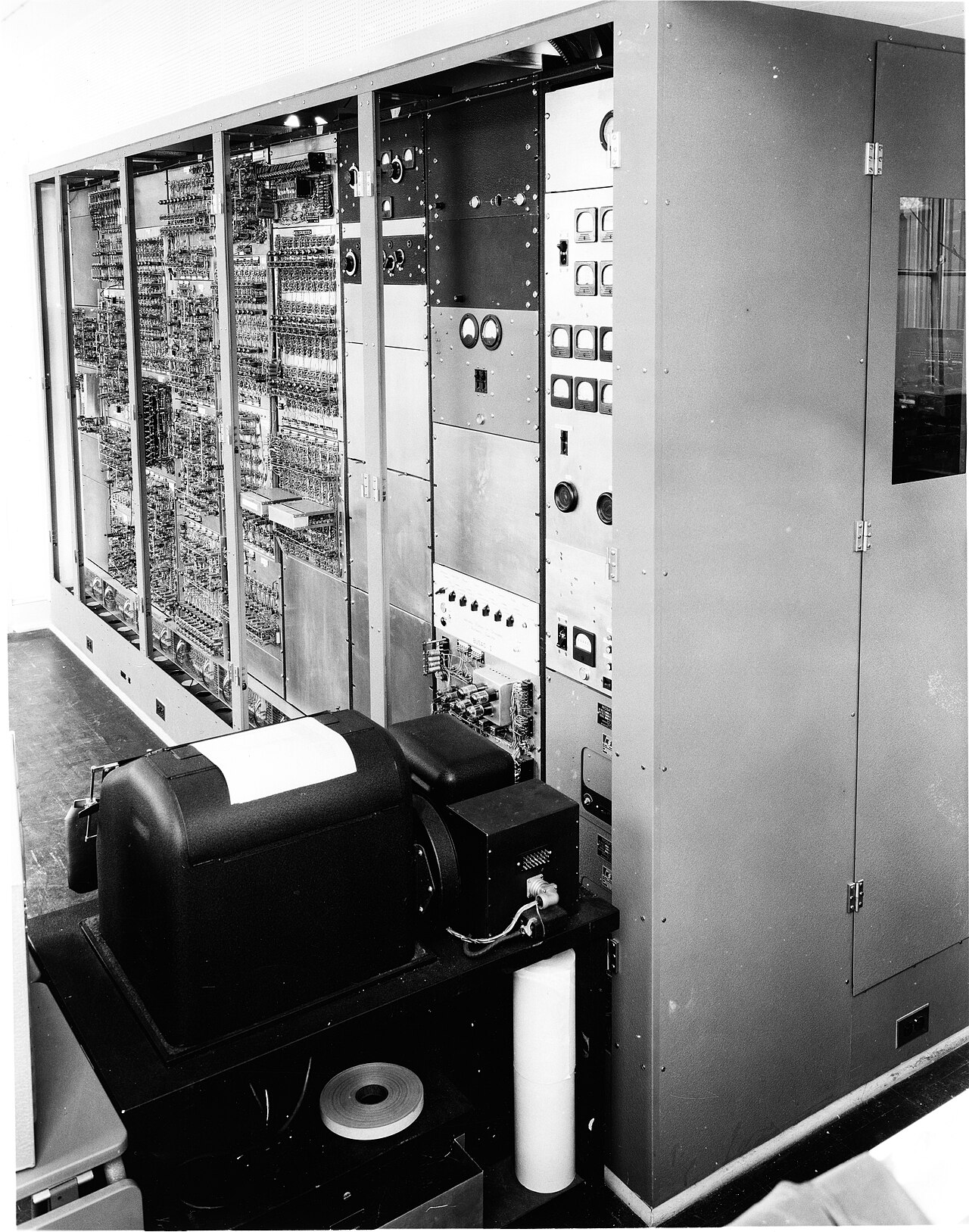
The Standards Eastern Automatic Computer (SEAC), built by the US National Bureau of Standards in Washington and running from April 1950, was one of the first stored-program computers working in the United States. It was meant as a stopgap until the government’s UNIVACs arrived, and its logic ran on germanium diodes rather than tubes. Its West Coast sibling, SWAC, briefly the fastest computer in the world, found five new Mersenne primes in 1952. In 1957 Russell Kirsch (1929–2020) and his group fed SEAC a photograph of his three-month-old son through a home-built drum scanner, producing one of the first digital images, 176 by 176 square pixels. In 2010 Kirsch called the square pixel “something very foolish that everyone in the world has been suffering from ever since”.
An Interim Computer
In the late 1940s the National Bureau of Standards (NBS) was buying computers for other government agencies, among them the Census Bureau, which had ordered a UNIVAC from Eckert and Mauchly (see UNIVAC and the Eckert-Mauchly Computer Corporation). The UNIVAC was late, and the Bureau decided to build a small machine of its own in the meantime to learn how such computers behaved. It was first called the National Bureau of Standards Interim Computer. A team led by Samuel N. Alexander and Ralph J. Slutz built it.
SEAC ran its first program in April 1950 and was dedicated in June. Most of its logic used germanium diodes, 10,500 at first and later 16,000, with tubes (747 at first, later about 1,500) only where amplification was needed. It stored 512 words of 45 bits in 64 mercury acoustic delay lines, ran at a clock of 1 MHz, added in 864 microseconds and multiplied in 2,980. It is often called the first fully operational stored-program electronic computer in the United States; the Computer History Museum more carefully lists it “among the first”. Operators worked it through a teletype, and it was one of the first computers to be used remotely.
Because it was a government test bed rather than a production machine, SEAC was open to odd projects. Over fourteen years it computed optical lens designs, LORAN navigation tables, weather problems, linear programs and calculations for Los Alamos, and served for experiments in computer animation and image processing. It was switched off in 1964.
SWAC
The Bureau’s second machine, the Standards Western Automatic Computer (SWAC), was built by Harry Huskey at the NBS Institute for Numerical Analysis on the UCLA campus. Huskey chose speed over caution: 2,300 tubes and a Williams-tube memory of 256 words of 37 bits. When it was completed in August 1950 it was the fastest computer in the world, adding two numbers in 64 microseconds. In 1952 the mathematician Raphael Robinson used it to find five new Mersenne primes, the largest primes then known, with 157, 183, 386, 664 and 687 digits. The NBS ran SWAC until 1954; UCLA kept it, with modifications, until 1967, renting time at $40 an hour.
Russell Kirsch
Russell Kirsch was born in Manhattan on 20 June 1929 to Jewish immigrants from Russia and Hungary. He went to the Bronx High School of Science, took an electrical-engineering degree at New York University in 1950 and a master’s at Harvard in 1952, and joined the NBS in 1951 as one of the people who ran SEAC. He stayed with the Bureau, which became NIST, for nearly fifty years, and on retiring moved to Portland, Oregon, in 2001.
The First Scanned Picture
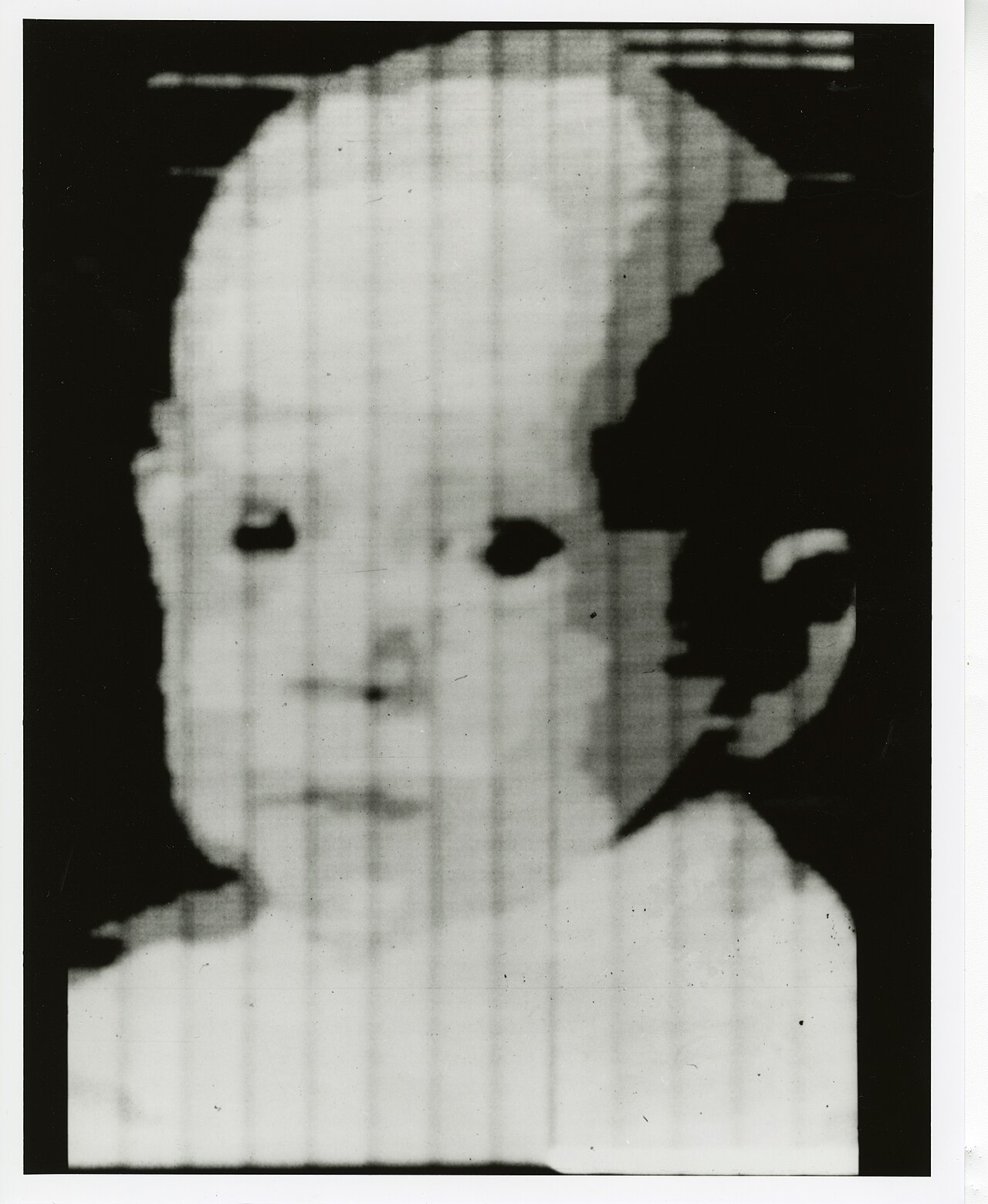
Kirsch’s question, as NIST later summed it up, was: “What would happen if computers could look at pictures?” In 1957 his group built a scanner from a rotating drum. A photograph was mounted on the drum, and a photomultiplier tube moved along a lead screw and read the picture through a small square opening, one point at a time, sending SEAC a 1 for light and a 0 for dark. The first picture was a head-and-shoulders photograph of his three-month-old son, Walden: 5 by 5 centimetres, 176 by 176 picture elements, 30,976 bits in all.
It was among the first photographs turned into data, and with it came the choice of a square grid of square picture elements, matching the scanner’s square aperture. Image processing, satellite imagery, medical scans and digital photography all inherited it (see Digital Photography and the Fall of Kodak). Life magazine included the scan in its 2003 book 100 Photographs That Changed the World. The original is in the Portland Art Museum.
The Square Pixel
In retirement in Portland, Oregon, Kirsch returned to the problem. In 2010, at 81, he published “Precision and Accuracy in Scientific Imaging” in NIST’s Journal of Research, proposing pixels of variable shape, and showed that the scan of Walden could be rebuilt from fewer, irregular pixels with smoother outlines. He was frank about the original decision. “Squares was the logical thing to do,” he told Wired. “Of course, the logical thing was not the only possibility … but we used squares. It was something very foolish that everyone in the world has been suffering from ever since.”
Kirsch died at his home in Portland on 11 August 2020, aged 91.
📚 Sources
- NIST: First Digital Image
- Russell A. Kirsch, “Precision and Accuracy in Scientific Imaging”, Journal of Research of the National Institute of Standards and Technology 115:3 (2010)
- Computer History Museum: Timeline of Computer History, 1950 (SEAC, SWAC)
- Computer History Museum: Timeline of Computer History, 1957 (Kirsch’s scanned image)
- Wikipedia: SEAC (computer)
- Wikipedia: SWAC (computer)
- Wikipedia: Russell A. Kirsch
- Rachel Ehrenberg, “Square Pixel Inventor Tries to Smooth Things Out”, Wired (28 June 2010)
- PBS NewsHour / Associated Press, “Computer scientist and pixel inventor Russell Kirsch dead at 91” (August 2020)
- Hackaday, “Russell Kirsch: Pixel Pioneer and the Father of Digital Imaging” (20 August 2020)